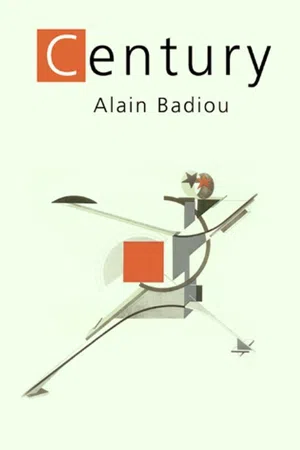
It is not Badiou's wish to plead for an accused that is perfectly capable of defending itself without the authors aid. Nor does he seek to proclaim, like Frantz, the hero of Sartre's Prisoners of Altona, 'I have taken the century on my shoulders and I have said: I will answer for it!' The Century simply aims to examine what this accursed century, from within its own unfolding, said that it was. Badiou's proposal is to reopen the dossier on the century - not from the angle of those wise and sated judges we too often claim to be, but from the standpoint of the century itself.
eBook - ePub
The Century
About this book
Everywhere, the twentieth century has been judged and condemned: the century of totalitarian terror, of utopian and criminal ideologies, of empty illusions, of genocides, of false avant-gardes, of democratic realism everywhere replaced by abstraction.
Information
1
Search for a method
What is a century? I have in mind Jean Genet's preface to his play The Blacks.1 In it, he asks ironically: ‘What is a black man?’ Adding at once: ‘And first of all, what colour is he?’ Likewise, I want to ask: A century, how many years is that? A hundred? This time, it's Bossuet's question that commands our attention: ‘What are a hundred years, a thousand years, when a single instant effaces them?’2 Must we then ask which is the instant of exception that effaces the twentieth century? The fall of the Berlin wall? The mapping of the genome? The launch of the euro?
Even supposing that we could manage to construct the century, to constitute it as an object for thought, would this be a philosophical object, exposed to that singular will which is the will to speculation? Is the century not first and foremost a historical unit?
Let's be tempted by the mistress of the moment: History. History, which is presumed to be the unshakeable support for any politics whatsoever. For instance, I could plausibly make the following claim: the century begins with the war of 1914–18 (a war that includes the revolution of October 1917) and comes to a close with the collapse of the USSR and the end of the Cold War. This is the short century (seventy-five years), a strongly unified century. In a word, the Soviet century. We construct this century with the aid of historical and political parameters that are both thoroughly recognizable and entirely classical: war and revolution. Here, war and revolution are specifically connected to the ‘world’. This century is articulated, on the one hand, around two world wars and, on the other, around the inception, deployment and collapse of the so-called ‘communist’ enterprise, envisaged as a planetary enterprise.
It's true that others, equally obsessed with History (or with what they call ‘memory’) count the century in an entirely different fashion. I can easily follow their lead. This time, the century is the site of apocalyptic events – events so ghastly the only category capable of reckoning with the century's unity is that of crime: the crimes of Stalinist communism and the crimes of Nazism. At the heart of the century lies the Crime which provides the paragon for all the others: the destruction of the European Jews. This century is an accursed century. The principal parameters for thinking it are the extermination camps, the gas chambers, massacres, tortures and organized state crime. Number intervenes as an intrinsic qualification. The reason is that once the category of crime is linked to the state, it designates mass murder. The balance sheet of the century immediately raises the question of counting the dead.3 Why this will to count? Because, in this instance, ethical judgement can only locate its real in the devastating excess of the crime, in the counting – by the millions – of the victims. The count is that point at which the industrial dimension of death intersects with the necessity of judgement. The count is the real which is presupposed by the moral imperative. The union of this real with state crime has a name: this century is the totalitarian century.
Note that the totalitarian century is even shorter than the ‘communist’ century. It begins in 1917 with Lenin (some would happily have it begin in 1793, with Robespierre,4 but then it would grow far too long), reaches its apex in 1937 with Stalin and 1942–5 with Hitler, and to all intents and purposes comes to an end with Mao Tsetung's death in 1976. It lasts about sixty years – provided one ignores exotic survivors like Fidel Castro, or certain marginal and diabolical resurgences, such as Islamic ‘extremism’.
Nevertheless, it is possible, for one coldly straddling this short century in all its lethal furore or seeking to turn it into the object of memory or contrite commemoration, to think our epoch historically in terms of its result. When all's said and done, the twentieth century would be the century of the triumph of capitalism and the global market. Having interred the pathologies of an unbridled will, the happy correlation of a Market without restrictions and a Democracy without shores would finally have established that the meaning of the century lies in pacification, or in the wisdom of mediocrity. The century would thereby express the victory of the economy, in all senses of the term: the victory of Capital, economizing on the unreasonable passions of thought. This is the liberal century. This century – in which parliamentarianism and its support pave the way to the triumph of minuscule ideas – is the shortest of them all. Beginning, at the earliest, after the seventies (the final years of revolutionary fervour), it lasts only thirty years. A happy century, they say. A rump century.
How can we meditate philosophically on all this? What can we say, in accordance with the concept, about the interlacing of the totalitarian century, the Soviet century and the liberal century? It's no use at this point picking some kind of objective or historical unity (the communist epic, radical evil, triumphant democracy…). For us philosophers, the question is not what took place in the century, but what was thought in it. What did the men of this century think, over and above merely developing the thought of their predecessors? In other words, what are the century's un-inherited thoughts? What was thought in the century that was previously unthought – or even unthinkable?
My method will consist in extracting, from among the century's productions, some documents or traces indicative of how the century thought itself. To be more precise, how the century thought its own thought, how it identified the thinking singul-arity of the relation it entertained with the historicity of its own thought.
To clarify this issue of method, allow me to raise what nowadays is a provocative, or even forbidden, question: What was the thought of the Nazis? What did the Nazis think? There is a way of always leading everything back to what the Nazis did (they undertook the extermination of the European Jews in gas chambers) that completely precludes any access to what they thought, or imagined they were thinking, in doing what they did. But ref-using to think through what the Nazis themselves thought also prevents us from thinking through what they did, and consequently forbids the formulation of any real politics that would prohibit the return of their actions. As long as Nazi thinking is not itself thought through it will continue to dwell among us, unthought and therefore indestructible.
When some say, casually, that what the Nazis did (the extermination) is of the order of the unthinkable, or of the intractable, they forget something crucial: that the Nazis both thought and treated what they did with the greatest care, the greatest determination.
To maintain that Nazism is not a form of thought, or, more generally, that barbarism does not think, is to abet a process of surreptitious absolution. It is one of the guises taken by today's intellectual hegemony, encapsulated in the slogan ‘there is no alternative’, what the French call la pensée unique. This is really nothing but the promotion of a politics without an alternative, a politique unique. Politics thinks, barbarism does not, ergo no politics can be barbarous. The sole aim of this syllogism is to hide the otherwise evident barbarity of the capitalist parliamentarianism which presides over our current fate. In order to escape this obfuscation we must maintain, in and by the century's testimony, that Nazism itself is both a politics and a thought.
Some will retort: ‘You refuse to see that Nazism – and Stalinism by proxy – is above all a figure of Evil.’ On the contrary, I maintain that by identifying them as forms of thought (or politics) it is I who finally accord myself the means to judge them, and you who, by hypostasizing judgement, end up protecting their repetition.
In fact, the moral equation that identifies the Nazi (or Stalinist) ‘unthinkable’ with Evil amounts to nothing more than a feeble theology. We have inherited a long history, after all, that of the theological equation of Evil and non-being. If, in effect, Evil is – if Evil enjoys a positive ontological status – it follows that God is its creator, and therefore responsible for it. To absolve God, Evil must be denied any being whatsoever. Those who affirm that Nazism is not a form of thought, or that it is not a politics (unlike their ‘democracy’), simply desire the absolution of thinking, or of politics. That is, they wish to conceal the deep and secret bond between the political real of Nazism and what they proclaim to be the innocence of democracy.
One of the century's truths is that the democracies allied in war against Hitler were more or less unconcerned with the extermination. Strategically speaking, they were at war with German expansionism, not at all with the Nazi regime. Tactically speaking (in the timing of the offensives, the choice of bombing targets, the commando operations, and so on), none of their decisions aimed at preventing, or even limiting, the extermination. This was the case even though, from an early date, they were perfectly aware of what was taking place.5 Today we can say the same thing as we witness our democracies – utterly humanitarian when it comes to bombing Serbia or Iraq – displaying an almost total lack of concern for the extermination of millions of Africans by AIDS, a disease that can and is effectively brought under control in Europe and America. But for reasons of property and economics, reasons stemming from commercial law and the priority of investments – for imperial reasons, reasons that are entirely thinkable and indeed are thought – medication will not be provided for dying Africans. Only for white democrats. In both cases, the century's real problem is to be located in the linkage between ‘democracies’ and that which, after the fact, they designate as their Other – the barbarism of which they are wholly innocent. What needs to be undone is precisely this discursive procedure of absolution. Only thus will we be able to construct some truths about the matter at hand.
The logic of these truths presupposes that we determine their subject, in other words, that we identify the actual operation at work in the denial of this or that fragment of the real. That is what I will attempt to do with regard to the century.
My idea is that we stick as closely as possible to the subjectivities of the century. Not just to any subjectivity, but precisely to the kind of subjectivity that relates to the century itself. The goal is to try and see if the phrase ‘twentieth century’ bears a certain pertinence for thinking, in a manner that goes beyond mere empirical calculation. Thus, we will adopt a method of maximal interiority. Our aim is not to judge the century as an objective datum, but rather to ask how it has come to be subjectivated. We wish to grasp the century on the basis of its immanent prescriptions; to grasp ‘the century’ as a category of the century itself. Our privileged documents will be the texts (or paintings, or sequences…) which evoke the meaning that the century held for its own actors; documents which, while the century was still under way, or had only just begun, made ‘century’ into one of their keywords.
In this way, we might manage to replace the passing of judgements with the resolution of some problems. The current moral inflation means that, on all sides, the century is being judged…and condemned. My aim is not to rehabilitate the century, but only to think it, and thus to show how it is thinkable. What should primarily arouse our interest is not the century's ‘worth’ before a court of human rights whose intellectual mediocrity bears comparison with the juridical and political mediocrity of the International Criminal Tribunal set up by the Americans. Instead, let us attempt to isolate and work through a few enigmas.
To conclude this lesson, I will address one of these enigmas, whose significance is hard to underestimate.
The twentieth century kicks off in an exceptional fashion. Let us take the two great decades between 1890 and 1914 as the century's prologue. In every field of thought these years represent a period of exceptional invention, marked by a polymorphous creativity that can only be compared to the Florentine Renaissance or the century of Pericles. It is a prodigious period of excitement and rupture. Consider just a few of its milestones. In 1898, Mallarmé dies, shortly after having published the manifesto of modern writing, Un coup de dés jamais… In 1905, Einstein invents special relativity (unless he was anticipated by Poincaré), together with the quantum theory of light. In 1900, Freud publishes The Interpretation of Dreams, providing the psychoanalytic revolution with its first systematic masterpiece. Still in Vienna, in 1908, Schoenberg establishes the possibility of an atonal music. In 1902, Lenin creates modern politics, a creation set down in What is to be Done? This period also sees the publication of the vast novels of James and Conrad, the writing of the bulk of Proust's In Search of Lost Time, and the maturation of Joyce's Ulysses. Mathematical logic, inaugurated by Frege, with the contribution, among others, of Russell, Hilbert and the young Wittgenstein, together with its sister discipline, the philosophy of language, takes hold both on the continent and in the United Kingdom. Now witness, around 1912, how Picasso and Braque undermine the logic of painting. Husserl, with solitary obstinacy, elucidates phenomenological description. In parallel, geniuses such as Poincaré and Hilbert – heirs to Riemann, Dedekind and Cantor – give a new foundation to the very style of mathematics. Just before the war of 1914, in Portugal, Fernando Pessoa sets some Herculean tasks for poetry. Cinema itself, having been invented only recently, finds its first geniuses in Méliès, Griffith and Chaplin. The list of wonders populating this brief period could go on and on.
But this period is immediately followed by something resembling a long tragedy, whose tone is established by the war o...
Table of contents
- Cover
- Table of Contents
- Title page
- Copyright page
- Translating the century
- Dedication
- 1: Search for a method
- 2: The beast
- 3: The unreconciled
- 4: A new world. Yes, but when?
- 5: The passion for the real and the montage of semblance
- 6: One divides into two
- 7: Sex in crisis
- 8: Anabasis
- 9: Seven variations
- 10: Cruelties
- 11: Avant-gardes
- 12: The infinite
- 13: The joint disappearances of Man and God
- ‘European nihilism’ and beyond: commentary by Alberto Toscano
- Remarks on the translation
- Select bibliography
- Index
- End User License Agreement
Trusted by 375,005 students
Access to over 1.5 million titles for a fair monthly price.
Study more efficiently using our study tools.
Frequently asked questions
Yes, you can cancel anytime from the Subscription tab in your account settings on the Perlego website. Your subscription will stay active until the end of your current billing period. Learn how to cancel your subscription
No, books cannot be downloaded as external files, such as PDFs, for use outside of Perlego. However, you can download books within the Perlego app for offline reading on mobile or tablet. Learn how to download books offline
Perlego offers two plans: Essential and Complete
- Essential is ideal for learners and professionals who enjoy exploring a wide range of subjects. Access the Essential Library with 800,000+ trusted titles and best-sellers across business, personal growth, and the humanities. Includes unlimited reading time and Standard Read Aloud voice.
- Complete: Perfect for advanced learners and researchers needing full, unrestricted access. Unlock 1.5M+ books across hundreds of subjects, including academic and specialized titles. The Complete Plan also includes advanced features like Premium Read Aloud and Research Assistant.
We are an online textbook subscription service, where you can get access to an entire online library for less than the price of a single book per month. With over 1.5 million books across 990+ topics, we’ve got you covered! Learn about our mission
Look out for the read-aloud symbol on your next book to see if you can listen to it. The read-aloud tool reads text aloud for you, highlighting the text as it is being read. You can pause it, speed it up and slow it down. Learn more about Read Aloud
Yes! You can use the Perlego app on both iOS and Android devices to read anytime, anywhere — even offline. Perfect for commutes or when you’re on the go.
Please note we cannot support devices running on iOS 13 and Android 7 or earlier. Learn more about using the app
Please note we cannot support devices running on iOS 13 and Android 7 or earlier. Learn more about using the app
Yes, you can access The Century by Alain Badiou in PDF and/or ePUB format, as well as other popular books in Philosophy & Philosophy History & Theory. We have over 1.5 million books available in our catalogue for you to explore.