Russia's resurgence as an assertive actor in the global diplomatic arena after a long period of introspection and preoccupation with domestic troubles, and the economic revival that underpins it, are among the most striking developments in international relations of recent years. But what drives Russian foreign policy at the end of the Putin era? To what extent is it shaped by Russia's role as a major energy supplier, and how long can the country remain anenergy superpower if indeed it is one? How might Russian foreign policy change in the years ahead? Which way will Russia, faced with the might of growing powers around it, and struggling with the fragility of its economic success and stability at home, choose to face in international relations?
This Adelphi Paper examines the domestic context of contemporary Russian foreign policy and its key political, economic, military and security drivers, as well as looking at the contrasting outlook that preceded it, and at how Russia's international posture may adjust again in the coming years. It concludes with recommendations for Western policy makers on how to respond to Russia's return.
- 104 pages
- English
- ePUB (mobile friendly)
- Available on iOS & Android
eBook - ePub
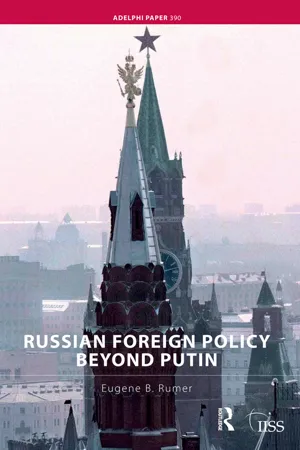
Russian Foreign Policy Beyond Putin
About this book
Information
Chapter One
A Foreign Policy in Transition
The attention devoted by scholars and policymakers in the US and Europe at the end of Putin’s second term to Russian foreign policy represents a relatively new phenomenon with respect to post-Soviet Russia. For most of the decade-and-a-half since the break-up of the Soviet Union, the attention of policy and academic communities has been drawn primarily to the country’s domestic developments, and the historic changes they represented. The privatisation of the Russian economy; the introduction of competitive federal, regional and local elections; the establishment of capital markets; and reforms of currency, taxes, social welfare and various other aspects of Russia’s domestic arrangements tended to monopolise the focus of Russia analysts in this period.
Active Western involvement in Russian domestic affairs in the 1990s, via advisory efforts and the delivery of various forms of economic, humanitarian and security assistance and training programmes, funded mostly by Western taxpayers, accounted for much of the interest in Russia’s progress along the road to economic and political transformation in that decade. Western taxpayers and their elected representatives wanted to know that their money was being spent productively, and that as a result of that spending Russia was becoming democratic and market-oriented. Amid confusing evidence about the nature and progress of the country’s domestic evolution, competing claims sparked an intense debate among academics and policy analysts about the quality of Russia’s political system and economic arrangements. Was Russia a democracy? A market economy? Were the reforms sponsored by the West helping Russia develop in the right direction? Grappling with these and other major questions, some of them unanswered to the present day, left scholars and policymakers little room to contemplate the international aspects of Russian policymaking.1
A 'domestic' foreign policy?
There were other reasons for the comparative neglect of foreign policy in these years. Russian foreign policy was a field in which relatively little was taking place. The country’s domestic weakness and succession of political and economic crises throughout the 1990s in effect subordinated foreign affairs to domestic ones. Highly dependent on support from the United States and Europe, the Russian government did not have the luxury of pursuing a foreign-policy line substantially at odds with the policy priorities of its principal backers and donors. For most of the 1990s the country’s foreign-policy agenda was dominated, to the exclusion of almost all other considerations, by relations with donors. The result was Russia’s absence as an active force in international relations on many major issues.
The legacy of the final Soviet period offered few clues as to how Russia might stand on the international stage in the 1990s. The most important feature of the foreign policy of that era, under the leadership of Mikhail Gorbachev, had of course been unprecedented rapprochement with the West. Soviet withdrawal from Eastern Europe, German unification and the signing of the CFE and Intermediate-Range Nuclear Forces treaties were its major accomplishments, and they redefined the political and security landscape of Europe. As significant as they were, however, these achievements were perceived at the time in both the West and the East as repairs of damage done in the Cold War; they offered little in the way of guidance for the future. Once the repairs were completed and the Cold War decisively relegated to the past, Soviet foreign policy was left rudderless, with Soviet ideology discredited and the country’s great-power ambitions having fallen prey to deteriorating material circumstances.
The question of what form its foreign policy should take remained for Russia after the Soviet Union collapsed. The domestic agenda was dominated by the multiple tasks of political and economic reforms; but how that agenda ought to manifest itself in a foreign-affairs context was not clear. How do the twin tasks of building a democratic society and a market economy translate into foreign policy?
Echoing a theme that had first emerged during the late Soviet era, the country’s first post-Soviet foreign minister, Andrey Kozyrev, envisioned Russia becoming a ’normal‘ country. Writing in Foreign Affairs in early 1992, only a few months after the break-up of the Soviet Union, he stated that while Russia would not ’cease to be a great power’, it would be a ’normal’ great power.2 He added that as a ’normal great power’, Russia would pursue national interests that, he promised, would be ’understandable to democratic countries’.
According to Kozyrev, post-Soviet Russia would benefit from a benign international environment with few external threats. As a result, Russian foreign policy could afford to pursue goals that were dictated by the domestic agenda. He listed the following as priority steps according to that agenda: securing Russian participation in the International Monetary Fund, the World Bank and the General Agreement on Tariffs and Trade (succeeded by the World Trade Organisation in the 1990s); and establishing close relations with the G7 and the European Community (soon to become the European Union). Russia would thereby become ’a reliable partner in the community of civilized states’.3
Kozyrev left no doubt that foreign policy would be wholly subordinated to the task of political and economic reconstruction, which, by transforming Russia into a democracy and a market economy, would turn the country into a model citizen of the international community. In 1992, all Russian foreign policy was indeed domestic.
Many in Russia’s political and foreign policy elite rejected Kozyrev’s agenda at the time, and its impact on Russian foreign policy in the 1990s may well have been exaggerated. But his vision is important to note nevertheless, because it is still remembered in Russia as a symptom of the country’s decline and retreat during that decade. Kozyrev remains significant, if only as a symbol of what many Russians do not want to revisit.
Post-Cold War context
Kozyrev’s approach to the new country’s foreign policy was not unique in the early part of the post-Cold War era. In fact, it mirrored – and quite likely was influenced by – the prevailing thinking about foreign policy and international relations in policy and academic communities in the West during that time.
Global, democratic, market-oriented
At the end of the Cold War, the victory of the liberal democratic idea was beyond dispute. The great ideological stand-off between liberal democracy and communism was over; communism had suffered a defeat of historic proportions that had put an end to it as a political ideology. The reach of liberal democracy could only increase. The prevailing view was that liberal democracy held the answer to the challenge of instability and was the only form of political organisation capable of ensuring long-term stability.
Just as liberal democracy triumphed over communism, market capitalism proved victorious over central planning. It was the only form of economic organisation that could secure the fundamental conditions for healthy economic development, as well as the necessary conditions for liberal democracies to prosper. This was held to have been borne out with particular clarity in the former Soviet bloc; the site of the dramatic downfall of communism and central planning.
The importance of free markets was underscored by the new phenomenon of globalisation. The triumph of market capitalism coincided with a period of rapid technological change. Together, the freedom of ideas and the freedom of markets would make it possible for new technologies to spread rapidly and introduce a new era in which the world would become more interconnected and prosperous than ever before. People, ideas, goods, capital and technology would flow across political and geographical boundaries freely and rapidly. Those interfering with the free flow or not ready to join the global express would pay a heavy price, because the ‘invisible hand’ of the free market was never mistaken.
The spread of liberal democracy would, the thinking went, produce greater accountability on the part of governments, whose policies would also be judged by markets, which would react swiftly to bad decisions, prompting an equally swift response on the part of the electorate. Thus, good policies would be adopted in the self-interest of governments. The long-term – or sustainable, to use the term that came into fashion at the time – stability and prosperity of a given nation thus hinged on its ability and commitment to establish free markets and democratic governance, in line with the rules of the globalising world, as made by the free market.4 In this atmosphere, one might begin to wonder whether a nation needed a foreign policy at all.5
Betting on transition
The ‘transition paradigm’,6 embraced by many in academic and policy circles in the 1990s, was an elaboration of elements of this vision. In this view, the world was witnessing an unstoppable progression towards democracy, which would eventually become, in effect, the universal form of governance.
Very broadly, all countries could be divided into three categories: those that were democracies; those that were not; and those that were in transition from the latter to the former. The choice before the last, transitioning, group was either to succeed and join the democratic camp, or else fail and either fail as a state, as in the case of Afghanistan or Haiti, or join the pariahs, such as North Korea and Iraq.
Since, it was also held, democracies don’t wage wars on one another, this wave of democratisation would bring with it unprecedented harmony in international relations. With major war relegated to history with the end of the Cold War, the only conflict the international community would now face would be between democracies and non-democracies. As for the countries in transition, they might face some frictions along the way, but as they made progress and integrated in the community of democratic nations, they too would relegate armed conflict to their pasts. Such conflicts as emerged from the ruins of the old international order – in Nagorno-Karabakh, in the Balkans – were both the final gasps of the old and the birth pangs of the new international order.
In short, though not an outright repudiation of balance-of-power theory, much of the prevalent thinking about international relations shortly after the end of the Cold War at least posited an unprecedented fusion of interests and values across states. In the global marketplace of ideas and goods, the balance of power and interests would be decided by the market’s invisible hand.
This was the intellectual context in which Russia inaugurated its new foreign policy in the early 1990s. Foreign Minister Kozyrev’s policy, as articulated in his 1992 Foreign Affairs article, fitted the mood of the moment perfectly. It made sense that Russia would in effect need no ‘foreign policy’ as such, that its position in the international community would be determined by its domestic condition.
It should also be noted that Russian preoccupation with domestic affairs suited Western interests in any case. The United States and its NATO allies were free to pursue their foreign-policy objectives (for such things, the new international order notwithstanding, did still exist) without needing to worry about accommodating Moscow’s concerns, mollifying the Russians or countering Russian actions. ’A world without Russia‘ was quite convenient for the US and its allies.
Russia in this period was the pre-eminent example of a country in transition. Its transition was taking place on such a scale and was of such scope that, if successful, it would revolutionise the international system. It was clear that a transition of such magnitude could not be a discrete event, would involve steps backward as well as forward, be difficult to measure and would take a long time to complete. Policymakers on both sides of the Atlantic spoke about it in terms of vast generational change that would take decades to accomplish. They counselled patience – strategic patience – when dealing with Russia. They reassured themselves and their Western publics that things would only improve with time. As older generations who resisted progress moved on, younger ones would take their place, and the forces of progress would eventually prevail.7
Western policies towards Russia were built on the assumption that, at the end of this transition, Russia would indeed become a democracy, a ’normal‘ country, a pillar of the Euro-Atlantic security structure. Alternatives were not much discussed, nor were the roots of any other outcome very apparent. A return to the country’s totalitarian past did not bear thinking about. The other possibility – further disintegration of the Russian state, culminating in state failure – was also too much to contemplate publicly in the context of a country with thousands of nuclear weapons. There appeared to be simply no alternative to the transition’s success.
In the meantime, however, the transition paradigm, perhaps unsurprisingly, offered little guidance with respect to the foreign policy of a country in transition, and events in Europe and elsewhere in the world would not wait for Russia to emerge from its transformation with a new domestic arrangement and a foreign policy to match. Those events had to be responded to, with or without Russia. The US and its European allies, acting as the principal architects of the new post-Cold War international order, proceeded on the basis of their assumptions about Russia and the eventual results of its transition.
In practical terms this meant expanding NATO into Eastern Europe; intervening militarily in the Balkans to put an end to inter-ethnic bloodshed; actively engaging Moscow’s former satellites in the former Soviet Union in security cooperation programmes; and promoting energy export schemes from former Soviet countries, bypassing Russia. More often than not the Russian government objected to these moves, but, necessarily focused on its domestic challenges, it was rarely, if ever, in a position to do much about them.
Western policy was not, however, confined to simply ignoring Russia. Confident that Russia’s transformation would be successful, and interpreting Russian opposition to many of the West’s policies as a short-term phenomenon, Europe and the United States took Russian leaders at their word when they said that they aspired to turn their country into a ’normal‘ member of the community of democratic nations at peace with themselves and each other, and actively sought to engage Russia in a broad effort ’to build Europe whole and free’.8
This policy manifested itself in Russia’s participation in the G7 summits and its formal admittance to the group in 1997; efforts by NATO to engage Russia in a dialogue and a broad security cooperation agenda; and Russian involvement in peacekeeping operations in the Balkans. Europe and the United States believed that by giving Russia a place at the table, they could reinforce a Russian commitment to pursuing a new, ‘normal’ foreign policy, and help to give that foreign policy the right shape.
A less frequently articulated aspect of Western policy towards Russia was that aspects of it would provide a hedge against the unconscionable alternative of Russia failing in its transition and re-emerging as a threat to Europe, as either a totalitarian or a failing state. By expanding NATO and securing Russia’s periphery, the thinking was at the time, the West would put itself in a better position to cope with that kind of Russia.9
For much of the past 15 years, this approach seemed to have worked well, from the Western point of view. NATO has expanded twice and now includes all Moscow’s former Warsaw Pact allies and three Baltic states, all of which are also members of the European Union. The Balkans are at peace, with a settlement for Kosovo in the works. The US and its European allies are actively engaged in the search for security and stability in Ukraine, the Caucasus and Central Asia. Russia and NATO have established a forum for consultations and are engaged in discussions about joint missile defence projects for Russia and Europe, among other things. Following its withdrawal from the Cold War Anti-Ballistic Missile (ABM) Treaty in 2002, the US signed a new agreement with Russia – the ‘Moscow Treaty’ –to drastically reduce the two countries’ strategic nuclear arsenals, thus inaugurating a new arms-control regime and strategic nuclear relationship between the two former adversaries. All these are elements of a transatlantic post-Cold War architecture that includes Russia and its former satellites, and that is premised on a shared vision of Europe ’whole and free‘, with Russia as one of its central pillars.10
But this array of accomplishments, though impressive, tells only one part of the story of relations between Russia and the West since the early 1990s. The story also includes the strikingly steadfast Russian opposition over the course of 15 years to much in the West’s foreign policy, including several of the achievements listed, notably the eastward expansion of NATO; NATO’s military actions in the Balkans, which flared up in the crisis at the Pristina airport in Kosovo in 1999, during which Russian and NATO troops stood on the brink of a military confrontation; the US unilateral withdrawal from the ABM Treaty; the new, flexible US approach to strategic arms control as laid out...
Table of contents
- Cover
- Title
- Copyright
- Contents
- Glossary
- Acknowledgements
- Introduction A Cool Breeze
- Chapter One A Foreign Policy in Transition
- Chapter Two Putin's Foreign Policy – A Matter of Interest
- Chapter Three The Domestic Political Setting
- Chapter Four The Economic Picture
- Chapter Five The Military Factor
- Conclusion Changes abroad
- Notes
- About the Author
Trusted by 375,005 students
Access to over 1.5 million titles for a fair monthly price.
Study more efficiently using our study tools.
Frequently asked questions
Yes, you can cancel anytime from the Subscription tab in your account settings on the Perlego website. Your subscription will stay active until the end of your current billing period. Learn how to cancel your subscription
No, books cannot be downloaded as external files, such as PDFs, for use outside of Perlego. However, you can download books within the Perlego app for offline reading on mobile or tablet. Learn how to download books offline
Perlego offers two plans: Essential and Complete
- Essential is ideal for learners and professionals who enjoy exploring a wide range of subjects. Access the Essential Library with 800,000+ trusted titles and best-sellers across business, personal growth, and the humanities. Includes unlimited reading time and Standard Read Aloud voice.
- Complete: Perfect for advanced learners and researchers needing full, unrestricted access. Unlock 1.5M+ books across hundreds of subjects, including academic and specialized titles. The Complete Plan also includes advanced features like Premium Read Aloud and Research Assistant.
We are an online textbook subscription service, where you can get access to an entire online library for less than the price of a single book per month. With over 1.5 million books across 990+ topics, we’ve got you covered! Learn about our mission
Look out for the read-aloud symbol on your next book to see if you can listen to it. The read-aloud tool reads text aloud for you, highlighting the text as it is being read. You can pause it, speed it up and slow it down. Learn more about Read Aloud
Yes! You can use the Perlego app on both iOS and Android devices to read anytime, anywhere — even offline. Perfect for commutes or when you’re on the go.
Please note we cannot support devices running on iOS 13 and Android 7 or earlier. Learn more about using the app
Please note we cannot support devices running on iOS 13 and Android 7 or earlier. Learn more about using the app
Yes, you can access Russian Foreign Policy Beyond Putin by Eugene B. Rumer in PDF and/or ePUB format, as well as other popular books in Politics & International Relations & Military & Maritime History. We have over 1.5 million books available in our catalogue for you to explore.