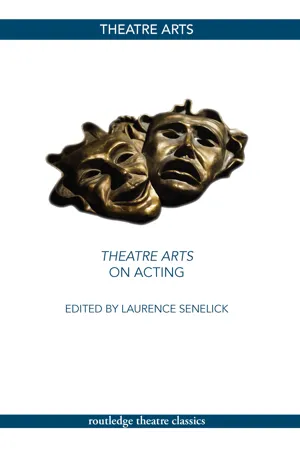
During its fifty year run, Theatre Arts Magazine was a bustling forum for the foremost names in the performing arts, including Stanislavski, Laurence Olivier, Lee Strasberg, John Gielgud and Shelley Winters. Renowned theatre historian Laurence Senelick has plundered its stunning archives to assemble a stellar collection of articles on every aspect of acting and theatrical life.
- 534 pages
- English
- ePUB (mobile friendly)
- Available on iOS & Android
eBook - ePub
Theatre Arts on Acting
About this book
Information
Part I
Acting in the American tradition
1
Acting and the New Stagecraft
November 1916
Theatre Arts was founded to propagate the New Stagecraft, which, born of the ideas of Adolphe Appia and Edward Gordon Craig, was concerned largely with scene design and the stage picture. The very first article in the very first issue, however, turned its attention to how these innovations affected acting and how, in turn, acting was to respond. Not so much a manifesto as a modest proposal, it was written by Walter Prichard Eaton (1878–1957), a Harvard-educated dramatic critic of long experience, who later became professor of playwriting at Yale. He would eventually write a chronicle of the first ten years of the Theatre Guild. In championing the New Stagecraft, he was careful not to turn professional and amateur, realism and conventionalism, commercial and experimental into opposing camps; rather, he argued that the best of all factions be preserved.
THE new spirit of experimentation in the arts of the theatre has, so far at least, affected the American theatre but little, so little, indeed, that the result is almost negligible. By the American theatre I mean, of course, the professional theatre patronized by the great public, which sends its productions out through the land and is, when all is said, the stronghold which must be stormed and captured before Progress can claim a victory. Robert Jones and Joseph Urban and Livingston Platt, to be sure, have designed certain settings, some of them beautiful settings; and Maxfield Parrish is now being called in to give his talent to the theatre. Yet one would scarcely call the Ziegfeld “Follies” an experiment in the new stagecraft, though Mr. Urban did design the settings; while the ballet at the Hippodrome, devised by Bakst and Pavlowa, was, after the first night or two, so befuddled with Hippodrome chorus girls (who finally were hauled up on wires as a climax!) that it would hardly be distinguished from the Good Old Stuff. We must, I fear, face the fact that the experimental spirit in America is still an amateur spirit, and in the immediate future, at least, we must look for its flowering, for the results of genuine experiment, in the various “little theatres” and other refuges of the dissatisfied or the dilettantes. After all, there can be no progress without dissatisfaction, and it is often enough the dilettante with talent who becomes the professional with power.
But in my own observations of these experimental theatres, I have been struck with one odd fact. While the experimenters were eager to produce fresher and more vital drama, to create more illusive and effective lighting effects, to paint more suggestive and beautiful scenery, to get away from the dull rut of conventional “realism,” at the same time they were, almost without exception, apparently quite neglectful of showing us fresher, more vital, more illusive acting, or at any rate ignorant of how to do it. In the case of such an organization as the Washington Square Players, say, we must of course be mindful of the fact that the scene-painters are frequently professional artists, the dramatists professional dramatists, while the actors have been for the most part amateurs. No amateur, however gifted, can walk out on the boards and give at once a performance without a flaw, can give a performance as illusive of character as any second-rate professional with intelligence. All the more reason, then, why the actors in the experimental theatres should be trained at least to do well what they can do well, and what the conventional professional actors do badly, while they are learning slowly in the hard school of practice to create the illusion of character.
What are some of the things they could be trained to do? In the first place, they could be trained to speak. The new stagecraft, so far as it has been practised here, seems to have forgotten that as long as it is dedicated to the spoken drama, part of its task will be to make that speech audible, and consequently to make it effective to the last degree. Ask yourself this question: if you were witnessing “Hamlet,” which would you rather find, a glorious, illusive setting with a bad actor mumbling “To be or not to be....”, or a bare stage and Booth speaking those words as only he could speak them? Certainly, most people would choose Booth, and they would be quite right in so doing. Yet, under the influence of our bald, colloquial modern drama, beautiful speech, clean enunciation, a sense for rhythm, has almost perished from the professional stage. Let a modern author write a speech which he wants to hear delivered like music as well as human conversation — and he weeps bloody tears at each rehearsal. There are no actors to read it. It cannot be read properly without proper feeling for verbal felicities, and without practice. But a feeling for verbal felicities is just what genuine devotees of the new stagecraft should have, or their boasted devotion to beauty is a one-sided thing; and practice in correct, clean, felicitous utterance is just what the stages of our experimental theatres should afford. The rankest amateur ought to be able to pronounce correctly, and enunciate all the syllables of a polysyllabic word without swallowing the penult. If he cannot, he should be politely invited to become a professional and join Mr. Cohan’s company. When you enter a little theatre you ought at least to be confident of hearing better speech than in any Broadway production.
Our experimental theatres are not dedicated to realism. They do not neglect it, but the new stagecraft needs the fanciful, the poetic, the suggestive, for its full expression. And the fanciful, the poetic, the suggestive in drama cannot be acted as the realistic drama is acted. The instinct which leads the opera singer to gesticulate like a windmill, which leads Lou-Tellegen to strike romantic attitudes, is a perfectly sound instinct. Convention has made the result grotesque, to be sure, but in their hatred of convention too many experimental theatres have quite lost sight of the rightness of the instinct, and as a result play a scene of romance or poetry, in a setting not of this world but of the abstract land of beauty, with actors who stand about as stiff as freshmen at the President’s first reception, talking in the nasal, colloquial tones of the average American. This may be unconventional, but it isn’t good art, and it is holding back the new stagecraft in popular regard. If the new stagecraft is to play fantasy and poetry, in imaginative, beautiful sets, it must train its actors to beauty and grace of carriage, to fluidity of pose, to expressive gesture (there is nothing poetic about keeping your hands in your pockets, as the mere public very well knows), to that general charm of romantic bearing which certain of the older actors even in our generation possessed, which is as old as histrionic art, indeed, and will always be as young as the latest lyric. To try to foster and develop this charm should be a task of the experimental theatres. If they cannot keep those who possess it from the affectations and absurdities of conventional romance, from the posturings of a Lou-Tellegen, that is merely a confession of weakness on their part. It is no sign of strength, certainly, to be so afraid of the excesses that you abolish the essentials.
Indeed, in the revolt from the conventions of the “commercial” theatre, it is rather to be feared that we have tended to throw overboard a good deal that is sound and necessary. Enough light to see the actors’ faces is one thing. The downright force and predominant importance of good acting is another. When all is said, the spoken drama is brought to life for an audience by the actors, not the electrician nor the scene-painter, not the costume designer nor the orchestra conductor nor even the stage-manager, but by the actors. It is they the audience watches, recking not of the director who may have trained them; they who are, for three hours traffic, the protagonists of the play. It can be no better than they are, and with the great public its success will depend upon them.
Little theatres, experimental theatres of all sorts, may help the new stagecraft in a hundred ways, and bring various kinds of pleasure to us, but they will never ultimately persuade the public unless they can show illusive acting, unless they can train players to impersonate, to bring the characters of the drama to vivid life. Too many of our experimental theatres are weakest on this most important side; they have neglected the art of acting, the foundation stone of the dramatic structure, and the stone which changes least of all with the changing styles of architecture. They ask patronage to behold beautiful scenery, to hear brilliant “lines,” to witness the play of magic lights; but what the public primarily pays for is a story, so well acted that it cheats them into belief. The new stagecraft has got to play the game. It has got to furnish the actors. Nor is that so impossible a task, if once we realize its necessity.
2
The place of the actor in “the new movement”
July 1922
Claude King (1875–1941) was an English-born actor, who had played Dr. Watson in Conan Doyle’s dramatization of his Sherlock Holmes story The Speckled Band (1910). He began appearing on Broadway in 1906, and had several roles in the Theatre Guild premiere of Shaw’s Back to Methusaleh (1922), although his best part was the young playwright Tom Wrench in Trelawney of the “Wells” (1925). From 1923, he appeared in Hollywood films, many with Lon Chaney, usually typecast as an “English gentleman”, and was one of the founding members of the Screen Actors Guild.
IN all that has been written and said about the new movement in the theatre, I find so much about décor and lighting and so little about acting, that I am almost reduced to feeling that the actor has no place in the revolution or evolution, if the term is a better one, that is undoubtedly taking place. And since it is upon the shoulders of the actor that the final burden has to be carried, I think it is now due to him to find out just what his position is, or is going to be. For remember that when the curtain rises on the first night, the author may not be present, the artist responsible for the décor may be comfortably working in his studio on the models for his next production, the manager may be on his way to Europe, but the actor has to be there, on the spot, to interpret the living part of the accumulated efforts of all concerned.
Gordon Craig has released the current in the direction of the spiritual and the imaginative in the theatre, and the present trouble is that very often in the experimental theatre the scenery soars in the regions of the new movement, while the actor plays in something less than the good “old fashioned” way. If the actor can give the required quality to any scene the lighting and scenery should serve to accentuate and heighten that quality in some way, but the experiment must not be used as a compensation for the lack of the required quality in the actor. If the theatre is going to advance healthily it must keep near to, and conscious of its source. Then only will it become a vital part of the whole social organism.
And when I speak of the actor I mean the trained actor, the man who has served his apprenticeship at his craft, and has learned his technique sufficiently well to be able to forget it, or at any rate to hide its mechanics. Talma says that twenty years is the minimum period required to learn the art of acting, and both Irving and Forbes Robertson have agreed that he is right. But the mere term of years spent in the theatre is not necessarily important; they must have been years spent in the proper acquisition of the knowledge required to make the actor, in the fullest sense of the term, an interpreter of the play.
We so often see a brilliant young performer spoiled by too early success. It takes character and a very beautiful kind of humility for the young to realize the need of study, not book-lore necessarily, rather the study of the many and various phases of human nature, the cultivation of understanding, the appreciation of all the curious reactions and nuances which go to make up our individualities.
Perhaps one of the most necessary things for the actor of today to acquire is social perspective. We are, on the whole, rather inclined to think of our work in just terms of “theatre.” I think this will disappear as we extend our human sympathies, intensify our human contacts, and cultivate a greater flexibility of mind in the direction of wonder and imagination. Automatically the actor who enlarges his vision will grow away from the traditional convention towards something which is truer, simpler, more modern, still retaining what is good in the older forms. A phrase of Gilbert Murray’s haunts me, “Dominant emotion tempered by gentler thought.” This phrase applied to the actor conveys to me the power of giving to each part the requisite emotion, fitting into a thoughtful conception of the whole play; but, mark you, the emotion must be dominant, projected; we want no intellectual meandering.
If the theatre of today is the theatre of the idea, that idea has to be embodied, and the actor needs not only to understand but to feel the significance of his role in relation to the governing idea of the play.
The value to the actor of the social drama is very interesting. Taking a long view of the playwrights from the eighties, their plays largely reflect the awakening of the people to political and social self-consciousness. Through these plays the actor establishes his identity with the social organism. Artists often anticipate the general acknowledgment of some new current, but artists are a rare species. The actor who still thinks in terms of the theatre apart from the social organism, or in terms of his own personality, may have a long road to travel before he attains to the simplicity, the integrity, or even the “groping sincerity” which characterize the real artist.
After all what is this thing which has come to be called the New Movement? Is it not as it affects the actor just another angle of approach, a development of the spirit of the time, a new vision by which we re-view all plays? Let us apply it to a classic, Shakespeare for example. Macbeth, instead of a mighty melodrama, becomes in the light of present day psychology the document of two human souls, exalted, illegitimately ambitious. Outraged Nature at the helm breaks them. The woman may not pervert her sex to the uses of “direst cruelty,” the man may not wade to an empty form of power through the lovely life-blood of friends. Played perfectly in the spirit of the new movement, this play would uncover the whole canker of illegitimate personal ambition. Can you imagine it? Each actor in his right relation to the whole, those two splendid lovers disintegrating before our very eyes, in some wild vortex of ambition; here is this mighty problem told in language of such beauty as to give “balm to hurt minds.”
Gordon Craig says in “The Art of The Theatre”: “It is impossible for a work of art ever to be produced where more than one brain is permitted to direct; and if works of art are not seen in the theatre this one reason is a sufficient one, though there are plenty more. There must be one man capable of inventing and rehearsing a play; of designing and superintending the construction of both scenery and costume; of writing any necessary music; of inventing such machinery as is needed and the lighting that is to be used.” Kenneth Macgowan describes this demand as the extravagance of the ideal, in his very excellent book “The Theatre of Tomorrow,” and I entirely agree with him.
The influence of Craig seems to have moved towards the “theatric,” that is, the thing to be seen, the sensuous appeal of the aesthetic, even to the substitution of the “über-marionette” for the actor, and thus he may succeed in producing a new form for the theatre in the same way as has been accomplished by the Russian Ballet with its characteristic mime and music. But we actors care for the spoken word, and wh...
Table of contents
- Cover
- Half Title
- Title Page
- Copyright Page
- Dedication
- Table of Contents
- Acknowledgments
- Introduction
- Part I: Acting in the American tradition
- Part II: The British legacy
- Part III: Foreign modes of performance
- Part IV: Stanislavsky and his followers
- Part V: The actor and his role
- Part VI: Technical matters
- Glossary of proper names
Trusted by 375,005 students
Access to over 1.5 million titles for a fair monthly price.
Study more efficiently using our study tools.
Frequently asked questions
Yes, you can cancel anytime from the Subscription tab in your account settings on the Perlego website. Your subscription will stay active until the end of your current billing period. Learn how to cancel your subscription
No, books cannot be downloaded as external files, such as PDFs, for use outside of Perlego. However, you can download books within the Perlego app for offline reading on mobile or tablet. Learn how to download books offline
Perlego offers two plans: Essential and Complete
- Essential is ideal for learners and professionals who enjoy exploring a wide range of subjects. Access the Essential Library with 800,000+ trusted titles and best-sellers across business, personal growth, and the humanities. Includes unlimited reading time and Standard Read Aloud voice.
- Complete: Perfect for advanced learners and researchers needing full, unrestricted access. Unlock 1.5M+ books across hundreds of subjects, including academic and specialized titles. The Complete Plan also includes advanced features like Premium Read Aloud and Research Assistant.
We are an online textbook subscription service, where you can get access to an entire online library for less than the price of a single book per month. With over 1.5 million books across 990+ topics, we’ve got you covered! Learn about our mission
Look out for the read-aloud symbol on your next book to see if you can listen to it. The read-aloud tool reads text aloud for you, highlighting the text as it is being read. You can pause it, speed it up and slow it down. Learn more about Read Aloud
Yes! You can use the Perlego app on both iOS and Android devices to read anytime, anywhere — even offline. Perfect for commutes or when you’re on the go.
Please note we cannot support devices running on iOS 13 and Android 7 or earlier. Learn more about using the app
Please note we cannot support devices running on iOS 13 and Android 7 or earlier. Learn more about using the app
Yes, you can access Theatre Arts on Acting by Laurence Senelick in PDF and/or ePUB format, as well as other popular books in Media & Performing Arts & Acting & Auditioning. We have over 1.5 million books available in our catalogue for you to explore.