- 318 pages
- English
- ePUB (mobile friendly)
- Available on iOS & Android
eBook - ePub
About this book
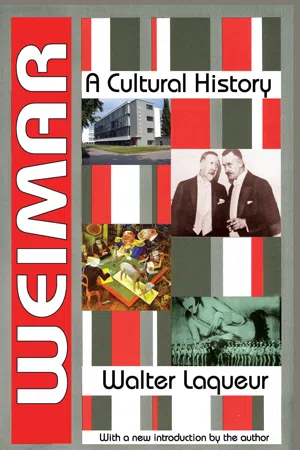
The term "Weimar culture," while generally accepted, is in some respects unsatisfactory, if only because political and cultural history seldom coincides in time. Expressionism was not born with the defeat of the Imperial German army, nor is there any obvious connection between abstract painting and atonal music and the escape of the Kaiser, nor were the great scientific discoveries triggered off by the proclamation of the Republic in 1919. As the eminent historian Walter Laqueur demonstrates, the avant-gardism commonly associated with post-World War One precedes the Weimar Republic by a decade.It would no doubt be easier for the historian if the cultural history of Weimar were identical with the plays and theories of Bertolt Brecht; the creations of the Bauhaus and the articles published by the Weltbühne. But there were a great many other individuals and groups at work, and Laqueur gives a full and vivid accounting of their ideas and activities. The realities of Weimar culture comprise the political right as well as the left, the universities as well as the literary intelligentsia. It would not be complete without occasional glances beyond avant-garde thought and creation and their effects upon traditional German social and cultural attitudes and the often violent reactions against "Weimar" that would culminate with the rise of Hitler and the fall of the republic in 1933.This authoritative work is of immense importance to anyone interested in the history of Germany in this critical period of the country's life.
Trusted by 375,005 students
Access to over 1.5 million titles for a fair monthly price.
Study more efficiently using our study tools.
Information
Subtopic
History of Contemporary ArtIndex
HistoryI
Between Potsdam and Weimar
On 30 September 1918 Ludendorff and Hindenburg told the Kaiser at Supreme Headquarters at Spa that the war was lost. It was more than a century since Germany had suffered a military defeat, and its rulers were no longer familiar with the procedure to be adopted in such circumstances. Instead of bowing out in more or less dignified fashion, the Kaiser hung on, hoping that something would turn up which would make abdication unnecessary. Perhaps he preferred not to think about the future; responsibility and foresight had not been the outstanding characteristics of Wilhelm II and the courtiers surrounding him. Under his rule ‘Prussianism’ had become a synonym for aggressiveness and arrogance, for a society in which the military caste enjoyed the highest social prestige; while the landed aristocracy was still the ruling class although it had outlived whatever social, political and economic functions it had once possessed. It had become, in other words, an intolerable anachronism.
Once upon a time the Prussian spirit had different connotations ; it stood for service, for selfless work, incorruptibility and other sterling qualities. But a whole world divided the age of von Stein, Scharnhorst and Gneisenau from the imperial braggart who had ruled Germany with the help of mediocrities for more than two decades. And yet, even in his time and despite his rule, there had been a great deal of progress ; Germany before 1914 exuded confidence and optimism to a remarkable degree. Almost the only dissonant voices came from a few Kulturpessimisten of the left and right, such as could be found in every age, as well as from a few eccentric writers and painters who predicted impending chaos and ruin, and whose inchoate mutterings were not taken seriously. Burke said of pre-revolutionary France that the unbought grace of life had gone for ever. The outstanding feature of prewar Germany was certainly not its grace of life, but it had known a sense of security such as subsequent generations were never even remotely to experience. What Stefan Zweig wrote about his native Austria applied equally to Germany. There had been in that ‘world of yesterday’ a state and a parliament, as well as a reliable currency based on gold; men of property could calculate without undue difficulty how much they would receive from their savings or investments in the years to come, children inherited the parental home, every family had its budget and knew how to live within its limits. It has been said that such latterday nostalgic reflec-tions merely mirrored the sadness of an impoverished middle class. Was it not true that the great majority of the people inherited nothing, had no investments, enjoyed no security, and that a substantial part lived in dire poverty ? Was it not also the age of slums, of long hours and low wages ? All this is true, but it is also a fact that even if the economic position of the working classes and most of the peasantry was less than rosy, it was steadily improving; these classes too shared the general mood of optimism. It was not just weakness of character – as Lenin and Rosa Luxemburg seemed to believe - which made gradualists of the erstwhile revolutionaries who led German social democracy. On the contrary their attitude accurately reflected the mood of the rank and file. Once a small group of outcasts, they had within three decades built Germany’s strongest political movement. In 1912, in the last general election before the war, their party had polled more than 70 per cent of all votes in Berlin, more than 60 per cent in Hamburg, Germany’s second city. The prevailing electoral system did not give them proportional representation. Was there not every reason to assume that the reactionaries would not be able to hold out for ever against the irresistible advance of the masses ? Marx, after all, had demonstrated that as the socio-economic basis changed, the legal-ideological superstructure was bound to follow suit. The belief in progress, enlightenment and reason was deeply anchored in both the middle and the working classes. Technical innovations, such as the growing use of electricity, symbolizing the victory of light over the forces of darkness, seemed to justify their expectations. Paul Lincke, the famous light orchestra conductor and darling of the Berlin public, had just composed a song dealing with this very topic, which was hummed by young and old, rich and poor. He compared the newly invented electric bulb to a glow-worm’s light, and the verse which eventually acquired world-wide popularity ended :
Glühwürmchen, Glühwürmchen, flimmere, flimmere
Glühwürmchen, Glühwürmchen, schimmere, schimmere
Führe uns auf rechten
Wegen Führe uns dem Glück entgegen.
(Glow-worm, glow-worm, glimmer, glimmer
Glow-worm, glow-worm, shimmer, shimmer
Lead us on the right path
Lead us on to happiness.)
Happiness was the goal and, a few extremists apart, no one believed that violence would be needed to attain it. There had been no major war in Europe for more than four decades nor had there been any large-scale civil disorder. Wilhelmian Germany was certainly not a free country by West European or American standards, but it is useful to recall from time to time that there are degrees of oppression. It was no cruel dictatorship : there was a constitution and there were laws which had to be observed by rulers as well as ruled. In comparison with the dictatorships that were to emerge in Europe after the war, Wilhelmian Germany was a permissive country to an almost bewildering degree. Political murders were unknown, as was arrest and trial without due process of law. The Emperor himself was openly criticized in the press, as in the Daily Telegraph affair; and if an officer assaulted a civilian, as had happened in the little Alsatian town of Zabern, this became a cause célèbre all over Germany. Workers on strike were not shot, censorship was applied only in extreme cases of lèse-majesté and blasphemy, and it is doubtful whether justice could have been flagrantly perverted as in the Dreyfus case
Whoever chooses to ignore these facts about pre-1914 Germany is bound to be baffled by the intensity of the widespread postwar nostalgia for the ‘good old days’, not just among the aristocracy, which was insignificant in numbers anyway, but among wide sections of the middle classes. If it had been a matter of ‘class interest’ tout court they would certainly have identified themselves with the liberal-bourgeois republic which had been proclaimed by the Social Democrats only with some reluctance - mainly because they were afraid of being overtaken on the left by the Spartacists. If the middle classes in their majority did not welcome the Republic, it was partly because life under the Kaiser had by no means been intolerable, and on the other hand because, having to choose between order and freedom, they would almost certainly opt for the former.
There had at one time been a fairly strong democratic tradition in Germany, but in recent generations it had grown progressively weaker. In 1918 at any rate the Republic came to Germany as a foreign importation. Parliamentary democracy was considered un-German in right-wing circles, suitable perhaps for the Americans or the French, but not for a nation which had always striven for wholeness and unity. Political parties were regarded at best as a necessary evil - evil because they expressed only part of the popular will, had a divisive effect, and restricted the operations of a strong executive without which few could envisage a state functioning. And even if it did somehow manage to muddle through, it would certainly not be able to pursue a determined, purposeful foreign policy which, according to the Bismarckian tradition, should always have primacy over domestic affairs.
The intelligentsia was by and large conservative, but even those who accepted the Republic did not feel enthusiastic. ‘One serves the Republic but one does not love it’, wrote the eminent historian Hans Delbrück. Thomas Mann, once a fervent believer in the justness of the war (having preached the merits of German ‘culture’ as against Western ‘civilization’), was one of the few converts to democracy. But the only advice he could offer the middle classes and the intelligentsia was not to be obstinate, not to shy away from the term ‘republic’ which (he thought) was what irritated them most. (‘Don’t consider the Republic the domain of some sharp young Jews. Take the wind out of their sails.’)
What distressed the enemies of the new political system was not so much its name : they had no faith in parliamentarism, in the popular will. They were unhappy about the absence of a central idea and a strong authority. For the new rulers they had nothing but scorn and ridicule. It was in a way quite characteristic that the very idea of ‘loving’ democracy or the Republic should have been an issue at all, as if a political system was evil unless it evoked emotions of this kind. The thought itself would have struck Frenchmen and Englishmen as absurd, an exalted romantic notion. But many Germans were romantic in their attitude towards the state, and since the Republic was so unromantic, it was mal-aimeé.
Certain ideas had been axiomatic in Germany before 1914. These concerned the civilizing mission of the German people, the evil intentions of its rivals, the need to secure for Germany a place in the sun. Above all, there was the deep-seated belief in German military superiority. Astounding victories had been won in 1914-16 against a ‘world of enemies’; the fact that the last and decisive battle had been lost was, with all its implications, impossible to accept. Hence the readiness to believe that the German armies, undefeated in battle, had been stabbed in the back by the domestic enemy. This allegation, made by among others Hindenburg, the future president of the Republic, was not just factually untrue. It was the grossest slander, for the ‘home front’ had for more than four years accepted without grumbling countless sacrifices simply because it had been told to do so by military leaders of indifferent quality. Nevertheless the ‘stab in the back’ legend was to play a central role in anti-republican propaganda during the years to come.
There were other myths concerning the ‘November criminals’ - the men who had signed on Germany’s behalf the shameful Versailles treaty. Many were only too willing to believe in the existence of a ‘hidden hand’, of all-powerful forces which had brought about Germany’s ruin. Millions had been killed and wounded in the war, many more had been hit by economic disaster. Such suffering gave rise to a great deal of brooding and political speculation, a search for the cause of the catastrophe. How could one explain the fact that institutions which it had been thought would exist forever had disappeared overnight without trace, and that the old masters were suddenly replaced by new men with wholly unfamiliar names ? Where had they come from ? What foreign interests did they serve ? How could an Ebert and a Scheidemann, let alone an Eisner or a Rathenau dare to take the place once filled by Bismarck? Wide credence was given to ‘documents’ such as the Protocols of the Elders of Zion, which proved beyond any shadow of doubt that it was not the Germans who were to blame for the apocalyptic events which had occurred in their country, but foreign plotters and agents who for a long time had been at work to bring about its downfall.
The armistice was signed at Compiègne on 11 November 1918. It should have borne the signatures of Hindenburg and Ludendorff, the military leaders responsible for the defeat. Instead it was signed by Erzberger, a Catholic civilian, thus providing a convenient alibi for the high command. The new regime was off to a bad start in more senses than one : the war was over but peace had not returned. Political and social unrest, coups d’état and political assassinations, were to mark the next five years.
In January 1919 the extreme left staged a rising in Berlin, which was suppressed within a few days. A similar attempt in Munich in April the same year was initially more successful and lasted longer but likewise ended in defeat and bloody repression. 1920–1 were the years of the right-wing Kapp putsch and of local communist risings in the Ruhr and Central Germany. In 1922 galloping inflation set in, reaching its climax in 1923 -which was also the year of the Hitler putsch. Karl Liebknecht and Rosa Luxemburg had been killed by right-wing terrorists in January 1919, Erzberger in August 1921, Walther Rathenau, the foreign minister of the Republic, in June 1922; but these were only the best-known names in a long list of political assassinations. There were more than 2.5 million unemployed in the winter of 1923-4. The currency was stabilized early in 1924, and it was during the next five years that the Republic had its first and only respite.
The Kaiser abdicated, having been told that the loyalty of the troops could no longer be relied upon, while the sailors of the high seas fleet were in open rebellion. All over Germany authority was rapidly disintegrating. There was revolutionary ferment, but there was no revolution. The question of political succession remained wide open. Only one group knew exactly what it wanted – the radical left, which demanded a socialist republic, based on workers’ and soldiers’ councils. But this was the smallest group of all and its appeals for mass support fell on deaf ears. True, the Bolsheviks had also been a small minority in the summer of 1917, but the conditions for the spread of their influence had been incomparably more favourable; Berlin and Munich simply were not Petrograd and Moscow. If the communist bid for power in Germany failed, it was not just because of the absence of capable and determined leaders.
The Social Democrats, the strongest party in Germany, were the obvious candidates for the succession. But power was something they had never enjoyed and, worse, they lacked the instinct and the craving for it. Their theoreticians had written about it, to be sure, but the political leadership had long ceased to be revolutionary. They were radical democrats, they opposed the Wilhelmian establishment; but their education and experience, their whole mental make-up, had conditioned them to expect peaceful change, not revolution. ‘Violence is always reactionary’, declared Ebert, the future president, at a mass demonstration in Berlin in December 1918. When in doubt, the Social Democrats always chose the line of least resistance, in foreign and domestic policy alike. This is not to say that they were Cowards or traitors ; their freedom of manoeuvre was, in fact, much more limited than their left-wing critics would allow. Perhaps it had been a mistake to sign the Versailles treaty in the first place, thus accepting responsibility for a war which had been unleashed by the old regime. This had laid them open to charges of lack of patriotism, if not outright treason. A little less responsibility on their part would have been advisable; by refusing to sign the treaty they would probably have procured better conditions with regard to reparations, for instance. But such wisdom after the event ignores the immediate difficulties facing the country, the danger of mass starvation, of total economic breakdown, of French and Polish forces occupying additional parts of Germany. In 1918–9 there was a real danger that the German state would cease to exist. The Social Democrats would have been better statesmen had their sense of duty been less pronounced.
Equally, on the home front, it is easy to blame them for accepting the aid of right-wing military units against the extreme left. By so doing, they paved the way for the ‘nationalist restoration’ and made the very existence of their government in a time of crisis dependent on the goodwill of a military force which was neutral only in theory; by tradition, outlook and interest, the Reichswehr was oriented towards the right. All this is true, but it is not easy to point to an alternative. In what way could the Social Democrats have defended themselves against those who tried to overthrow them: by abducting some of their leaders and threatening to shoot them ? Unlike the Spartacists, the Social Democrats had no armed units at their disposal; perhaps this was their main sin of omission. Lacking the sense for power, they failed to realize that there are moments in history when the talking has to stop and when only bayonets and machine-guns count. To blame them for having betrayed the German revolution is at best an over-simplification. Even if they had not opposed the Spartacist onslaught, the revolution would have fallen prey to the units of the old army which were still intact.
This does not absolve Ebert and Noske, Scheidemann and Wels, from the charge of failing to act decisively. During the first few months after the defeat, the right was in a state of disarray. Just as the Social Democrats had pushed through important social legislation within a few days, they could have carried out far-reaching political reforms, such as purging the state apparatus of reactionary elements. Once they were more firmly in the saddle they could have tried to democratize the army, to make it a loyal servant of the Republic. But, afraid of acting alone, they were from the very first day almost desperately looking for partners to share the responsibility for running the state. The fact that the party was split was yet another source of weakness. Yet a determined effort could have been made to heal the rift with the Independents (USPD), whose ranks included those who had come to oppose the war. But there was no room between the Social Democrats and the Communists for yet another left-wing party. Within three years the USPD was to disappear from the political scene; some of its members joined the Communists, others re-entered the SPD. By that time, however, the damage had been done.
The next stage in the unhappy history of the Weimar Republic was reached with the elections in January 1919 to the Constituent Assembly. The Communists boycotted them because they assumed, correctly from their point of view, that they would not come out well. But for the Social Democrats, too, the results were a bitter disappointment; together with the USPD they polled only 45 per cent. Under the old (plurality) voting system which they had just abolished, the Socialists would have obtained a majority of seats in parliament. Proportional representation, while in theory the most democratic of all systems, resulted in a proliferation of parties and made stable government difficult and, towards the end of the Republic, altogether impossible. To claim that proportional representation ruined the Weimar Republic is a gross exaggeration; it is not at all certain that the Social Democrats would have been able to act boldly even with the support of a parliamentary majority. Equally, there is no doubt that proportional representation further aggravated the existing weakness and confusion. The results of the 1919 elections showed that while the great majority of the workers had voted for the Social Democrats and the Independents, the SPD had not been able to effect a breakthrough from a class to a national party. Nor were they to improve their position; their vote remained fairly stable throughout the fourteen years of the Republic, but it was never again to reach, let alone exceed, the results of 1919.
The other main pillar of the Republic was the Democratic Party, liberal and slightly left-of-centre in outlook, progressive but not too much so, in favour of reform but afraid of going too far and too fast. Everything that has been said about the SPD applies a fortiori to this party. Its leaders were decent people, a little timid perhaps, but firmly opposed to a dictatorship from left or right. They were neither better nor worse than the French Radical Socialists or the British Liberals, but they never exerted a similar attraction on the educated middle class. They had quite a few professors among their leading supporters and also some bankers and industrialists, but for the majority of the academics – and for the middle classes in general – the sober, matter-of-fact approach of this party was quite unacceptable. It preached understanding with France and Britain at a time when such a policy was anything but popular. The very essence of its philosophy, liberalism, was outside the mainstream of German thought. The decline of this party, which polled 16 per cent in 1918 and 1 per cent in 1932, symbolizes the decline of German democracy. Twentieth-century bourgeois parties are never militant, almost by definition ; the German Democratic Party was perhaps the least militant of all.
These two forces were the only ones whose support for the Republic was unqualified. The German People’s Party, while not rejecting the new state tout court, certainly had never wanted it; at best it was willing to give it a try. It participated in various coalition governments and had some capable leaders such as Stresemann and Schacht; electorally it fared no better than the Democrats and all but disappeared towards the end. The attitude of the Catholic Centre Party towards the new republic was ambivalent: it collaborated with the Social Democrats, but not without serious misgivings. The influence of right-wing nationalist elements was predominant in its counsels; it was bitterly opposed to the cultural and ...
Table of contents
- Cover Page
- Title Page
- Copyright Page
- Contents
- Introduction to the Transaction Edition
- Acknowledgments
- Preface
- 1 Between Potsdam and Weimar
- 2 The Left-Wing Intellectuals
- 3 Thunder from the Right
- 4 The Rise and Decline of the Avant-Garde I: New Writing and the Stage
- 5 The Rise and Decline of the Avant-Garde II: Modernism and the Arts
- 6 Universities in Opposition
- 7 Berlin s’amuse
- 8 ‘An End with Horror’
- 9 Weimar in Perspective
- Bibliography
- Index
Frequently asked questions
Yes, you can cancel anytime from the Subscription tab in your account settings on the Perlego website. Your subscription will stay active until the end of your current billing period. Learn how to cancel your subscription
No, books cannot be downloaded as external files, such as PDFs, for use outside of Perlego. However, you can download books within the Perlego app for offline reading on mobile or tablet. Learn how to download books offline
Perlego offers two plans: Essential and Complete
- Essential is ideal for learners and professionals who enjoy exploring a wide range of subjects. Access the Essential Library with 800,000+ trusted titles and best-sellers across business, personal growth, and the humanities. Includes unlimited reading time and Standard Read Aloud voice.
- Complete: Perfect for advanced learners and researchers needing full, unrestricted access. Unlock 1.5M+ books across hundreds of subjects, including academic and specialized titles. The Complete Plan also includes advanced features like Premium Read Aloud and Research Assistant.
We are an online textbook subscription service, where you can get access to an entire online library for less than the price of a single book per month. With over 1.5 million books across 990+ topics, we’ve got you covered! Learn about our mission
Look out for the read-aloud symbol on your next book to see if you can listen to it. The read-aloud tool reads text aloud for you, highlighting the text as it is being read. You can pause it, speed it up and slow it down. Learn more about Read Aloud
Yes! You can use the Perlego app on both iOS and Android devices to read anytime, anywhere — even offline. Perfect for commutes or when you’re on the go.
Please note we cannot support devices running on iOS 13 and Android 7 or earlier. Learn more about using the app
Please note we cannot support devices running on iOS 13 and Android 7 or earlier. Learn more about using the app
Yes, you can access Weimar by Walter Laqueur in PDF and/or ePUB format, as well as other popular books in History & History of Contemporary Art. We have over 1.5 million books available in our catalogue for you to explore.