eBook - ePub
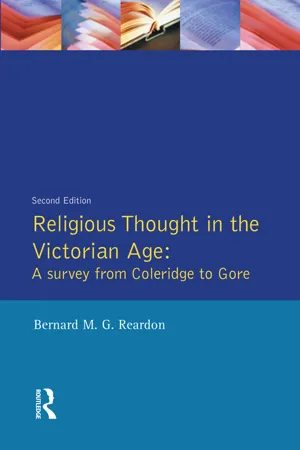
Religious Thought in the Victorian Age
A Survey from Coleridge to Gore
- 386 pages
- English
- ePUB (mobile friendly)
- Available on iOS & Android
eBook - ePub
About this book
An account of the intellectual and theological ferment of nineteenth-century Britain - the dynamic period when so many of the ideas and attitudes we take for granted today were first established (including the impact of biblical criticism upon traditional theology, and the belief in a social as well as a spirtual mission for the Church). Key figures include Coleridge, Newman Carlyle, Matthew Arnold and F. D. Maurice. Unavailable for some time, the reappearance of this updated Second Edition will be welcomed by theologians and intellectual and literary historians alike.
Information
Chapter 1
THE EARLY DECADES
The Evangelicals
‘The deepest and most fervid religion in England during the first three decades of this century’, wrote Henry Parry Liddon, ‘was that of the Evangelicals. The world to come, with the boundless issues of life and death, the infinite value of the one Atonement, the regenerating, purifying, guiding action of God the Holy Spirit in respect of the Christian soul, were preached to our grandfathers with a force and earnestness which are beyond controversy.’1 As a party within the Church of England the Evangelicals, although the heirs of the religious revival of the preceding century the outcome of which had been the Methodist schism, were loyal adherents of the establishment and the Prayer Book. No doubt, too, they were ‘Low’ Churchmen, but at the same time they were clearly distinguishable from the Whig Latitudinarians who commonly bore the designation. Always dedicated to charitable causes, they, like the Methodists, nevertheless cultivated the inner life as the spititual substance of all true religion. In the impression they made on the public mind of their day they were unique, combining as they did an energy for good works with an evangelistic zeal and a personal moral discipline which provoked both admiration and dislike, but rendered indifference impossible. Criticism they certainly encountered: the party, although influential, was not popular. The majority of the clergy resented or distrusted them; not entirely without reason, for the tone of evangelical piety was sometimes distasteful even to men of goodwill.
Preferment, in the early days, eluded them. Henry Ryder, appointed to the see of Gloucester in 1815, was the first to be raised to the episcopate. The bishop of London, Beilby Porteus, was markedly sympathetic, but as a rule his brethren on the bench were chary of ordaining men with known evangelical leanings, whilst the universities, as the experience of Charles Simeon at Cambridge well illustrates, were milieux of a kind which no evangelical clergyman was likely to find very congenial. As late even as 1810 the subscription lists of the Church Missionary Society did not include the name of a bishop or peer, and it was difficult for any clerical member of the Society to gain access to a pulpit. The Evangelicals’ rise to power—for later the party became very powerful in the Church, to remain so until quite recent years—was gradual. The current of opinion began to flow in their favour chiefly as a result of frank recognition of evangelical virtues and achievements, but also, in the fourth decade of the century, from a reaction to the supposedly Romanizing aims of Tractarianism. For the evangelical teaching was uncompromisingly Protestant and its puritan moral temper fully in accord with a growing seriousness of outlook in the nation at large.
The older generation of Evangelicals, typified by such men as John Newton and Richard Cecil, scarcely survived the age of Wesley himself. The new generation was associated mainly with Clapham, then an outlying London suburb, and with Cambridge, where Simeon, a fellow of King’s, was vicar of Holy Trinity. The ‘Clapham Sect’—and Sidney Smith’s label at once stuck to them—comprised a group of high-principled and energetic men, friends and neighbours united by a shared religious faith and a common philanthropic purpose. A natural leader was the banker, Henry Thornton, member of parliament for Southwark and a tireless promoter of good causes. His nearest neighbour and close friend was William Wilberforce (1759–1833), himself a rich man and a member of parliament also—he was an intimate of William Pitt’s—who won renown as the protagonist in the movement for the abolition of the slave trade. Other members of the group were Granville Sharp, Zachary Macaulay—Thomas Babington Macaulay’s father—likewise devoted to the anti-slavery campaign, Lord Teignmouth, a former governor-general of India, and James Stephen, a man in Brougham’s opinion of ‘the strictest integrity and nicest sense of both honour and justice’. All were laymen, but they were warmly supported by John Venn, rector of Clapham from 1792 to 1813. Frequent visitors to the district included Hannah More (1743–1833), prolific author of edifying books and pamphlets and a courageous worker for the poor, insufferably condescending though her social attitudes would now be judged, and the two outstanding members of the Cambridge following, Charles Simeon (1759–1836) and Isaac Milner (1751–1820), the latter president of Queens’ College and dean of Carlisle, a man of respected position in the university and the most impressive scholar in the party.
The literary organ of the Evangelicals was The Christian Observer, founded in 1802, which did much to publicize their opinions, but their contribution to theological study was meagre. Wilberforce’s Practical View, first published in 1797 and repeatedly reissued, is representative and in its day had great influence.2 But although they are chiefly remembered for their philanthropy, which their wealth made possible, they were not simply activists. None of them ever thought of his religion only in terms of moral endeavour. What moved them was a fervently held if narrow Bible Protestantism, although their contemporaries often despised them for the weakness of their theology, with its alleged lack of intellectual fibre and the conventionalism of its language. Thus Newman dismissed it as ‘but an inchoate state or stage of a doctrine’, whose final resolution would be in rationalism. But the charge is hardly fair. Evangelical theology was unspeculative certainly, and it had very little to offer in the way of an ecclesiology, whilst the emotive phrases of the popular evangelism in which it found expression were apt to sound glib. Yet its teaching, within its limits, was clear and firm. The very point of Wilberforce’s book was to impress on its readers the need of an adequate Christian belief. There was much, he feared, in the religion of people of his own social class—and his words were addressed to them—which was merely nominal and formal, yet if the basis of faith was insecurely laid the superstructure was bound to be precarious. A superficial and complacent moralism, the notion that ‘if, on the whole, our lives be tolerably good, we shall escape with little or no punishment’, would not do. Such an error sprang from an impoverished idea of what the fundamentals of Christianity really are. The ‘fruits of holiness’, contrary to the popular view, are the effects not the causes of justification and reconciliation. The intrinsic corruption of human nature—‘the sense we ought to entertain of our natural misery and helplessness’—the death of Christ, accordingly, as the one satisfaction for human sin, and the converting and sanctifying influence of the Holy Spirit—these are the elemental truths necessary to a real Christian profession. They are not abstruse, and the poor and simple can grasp them often better than the sophisticated. The humblest intelligence may hold to the death of Christ as an atonement for sin and the purchase price of a believer’s future happiness.
The Reformation doctrine of justification by faith lay at the root of evangelical piety. The Christian religion was a way of personal salvation, rendered urgent by the presence and power of sin in human life. In the words of John Overton’s True Churchman Ascertained (1801), a reply to Robert Fellowes’s The Anti-Calvinist: ‘We can only teach that every man who is born, considered independent of the grace of God, and in respect to spiritual concerns, is wholly corrupt, utterly impotent, under the wrath of God, and liable to everlasting torments.’3 Overton indeed, unlike most English Evangelicals of the time, was a pronounced Calvinist, taking the gravest view of man’s spiritual incapacity. But even Wilberforce, himself not at all of the Calvinist conviction, followed suit in this matter, believing sincerely that humanity is ‘tainted with sin, not slightly and superficially, but radically and to the very core’.4 This impressed him as the plain teaching of the Church of England, in its Articles even more expressly than in its liturgy. Nothing in this world was so important as the salvation of individual sinners from their sin and its consequences. Good intentions, however, are unavailing; rather must one turn to ‘the high mysterious doctrines’ professed by ‘real’ Christians. Wilberforce speaks with warmth of ‘the profaneness of … treating as matters of subordinate consideration those parts of the system of Christianity, which are so strongly impressed on our reverence by the dignity of the person to whom they relate’. Man’s only hope lies in Christ crucified:
If we would love Him as affectionately, and rejoice in Him as triumphantly, as the first Christians did, we must learn like them to repose our entire trust in Him, and to adopt the language of the Apostle, ‘God forbid that I should glory, save in the cross of our Lord Jesus Christ’.
Thus the atonement is the heart of Christian truth. It was no mere example of self-giving love but a unique event in which, by the substitution of the sinless one for sinners, the just wrath of God was appeased and his attitude to mankind changed. Man himself contributes no more to his redemption than he did to his first creation. To God alone is the praise.
Yet neither is salvation unconditional. To accept or reject it is the sinner’s own awful responsibility and he can accept it only by an act of faith beyond all consideration of personal merit. ‘You build for eternity’, said Isaac Milner, ‘on the righteousness of Christ; you renounce for ever, as a foundation of hope, your own righteousness.’5 A true Christian indeed is one who is moved to believe that Christ died, not to endorse some broad moral principle, but, quite literally, for him. It was his sin, along with that of all his fellows, which made that holy death necessary. To admit this, out of personal conviction, is the beginning of conversion. Once possessed, the sense of sin is overwhelming. Moral virtues are discounted and one is aware only of mercy received. To suppose therefore that the Evangelicals’ works of charity were done from utilitarian motives, in expectation of a heavenly reward, is to misconceive them completely. But good works, it was believed, are rightly taken as evidence of a justified state. They show that the faith professed is a living one. For the sinner to go unrepentant, and so fail to bring forth the fruits of the Spirit, is to await eternal doom. Even a man like Simeon adhered to the doctrine of reprobation without the slightest misgivings. It was sufficient that the Bible should teach it.
The Evangelicals were agreed, then, that the aim of religion is not only to humble the sinner and exalt the Saviour but to promote personal holiness. Sanctification was as much a divine operation as conversion. The two, in fact, were continuous, since conversion, so far from being of necessity instantaneous, is only the start of a process expected to last through life. The nature of holiness was conceived on puritan but not ascetic lines. Prayer and Bible-reading were vital to it, and regular attendance at Sunday worship was its dutiful expression. Thus G. W. E. Russell recalled from his youth ‘an abiding sense of religious responsibility, a self-sacrificing energy in works of mercy, an evangelistic zeal, an aloofness from the world, and a level of saintliness in daily life such as I do not expect to see realized again on earth’.6 Such testimony may be over-idealistic, but conduct in evangelical households was carefully regulated and a benefiting tone of ‘seriousness’ or ‘earnestness’ always looked for. Yet the Thorntons and the Wilberforces and their friends—unworldly men of the world—did not eschew the solid comforts and conveniencies appropriate to their rank in society. Nor were ‘innocent’ amusements by any means prohibited; it was only that the question of innocence had ‘not to be tried’, as Wilberforce put it, ‘by the loose maxims of worldly morality, but by the spirit of the injunctions of the word of God’. Believers, he said, are not gloomy. ‘The Christian relaxes in the temperate use of all the gifts of Providence.’ Imagination and taste and genius, and the beauties of creation and works of art, all lie open to him. No doubt the advice was honestly meant, but it cannot be claimed that the Evangelicals displayed much aesthetic sensibility or an interest in liberal culture for its own sake. It was religion that dominated their lives and imposed a kind of ethical stewardship ‘for every hour passed and every penny spent’.
The Evangelicals of the early nineteenth century, unlike many of their predecessors in the eighteenth, were not usually Calvinists. Legh Richmond, vicar successively of Brady in the Isle of Wight and Turvey in Bedfordshire, was among those who maintained the tradition in the Church of England, if in a modified form, whilst Overton was probably its doughtiest defender. But by this time the heat had gone out of the controversy.7 The majority of Evangelicals believed that Christ had died for all men and not simply for the elect few and that the appeal of the gospel is universal, a conviction with which their missionary zeal fully accorded. They were genuinely lovers of souls and could not contemplate that any should finally be lost, unless from his own hardness of heart.
The practical basis of evangelical religion was Bible study. Scripture was the Word of God, indeed the very words of God. It was verbally inspired in the sense that every statement in it was divinely authorized and essentially inerrant. The result was a biblicism, not to say a bibliolatry, the effect of which was intellectually benumbing. The sacred pages were treated as an oracle. Not only was critical curiosity about the facts of the Bible’s historical origins non-existent; the Evangelicals produced remarkably little in the way of Scripture exegesis. Th...
Table of contents
- Cover
- Half Title
- Title Page
- Copyright Page
- Table of Contents
- Dedication
- Preface
- Preface to the 1980 Paperback Edition
- Preface to the Second Edition, 1995
- Introduction
- 1 The early decades
- 2 Coleridge
- 3 The Oxford Movement
- 4 John Henry Newman
- 5 F. D. Maurice (1) The Kingdom of Christ
- 6 F. D. Maurice (2) Theology and Life
- 7 The limits of religious knowledge
- 8 The erosion of belief
- 9 Religion, science and philosophy
- 10 Liberal theology and the biblical question
- 11 Literature and dogma
- 12 Scottish developments
- 13 Critical orthodoxy
- Appendix I: The Gorham Judgment
- Appendix II: Liberal Catholicism
- Appendix III: Gladstone on Church and State
- Select bibliography
- Index
Trusted by 375,005 students
Access to over 1.5 million titles for a fair monthly price.
Study more efficiently using our study tools.
Frequently asked questions
Yes, you can cancel anytime from the Subscription tab in your account settings on the Perlego website. Your subscription will stay active until the end of your current billing period. Learn how to cancel your subscription
No, books cannot be downloaded as external files, such as PDFs, for use outside of Perlego. However, you can download books within the Perlego app for offline reading on mobile or tablet. Learn how to download books offline
We are an online textbook subscription service, where you can get access to an entire online library for less than the price of a single book per month. With over 1.5 million books across 990+ topics, we’ve got you covered! Learn about our mission
Look out for the read-aloud symbol on your next book to see if you can listen to it. The read-aloud tool reads text aloud for you, highlighting the text as it is being read. You can pause it, speed it up and slow it down. Learn more about Read Aloud
Yes! You can use the Perlego app on both iOS and Android devices to read anytime, anywhere — even offline. Perfect for commutes or when you’re on the go.
Please note we cannot support devices running on iOS 13 and Android 7 or earlier. Learn more about using the app
Please note we cannot support devices running on iOS 13 and Android 7 or earlier. Learn more about using the app
Yes, you can access Religious Thought in the Victorian Age by Bernard M. G. Reardon in PDF and/or ePUB format, as well as other popular books in Theology & Religion & British History. We have over 1.5 million books available in our catalogue for you to explore.