The nineteenth century was one of the most fascinating and volatile periods in Christian history. It was during this time that Christianity evolved into a truly global religion, which led to an ever greater variety of ways for Christians to express and profess their faith. Frances Knight addresses the crucial question of how Christianity contributed to individual identity in a context of widespread urbanisation and modernisation. She explores important topics such as the Evangelical revival led by the likes of the founder of the Christian Mission - later the Salvation Army - William Booth; the Oxford Movement under Newman, Keble and Pusey; Mormonism and Protestant revivalism in the USA; socialism and the impacts of Karl Marx and anarchism; continuing theological divisions between Protestants and Catholics; and the development of pilgrimage and devotion at places like Lourdes and Knock. Her book also examines the most significant intellectual trends, such as the rise of critical approaches to the Bible, and the different directions that these took in Britain and America.
The author's unique emphasis on the 'ordinary' experience of Christians worldwide makes her volume indispensable for students and general readers who will be fascinated by this sensitive twenty-first century perspective on the nineteenth century.
eBook - ePub
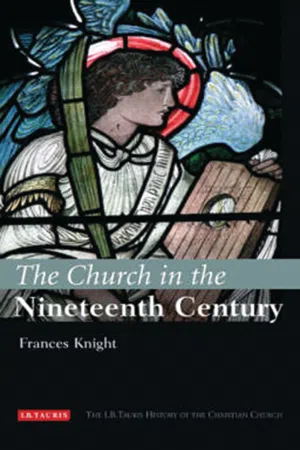
The Church in the Nineteenth Century
The I.B.Tauris History of the Christian Church
- 256 pages
- English
- ePUB (mobile friendly)
- Available on iOS & Android
eBook - ePub
About this book
Information
PART I
PLACES
CHAPTER 1
England and Wales
The 1851 religious census in the city of Nottingham
The 30th of March 1851 was an unsettled day. As dawn broke across the fens and wolds of central England, rain was already in the air, yet there was a mildness which hinted that a storm might be on the way. The wind was rising. It was the lambing season, and the insistent, high-pitched cry of the newly born carried across gently undulating fields, mixing with the deeper notes of early morning cockerels and cattle. There was evidence of fields being prepared for seed drilling, but on this morning the only signs of agricultural activity related to the welfare of livestock, for this was a Sunday, in a country where Sunday churchgoing and Sabbath rest were generally regarded as being of paramount importance.
In a town in the English Midlands, in the newly built vicarage of St Mary’s Nottingham, the Reverend Joshua Brooks was feeling anxious. Since moving from Retford to be vicar of Nottingham, his health had deteriorated, and his adoption of the ‘water system’ – going to bed with towels steeped in cold water around his neck – had not provided him with much relief. Today was a particularly anxious day. It was the day appointed for the first national census of religious attendance. He had been sent forms to fill in, which required him to give details of the numbers attending at each of the services that would take place that day, the numbers attending the Sunday schools, the average attendance over the last 12 months and the number of sittings available in each of the places of worship for which he was responsible. He was worried about how he was supposed to manage all this counting, and how the information would be used once he had collected it. Was he supposed to stand in the pulpit and count every individual, jabbing his finger at every worshipper and muttering under his breath? Or stand at the door like a footman and count the congregation in and out? Or would round numbers do? Brooks decided that the London bureaucrats who were due to receive his census return would have to put up with round numbers. In any case, Brooks knew that attendance would not be as good as usual because of the measles epidemic which had hit the town, and because it was Mid-Lent Sunday, when younger people living away from home would make a special effort to go back to their villages to visit their mothers. How foolish of the authorities to commission this survey for Mothering Sunday, and at such a wet time of year! Then there was the problem of what to do with the forms once he had filled them in. He knew that he was supposed to return them to one of the local census enumerators, and that they would dispatch them to London. But he did not trust them. None of them were Church of England; in fact he considered that they were all Dissenters of the worst sort, the type who would try to make political capital out of any weakness that they could detect in the returns for St Mary’s, or for the cemetery chapel or the school room for which Brooks was also responsible.
To entrust his census returns to Dissenters was an appalling prospect. They might tamper with figures, and they were bound to exaggerate the numbers at their own places of worship! Brooks remembered the time when, a decade previously, dissenting radicals had seized control of St Mary’s by getting themselves elected as the churchwardens. They had refused to set a church rate or to spend any money on the upkeep of the building. Eventually the church had been declared unsafe and was closed for months on end, with a massive £4,600 needed for repairs. The incident had resulted in uproar in the town, and the resignation of his predecessor. Numbers had never recovered, and many couples who would once have come to St Mary’s for marriage or to have their babies baptized had resorted instead to the office of the Superintendent Registrar. Brooks had been under more or less constant stress since his arrival in the parish in 1843. As the vicar of the most prominent Church of England church in the heart of the city of Nottingham, he regarded himself as the senior ecclesiastic in the town. But now that there was such a free market in religion, it was such a hard position to defend. It seemed to Joshua Brooks that Protestant Dissenters of all types – and now Catholics – were everywhere in Nottingham. There were several Baptist and Independent congregations, and a bewildering variety of Methodists. There were Presbyterians who were on the way to Unitarianism, and there were Quakers and Mormons. Only the previous October, the Swedenborgians had opened a branch of the New Jerusalem Church in Trinity Street. Meanwhile the Roman Catholics had a new church on the Derby Road designed by the leading Gothic revival architect A.W.N. Pugin, which was reputed to accommodate well over 1,000. Their old chapel, in George Street, was being converted into a ragged school, to be run by the Sisters of Mercy. Thus, all within easy walking distance of St Mary’s parish church, there was a host of vibrant and often newly established Christian communities, all developing their own infrastructure and distinctive ways of believing.
Brooks knew that every minister from Francis Cheadle, the senior Roman Catholic priest in the town, to Cuthbert Orlebar, who styled himself the Angel or Bishop of the Catholic and Apostolic Church in Nottingham, would be filling in their census forms on that Sunday or on the following Monday, if ministerial commitments or sabbatarian principles prevented him from doing it on the day. All denominations, whether sectarian or papist, treated as equal by the London bureaucrats! This was a painful thought for a Church of England clergyman who had been brought up to believe not only that his religion gave him particular privileges, such as entry into the universities of Cambridge and Oxford, but also the right to expect that the government would support him in the promotion of the Anglican form of Christianity. Brooks believed in the importance of maintaining the special privileges of the Church – an Anglican establishment in England and Wales. Yet he knew that in Nottingham at least, the Church of England was unlikely to emerge from the census as the majority denomination, and that the case for a state-supported establishment rested to a large extent on its continuing to have the support of the majority of the population. He also knew that nothing would make him entrust his census forms to men whom he regarded as dissenting infidels. He would send them direct to George Graham, the Registrar General, with a covering letter.1 It must have been a stressful day all told – and no doubt the water system did not help him get a good night’s rest, as the world moved on to Monday 31 March 1851.
When the results of the religious census of 1851 were published in January 1854, they revealed that 31 per cent of the churchgoing citizens of Nottingham had attended Anglican worship, as against 62 per cent who attended Nonconformist chapels.2 In the Nottingham registration district, the central city area which covered 1,870 acres, there were 38 places of worship. Nine of these were Anglican, seven were Baptist, seven were some variety of Methodist, five were Independent, five belonged to the smaller sects, two were Roman Catholic, one was Presbyterian/Unitarian, one was Quaker and one was Jewish.3 It was a bewildering array of different types of religion to have in such close proximity in a single English town, all of them making claims about the veracity of their own doctrine and order, in most cases directly against the claims of their rivals. As one Protestant pamphlet that circulated in Nottingham in the 1840s put it, ‘If the Protestant is right, then a Roman Catholic cannot be saved; but if the Roman Catholic be right, then a Protestant cannot be saved.’4 This was the stark dilemma that faced the ordinary Sunday churchgoer, as she made her way past perhaps half a dozen different places of worship until she reached the church or chapel which appeared to her to have the greatest claim on religious truth, as well as providing the most congenial environment for worship, among those with whom she could feel a sense of kinship.
Denominations in competition at mid-century
This sectarian model of religious life, in which competing and mutually hostile religious groups operated cheek by jowl as they attempted to attract and retain the support of the local population, was repeated all over England and Wales. It was, however, subject to considerable regional variation, which has been mapped for England by Hugh McLeod, and in greater detail for England and Wales by K.D.M. Snell and Paul S. Ell.5 The Church of England had not been everywhere as eclipsed by Nonconformity as it was in Nottingham, and it retained strongholds in the southern rural counties of east Hampshire, west Sussex, much of Surrey, and also in east Devon, central and west Somerset and most of Dorset. It was strong in east Kent, much of Herefordshire, parts of Worcestershire and south Shropshire, in some districts immediately east of Leicester, and in some areas of central East Anglia.6 It had ceased to be the majority denomination in much of north east and central England. In Cornwall, and a vast swathe of the north east stretching from central Northumberland to the south of Lincolnshire, Wesleyan Methodists were the strongest denomination.7 Primitive Methodists were strongest in north Lincolnshire, much of Norfolk and in parts of Yorkshire, Northumberland and county Durham.8 Independents and Baptists thrived across central and eastern England, and were also strong in Wales. The Church of England and Nonconformist denominations were fairly evenly weighted in much of East Anglia and the east Midlands, and in parts of the north Midlands, north Somerset, north Wiltshire and south Gloucestershire.9 Although the Catholic population in England had risen steeply since the beginning of the nineteenth century, the only places in which Roman Catholics were the largest non-established denomination in 1851 were Liverpool, Preston, the Strand district of central London and St George’s Southwark, immediately south of the Thames.10
It has been estimated that at the time of the 1851 census, some 60 per cent of the English population regarded themselves as Anglicans, and perhaps 30 per would have defined themselves as Nonconformist. Four per cent were Roman Catholics. Because less than the total Anglican population attended worship on census Sunday, and many of the Nonconformists attended more than one service, the census results, which counted attendances at all services, rather than the number of individual worshippers, gave the impression of almost equal numbers of Anglicans and Nonconformists.11 The other 6 per cent of the population in 1851 comprised Jews, very small numbers of adherents of other world faiths and new religious movements, such as Theosophists and Spiritualists, and a small but vocal group of freethinkers, atheists and secularists.12
In Wales differences in language and religious culture resulted in different patterns of denominational allegiance.13 The Church of England operated as an established Church in Wales until 1920, and was known, rather oddly, as the Church of England in Wales, with the four Welsh dioceses regarded as part of the province of Canterbury, in the same way that the southern English dioceses were. The Welsh dioceses were, however, very much less strongly supported than the English dioceses, in what was an intensely religious country in 1851. Wales offered an enormously high level of religious provision for its population, with 4,006 separate places of worship. These places contained a total of 1,005,410 sittings for a population of 1,188,914; thus overall 84.5 per cent of the population could have been seated at worship. Horace Mann, the author of the census report, described Wales as ‘fortunately basking in an excess of spiritual privileges’.14 Indeed, the counties of Merioneth and Breconshire had more seats available than population to fill them.15 Wales also recorded much higher levels of attendance than England – equivalent to 83.4 per cent of the population in South Wales and 86.6 per cent in North Wales.16
Thus the concept of secularization, which became widely discussed in British society after the census findings were published, is something which was much less meaningful in mid-nineteenth-century Wales than it was in England, where worship was attended by 59.1 per cent of the population. Equally, it challenges the assertion that was made by Horace Mann, and widely picked up by others, both at the time and since, that it was the working classes, the ‘unconscious secularists’, who stayed away from religion. Working-class Welsh people had, at this date, clearly not abandoned the practice of religion. The sheer size of Welsh Protestant Dissent is another obvious and important finding: the Welsh were far more likely than the English to be Nonconformists, and Anglicans were a minority throughout the principality. In the south, the main source of rivalry for the Anglicans came from the Independents; in the north, Calvinistic Methodists were in the majority.17 There is also evidence of an east–west split within Nonconformity, with Calvinistic Methodist and Independent congregations noticeably strongest in the Welsh-speaking west, and Wesleyan Methodism more densely clustered in the east of Wales. The strength of Nonconformity is revealed by the sheer number of their sittings, particularly in the south. The percentage share of Anglican sittings was lowest in Wales, with a dramatic decline being visible along the southern part of the English–Welsh border, between the dioceses of Hereford and St Davids. The place with the lowest share of Anglican sittings anywhere in England or Wales was Merthyr Tydfil. In about half of Wales, the Anglican share was less than 30 per cent. This differentiated Wales very significantly from most of England, where large parts of the south and Midlands registered a share in excess of 60 per cent, with five registration districts in Sussex all recording well over 80 per cent. Merthyr also registered the lowest share of Anglican attendances – 6.2 per cent. Indeed, the 14 districts with the lowest Anglican attendance were all in Wales. In parts of Hampshire, meanwhile, Anglican attendance ran at 90 per cent.18
Despite the very significant importance of regional diversity, the predominant religious paradigm in nineteenth-century England and Wales was therefore two very large and finely balanced Anglican and Nonconformist blocs, eyeing each other with mutual jealousy whilst simultaneously aware of the splits and divisions within their own ranks. This is the national variation on the global picture which was sketched out in the Introduction, in which the two large groupings dominating Christianity were identified as Protestant evangelicalism and Roman Catholicism. It reflects the power of the state Church in England and Wales, and the relative weakness at this date of Roman Catholicism within a largely Protestant society. The more global Protestant–Catholic hostility had been transferred into a Nonconformist–Anglican one. As Anglicans and Nonconformists exchanged hostile glances, they were also acutely aware of the presence of two other alien entities. On the one hand there were Roman Catholics, threatening because they were growing, who were perceived as owing their primary allegiance to a foreign power, and who were newly organized into diocesan structures. On the other there were secularists, freethinkers and atheists, threatening because they were seen as having no vested interest in the maintenance of the status quo, or indeed of traditional Christian morality, which was believed to be the bedrock of Victorian society.
In reality, both Catholics and secularists were still tiny in number. The power which they wielded over the English and Welsh Protestant majority was more psychological than actual. It was markedly different from the pattern in Catholic countries, such as France, Spain, Italy and Portugal, where the fault-lines between Catholics and anti-clerical socialists were deep, and where non-Catholic varieties of Christianity made little impact. It was different again from the predominant patterns in parts of North America and Africa, where particular denominations grew because of the work of individual mission agencies, but where there was little internal competition between different denominations. In these places, a traveller could move quite unconsciously from the stronghold of one denomination to the stronghold of another, or pass into an unevangelized ‘no man’s land’ for no other reason than that he had passed over the invisible boundary that marked the outer reaches of the missionary agency’s evangelistic endeavours.
Nonconformist consolidation
By the mid-nineteenth century, there was, as we have seen, a flourishing free market for Christianity in England and Wales. This was not something which had been intended, but it turned out to be one of the longer-term consequences of the nation’s official adoption of Protestantism from 1559. In 1662, the passing of the Act of Uniformity had meant that, in theory at least, England had declared itself as having just one officially sanctioned form of religion, and that was the Ecclesia Anglicana (the term ‘Anglican’ did not come into use until the middle of the nineteenth century). The Act of Uniformity worked on the basis of imposing a single liturgical framework on the people of England and Wales. All ministers were required to use only those forms of worship that were in the Book of Common Prayer, the service book that had been compiled mainly by Thomas Cranmer in the 1540s and 1550s. Those ministers who by 24 August 1662 had refused to conform to the Book of Common Prayer, or to seek episcopal ordination, were ejected from the Church of England. It was from the ranks of these 2,000 men that the first generation of Nonconformist (in the strict sense) ministers emerged – men who espoused Presbyterian theology and church government. They joined already existing Baptists, Quakers and Independents (also known as Congregationalists) to provide distinctive, Protestant alternatives to the established Church.
These emerging denominations had some shared emphases, but also certain distinctive features which set them apart from each other. They shared in common a belief in preaching the pure word of God, in simplicity in worship and life, in Christ’s sole headship of the Church, in the priesthood of all believers and in the locus of the Church as in the locally gathered congregation. They were all strongly anti-episcopal; whatever constituted the true Church, they were sure that bishops were not part of it. The Quakers were the most radical in theology and had a history of passive resistance to those actions of the state of which they disapproved. Thus they refused to pay church rate, or, being pacifist, taxes in support of the army. By the nineteenth century, some Quakers had come under the in...
Table of contents
- Cover
- About the Author
- Title Page
- Copyright
- Contents
- Dedication
- Abbreviations
- Acknowledgements
- Introduction
- PART I. PLACES
- PART II. THEMES
- Notes
- Select Bibliography
Trusted by 375,005 students
Access to over 1.5 million titles for a fair monthly price.
Study more efficiently using our study tools.
Frequently asked questions
Yes, you can cancel anytime from the Subscription tab in your account settings on the Perlego website. Your subscription will stay active until the end of your current billing period. Learn how to cancel your subscription
No, books cannot be downloaded as external files, such as PDFs, for use outside of Perlego. However, you can download books within the Perlego app for offline reading on mobile or tablet. Learn how to download books offline
Perlego offers two plans: Essential and Complete
- Essential is ideal for learners and professionals who enjoy exploring a wide range of subjects. Access the Essential Library with 800,000+ trusted titles and best-sellers across business, personal growth, and the humanities. Includes unlimited reading time and Standard Read Aloud voice.
- Complete: Perfect for advanced learners and researchers needing full, unrestricted access. Unlock 1.5M+ books across hundreds of subjects, including academic and specialized titles. The Complete Plan also includes advanced features like Premium Read Aloud and Research Assistant.
We are an online textbook subscription service, where you can get access to an entire online library for less than the price of a single book per month. With over 1.5 million books across 990+ topics, we’ve got you covered! Learn about our mission
Look out for the read-aloud symbol on your next book to see if you can listen to it. The read-aloud tool reads text aloud for you, highlighting the text as it is being read. You can pause it, speed it up and slow it down. Learn more about Read Aloud
Yes! You can use the Perlego app on both iOS and Android devices to read anytime, anywhere — even offline. Perfect for commutes or when you’re on the go.
Please note we cannot support devices running on iOS 13 and Android 7 or earlier. Learn more about using the app
Please note we cannot support devices running on iOS 13 and Android 7 or earlier. Learn more about using the app
Yes, you can access The Church in the Nineteenth Century by Frances Knight in PDF and/or ePUB format, as well as other popular books in Teología y religión & Historia del cristianismo. We have over 1.5 million books available in our catalogue for you to explore.