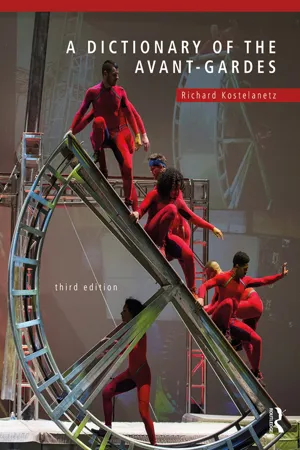
Twenty-five years after the publication of A Dictionary of the Avant-Gardes, the distinguished critic and arts historian Richard Kostelanetz returns to his favorite subject for a third edition. Rewriting earlier entries, adding hundreds of new ones, Kostelanetz provides intelligence and information unavailable anywhere else, no less in print than online, about a wealth of subjects and individuals. Focused upon what is truly innovative and excellent, he ranges widely with insight and surprise, including appreciations of artistic athletes such as Muhammad Ali, Johan Cruyff, and the Harlem Globetrotters and such collective creations as Las Vegas and his native New York City. Continuing the traditions of cheeky high-style Dictionarysts, honoring Samuel Johnson and Nicolas Slonimsky (both with individual entries), Kostelanetz offers a "reference book" to be enjoyed not only in bits and chunks, but continuously as one of the dozen books someone would take if they planned to be stranded on a desert isle.
- 462 pages
- English
- ePUB (mobile friendly)
- Available on iOS & Android
eBook - ePub
A Dictionary of the Avant-Gardes
About this book
Information
A
Abish, Walter
(24 December 1931)
Though he was born in Vienna, raised in Shanghai’s Jewish community during World War II, and lived in Israel before emigrating to the United States, Abish has published only in English. The distinguishing mark of his novel Alphabetical Africa (1974) is its severe compositional discipline. The first chapter has only words beginning with the letter A (“Ages ago, Alex, Allen and Alva arrived at Antibes,” etc.). For the second chapter, he additionally uses words beginning with the letter B. Only by the Z chapter, which is in the middle of the book, does the full alphabet become available, then to contract again to a conclusion composed exclusively of words beginning with the letter A.
The next two Abish books are collections of stories, some of them more experimental than others. Each pair of paragraphs in “In So Many Words” is preceded by a numeral announcing how many words are in the following paragraph; while the second paragraph in each pair, set in roman type, tells a dry story, the first paragraph contains all of its successor’s words set in italics in alphabetical order. In short, Abish displays a fascination with numbers reminiscent of RAYMOND QUENEAU, though lacking the latter’s extravagant wit and audacity.
It was Abish’s good fortune, or misfortune, to write How German Is It (1980), a far more accessible novel that won him a Guggenheim fellowship, a CAPS grant, and later a lush MacArthur fellowship, in addition to a contract from a slick publisher not otherwise known for publishing avant-garde writers. The result was Eclipse Fever (1993), a fiction far more conventional than its predecessors, and Double Vision: A Self-Portrait (2004), a modestly unusual autobiography. If his writing fell into the capacious hole of the literary-industrial complex, too bad.
Abrahamsen, Hans
(23 December 1952)
A prominent Danish composer, he had explored quietude – more specifically, how quiet music can be and still be music. His masterpiece is Schnee (2006–08, Snow), which opens with string players barely scratching their instruments in their upper registers before proceeding to louder sound. Because it starts so quietly, Schnee is better seen live to be heard. Early in his career Abrahamsen was praised for representing a New Simplicity in a false competition with serial music, as they came in time to co-exist. At a time when amplification of music is so easy and widespread, his effort becomes ever more laudable.
Abramovic, Marina
(30 November 1946)
Born in Belgrade just after World War II, she attended the Academy of Fine Arts in Belgrade before beginning a career mostly of stunning PERFORMANCE and installations. Initially she explored themes of pain and duration, especially on herself. In Rhythm 0 (1974, in Naples), she invited spectators to use on her a range of instruments including knives. Moving to Amsterdam in 1975, she met Uwe Laysiepen (1943), a German known as Ulay. In their thirteen years together they did many prominent performances, including Relation in Space (1976), where they crashed their naked bodies into each other for an hour. In Night Crossing (1981), they abjured talking and eating for more than two weeks, repeating this performance in various venues, mostly notably in Australia, where it was also called Gold Found by the Artists (1981). They concluded their collaboration with The Lovers: Walk on the Great Wall (1988), where they started at opposite ends of the Chinese landmark, one crossing the Gobi Desert and the other treacherous mountain tops, until meeting on a bridge in the Shaanxi Province. After the legendary couple split, Abramovic returned to solo performances, including Biography (1992–96), a theatrical retrospective of twenty-five years of previous performances. In Cleaning the Mirror (1995, New York), clad in a long white shift, in a dank and dark basement, she scrubbed obsessively at large cow bones, removing bloody refuse that soiled her dress, creating, in RoseLee Goldberg’s judgment, “a metaphor for ethnic cleansing in Bosnia [that was] an unforgettable image of grief for her times.” Seriously entrenched in her particular art, Abramovic in 2005 presented at New York’s Guggenheim Museum Seven Easy Pieces in which she redid wholly on her own classics initially performed by other artists mostly (e.g., VITO ACCONCI, Valie Export [1940]). In 2010 she became the first performance artist to merit a retrospective at New York’s MUSEUM OF MODERN ART.
Abstract Expressionism
(c. 1948)
If only because it emphasizes esthetic qualities, this term has come to be the most acceptable epithet for the innovative painting that became prominent in NEW YORK CITY in the late 1940s (and was thus sometimes called the NEW YORK SCHOOL). Drawing not only from SURREALISM but from JAZZ- based ideas of improvisatory gestural expression, certain artists laid paint on the canvas in ways that reflected physical attack, whether in the extended dripped lines of JACKSON POLLOCK or in the broad strokes of FRANZ KLINE. “Action painting,” another epithet once popular for this style of painting, was coined by the critic HAROLD ROSENBERG, who theorized that these abstractions represented the artist’s mental state at the moment(s) of composition. One esthetic common to such painting was “all-over” composition, which is to say that the activity could be just as strong near the edges of the canvas as in the center, purportedly in contrast to the more hierarchical focusing typical of traditional art.
WILLEM DE KOONING’s work is customarily placed within this term, even though his best paintings acknowledge figuration and focusing; so are BARNETT NEWMAN and AD REINHARDT, perhaps because they were roughly the same age as the others (and resided mostly in NEW YORK CITY), even though their art proceeded from decidedly nonexpressionist premises. A European epithet for comparable painting was ART INFORMAL.
Abstract Film
(1913)
In Art of Our Time (1939), the MUSEUM OF MODERN ART’s self-retrospective of its first decade, is a two-page final chapter, much shorter than its predecessors, that seems an afterthought, as indeed “Designs for Abstract Film” probably was. It features Léopold Survage (1879–1968), a Russian then residing in Paris, who in 1913 produced a sequence of six paintings, Le Rhythme Coloré (Colored Rhythm), that he imagined would become an animated film not from filming them but copying his designs directly onto celluloid stock. In his classic polemic, Survage suggested radically that abstraction in art says little until “it sets in motion, when it is transformed and meets other forms, that it becomes capable of evoking a feeling.” He added, “It is in this way that visual rhythm becomes analogous to the sound-rhythm of music.”
Though Survage’s proposal never advanced beyond a 1917 gallery exhibition prefaced by his friend GUILLAUME APOLLINAIRE, his fertile cinematic vision was soon realized by VIKING EGGELING, HANS RICHTER, and WALTER RUTTMANN, among others. The apex was perhaps Ballet Méchanique (1924) made by FERNAND LÉGER and MAN RAY. Later in the 1920s came abstract films from OSKAR FISCHINGER; in the 1930s, from LEN LYE. One theme of their work is images unique to film. This quality became more obvious decades later with the development of abstract video with, for instance, fuzzy edges that could not be realized with film. Indeed, when the Cleveland art professor Bruce Checefsky (1957) animated all twelve Survage paintings in 2005, they look like less like film than video.
Abstract Graphic Narrative
(20th century)
Where earlier examples existed, the epithet “graphic novel” wasn’t much heard until the century’s end. That latter category classified spine-bound books whose pages were mostly frames with words and images more typical of comic strips. Two turning points in gaining critical acceptability for this format came with the publication of Alan Moore and David Gibbons’s Watchmen (1987) in England and Art Spiegelman’s Maus (1991) in America.
While commercial publishers have since issued many graphic narratives, what became more scarce by comparison, still off the maps of both literature and art, were narratives whose visual content was simply shapes and sometimes just verbal symbols that evolved a story over successive frames or turned pages. One historic precursor was EL LISSITZKY’s About Two Squares (1922), which curiously began as a children’s book, perhaps under the assumption that shapes are more comprehensible, surely more internationally understood, than words. (Should the reader take its images from the Internet, consider cutting them apart and reassembling to simulate the structure of a book with pages.)
This form I discovered in the chapbook Artificiata (1969) by MANFRED MOHR, whose abstract vertical drawings weaved a narrative over successive pages, no matter if the book were read from its front or its back. The initial achievement of SOL LEWITT’s Arcs Circles Grids (1972) was a bigger book, clearly for adults, where the narrative develops wholly through the changing configuration of lines over successive pages, thus fusing abstract art, which LeWitt also practiced, with the linear form of narrative.
This recognition is important to me, because in the mid-1970s I produced Constructivist Fictions of symmetrical line drawings metamorphosing in a systemic sequence. The theme behind the collective name was suggesting that the historic Constructivists would have made these abstract graphic fictions, had they thought about making narratives. In collaboration with the animator Peter Longauer (1949), I also produced from these drawings a short 16 mm ABSTRACT FILM (1978).
Nonetheless, I find that whenever I try to explain AGN to others, as I’m doing here, I am continually surprised at how many people involved in both abstract art on one hand and narrative on the other can’t understand it until they see an example.
Abstract Music
(1950s)
Abstraction in music implies a separation of sonic structures from representational images, whether pictorial or psychological. Abstract music is the antonym of all musical styles that are concrete or naturalistic; abstract works are usually short, athematic, and rhythmically asymmetric. Intellectual fantasy, rather than sensual excitation, is the generating impulse of abstract music; its titles are derived from constructivistic and scientific concepts: structures, projections, extensions, frequencies, sound. The German composer Boris Blacher has developed a successful form of abstract opera in which concrete action takes place in a swarm of discrete sonic particles, disjected words in several languages, and isolated melodic fragments. ABSTRACT EXPRESSIONISM, a term applied to nonobjective painting, is sometimes used to describe musical works of abstract quality with expressionistic connotations. A subsidiary genre of abstract music is ALEATORY M USIC, in which the process of musical cerebration is replaced by a random interplay of sounds and rhythms.
—Nicolas Slonimsky
Abstraction
(c. 5000 B.C.)
This term generally defines artwork, whether visual, aural, or verbal, that neither represents nor symbolizes anything in the mundane world; but, because pure abstraction is primarily an ideal, the epithet also refers to work that at least approaches the absence of identifiable figurative representation. Although some commentators make a case for abstraction as a new development in the history of visual art, such a generalization necessarily depends upon ignorance of Islamic art that traditionally observes a proscription against graven images. (Those arguing for modern abstraction as a development dismiss such Islamic art as “decorative.”)
Abstract art in the West became avant-garde in the 20th century, precisely because various styles of representation had been dominant for centuries before. Within modern abstract art are two divergent traditions, one emphasizing structure and the other favoring expression; examples of both of these traditions appear not only in painting and sculpture but also in music and dance. One reason behind the oft-heard piety that “painting is more advanced than poetry” is that abstraction became more acceptable among visual artists than among writers in our century.
Absurd, Theater of the
(c. 1961)
The epithet comes from Martin Esslin’s brilliant 1961 book of the same title. In the plays of SAMUEL B ECKETT and E UGÈNE I ONESCO, and to a lesser extent others, Esslin (1918–2002) identified nonsensical and ridiculous events that have sufficient metaphysical resonance to suggest the ultimate absurdity, or meaninglessness, of human existence. Reflecting philosophical existentialism, absurd writing represents an advance on the literature incidentally composed by the existentialist philosophers. If the latter sought a serious surface, the theatrical absurdists favored dark comedy in the tradition of ALFRED JARRY. The innovation was to demonstrate the theme of absurdity, in contrast to an earlier theater, identified with Jean-Paul Sartre (1905–80) and Albert Camus (1913–60), where characters debate it.
By contrast, at the end of Ionesco’s The Chairs (1952), a particularly neat model of the convention, a hired lecturer addresses a nonexistent audience in an indecipherable tongue. This is the absurd surface. Because the lecturer’s message is supposed to represent the final wisdom of a 95-year-old couple, the meaningless message becomes an effective symbol for the metaphysical void. In a more familiar example from SAMUEL BECKETT, two men wait for a mysterious Godot, who obviously is not coming. On the strictly theatrical influence of absurd theater, the Cambridge Guide to Literature in English (1988) says:
The carrying of logic ad absurdum, the dissolution of language, the bizarre relationship of stage properties to dramatic situation, the diminution of sense by repetition or unexplained intensification, the rejection of narrative continuity, and the refusal to allow character or even scenery to be self-defining have become acceptable stage conventions.
(Thanks for this summary.)
Fifty years ago, I found a similar absurdist style in certain early 1960s American fiction by JOHN B ARTH, Joseph Heller (1923–99), and THOMAS P YNCHON, among others. What seemed awesomely original and true in 1960s theater and fiction, now strikes most viewers as dated.
Academic Critics
When professors discuss avant-garde art, particularly literature, they tend to focus upon the more conservative, more accessible dimensions of an artist’s work, in part to make their criticism more digestible to th...
Table of contents
- Cover
- Half Title
- Title
- Copyright
- Dedication
- Contents
- Preface
- Introduction
- The dictionary
- Biographical notes
Trusted by 375,005 students
Access to over 1.5 million titles for a fair monthly price.
Study more efficiently using our study tools.
Frequently asked questions
Yes, you can cancel anytime from the Subscription tab in your account settings on the Perlego website. Your subscription will stay active until the end of your current billing period. Learn how to cancel your subscription
No, books cannot be downloaded as external files, such as PDFs, for use outside of Perlego. However, you can download books within the Perlego app for offline reading on mobile or tablet. Learn how to download books offline
Perlego offers two plans: Essential and Complete
- Essential is ideal for learners and professionals who enjoy exploring a wide range of subjects. Access the Essential Library with 800,000+ trusted titles and best-sellers across business, personal growth, and the humanities. Includes unlimited reading time and Standard Read Aloud voice.
- Complete: Perfect for advanced learners and researchers needing full, unrestricted access. Unlock 1.5M+ books across hundreds of subjects, including academic and specialized titles. The Complete Plan also includes advanced features like Premium Read Aloud and Research Assistant.
We are an online textbook subscription service, where you can get access to an entire online library for less than the price of a single book per month. With over 1.5 million books across 990+ topics, we’ve got you covered! Learn about our mission
Look out for the read-aloud symbol on your next book to see if you can listen to it. The read-aloud tool reads text aloud for you, highlighting the text as it is being read. You can pause it, speed it up and slow it down. Learn more about Read Aloud
Yes! You can use the Perlego app on both iOS and Android devices to read anytime, anywhere — even offline. Perfect for commutes or when you’re on the go.
Please note we cannot support devices running on iOS 13 and Android 7 or earlier. Learn more about using the app
Please note we cannot support devices running on iOS 13 and Android 7 or earlier. Learn more about using the app
Yes, you can access A Dictionary of the Avant-Gardes by Richard Kostelanetz in PDF and/or ePUB format, as well as other popular books in Art & Art General. We have over 1.5 million books available in our catalogue for you to explore.