eBook - ePub
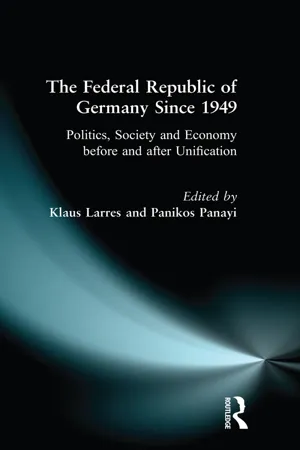
The Federal Republic of Germany since 1949
Politics, Society and Economy before and after Unification
- 354 pages
- English
- ePUB (mobile friendly)
- Available on iOS & Android
eBook - ePub
The Federal Republic of Germany since 1949
Politics, Society and Economy before and after Unification
About this book
Today the problems of reunification seem to feature more often in the international spotlight than the benefits. This timely volume offers a reassessment of Germany's postwar development from its inception through to reunification, including a thorough examination of the implications for economic, political and social policies.
The impressive team of contributors include leading names in the history of modern Germany, together with some of the ablest younger scholars in the field. They are: Hartmut Berghoff, David Childs, Immanuel Geiss, Graham Hallett, Klaus Larres, Terry McNeill, Torsten Opelland, Richard Overy, Stephen Padgett, Panikos Panayi, and Mathias Siekmeier.
PART ONE
The Development of the Federal Republic: a Survey
CHAPTER ONE
The Economy Republic since of the Federal 1949
Richard Overy
Shortly after the collapse of the communist regime in East Germany an article in the West German journal Wirtschaftsdienst explored the options open to its neighbour as the command economy crumbled. Reform was out of the question. There was, the article continued, only one acceptable course: abolition of the old system ‘and replacement with a market economy’. More precisely it should be a market economy constructed along the lines of the Federal Republic, ‘functionally efficient’ with autonomous, highly competitive enterprises, free prices, and an effective monetary and currency system.1 Here, in a nutshell, was the recipe for the startling success of the West German economy since the state’s foundation in 1949. ‘Capitalist restoration’ had worked then; the assumption widely held in German circles in 1990 was that it would work again in the east.
Such a view is hardly surprising. The success of the market economy has been one of the defining features of the Federal Republic almost from its inception. To the outside world German strength is economic strength, and German revival a paradigm of the transforming power of modern capitalism. The very term ‘economic miracle’ has entered the vocabulary of modern political economy as first and foremost a German phenomenon. It is entirely plausible to argue that the political and social stability enjoyed by the Federal Republic for half a century owes a great deal to a solid foundation of economic success, in contrast to the economic stagnation of the inter-war years which spawned a violent radical nationalism.
There is no doubt that a remarkable economic revival did occur in the 1950s, and that high levels of growth were sustained, with small deviations, through to the 1990s. Between 1950 and 1970 the rate of growth was on average double the rate achieved in the years of rapid industrialization between 1871 and 1913. Growth during this period — the core of the ‘economic miracle’ — was faster than all the other major industrial states save Japan.2 Even with slower rates of growth in the 1970s and 1980s, the Federal economy on the eve of unification had grown at an average of 4.4 per cent a year for almost 40 years, the highest rate in Western Europe. The underlying long-term trend is an important indicator of the real strength of the Federal economy. In the 1950s high growth reflected recovery from the crisis conditions of the immediate post-war years; but from the 1960s growth was sustained well beyond the level of readjustment to more normal market conditions.
This distinction should act as a warning against any attempt to explain economic performance over the whole period with a common set of causes. The circumstances governing economic development in the early years of the new republic were not the same as those of the 1960s or the 1980s. Even the much-vaunted free market has been through a series of stages where state regulation or assistance has acted to push the market in the right direction, or to alter the terms of market competition. Nor has economic performance been entirely the product of forces developed within the Federal Republic; exogenous factors have also played a part in shaping German success. There is no simple recipe to explain German economic performance since 1949, as the citizens of Germany’s new eastern provinces have since discovered.
THE ‘CAPITALIST RESTORATION’
The development of the economy of the Federal Republic after 1949 must be understood in the context of what went before. It has always been a temptation to argue that economic revival in the 1950s was the product of a new beginning, like the construction of an effective parliamentary democracy. But only a few years before the birth of the new state, Germany was the second largest industrial economy in the world behind the United States. The German population enjoyed a high skill ratio in international terms. German science and technology boasted a large establishment and its practitioners worked in a whole range of vanguard technologies. After 25 years of war and economic crisis it was not a wealthy economy, but it was richly endowed with physical assets and manpower capable, under the right conditions, of generating high levels of prosperity.
At the end of the Second World War those conditions could not be met for reasons that are obvious. The bombing of Germany left much of the industrial and urban areas in ruins. In the major cities, an average of 50 per cent of the built-up area was destroyed and 45 per cent of the housing stock rendered uninhabitable.3 Germany was occupied by Allies who could not decide the long-term future of the area, but who were anxious to reduce Germany’s economic potential. German firms were seized as reparation, or limited in what they could produce. The ‘Level of Industry’ plan adopted by the Allies in 1946 was designed to restrict Germany to roughly half the industrial output of 1938. German firms were prohibited from producing aircraft, ships, ball-bearings, radio transmitters and a host of other products deemed to have a military significance. Steel production was limited to 7.5 million tons in a country capable of producing three to four times as much.4 Germany was physically divided into four zones, each with its own economic organization. Even when the western zones were linked together into a single economic unit in 1947, economic life remained fragmented and insecure. Hunger and poverty were widespread; neither inflation nor the black market could be suppressed. A loaf of bread that cost 50 Pfennigs under Allied price controls cost 25 Marks on the black market in 1947.5 After two years of occupation industrial production was only 44 per cent of the level achieved in 1936.
These conditions, over which German politicians and businessmen had little control, masked the real potential of the German economy. Labour was plentiful and cheap, and much of it highly trained. Bombing and reparations eliminated some of Germany’s capital stock, but in 1945 the aggregate value of the buildings and plant that survived was greater in the western zones than it had been in 1936, 62 billion Marks against 51 billion Marks. Reparation accounted for a loss of a further 2 billion Marks of equipment, but a large number of machines, many of them hidden in caves or mines to avoid bomb damage, emerged intact and workable from the war.6 Much of this capacity remained under-utilized because of Allied controls restricting production and trade and the poverty of much of the German population. In 1949, when the western zones became the new Federal Republic, manufacturing industry operated at only 63 per cent of its capacity.7
Most historians are agreed that the revival of the post-war economy depended not on material conditions but on political and psychological adjustment. Under the occupation German businessmen were reluctant to invest until they knew the long-term prospects for expansion. Producers and consumers resented the command economy imposed on them, and feared inflation and economic disorder. This situation was reversed in 1948 when the western zones were given a new currency — the Deutschmark — and the limited restoration of a free market. The currency reform of 20/1 June 1948 provided a foundation for stable prices and wages, and a framework for the revival of the productive industrial economy. Debts, including over 400 billion Reichsmarks of debt accumulated from the war, were wiped out and savings sharply reduced. The reform favoured work and production against creditor interests. In the six months following the reform, industrial output increased by 50 per cent, and the length of the average working week also increased significantly.8 The following year the Federal Republic was established and the network of controls and regulations imposed since 1945 was gradually unravelled. Restrictions on trade remained in force until 1950, and prohibitions on the production of certain goods for longer, but by 1951 economic sovereignty was fully restored. Both government and people welcomed the increased liberalization of the economy, and embarked on a rush for growth.
The change in the political framework was clearly an essential first step, not because the Allies prevented growth — revival began even before the currency reform — but because there was an overwhelming desire among the German public to control their own economic affairs. The practical effects of the change should not be exaggerated. The Federal economy faced serious problems in 1949. Currency reform produced short-term unemployment, made worse by the yearly influx of refugees and expellees from Eastern Europe. The balance of payments remained heavily in the red. Capital was in very short supply. Wages and labour productivity remained low. Although the 1936 level of overall industrial production was reached in 1950, the rest of Western Europe produced one-fifth more than in 1936. By 1952 trade was back to the 1938 level, but in Britain it was 40 per cent higher and in France 60 per cent.9 The new economy needed foreign funds to expand production and between 1948 and 1950 $2,031 million was made available from relief and reconstruction funds, mainly from the United States, including $714 million of Marshall Aid.10 There were fears that the stagnation of the 1920s might be repeated, along with the dangerous dependence on American money exposed by the slump of 1929.
The Federal economy was saved from stagnation by the buoyant growth of the world economy during the 1950s and the sustained demand this generated for Germany’s traditional high-value exports, machinery, chemicals, electro-technical equipment and vehicles. After almost 40 years of reduced export demand and growing dependence on the poorer home market, the Federal economy experienced an export boom in the 1950s and 1960s that dragged the rest of the economy along with it, and solved the problems of unemployment, trade deficits and capital shortage inherited in 1949. High levels of foreign trade released the potential in the Federal economy that the home market, with low wages and low savings, could not.
Of course there was a great deal more to the revival in the 1950s than a favourable world market. The promotion of trade became a government priority, ‘the highest and most fundamental concern of every German economic and trade policy’, as one Economics Ministry official put it in 1955.11 German producers enjoyed a number of advantages over their competitors. With under-utilized capacity and low wages, German industrial goods were cheaper on world markets; in addition, German industry was geared to producing the kind of high- quality, high-value capital goods and equipment that both the developing world and a reviving European economy wanted. These were all areas of high growth potential, and they were given tax concessions and sub...
Table of contents
- Cover
- Half Title
- Title Page
- Copyright Page
- Table of Contents
- List of Maps
- Introduction
- Notes on the contributors
- Glossary
- Part One The Development of the Federal Republic: a Survey
- Part Two Politics, Society and Economy in the Federal Republic: Key Themes
- Maps
- Index
Trusted by 375,005 students
Access to over 1.5 million titles for a fair monthly price.
Study more efficiently using our study tools.
Frequently asked questions
Yes, you can cancel anytime from the Subscription tab in your account settings on the Perlego website. Your subscription will stay active until the end of your current billing period. Learn how to cancel your subscription
No, books cannot be downloaded as external files, such as PDFs, for use outside of Perlego. However, you can download books within the Perlego app for offline reading on mobile or tablet. Learn how to download books offline
Perlego offers two plans: Essential and Complete
- Essential is ideal for learners and professionals who enjoy exploring a wide range of subjects. Access the Essential Library with 800,000+ trusted titles and best-sellers across business, personal growth, and the humanities. Includes unlimited reading time and Standard Read Aloud voice.
- Complete: Perfect for advanced learners and researchers needing full, unrestricted access. Unlock 1.5M+ books across hundreds of subjects, including academic and specialized titles. The Complete Plan also includes advanced features like Premium Read Aloud and Research Assistant.
We are an online textbook subscription service, where you can get access to an entire online library for less than the price of a single book per month. With over 1.5 million books across 990+ topics, we’ve got you covered! Learn about our mission
Look out for the read-aloud symbol on your next book to see if you can listen to it. The read-aloud tool reads text aloud for you, highlighting the text as it is being read. You can pause it, speed it up and slow it down. Learn more about Read Aloud
Yes! You can use the Perlego app on both iOS and Android devices to read anytime, anywhere — even offline. Perfect for commutes or when you’re on the go.
Please note we cannot support devices running on iOS 13 and Android 7 or earlier. Learn more about using the app
Please note we cannot support devices running on iOS 13 and Android 7 or earlier. Learn more about using the app
Yes, you can access The Federal Republic of Germany since 1949 by Klaus Larres,Panikos Panayi in PDF and/or ePUB format, as well as other popular books in History & 20th Century History. We have over 1.5 million books available in our catalogue for you to explore.