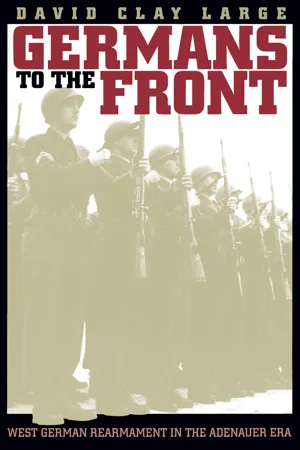
In Germans to the Front, David Large charts the path from Germany’s total demilitarization immediately after World War II to the appearance of the Bundeswehr, the West German army, in 1956. The book is the first comprehensive study in English of West German rearmament during this critical period. Large’s analysis of the complex interplay between the diplomatic and domestic facets of the rearmament debate illuminates key elements in the development of the Cold War and in Germany’s ongoing difficulty in formulating a role for itself on the international scene.
Rearmament severely tested West Germany’s new parliamentary institutions, dramatically defined emerging power relationships in German politics, and posed a crucial challenge for the NATO alliance. Although the establishment of the Bundeswehr ultimately helped stabilize the nation, the acrimony surrounding its formation generated deep divisions in German society that persisted long after the army took the field. According to Large, the conflict was so bitter because rearmament forced a confrontation with fundamental questions of national identity and demanded a painful reckoning with the past.
- 341 pages
- English
- ePUB (mobile friendly)
- Available on iOS & Android
eBook - ePub
About this book
Information
Part 1. The Rearmament Decision
Chapter 1. Germany Disarmed
Often during World War II, the leaders of the Big Three Allied powers—Winston Churchill, Franklin Roosevelt, and Josef Stalin—claimed that they had learned the lessons of World War I: this time, after defeating Germany, they would so thoroughly demilitarize the country that it would never again disturb the peace of the world. Once the postwar military occupation had begun, the Allied Control Council (ACC), in which France was also represented, began issuing directives designed to accomplish this goal. But though this policy seemed straightforward enough, it was understood in quite different ways by the conquering powers. The primary problem was that the disarmament effort had meaning only within a broader context of political and economic reorganization in which a welter of ambiguities produced extensive quarreling. Thus the business of disarming the Reich soon became enmeshed in the tangle of postwar disputes that eventually led to the bifurcation of Germany and Europe.
Another problem was that the victors, especially the Americans, tended to oversimplify the issues they were dealing with. They tended to see the German war machine as the culmination of three hundred years of Prusso-German military history. In this view, the Nazis were the heirs of a unilinear tradition beginning with the Great Elector in the mid-seventeenth century; Hitler’s attempt to conquer all of Europe was the “latest stage of Prussian militarism.”1 American policy makers believed that the only way to end this pattern of “militaristic aggression” was to insist upon a thorough “demilitarization of the German mind.” The notion that there was a militarized German mind was in itself dubious; and in any event the demilitarization project soon proved unworkable because of the complexity of historical legacies and contemporary challenges faced by the World War II victors in the postwar era.
WARTIME DISSONANCES
Intimations of future difficulties were evident in some of the earliest wartime pronouncements on German disarmament. Winston Churchill and Franklin Roosevelt could agree in the Atlantic Charter (14 August 1941) that “perennial disturbers of the peace” like Germany and Japan must be deprived of their capacity to wage future wars. But Josef Stalin, who was not a party to the charter, declared on 6 November 1942 that the Soviets did not envisage “any such endeavor as the destruction of all organized military power in Germany,” for that was “neither possible nor in the best interests of the victor.” Moscow’s only enemy was the “National Socialist system.”2
Stalin made this declaration to encourage aspirations for an armistice among his German adversaries at a time when the war was going badly for the Soviet Union. In January 1943, at the Casablanca Conference, Stalin joined the Western allies in calling for unconditional surrender, but a few months later Moscow established the National Committee for a Free Germany, composed of prominent German prisoners of war, to propagandize against Hitler and the German war effort. This initiative contradicted the declared policy of unconditional surrender because the committee’s leaders were promised that if Hitler were overthrown and the war terminated, Germany would be allowed to retain its borders of 1937.3 Here demilitarization was subordinated to the larger goals of foreign policy, as indeed it would often be in the future, and not only by the Soviets.
When the three Allied leaders gathered in Teheran in December 1943, they were again unanimous in their professed determination to demilitarize Germany, but they did not see eye to eye on the all-important question of economic disarmament. The statesmen agreed that Germany’s “war industry” must be destroyed and that it must pay reparations, but they had trouble defining these terms and establishing their scope. Stalin set the tone for future Soviet policy when he noted that furniture factories and clock works ought to be considered war industries because they could be converted into aircraft plants or bomb-fuse facilities. The Germans, he reminded his colleagues, were a “very talented people [who] could easily revive within fifteen or twenty years and again become a threat to the world” unless held firmly in check by their conquerors.4
With these innocuous-sounding phrases the Soviet leader was hinting at another crucial dimension of Moscow’s emerging demilitarization policy—the notion that removing Germany as a military threat would mean dramatically altering its socioeconomic structure, which was allegedly at the root of the militarist evil. More specifically, in the Soviet perspective demilitarization would soon come to mean “liquidation of the Junkers as a class” and the “destruction of German monopoly-capital.” Once these goals were accomplished, Germany could presumably be entrusted with military forces of some sort. Indeed, even before the war was over, Moscow was developing plans for a “people’s militia” in “liberated Germany.” Of course, Stalin could not discuss such notions with his wartime allies, but even his broad definition of war industry ran counter to the Western policy of that time, which said that defeated Germany should be allowed to maintain its “economic independence,” a goal hardly compatible with the destruction or confiscation of its entire industrial capacity.
The battles over disarmament policy advanced across the diplomatic landscape as the German armies retreated over the battered physical terrain of Europe. The British and American armies needed guidance on how to administer enemy territories once they had overrun them. They were given a directive by the Supreme Headquarters Allied Expeditionary Force (SHAEF), known as CCS 551, which urged the “normalization” of conditions so as not to impede the conduct of the war. Military administration was to be “as just and humane with respect to the civilian population … as [was] consistent with strict military requirements”; local agriculture and industry were to be kept functioning “to prevent a breakdown in the economy.”5 Surrendering soldiers might be herded into “internment areas,” rather than confined in prisoner of war camps, as was required by the Geneva Convention. Justifying this decision, the British and Americans insisted that adhering to the Geneva rules would have imposed an “unbearable” burden on their limited resources. Besides, they added, it was “politically out of the question to pamper Germans … when their victims, the liberated populations [of Europe], were in desperate want.”6
The Soviets, having agreed with their Western allies to sidestep the Geneva Convention, were nonetheless very suspicious of their partners’ tactics. They rejected the Anglo-American provisions for the German economy as too generous, while complaining that the Western treatment of German troops, far from pampering the enemy, was all too “tender to German fascism and militarism.”7 The West’s internment of German troops, though also practiced by the Red Army, awakened old Soviet fears that the British and Americans might make common cause with the Germans against the USSR. Certainly the comments of General George Patton, who favored “pushing on to Moscow,” and of Field Marshal Bernard Montgomery, who advocated the immediate establishment of a “flank facing east,” did much to exacerbate Soviet anxieties.8
The Soviets were not the only ones who were unhappy with Anglo-American occupation policy as expressed in CCS 551 or in SHAEF’s Occupation Handbook. Within the American camp, Secretary of the Treasury Henry Morgenthau was incensed over what he regarded as coddling of the enemy. He thought harsh control and economic deprivation were just what these people deserved. He favored summarily executing Nazi war criminals; dividing Germany into northern and southern states; and ceding the Saar to France, Silesia to Poland, and East Prussia to the Soviet Union. There was considerable irony in this territorial proposition, for if, as Morgenthau (like so many American policy makers) believed, “Prussia” was at the heart of German militarism, putting the core Prussian lands in the Soviet orbit was perhaps not the wisest idea. Equally bizarre was Morgenthau’s long-term solution to the problem of German aggression: the entire nation should be turned into a patchwork of small pastoral enclaves, like Denmark. “As a farmer myself,” he wrote, “I knew that people who lived close to the land tended to tranquil and peaceloving lives, [so] why not make Germany a nation predominantly of small farmers?”9
In mid-1944 Morgenthau presented his views to FDR, who was likewise convinced that the Germans were inherently aggressive. At a cabinet meeting the president expressed his displeasure with the “lack of severity” in the Occupation Handbook, arguing that a system of “army soup kitchens” would be adequate to sustain life for the German population. In a memorandum to Secretary of War Henry Stimson, he fumed that the handbook “gives me the impression that Germany is to be restored just as much as the Netherlands or Belgium, and the people of Germany brought back as quickly as possible to their pre-war estate. [But] it is of the utmost importance that every person in Germany should realize that this time Germany is a defeated nation.”10
FDR’s agreement with Morgenthau was evident also at the second Quebec Conference (September 1944), where the president proposed to Churchill that “we have to castrate the German people or … treat them in such a manner so they can’t just go on reproducing people who want to continue the way they have in the past.” 11 Against the advice of Stimson and Secretary of State Cordell Hull, FDR pressed for a disarmament program that included dismantling the industries of the Ruhr and the Saar.
Churchill had come to Quebec prepared to oppose this proposal. He had been advised by his Foreign Office that these measures would substantially complicate the occupation by producing economic chaos. The Allies, argued the Foreign Office, would be forced to support a starving population, and their attempts to establish a democratic government would be undermined—as the Weimar government had been undercut—by popular association with economic collapse and deprivation. Impressed by these arguments, Churchill argued vehemently against Morgenthau’s plan, declaring with characteristic pith that he did “not want to be chained to a dead German.” Within hours, however, he reversed his position, explaining that he now saw the American scheme as “beneficial” to Britain.12 Apparently he had been convinced by Morgenthau that British coal and steel production would substantially profit from the curtailment of German competition. Morgenthau had also proposed that Washington grant Britain financial credits totaling some $6.5 billion. As Cordell Hull quipped in his memoirs: “This might suggest to some the quid pro quo with which the Secretary of the Treasury was able to get Mr. Churchill’s adherence to his cataclysmic plan for Germany.”13
The result of Churchill’s volte-face was a communiqué from Quebec that sounded almost as harsh as the Morgenthau plan. The heavy industries in the Ruhr and Saar would be “put out of action and closed down.” The dismantling process would be conducted by “some body under the world organization [UN],” which would ensure that these industries “were not started up again by some subterfuge.” And finally, “This program for eliminating the war-making industries in the Ruhr and in the Saar is looking forward to converting Germany into a country primarily agricultural and pastoral in character.”14
Morgenthau’s influence reached its height in Quebec and declined rapidly thereafter. When FDR returned to Washington, Hull told him that Morgenthau’s plan was “out of all reason,” for it “would wipe out everything in Germany except land, and the Germans would have to live on the land.” Because “only sixty percent could support themselves” in this fashion, the other 40 percent “could die.” Unwilling, despite his anti-German sentiments, to risk this prospect, FDR rapidly disassociated himself from Morgenthau’s plan and put America’s entire German policy in limbo by declaring: “I dislike making detailed plans for a country which we do not yet occupy.”15 Yet concrete plans needed to be made, for Germany seemed about to collapse just as the Morgenthau plan was being debated in Washington and London. Thus the Departments of State, War, and the Treasury were instructed to work out updated arrangements for the administration of the German territories that the American military was scheduled to occupy.
The three departments held their deliberations in mid-September, when Morgenthau’s influence was still strong, and their new policy, code-named JCS 1067, reflected some of Morgenthau’s ideas. It declared flatly that Germany was to be treated as a “defeated” rather than as a “liberated” nation. To ensure that Germany would not again become a “threat to the peace of the world,” it proposed the “elimination of Nazism and militarism in any of their forms,” the “apprehension of war criminals,” and the “disarmament of Germany.” This last goal demanded the “elimination of the German Professional Officer Corps as an institution” and the arrest of all General Staff officers not already held as prisoners of war. Commanders were instructed to deny firearms “of any character” to all German nationals except members of native police forces that might be set up under military government authority.16
Ambitiously, JCS 1067 also demanded that the “spirit of militarism” be eradicated. To this end, all “archives, monuments, and museums of Nazi inception, or which [were] devoted to the perpetuation of German militarism,” were to be “seized, closed, and their properties held pending further instructions.” Steps were to be initiated to “prepare satisfactory textbooks and curricula and to obtain teaching personnel free of any taint of Nazism or militarism for secondary schools.” Commanders were to permit “no German parades, military or political, civilian or sports … no German military music, or German national or Nazi anthems.” And finally, in the much contested economic realm, commanders were to assume control of industrial facilities to ensure “the immediate cessation of the production, acquisition, or development of the implements of war.” Though goods and services necessary to prevent “disease and disorder” might be allowed, commanders were not to take any steps toward the “economic rehabilitation of Germany.”
What was striking about JCS 1067, aside from its overall severity, was its systematic coupling of Nazism and militarism. Ironically, in insisting upon this conflation, the Allies were echoing Nazi claims. National Socialist propaganda insisted that the...
Table of contents
- Cover Page
- Germans to the Front: West German Rearmament in the Adenauer Era
- Copyright Page
- Contents
- Acknowledgments
- Abbreviations
- Introduction
- Part 1. The Rearmament Decision
- Part 2. The European Defense Community
- Part 3. NATO and the Bundeswehr
- Conclusion
- Notes
- Index
Trusted by 375,005 students
Access to over 1.5 million titles for a fair monthly price.
Study more efficiently using our study tools.
Frequently asked questions
Yes, you can cancel anytime from the Subscription tab in your account settings on the Perlego website. Your subscription will stay active until the end of your current billing period. Learn how to cancel your subscription
No, books cannot be downloaded as external files, such as PDFs, for use outside of Perlego. However, you can download books within the Perlego app for offline reading on mobile or tablet. Learn how to download books offline
We are an online textbook subscription service, where you can get access to an entire online library for less than the price of a single book per month. With over 1.5 million books across 990+ topics, we’ve got you covered! Learn about our mission
Look out for the read-aloud symbol on your next book to see if you can listen to it. The read-aloud tool reads text aloud for you, highlighting the text as it is being read. You can pause it, speed it up and slow it down. Learn more about Read Aloud
Yes! You can use the Perlego app on both iOS and Android devices to read anytime, anywhere — even offline. Perfect for commutes or when you’re on the go.
Please note we cannot support devices running on iOS 13 and Android 7 or earlier. Learn more about using the app
Please note we cannot support devices running on iOS 13 and Android 7 or earlier. Learn more about using the app
Yes, you can access Germans to the Front by David Clay Large in PDF and/or ePUB format, as well as other popular books in History & German History. We have over 1.5 million books available in our catalogue for you to explore.