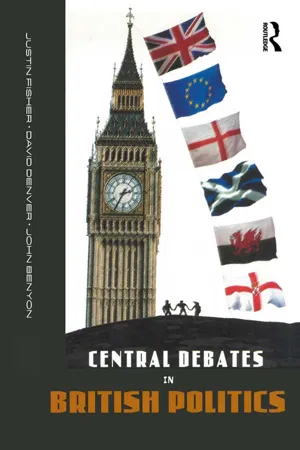
Central Debates in British Politics focuses on British politics in a changing social, economic and institutional context. The book explores issues and debates using a variety of approaches and techniques. It is written and edited by a team of leading experts who analyse key issues in a highly structured and thematic manner.
- 458 pages
- English
- ePUB (mobile friendly)
- Available on iOS & Android
eBook - ePub
Central Debates in British Politics
About this book
Information
PART ONE | Introduction: British Politics in Context |
The Contexts of British Politics
David Denver and Justin Fisher
CHAPTER ONE
Political activity does not take place in a vacuum. Politics is only one aspect of any society – albeit an important aspect – and is set within a broader context. Indeed, we have used the plural ‘contexts’ in the title of this chapter to emphasise that the background to politics includes a number of different elements. We can identify distinct historical, social, economic, international and cultural contexts, each of which impinge importantly on current British politics and the debates which form the substance of this book. As is made clear in the other introductory chapter, these debates also involve enduring theoretical and practical questions about politics, but the way in which contemporary political issues are framed, interpreted and assessed is in large part a consequence of recent changes in the contexts of politics. Moreover, as we shall see, the social, economic, international and cultural contexts have been characterised by very rapid change in recent years.
The International Context
All states are part of an international system in which they interact with other states. The interaction may involve conflict, bilateral or multilateral co-operation, or co-operation mediated through international organisations such as NATO or the European Union. There are also non-state actors at the international level, such as multinational corporations or international currency speculators, which states may seek to regulate. The position of the United Kingdom in this international system has changed dramatically over the last fifty years and this clearly impinges on domestic politics. Two salient features are worth picking out – Britain’s decline from world power and its increased involvement in Europe.
Decline from world power
At the end of the Second World War, Britain was one of three great powers in the world – the others being the United States and the Soviet Union. At the Potsdam conference in 1945 it was the British, American and Soviet leaders who determined the shape of the post-war world. In part, Britain’s status rested on the fact that it had a huge empire but the post-war period was to see the dissolution of the Empire. India, Ceylon and Burma gained independence in the 1940s and twenty other former colonies became independent states between 1950 and 1964. In some ways decolonisation was something of a triumph since, in most cases, the transition was orderly and peaceful. Nonetheless, it left the UK in a much weaker position in the world. Economic weakness also contributed to Britain’s decline. The Second World War had exhausted and impoverished the country and economic recovery was slow so that it was simply unable to afford to continue to play a world role. Overseas military bases were gradually closed as commitments were scaled down. For many people the Suez crisis in 1956 was the critical turning point, which made the country’s diminished status clear to all. The Egyptian leader, Nasser, had nationalised the Suez Canal and, perceiving this as a threat to British interests, the government sent troops to Egypt. The pound came under pressure, however, and, as a condition for supporting the pound, the United States forced Britain to withdraw its troops within a few weeks. This outcome came as a shock to British public opinion, which still thought of Britain as a major power. As Reynolds comments, ‘For an Egyptian ex-colonel to twist the lion’s tail, and get away with it, was a palpable and lasting blow to national self-esteem and international prestige’ (1991: 205).
Britain’s decline from world power after 1945 was spectacular (see Sanders, 1990) and since the 1970s the country has been – at best – a middle-ranking power. With the notable exception of the Falklands conflict, activity in the field of foreign affairs has not been unilateral but undertaken in co-operation with other states under the auspices of organisations such as the United Nations or NATO. Moreover, rather than having worldwide interests to defend and promote, the focus of external concerns is now mostly upon Europe.
Involvement in Europe
The UK finally joined what was then called the European Economic Community on 1 January 1973 and this action was ratified in a referendum two years later. Ever since, the question of ‘Europe’ has remained controversial and this is explored in Chapter 8 by Roger Scully. Despite the clear majority which voted for membership of the EEC in the referendum, Britain entered Europe rather unwillingly – entry was seen as a cure for Britain’s persistent economic weakness – and has since been aptly described as an ‘awkward partner’ (see George, 1994). Much of the debate over Britain’s position in Europe centres on the question of sovereignty. There are two slightly different strands involved. First, there is the idea that the UK is a sovereign state, which means that its people have the right to govern themselves and to follow whatever policies they choose without ‘interference’ from outside. Second, in the British constitutional tradition, within the UK itself Parliament is sovereign – it has ultimate authority to decide on any matter. In both cases membership of the EU appears to involve a loss of sovereignty to European-wide institutions and this underlies much of the hostility towards ‘Europe’ and to further European integration. Others argue, however, that the economic and other benefits of being in Europe outweigh any diminution in sovereignty and that Britain’s future outside the EU would be bleak. These issues have sharply divided the British public and also divided the major political parties over a long period and, if anything, divisions have sharpened over the whether the UK should join the European single currency, which is likely to be the subject of a referendum within the next few years. The outcome of such a referendum is far from certain, but what is clear is that it is now impossible to ignore the European dimension in British politics. In a whole series of areas – from the retiring age for women to the measures in which spirits are sold and the abolition of duty free allowances for travellers within the Ell – Britain has had to fall in line with decisions emanating from the institutions of the European Union.
The Social Context
There is an intimate relation between what might be characterised as the ‘social’ and the ‘political’. To use slightly old-fashioned terminology, the social context of politics strongly influences both the inputs and the outputs of the political system. That is to say, the kinds of demand that are made, and the issues that are raised, frequently reflect social changes and policies are produced in response to such demands. For exam ple, in the immediate post-1945 period, the population of the UK was overwhelmingly white. From the late 1950s, however, immigration from former colonies resulted in the establishment of significant ethnic minority communities. By the 1990s members of ethnic minorities accounted for about 6% of the population, heavily concentrated in particular locations such as London, and Leicester, and the proportion was increasing. This change in the ethnic make-up of the population provoked a variety of demands – for more control of immigration, for legislation to protect the rights of ethnic minority residents, and so on. As a result, there has been a series of immigration acts, a raft of ‘race-related legislation has been passed and specialist agencies such as the Commission for Racial Equality established. In addition, the political parties have been forced to find ways of appealing to ethnic minorities (see Saggar, 2000).
Clearly there have been other changes in British society which have influenced politics in important ways and continue to do so. It is impossible to discuss these in any detail here. However, we can sketch some of the more obvious changes, but readers will be able to think of others and how they impact on both the input and output side of the political system.
The growth in the number of older people
People live longer than they used to. In 1960 those aged 65 and over constituted 11.7% of the population. By 1997 the figure was 15.7% (Office for National Statistics, 1999: 38). This simple demographic fact has major implications for politics. First, there are more pensioners whose concerns political parties must address. In this respect it is significant that in the aftermath of the 2000 local elections, although it had helped poorer pensioners in other ways, the government’s bad performance was widely attributed to the fact that it had increased the basic state pension by only 75p. Perhaps more important in the long run is the cost imposed on the social security budget by an ageing population. Not only do older people have to have pensions, they also place extra demands on the National Health Service. Someone has to pay for this and it has to be through taxes paid by the shrinking population of working age. The difficulty is that the parties see increasing taxation as a sure vote loser.
Changing patterns of family life
To a large extent society is organised around what is frequently termed the ‘traditional’ family – two married parents with children. This is still the most common form of family arrangement but things have become more complex. Marriage itself has declined – the number of first marriages in 1996 was less than half what it had been in 1970 – and divorce has increased sharply (Office for National Statistics, 2000: 37). The proportion of births outside marriage rose from less than 10% in 1974 to almost 40% in 1997 (Office for National Statistics, 2000: 43). Between 1961 and 1998/99 the proportion of households comprising a couple (whether married or not) with children fell from 48% to 29% while single-person households rose from 11% to 29% (Office for National Statistics, 2000: 34). Some have suggested that there has been breakdown in traditional family life and that this is to blame for increased lawlessness on the part of young people and various other social ills. Whether or not this contentious suggestion has any basis, it is certainly the case that governments have to plan to provide housing for more single-person households and support for lone-parent families.
The decline of the working class
If by ‘middle class’ we mean people who have a non-manual occupation, then Britain became a middle-class society in 1981. The Census of that year found, for the first time ever, that among males in employment manual workers were in a minority. That minority has shrunk ever since. By the late 1990s the manual working class constituted less than one-third of the population. This had important consequences for the Labour Party in particular. For much of its life Labour had been the party of the working class. Now Labour could not win elections with the support of the working class alone, in response, although there were other factors in this, Labour in the 1990s under Tony Blair becain ‘New Labuui’ , a party for all classes.
The changing position of women
For a variety of reasons the position of women in British society has changed substantially over the past twenty years. Women now form more than half of the workforce and they constituted a record 18% of MPs after both the 1997 and 2001 elections. The aspirations of women have been recognised in equal pay legislation and other policies outlawing sex discrimination. More generally, greater ‘gender awareness’, produced in no small part by the efforts of women themselves, is evident in many ways – in how political parties choose candidates, in ‘equal opportunities’ policies relating to making all sorts of appointments, in the media, and so on.
As noted above, there have been numerous other important changes in British society over the past twenty years or so which have important implications for politics and policy – the explosion in university education, the decline of religious practice (if not of belief), the emergence of satellite and cable television are three that spring to mind. We have done enough, however, to show that we live in a rapidly changing society and that this conditions the agenda of politics as well as political behaviour in all its forms.
The Economic Context
Politics and economics are intimately interconnected. Getting the economy right is one of the first aims of governments since so much else depends on economic success. It is widely believed, moreover, that governments which succeed in making the economy buoyant will be rewarded by the voters at the polls. There are numerous accounts of the management of the British economy and of economic performance (see, for example, Gamble, 1994a), but for students of politics there are three salient issues – relative economic decline, the changing structure of the economy and economic globalisation.
Relative economic decline
For most of the twentieth century, and certainly since 1945, the British economy has been in relative decline. This should not be confused with an absolute decline, of course. At the start of the twenty-first century the Gross Domestic Product (GDP) was much greater than it had been even thirty years before. British citizens enjoyed a much higher standard of living than their forebears. In absolute terms, the UK had enjoyed almost continuous economic growth. When compared to other countries, however, Britain was falling behind and steadily slipping down the economic league. As Jim Tomlinson shows in this book (Chapter 17), at various times there were severe problems relating to inflation, unemployment and the balance of payments.
As already noted, relatively poor economic performance was one of the main reasons why governments sought to join the European Union and it was also the backdrop to a steady scaling-down of defence commitments. The country could no longer afford to maintain military bases in far-flung corners of the world. Moreover, lacking steady growth on a par with that achieved by our competitors, UK governments were unable to fulfil their policy aspirations in other areas. Persistent failure led in the mid-1970s to the abandonment of Keynesian policies, which had dominated economic thinking for thirty years and which involved government management of the economy, and, especially after 1979, the espousal of monetarist policies, which involve greater reliance on market forces. As part of this new approach many formerly publicly-owned industries were privatised while other old industries (such as coal) were allowed to go to the wall. Opinion remains divided as to whether these policies produced an ‘economic miracle’ and also whether Labour’s famously ‘prudnt’ handling of the economy produced a lasting turnaround in economic fortunes Nonetheless, there is no doubt that ‘the economy’ remains a central issue – perhaps the central issue – in British politics.
The structure of the economy
One aspect of the changing structure of the economy has already been touched on – the division between the private and the public sector. The list of industries that have been privatised in the last twenty years is a long one, including essential services such as telecommunications, gas, electricity, water and railways. Despite a feeling that there was nothing left worth privatising and clear public hostility to the policy, the Labour government elected in 1997 pushed on with plans to part- privatise the London Underground and the air traffic control system. The area of the economy in which government has a direct stake and ultimately responsibility has, the...
Table of contents
- Cover
- Half Title
- Title Page
- Copyright Page
- Table of Contents
- Preface
- Contributors
- Acknowledgements
- Part One: Introduction British Politics in Context
- Part Two: Constitutional Issues
- Part Three: Representation
- Part Four: Executives and Governance
- Part Five: Policy
- Part Six: Regulation
- Index
Trusted by 375,005 students
Access to over 1.5 million titles for a fair monthly price.
Study more efficiently using our study tools.
Frequently asked questions
Yes, you can cancel anytime from the Subscription tab in your account settings on the Perlego website. Your subscription will stay active until the end of your current billing period. Learn how to cancel your subscription
No, books cannot be downloaded as external files, such as PDFs, for use outside of Perlego. However, you can download books within the Perlego app for offline reading on mobile or tablet. Learn how to download books offline
Perlego offers two plans: Essential and Complete
- Essential is ideal for learners and professionals who enjoy exploring a wide range of subjects. Access the Essential Library with 800,000+ trusted titles and best-sellers across business, personal growth, and the humanities. Includes unlimited reading time and Standard Read Aloud voice.
- Complete: Perfect for advanced learners and researchers needing full, unrestricted access. Unlock 1.5M+ books across hundreds of subjects, including academic and specialized titles. The Complete Plan also includes advanced features like Premium Read Aloud and Research Assistant.
We are an online textbook subscription service, where you can get access to an entire online library for less than the price of a single book per month. With over 1.5 million books across 990+ topics, we’ve got you covered! Learn about our mission
Look out for the read-aloud symbol on your next book to see if you can listen to it. The read-aloud tool reads text aloud for you, highlighting the text as it is being read. You can pause it, speed it up and slow it down. Learn more about Read Aloud
Yes! You can use the Perlego app on both iOS and Android devices to read anytime, anywhere — even offline. Perfect for commutes or when you’re on the go.
Please note we cannot support devices running on iOS 13 and Android 7 or earlier. Learn more about using the app
Please note we cannot support devices running on iOS 13 and Android 7 or earlier. Learn more about using the app
Yes, you can access Central Debates in British Politics by John Benyon,David Denver,Justin Fisher in PDF and/or ePUB format, as well as other popular books in Politics & International Relations & Constitutions. We have over 1.5 million books available in our catalogue for you to explore.