The work of Stanley Cohen over four decades has come to acquire a classical status in the fields of criminology, sociology and human rights. His writing, research, teaching and practical engagement in these fields have been at once rigorously analytical and intellectually inspiring. It amounts to a unique contribution, immensely varied yet with several unifying themes, and it has made, and continues to make, a lasting impact around the world. His work thus has a protean character and scope which transcend time and place.
This book of essays in Stanley Cohen's honour aims to build on and reflect some of his many-sided contributions. It contains chapters by some of the world's leading thinkers as well as the rising generation of scholars and practitioners whose approach has been shaped in significant respects by his own.
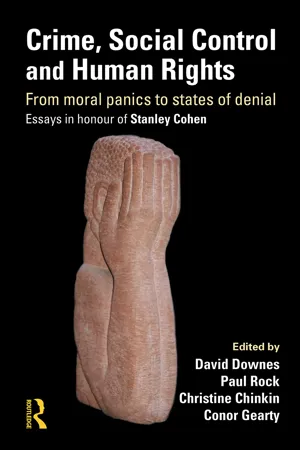
eBook - ePub
Crime, Social Control and Human Rights
From Moral Panics to States of Denial, Essays in Honour of Stanley Cohen
- 472 pages
- English
- ePUB (mobile friendly)
- Available on iOS & Android
eBook - ePub
Crime, Social Control and Human Rights
From Moral Panics to States of Denial, Essays in Honour of Stanley Cohen
About this book
Information
Seminal Influences
Chapter 1
Growing up with Stan
Stan and I have been friends almost forever. I actually attended the same kindergarten as Ruth, Stan’s future wife, but (as far as I remember) Stan and I first came together at Saxonwold Primary School in Johannesburg, at the age of 5, going on 6. Together we went on to Parktown High School for Boys, on the edge of the ridge, opposite the University of the Witwatersrand. In 1959 we crossed the road to the University. And shortly after graduation we both went to Britain for postgraduate studies in the social sciences.
In the first half of 2006, Stan and I recorded four conversations about those years. We agreed that our experience of growing up in South Africa in the 1950s and early 1960s shaped us as social scientists, but we were uncertain about quite how that happened, or what had been the decisive forces that propelled us along similar paths.
Our one real disagreement, however, has to do with the question of agency. I tend to ask what made us choose one path rather than another. As we reminisced, I was haunted by Robert Frost’s poem:
I shall be telling this with a sigh
Somewhere ages and ages hence:
Two roads diverged in a wood, and I –
I took the one less traveled by,
And that has made all the difference.
‘You’re interested in why things happen,’ Stan said to me at one point in our conversations. ‘I’m interested in why people say things happen.’ He is unconcerned about the road not taken. Indeed, he resists the idea that choices were made. He prefers the image of someone drifting along a stream, taken-for-granted habits and ideas propelling him more or less gently between the banks. He believes that we exercise little independent volition, however much we may go in for rationalisation.
Growing up together, we assumed that we were exactly the same sort of people, but as we talked these past few months it became apparent that our family backgrounds were different in some crucial ways – crucial, certainly, had we been British boys of the same generation.
Stan’s mother was the youngest – and the only South African-born – daughter of Polish-Jewish immigrants, who lived in a rural area of the Cape. She was the only member of the family to get a high-school education. And she went on to university. Stan’s father came to South Africa from Lithuania as a young man, together with four brothers and one sister. He started off as a trader in rural Zululand and learnt to read English, but not to write it. All Stan’s parents’ friends were small businessmen, most of them immigrants. Stan says he used to think the only difference between people was that some were in retail and others in wholesale.
My father’s grandfather had come to South Africa from Lithuania in the 1880s, accompanied by six brothers and a sister. My grandfather was sufficiently integrated to have been arrested by the British as a spy during the Boer War and imprisoned in St Helena. My parents, all my uncles, several of my aunts and all my parents’ friends were professionals or big businessmen. All the men and most of the women were graduates of the University of the Witwatersrand.
We were, I think, unaware of these differences – certainly unconcerned by them – and in fact they were insignificant as compared with our common experiences. We were both shaped from the start by the Judaism that enveloped us as children, by the Zionism of our adolescence, and then by our exhilarating, liberating student days at the University of the Witwatersrand during the revolutionary years in which the apartheid system was elaborated and the opposition began to crystallise.
South African society was organised above all by race, but the whites themselves were firmly divided into ethnic communities. The Jews were culturally assimilated to the Anglos, but they remained socially remarkably self-contained, even in their professional lives. Intermarriage was rare. Our own school friends were almost entirely Jewish boys. We were not much interested in the lives of other communities, let alone the wider world.
But if the Jewish world of our childhood was cohesive and absorbing, it is not easy to define the character of its Jewishness. Religion was not a matter of faith. None of us, indeed nobody in our parents’ circles, was a true believer. We had to go to synagogue on Saturdays and holidays, and we studied Hebrew. But we travelled to synagogue by car. On Saturday afternoon my father drove off for his tennis game. The kitchens were kosher, but Stan’s family had a special plate and knife for biltong, which could not be made from kosher beef. Stan’s father’s message to his sons was that he kept up the forms out of loyalty. In the wake of the Holocaust he could not allow himself to be the one to end the line of tradition. My father was also motivated mainly by a concern for solidarity, although he thought that we might be glad one day to have a religion to fall back on. My mother barely pretended to care about religion or ritual. Anyone who showed signs of religious enthusiasm was regarded by us, and by our parents, as meshugah (crazy).
The bedrock belief was that Jews should stick together. Zionism, which I suspect was largely a projection of the position of Jews in South Africa onto the wider world, was the one unchallenged idea, although there were terrific quarrels between Zionists of different camps. As adolescents, Stan and I belonged to Zionist youth movements – his, by chance, socialist; mine (my father’s choice) not. A big attraction was that there were girls. Our parents and theirs approved. Indeed, it was taken for granted that we would eventually marry one of those girls, and most us did, as soon as we could.
University was the great break. Not because, like young Britons and Americans, we now left home for the first time. In fact, when we went to the University, at the age of 16 going on 17, we lived with our parents. But when we travelled up the hill to the University of the Witwatersrand we entered a different world. We were enchanted by our studies: history and anthropology in my case; the applied social sciences in Stan’s. They helped us to understand the society that engrossed us, South Africa. And when we got there, Wits was still, just, racially integrated. Our fellow students included Africans and Indians, who took our broader education in hand. Essop Pahad, a common friend, is now Thabo Mbeki’s right-hand man. Stan’s best friend in his socialwork class – one of the most significant friends of his student days – was Zanele Dlamini, who later married Thabo Mbeki. His friendship with Zanele was based on the fact that he was the only man in the class and she was the only black.
These were fraught times. Our years at Wits coincided with the first great crisis of the apartheid system, marked by the campaign against passbooks, Sharpeville, and the State of Emergency. We talked politics obsessively, began to find our place in the spectrum of opposition movements, marched in protest to Johannesburg Fort, in which several Witsies were among those imprisoned without trial during the Emergency, and which was conveniently just up the road from the campus.
There was never the slightest question that I was headed for one of the professions, although there was some anxiety that I might end up as an academic like my father’s brother and his wife, and some of his less satisfactory cousins. Stan’s parents accepted that he was a luftmensch, obviously not cut out for business. His decision to train as a social worker was regarded as eccentric, but his father would later be impressed when Stan and his younger brother Robin found steady jobs that required them to go to work only irregularly, and then dressed in jeans and tee-shirts.
As soon as we graduated from Wits, we left the country. Was this the one great choice we made? Stan sees it as a product of taken-for-granted assumptions. Staying in South Africa was not an option as far back as we could remember, although different reasons for emigration would be articulated, at the time and afterwards, ranging from pessimism about the political future to a desire to escape from our provincial world. In any case, most of our friends also went abroad, to study in Britain or, in a few cases, to settle in Israel.
Stan went to the LSE and he was to be marked – I think indelibly – by those radical years, although he never became a sectarian. I was committed to Africa, became an anthropologist, and spent the years from 1964 to 1970 largely in Botswana and Uganda. I missed the 1960s. Our fields of research were also very different. Yet I agree with Stan that we became social scientists of a rather peculiar type as a result of growing up as we did, when we did, in South Africa. Stan says that the issues which are so much part of him, problems of identity and marginality, deviance and conformity, resistance and injustice, all are rooted, for him, in his South African background. Perhaps one can be even more specific. ‘My identity as a South African Jew is my primary identity,’ Stan told me. ‘If it is my primary identity, then it must, somehow, have influenced my choice of subjects and the way I did things.’
On the rest – our lives as grown-ups – I have only this to add. Neither of us became rooted in Britain, and we each spent many years in midcareer abroad, Stan in Israel, I in the Netherlands. We eventually drifted back, ending up, together again, in North London, sometimes dreaming that we might one day be able to go home, if only for an extended visit. To this day, we think of ourselves as South Africans. We both fail the cricket test.
Chapter 2
The art of exile: A study of Alexander Herzen
In the early spring of 1848, it seemed to Parisians like ‘Daniel Stern’ (the nom de plume of Marie d’Agoult, Franz Liszt’s one-time companion, whose chronicles of 1848 are a vivid record of the upheaval) that the ‘foreign colony will empty in a few days, as our friends return to the places which call them.’1 Given the nationalisms being trumpeted in the press, her expectation seems logical. The political question this nationalism posed to all those who had become foreigners – émigrés, expatriates, or exiles – is, why aren’t you home among your own kind? How, indeed, could you be Russian, somewhere else? Yet, by late April of 1848, Daniel Stern had noted that, oddly, few of the émigrés had left for home. ‘They are still to be found arguing in the Palais Royal, receiving emissaries from abroad, hectoring; they are full of hope, but no one has packed his bags.’2
Perhaps the greatest of nineteenth-century exiles was a man who would make but a brief appearance on this scene yet, from observing it, would capture in indelible prose the cursed relation between nationalism and the condition of being a foreigner. Alexander Herzen was the illegitimate son of an ageing Russian nobleman and a young German woman (hence his name, which is roughly equivalent to ‘of my heart’ [herzlich]). Inspired by the uprising of 1825, he was, as a young man, active in radical Russian politics as these politics were then understood; that is, he was a proponent of constitutional monarchy and liberal reforms. For this, he suffered internal exile and eventually expulsion from the Russian Empire. Like others of his generation, he thought of himself at first as in temporary exile, expecting to return to his native land when political circumstances made it possible. But when, at last, this possibility arose, he held back. It was not social assimilation, or love for European culture, or personal ties, like those of his friend Turgenev to Pauline Viardot, that kept him from returning. He remained passionately interested in the affairs of his country but felt no longer able to live in it. He perambulated the capitals of Western Europe, passing his later years in London, where he published a famous newsletter about Russian realities called The Bell.
There is a certain kind of social thinking, falsely humane, which posits an inverse relation between consciousness and circumstance. In this kind of thinking, the sufferings of the poor make them intellectual victims of their necessities; poor thought is the sheer calculation of survival. The niceties of consciousness, the complexities of interpretation, are seen as luxuries of the affluent. In this way of thinking, the bastard son of an aristocrat can be no guide to the dilemmas faced by the wave upon wave of emigrants who would quit Europe in the nineteenth century, much less a guide for the conundrums faced by Mexican day workers, Korean grocers, Soviet Jews, or other foreigners today. Herzen, the friend of John Stuart Mill, diffident with the diffidence bred of attending many formal occasions, Herzen so curious about the places in which, yet, he knew he did not belong, Herzen enters the story we have to tell in April of 1848. It was at this moment of delay that Herzen joined the exile colony in Paris; he did so to move away from Rome, which was in its own first moments of nationalist awakening.
It must not be thought that Herzen or the other Parisian émigrés who did not immediately respond to the call of their own nation were cowards; the lives of many émigrés read as a long series of prior imprisonment and torture, particularly at the hands of the Austrian police. In part, the answer to their immobility was to be found in a familiar cruelty, that of events passing them by. Their web of mutual contacts abroad was outdated, just as their political plans for constitutions and government agencies had no place in the new rhetoric of the people. But more than this, as Daniel Stern noted, something had happened to the foreigners themselves in exile. ‘It is as though they have looked in the mirror and seen another face than the one they thought they would see,’ she wrote.3 It puzzled the émigrés, as well as her: something in them resisted returning; something held them back.
It was exactly this connection that Herzen would, in the course of his life, take up, seeking to understand how nationalism had forced people to look in something like Manet’s mirror to find a liveable, humane image of themselves. Ritual, belief, habit, and the signs of language would appear far different in this displacing mirror than at home. The foreigner might indeed have a more intelligent, more humane relation to his or her culture than the person who has never moved, who knows nothing but that which is, who has not been obliged to ponder the differences of one culture from another. But that is not the pressing business of becoming a foreigner. It is rather that one has, with one’s own displaced condition, to deal creatively with the materials of identity the way an artist has to deal with the dumb facts which are things to be painted. One has to make oneself.
This was, at least, the possibility that Herzen sensed, reading newspaper accounts of a wave of violence in Slovakia directed against the Gypsies who had poured into the country, the Gypsies believing in 1848, as in 1990, that a nation which rises against its masters might promise them freedom as well; Herzen sipping wine in the Café Lamblin which even a century and a half later serves that beverage in the adulterated form which disgusted him; Herzen’s companions plotting, telegraphing, arguing, and remaining; Herzen leading a foreign contingent in a march on the National Assembly, in support of the ‘rights of man’. They would have to find a new way to be Russian.
On 27 June 1848, the revolution came to an end in Paris. Troops swept through the city indiscriminately shooting into crowds, deploying cannon in random barrages into working-class neighbourhoods; the forces of order had arrived. Herzen, like the other foreigners who had remained in Paris of their own free will, was now forced to leave; he went to Geneva, then back to Italy, and then back to France, arriving finally in London in August of 1852, an ailing, middle-aged man whose wife was erotically engaged elsewhere; who had set himself publicly against the Slavophiles dominating radical discourse in his homeland; and who spoke English haltingly in the manner of novels he had read by Sir Walter Scott. ‘[L]ittle by little I began to perceive that I had absolutely nowhere to go and no reason to go anywhere.’4 It is not inflating his suffering to say that at this moment Herzen became something like a tragic figure, a man who felt the second scar of homelessness which will not heal.
What is instructive about Herzen’s writings is the sense he comes to make about how to conduct daily life in such a condition, how to make sense of being a foreigner. ‘By degrees, a revolution took place within me.’ In part, he began to make a virtue of his very isolation in exile: ‘I was conscious of power in myself…. I grew more independent of everyone.’5 And so he began to reconstruct how he saw...
Table of contents
- Cover Page
- Half Title page
- Title Page
- Copyright Page
- Contents
- Dedication
- Notes on editors and contributors
- Foreword
- Introduction: The Editors
- Part 1 Seminal Influences
- Part 2 Gradations of Social Control: From Moral Panics to Long-term Imprisonment
- Part 3 Extremities of Control: Torture and the Death Penalty
- Part 4 Visions of Social Control
- Part 5 The Theory and Practice of Denial
- Part 6 Ways Ahead
- Name Index
- Subject Index
Trusted by 375,005 students
Access to over 1.5 million titles for a fair monthly price.
Study more efficiently using our study tools.
Frequently asked questions
Yes, you can cancel anytime from the Subscription tab in your account settings on the Perlego website. Your subscription will stay active until the end of your current billing period. Learn how to cancel your subscription
No, books cannot be downloaded as external files, such as PDFs, for use outside of Perlego. However, you can download books within the Perlego app for offline reading on mobile or tablet. Learn how to download books offline
Perlego offers two plans: Essential and Complete
- Essential is ideal for learners and professionals who enjoy exploring a wide range of subjects. Access the Essential Library with 800,000+ trusted titles and best-sellers across business, personal growth, and the humanities. Includes unlimited reading time and Standard Read Aloud voice.
- Complete: Perfect for advanced learners and researchers needing full, unrestricted access. Unlock 1.5M+ books across hundreds of subjects, including academic and specialized titles. The Complete Plan also includes advanced features like Premium Read Aloud and Research Assistant.
We are an online textbook subscription service, where you can get access to an entire online library for less than the price of a single book per month. With over 1.5 million books across 990+ topics, we’ve got you covered! Learn about our mission
Look out for the read-aloud symbol on your next book to see if you can listen to it. The read-aloud tool reads text aloud for you, highlighting the text as it is being read. You can pause it, speed it up and slow it down. Learn more about Read Aloud
Yes! You can use the Perlego app on both iOS and Android devices to read anytime, anywhere — even offline. Perfect for commutes or when you’re on the go.
Please note we cannot support devices running on iOS 13 and Android 7 or earlier. Learn more about using the app
Please note we cannot support devices running on iOS 13 and Android 7 or earlier. Learn more about using the app
Yes, you can access Crime, Social Control and Human Rights by David Downes, Paul Rock, Christine Chinkin, Conor Gearty, David Downes,Paul Rock,Christine Chinkin,Conor Gearty in PDF and/or ePUB format, as well as other popular books in Ciencias sociales & Derechos humanos. We have over 1.5 million books available in our catalogue for you to explore.