Advertising Theory provides detailed and current explorations of key theories in the advertising discipline. The volume gives a working knowledge of the primary theoretical approaches of advertising, offering a comprehensive synthesis of the vast literature in the area. Editors Shelly Rodgers and Esther Thorson have developed this volume as a forum in which to compare, contrast, and evaluate advertising theories in a comprehensive and structured presentation. With new chapters on forms of advertising, theories, and concepts, and an emphasis on the role of new technology, this new edition is uniquely positioned to provide detailed overviews of advertising theory.
Utilizing McGuire's persuasion matrix as the structural model for each chapter, the text offers a wider lens through which to view the phenomenon of advertising as it operates within various environments. Within each area of advertising theory—and across advertising contexts—both traditional and non-traditional approaches are addressed, including electronic word-of-mouth advertising, user-generated advertising, and social media advertising contexts.
This new edition includes a balance of theory and practice that will help provide a working knowledge of the primary theoretical approaches and will help readers synthesize the vast literature on advertising with the in-depth understanding of practical case studies and examples within every chapter. It also looks at mobile advertising in a broader context beyond the classroom and explores new areas such as native advertising, political advertising, mobile advertising, and digital video gaming.
Perspectives on Advertising and Advertising Theories
Chapter 1
Advertising Theory in the Digital Age
Esther Thorson and Shelly Rodgers
As we designed the second edition of this book, we had to revisit questions we considered in creating the first edition—mainly, what “theories” are and, of course, what “advertising” is. The greatest change from the first edition comes from the impact of the digital revolution on the field of advertising, more specifically on how advertising is moving toward redefinition. As we will argue below, advertising remains a unique phenomenon, but its definition is now much broader. We see traditional theories (e.g., Elaboration Likelihood Model, Persuasion Knowledge Model, Modality-Agency-Interactivity-Navigability (MAIN) Model, and Theory of Planned Behavior) that have been applied to understanding advertising changing as they are applied to advertising in digital realms like social media, the internet, and apps. The reader will see many examples of how advertising is being understood in the digital environment in the book chapters. As in the first edition, we asked contributing scholars to explore how their approaches relate to the broader picture of advertising as a scholarly research field. The result is a book that can help those just starting to understand advertising in all its many facets, as well as providing a refresher course for scholars who face the challenge of incorporating all the changes occurring in advertising into their own teaching and scholarship.
The world of technology has changed so drastically since the 2012 edition of this book that the fundamental definition of advertising itself has changed. In that edition, we defined advertising as paid messages from an identified sponsor using mass media to persuade an audience (Rodgers & Thorson, 2012). The “paid” in this definition meant that advertisers under most circumstances needed to pay to appear in content-providing media (e.g., in television news or entertainment programming, newspapers or magazines, or radio programming). This meant that advertising reached audiences that were attracted by media content, not the advertising embedded in it, although there were exceptions (e.g., fashion magazines) where the advertising also provides desired content. Advertisers had to pay the content providers to include their advertising, and, of course, it was those revenues that provided most of the financial support for traditional news organizations (e.g., newspapers, networks, and local television news), as well as a lot of support for development of entertainment programming. But as digital communication systems made possible by the internet (e.g., interactive websites, and social media like Facebook, Twitter, or Instagram) and new devices (e.g., mobile smartphones, netbooks, smartwatches) developed, dependence on content media as a channel for advertising distribution plummeted. In its place, “owned” media became increasingly important, meaning media the advertisers themselves controlled, like their social media pages, websites, blogs, and apps. For these, advertisers had to rely on development of their own audiences to replace audiences attracted to content media. Also, “earned” media became important, that is, the content people contributed about the advertiser’s brand or messaging such as sharing it with others, commenting on it, or “liking” it. The net result of these changes is that advertising no longer requires “paid” media in its definition.
Second, “identified sponsor” became unnecessary as an attribute of advertising’s definition because of the same kinds of technology changes in systems and devices. For example, you might receive information about a brand shared with you or commented on by a friend. You might hear about a brand from a favorite celebrity or product expert, who was actually, unbeknownst to you, being paid by the brand. Or others might simply create their own “ads” about a brand, messages that are referred to as “user-generated advertising.” This means that, frequently, people are receiving “advertising” but in such a way that they cannot discern the sponsor.
Third, mass media became inappropriate as a necessary attribute of advertising. Mass media refers to individual media that are delivered in a uniform way to many audience members (a one-to-many diffusion). But technology made it possible to customize messages to individuals based on demographics like age or education, by where people were located at the moment, or by complex algorithms of information about their past behavior (what they searched for online, where they had just travelled, or what they had just bought). Thus, advertising messages are often highly individualized (essentially one-to-one diffusion) rather than mass distributed.
The upshot of these changes is that what is left of the original definition is just two necessary attributes: a message from an advertiser, and the intention to persuade (e.g., see Dahlén & Rosengren, 2016). This simplified definition of advertising also meant that many more routes and patterns of advertising message delivery were now a part of “advertising.”
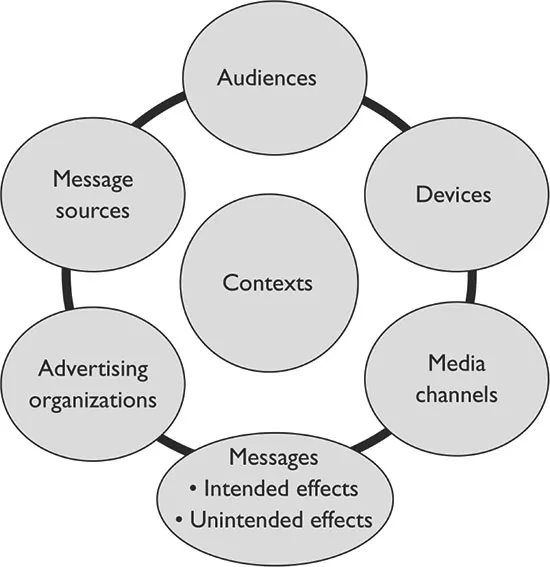
Although the attributes necessary for defining advertising have been trimmed, and as a result many more messages are now included in the definition, there is nevertheless a cohesive set of processes related to advertising that encompass most, if not all, of the work from researchers like those represented in this volume. Figure 1.1 shows a chart of aspects of many occurrences that have been studied within the domain of “advertising.” Table 1.1 provides examples of categories of each of these occurrences. These aspects occur in the theoretical approaches to understanding advertising that are represented here, and thus, Figure 1.1 provides a way of organizing these theories and their supportive research. Audiences are the intended and actual receivers of advertising messages. Receivers vary in terms of who they are, demographically speaking, what groups they belong to, as in differing market “segments,” what media and devices they use, and so on. Audiences can be described in many different ways, including, for example, their demographics, their psychographics (a combination of personality/social features with demographics), the type of media they most depend on (e.g., legacy media like television and newspapers versus digital media like computers and mobile phones), and the level of activity they exhibit on social media like Facebook or Instagram.
As we have seen, advertising messages can come from different sources; for example, directly from advertisers, or from a variety of other people who also deliver “advertising” to us, including, for example, user-generated ads or viral ads. However, in most cases, people see messages and perceive there is a source responsible for them. Controversy arises when advertising appears in a genre that makes it look like it is not advertising. A good example of this kind of advertising is native advertising (see Chapter 16), where ads are written and formatted to look just the same as the editorial content in which they appear, reducing the likelihood that people will identify advertiser sponsorship.
Figure 1.1 Components of the Advertising Process Circle.
Table 1.1 Examples of Components of the Advertising Process Circle
Contexts
Historical
Business
Ethical
Legal
Advertising Organizations
Advertising agencies
Corporations
Regulatory organizations
Self-regulatory organizations
Professional or scholarly associations (ARF, AAA)
Message Sources
Corporations
Politicians
Celebrities
Spokespersons
Ordinary citizens
Messages
Content
Features like print, video, audio, still images
Appeals
Types
Brand
Product
Corporate
Public service announcement
Political
Issue
Health
Channels
Newspapers
Magazines
Radio
Television
Internet
Social media
Search
Devices
Smartphone
e-Reader
Netbook
Laptop
Desktop
Audiences or Message Receivers
Demographic features of consumers (age, education, race)
Segments (bird watchers, fashionistas)
Children
Various cultures or geographies (international)
There are also different media channels, although these, as we have seen, are no longer limited to traditional content channels like television, radio, or print media. These channels now also include websites, blogs, social media, mobile apps, and many others. Some of the complexity of channels we overlook; for example, the content of your television may come from your phone line, a cable, or a satellite. But to you the viewer, it’s “television,” so we consider it a channel. But watching a movie on your iPhone or your iPad, or your television, are different experiences because now the devices are different. “Devices” are the noticeably different instruments that are used for mass communication. They include, for example, e-Readers, notebooks, laptops, and smartphones. Whether mobile, social, or local, digital devices are more important than ever to advertisers too.
The features of channels and devices differ significantly, and more importantly there is clear evidence that these features carry meaning. For example, a 360-degree view of a product may provide an experience closer to that of retail shopping, which in turn may increase the likelihood of purchase (see especially the MAIN Model in Chapter 5). Further, the devices you use to access a movie may involve different activities. You have to drive to a movie theatre and pay the price of a ticket. But you can stream that same movie into your home, enjoying it in your living room and paying little or nothing to access it. As advertising theory develops, distinguishing between channels and devices for advertising delivery continues to grow in importance.
We also argue that the internet has allowed the development of new media systems, which are best represented by social networking sites (e.g., Facebook, Twitter) and instant messaging applications (WhatsApp). Facebook is a system where people and organizations can share posts, photos, and videos with each other. They can also respond to each other’s posts by sharing, liking, and commenting. Twitter is a microblogging system more like a news organization where people can also interact with each other by retweeting, commenting, and using hashtags, but are limited to 280 characters. Pinterest allows people to post photos they like, organize them into groupings, and discover what other people are liking, doing, and organizing in their world. LinkedIn is a social site mainly for sharing business information, finding and filling jobs, and identifying and working with experts. Every social media network has its own rules and its own numbers and types of users, and often very different functions. The presence and role of advertising on each of these types of media systems varies accordingly.
For example, instant messaging technology allows people to communicate in real time. It includes such systems as WhatsApp, Skype, and Messenger. Although there is generally no advertising in these systems, technology experts are predicting that is in the processing of changing with WhatsApp indicating it will soon accept advertising (Dassanayake, 2018).
Advertising also varies in terms of what kind of persuasion is intended. As Sasser and Koslow (Chapter 13) point out, advertising messages that focus on different persuasion goals require different kinds of theory and different research methodologies to understand them. Political advertising promotes candidates for office, a much narrower focus (i.e., impact on voting) than most product ads have—intending to change attitude toward a brand, instill desire for a brand, or lead to a purchase. Issue advertising promotes ideas from the public service domain (e.g., preventing forest fires or crime); health advertising promotes behaviors that reduce illness, disability, or deaths (e.g., promotion of vaccines, admonishments to engage in safe sex, efforts to motivate smoking cessation); children’s advertising promotes directly to the under-aged; corporate advertising promotes the viewpoints of companies (e.g., that they are environmentally responsible, or that they take moral and/or legal responsibility for product failure or accidents)...
Table of contents
Cover Page
Half Title
Series Page
Title Page
Copyright Page
Dedication
Table of Contents
Foreword
Preface
List of Contributors
Acknowledgments
Part I Perspectives on Advertising and Advertising Theories
Part II Psychological Processes in Response to Advertisements
Part III Audiences and Roles in Advertising
Part IV Creativity and Advertising
Part V Different Types of Advertising Messages
Part VI Media and Media Devices
Part VII Organizations
Part VIII Contexts of Advertising
Index
Trusted by 375,005 students
Access to over 1.5 million titles for a fair monthly price.
Study more efficiently using our study tools.
Frequently asked questions
Yes, you can cancel anytime from the Subscription tab in your account settings on the Perlego website. Your subscription will stay active until the end of your current billing period. Learn how to cancel your subscription
No, books cannot be downloaded as external files, such as PDFs, for use outside of Perlego. However, you can download books within the Perlego app for offline reading on mobile or tablet. Learn how to download books offline
Perlego offers two plans: Essential and Complete
Essential is ideal for learners and professionals who enjoy exploring a wide range of subjects. Access the Essential Library with 800,000+ trusted titles and best-sellers across business, personal growth, and the humanities. Includes unlimited reading time and Standard Read Aloud voice.
Complete: Perfect for advanced learners and researchers needing full, unrestricted access. Unlock 1.5M+ books across hundreds of subjects, including academic and specialized titles. The Complete Plan also includes advanced features like Premium Read Aloud and Research Assistant.
Both plans are available with monthly, semester, or annual billing cycles.
We are an online textbook subscription service, where you can get access to an entire online library for less than the price of a single book per month. With over 1.5 million books across 990+ topics, we’ve got you covered! Learn about our mission
Look out for the read-aloud symbol on your next book to see if you can listen to it. The read-aloud tool reads text aloud for you, highlighting the text as it is being read. You can pause it, speed it up and slow it down. Learn more about Read Aloud
Yes! You can use the Perlego app on both iOS and Android devices to read anytime, anywhere — even offline. Perfect for commutes or when you’re on the go. Please note we cannot support devices running on iOS 13 and Android 7 or earlier. Learn more about using the app
Yes, you can access Advertising Theory by Shelly Rodgers, Esther Thorson, Shelly Rodgers,Esther Thorson in PDF and/or ePUB format, as well as other popular books in Business & Advertising. We have over 1.5 million books available in our catalogue for you to explore.