- 184 pages
- English
- ePUB (mobile friendly)
- Available on iOS & Android
eBook - ePub
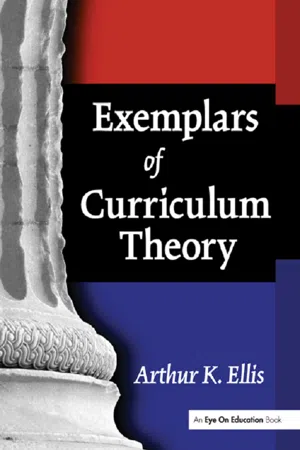
Exemplars of Curriculum Theory
About this book
This book crosses the divide between theoreticians and practitioners by demonstrating how curriculum theories and models are applied in classrooms today. It ties together broad educational theories such as progressivism, essentialism, perennialism, etc.; curriculum models, characterized as learner-centered, society-centered or knowledge-centered; and exemplars of curriculum theories and models, such as Reggio Emilia, Core Knowledge, the International Baccalaureate, etc.
Information
1
Toward Definition(s)
Curriculum. pl. curricula [Latin = course, career (lit, and fig.)]. A course: specifically, a regular course of study or training, as at a school or university.… 1633… Munimenta University of Glasgow.
The Oxford English Dictionary
What Is Curriculum?
A middle school teacher facilitates a class discussion about good and evil as portrayed in J. R. R. Tolkien’s Lord of the Rings. The students are encouraged to cite specific references from the book or film in order to support their arguments. They are asked to make connections to their own lives and to the society they see about them. They are challenged to find other examples in literature as a homework assignment and for grist for further discussion… .
A child brings a grasshopper in a jar to school and asks the teacher why it isn’t green like it is in the pictures she has seen. The child has already named her grasshopper, “Hoppy.” The teacher asks the child if she would like to learn more about grasshoppers. The child is excited and says, “yes,” she would. A study of insects has begun, and the child has participated as an author of the curriculum… .
Students studying ecosystems in a high school biology class are challenged by their teacher to become involved in the restoration of a stream where salmon once migrated and spawned. The class works cooperatively with the local parks department. Students find themselves volunteering their after school and week-end time to make the project a success… .
Each of these scenarios has several things in common. Teachers are challenging students to think and to act. Each scenario has content of one kind or another: A course of study is evident in each case. Learning is taking place. Students are actively involved, although their involvement is rather different in each situation. These are mere glimpses, to be sure. What might happen next is unknown to the reader. We can guess at the possibilities.
Of Origins and Metaphors
The term curriculum is of Latin origin, and it comes to us through the Old French verb, currere, meaning “to run.” Related terms include current, currency, and courier. Translated into English, curriculum means, roughly, a course, as in a running course. Over time and for school purposes, it has come to signify a course of study. As you can see from the excerpt in the unabridged Oxford English Dictionary, its first known applications in English were in documents of Scottish higher education, with particular reference to its usage at the University of Glasgow in the 17th Century.
The word curriculum is a metaphor that takes figurative meaning from literal meaning. Thus a running course becomes a course of study. There is nothing unusual about that. Consider, for example, the term kindergarten (children’s garden). Now it is certainly the case that kindergarten, a product of the Romantic Movement, is a more beautiful metaphor than curriculum. The imaginative idea of a children’s garden evokes compelling imagery, so powerful that it has protected the kindergarten over the years against the onslaughts of those who would make of it a junior first grade. It is also true that kindergarten is a less clumsy term for English speakers than is curriculum, a noun of the neuter gender set in the nominative case, pretty tough sledding for people who basically ignore case and gender in their spoken and written language.
How do you describe more than one curriculum? Well, the Latin plural form is “curricula,” but just as often we tend to Anglicize it into “curriculums.” All this is vexatious to say the least. As Oliva (1982, p. 5) laconically noted, “The amorphous nature of the word curriculum has given rise over the years to many interpretations.” Indeed, there are many definitions and points of view, as we shall see. So many definitions and descriptions have been offered up in recent years that the poor old word can mean just about anything your want it to mean.
Curriculum as Prescription
Attempts to define curriculum tend to be prescriptive, descriptive, or some combination of the two. Prescriptive definitions provide us with what “ought” to happen, and they more often than not take the form of a plan, an intended program, or some kind of expert opinion about what needs to take place in the course of study. In that sense, they have a future orientation, a sense of things to come. Of course, in the case of medical prescriptions, the majority are apparently never filled, and of those prescriptions that patients bother to have filled by the pharmacists, it is not known how many are actually followed accurately. The best guess is that most are not. There is some parallel to this in the world of the school curriculum since the teacher, like the patient, will ultimately decide whether the prescription will be followed. The developer proposes, but the teacher disposes.
Here are several prescriptive definitions of curriculum:
A prescribed body of knowledge and methods by which it might be communicated. Alan Block (1998)
…the master plan, devised by educators and other adults in a community, state, or nation that will best serve their needs, and, as they see it, the needs of their children. Donald Cay (1966)
A plan or program for all the experiences that the learner encounters under the direction of the school. Peter Oliva (1997)
A plan for learning. Hilda Taba (1962)
That series of experiences that children and youth must do and experience by way of developing abilities to do the things well that make up the affairs of adult life; and to be in all respects what adults should be. Franklin Bobbitt (1918)
So, we are told in the preceding definitions that the curriculum is basically a plan, a map, a prescription to be followed. It is a pre-existent artifact, pre-existent in the sense that it is completed, ready to go, and all that is lacking is implementation. We can find such curriculums in state or district curriculum guides, in textbooks and related materials adopted for school use in various subject areas, and in the daily lesson plans of teachers.
Curriculum as Experience
There probably is no such thing as an estimable set of plans apart from the way things really are. This thought has led a number of people to think about the curriculum, not merely in terms of how things ought to be according to expert advice, but how things are in real classrooms. Descriptive definitions, therefore, attempt to inform us of what happens when the planned curriculum is engaged, They provide “glimpses” of the curriculum in action, although those glimpses are only occasionally based on systematic observation and empirical evidence from classrooms. Rather they tend to be descriptive in the sense that whatever one might happen to see occurring in classrooms is in fact the curriculum. The key term in descriptive definitions is “experience,” so we might also call this the experienced curriculum.
Here are several examples of descriptive definitions of curriculum:
All the experiences children have under the guidance of teachers. Hollis Caswell and Doak Campbell (1935)
The set of actual experiences and perceptions of the experiences that each individual learner has of his or her program of education. Glen Hass (1987)
Those learnings each child selects, accepts, and incorporates into himself to act with, on, and upon, in subsequent experiences. Thomas Hopkins (1941)
All experiences of the child for which the school accepts responsibility. W. B. Ragan (1960)
The reconstruction of knowledge and experience that enables the learner to grow in exercising intelligent control of subsequent knowledge and experience. Daniel Tanner and Laurel Tanner (1995)
As you can see, these definitions are certainly different from the first set. For starters, they tend to be retrospective rather than predictive. Experience implies the idea that something has happened. If I asked you the difference between planning a vacation and experiencing a vacation, I am sure you would have little trouble providing a number of insights. If I asked you to talk about the difference between preparing for a job and actually working at that job, again, I can only imagine you could speak authoritatively to the matter. Addressing the matter of happiness in life, Aristotle wrote that only in looking back on life experiences are we qualified to judge whether we had found it.
This is not to say that one must choose between curriculum as plan or experience. There have been many attempts over the years to define curriculum both prescriptively and descriptively. Such definitions tend to imply authority (the school) and hence some kind of plan while also taking into account what happens when the plan is implemented. Here are a couple of them:
An interrelated set of plans and experiences which a student completes under the guidance of the school. C. Marsh and K. Stafford (1984)
The formal and informal content and process by which learners gain knowledge and understanding, develop skills, and alter attitudes, appreciations, and values under the auspices of the that school. Ronald Doll (1996)
And finally, curriculum definitions range from the terse and austere to the jargonesque and agglomerate. If one of the two following definitions says too little to be helpful and the other appears to have been written by a committee. Well, caveat lector (let the reader beware). Here they are; I will leave it to you to decide which is which:
The deliberate arrangement of subject matter. Arthur Foshay (1968)
We find curriculum still being construed very much in terms of ‘packages’ of skills and content at a time when a metaphor like ‘platforms’ seems much more apposite.… The postmodern philosophical concepts of anti-foundationalism and post-epistemological standpoint invoke logics and sensibilities that privilege active pursuit of ways of looking at the world rather than absorbing predefined content and skills grounded in extant worldviews. The learner who masters ‘platforms’ can proactively generate interpretations and frame designs that in turn generate their own learning and innovation agendas and, ultimately, worldviews. A. de Alba, E. Gonzalez-Gaudino, C. Lankshear, M. Peters (2000)
Have you found a favorite so far? Perhaps you’d like to write your own tentative definition of curriculum at this point. Go ahead, give it a try.
Summing Up
I’ll close this brief introductory chapter by offering two more definitions, one rather narrow and strict constructivist, the other rather all encompassing and open to interpretation. Here is Arthur Bestor’s (1955) description of the curriculum as limited to academic subjects:
“Curriculum must consist essentially of disciplined study in five great areas: (i) command of the mother tongue and the systematic study of grammar, literature, and writing; (ii) mathematics; (iii) sciences; (iv) history; (v) foreign language.” Arthur Bestor (1955)
Bestor’s perspective is limited not merely to school subjects but to certain school subjects. He excludes the arts, physical education, “life skills” courses (driver education, word processing, etc.), school-to-work experiences, and a number of other curricular offerings typically found in schools today. In that sense he takes what we could safely call a narrow, strict constructionist approach to the curriculum, only the basics. But what are the basics? In ancient Greece, physical education and the arts were thought to be basic. Aristotle himself went so far as to claim that physical education is more crucial in the bringing up of the young than is academic education. He ranked moral education as a priority in the middle of those two.
Contrast Bestor’s restrictive description with the wide open meaning offered by Gay (1990):
The entire culture of the school—not just subject matter content. Gay (1990)
Apparently Gay disagrees with Bestor, bestowing on the term enough latitude to cover everything including, one imagines, the kitchen sink, connected to the school experience. The “entire culture of the school” would certainly include the lunchroom, brief conversations held at lockers during change of classes, after school sports and drama, the bus ride to and from school, the teachers’ union, even the clothing the students, teachers, and others wear to school. Nothing gets left out.
Where does this leave us? I think we must find shelter under the umbrella of adjectives. Modifiers come to our rescue. Taking an adjectival perspective allows us the luxury of describing the curriculum as planned, written, enacted, measured, experienced, learned, collateral, incidental, concomitant, implicit, hidden, null, and extra, to name a few. We can describe the curriculum as technical, practical, and reflective. We can think of the curriculum by employing such philosophical descriptors as essentialist, perennialist, progressive, and reconstructionist. We can advance the process one step further by offering hyphenated modifiers such as child-centered, society-...
Table of contents
- Cover
- Title Page
- Copyright Page
- About the Author
- Table of Contents
- Acknowledgments
- Introduction
- 1 Toward Definition(s)
- 2 Reading Between the Lines
- 3 A Few Questions
- 4 The Progressive Paradigm
- 5 The Learner-Centered Curriculum
- 6 The Society-Centered Curriculum
- 7 The Knowledge-Centered Curriculum
- 8 Parting Thoughts
- Bibliography
- Index
Trusted by 375,005 students
Access to over 1.5 million titles for a fair monthly price.
Study more efficiently using our study tools.
Frequently asked questions
Yes, you can cancel anytime from the Subscription tab in your account settings on the Perlego website. Your subscription will stay active until the end of your current billing period. Learn how to cancel your subscription
No, books cannot be downloaded as external files, such as PDFs, for use outside of Perlego. However, you can download books within the Perlego app for offline reading on mobile or tablet. Learn how to download books offline
We are an online textbook subscription service, where you can get access to an entire online library for less than the price of a single book per month. With over 1.5 million books across 990+ topics, we’ve got you covered! Learn about our mission
Look out for the read-aloud symbol on your next book to see if you can listen to it. The read-aloud tool reads text aloud for you, highlighting the text as it is being read. You can pause it, speed it up and slow it down. Learn more about Read Aloud
Yes! You can use the Perlego app on both iOS and Android devices to read anytime, anywhere — even offline. Perfect for commutes or when you’re on the go.
Please note we cannot support devices running on iOS 13 and Android 7 or earlier. Learn more about using the app
Please note we cannot support devices running on iOS 13 and Android 7 or earlier. Learn more about using the app
Yes, you can access Exemplars of Curriculum Theory by Arthur K. Ellis in PDF and/or ePUB format, as well as other popular books in Education & Education General. We have over 1.5 million books available in our catalogue for you to explore.