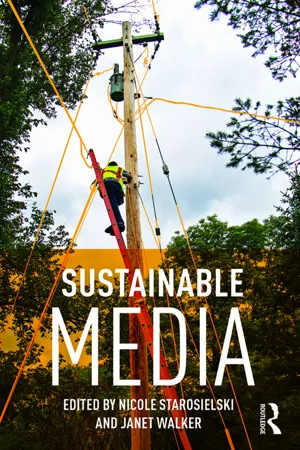
Sustainable Media explores the many ways that media and environment are intertwined from the exploitation of natural and human resources during media production to the installation and disposal of media in the landscape; from people's engagement with environmental issues in film, television, and digital media to the mediating properties of ecologies themselves. Edited by Nicole Starosielski and Janet Walker, the assembled chapters expose how the social and representational practices of media culture are necessarily caught up with technologies, infrastructures, and environments.Through in-depth analyses of media theories, practices, and objects including cell phone towers, ecologically-themed video games, Geiger counters for registering radiation, and sound waves traveling through the ocean, contributors question the sustainability of the media we build, exchange, and inhabit and chart emerging alternatives for media ecologies.
eBook - ePub
Sustainable Media
Critical Approaches to Media and Environment
- 296 pages
- English
- ePUB (mobile friendly)
- Available on iOS & Android
eBook - ePub
Sustainable Media
Critical Approaches to Media and Environment
About this book
Information
Resource Media
1
500,000 Kilowatts of Stardust
An Ecomaterialist Reframing of Singin’ in the Rain
Cut to:
INT. DARKNESS
A large warehouse door opens to reveal a couple in extreme long shot, silhouetted in the light. Cut to a long shot as they—Don Lockwood and Kathy Seldon—enter a Hollywood soundstage.
DON: | This is the proper setting. |
KATHY: | Why, it’s just an empty stage. |
DON: | At first glance, yes, but wait a second. (Don turns a handle and lights flare on a backdrop: a pink and silver skyline.) |
DON: | A beautiful sunset. (He pushes a lever: smoke comes out of a tube on the floor.) |
DON: | Mist from the distant mountains. (He throws another lever: red overhead light, the trill of a flute.) |
DON: | Colored lights in a garden. (Don takes Kathy’s hand and ushers her to a ladder, which she ascends.) |
DON: | A lady is standing on her balcony, in a rose-trellised bower. (Don turns a gel light on her: purple.) |
DON: | Flooded with moonlight. We add five hundred thousand kilowatts of stardust. (The flute trills as Don throws a number of levers and overhead lights of white, red, and green shower down.) |
DON: | A soft summer breeze. (Don turns on an industrial-sized fan and takes a step toward the ladder, pauses.) |
DON: | And…you sure look lovely in the moonlight, Kathy. (Cut to: close-up of Kathy, the lights in soft focus behind her.) |
Kathy: | Now that you have the proper setting, can you say it? (Cut to: medium shot of Don.) |
DON: | I’ll try. |
This pivotal scene from Stanley Donen and Gene Kelly’s 1952 classic, Singin’ in the Rain, provides the pinnacle of sincerity in a film that hinges on irony, artifice, and play. An integrated backstage musical set during Hollywood’s transition from silent to sound eras, Singin’ in the Rain is a self-reflexive satire of the deceptions and hypocrisies that fuel the myths of the silver screen. Its multiple semiotic layers and performative innovation have incited a long-standing track record of criticism from many angles: star studies, genre theory, Hollywood historiography, as well as more postmodern analysis of narrative self-referentiality. The film’s Hollywood-insider premise gives it a buffer from criticism, a sort of built-in self-analysis that invites us to partake in its irony; however, while many would agree with Sharon Buzzard’s generalization that the backstage musical genre “alerts the viewer to the importance of their engagement as informed spectators,” we must also consider what is being hidden deeper beneath this flattering guise.1
A big-budget genre film from the studio that defined excess, and an unapologetic catalyst for the performance of its star, MGM’s Singin’ in the Rain’s industrial provenance reaffirms the very artifice and manipulation it critiques—even the sacrilegious use of dubbing that is so central to its narrative meaning.2 In fact, despite its tongue-in-cheek revelation of the apparatus, Singin’ in the Rain never fully subverts the artificiality of Hollywood, and as such has maintained an ongoing threesome, comfortably in bed with the mainstream and its discontents. While the film’s narrative transparency has led many to embrace it as subversive, I would agree rather with Carol J. Clover’s insistence that we “see the moralizing surface story of Singin’ in the Rain as a guilty disavowal of the practices that went into its own making.”3 This disavowal is not a condemnation of Hollywood artifice, but a cover-up, a misdirection through which the film invites us to believe in its revelation of artifice, and plays upon our faith in its honesty. But what, then, is it covering—what is the film’s “guilty” secret?
This chapter provides an alternative approach to the film, an eco-critical approach that explores the film’s rich layering of conflicting discourses, the green ramifications of its material practices, and the larger significance of how it represents our relationship to the natural and the artificial. In light of these concerns, the soundstage scene laid out in my introduction offers great insight into the actual extent of Hollywood’s self-consciousness as to the natural resource cost of its fabrications, and becomes emblematic of the complex audience-industry compact designed to justify the exploitation of nature at the service of screen spectacle. In these pages, I will offer an ecomaterialist intervention in conventional film historiography, an alternative narrative of the ecological significance of a film’s production, textual meaning, and the network of discourses that extends from film marketing to its critical reception. By “ecomaterialism” I invoke a material turn in eco-criticism, a shift in current eco-critical approaches to focus less on the problems of representation and more on the concrete environmental consequences of film culture, from production methods to marketing discourse. I also hope to contribute to critical paradigms that move “materialism” beyond a unilaterally Marxist understanding, by offering an approach that pierces the concrete and tangible consequences of our cultural practices. Through archival research and production culture fieldwork, we can reveal far more about how, both on- and off-screen, media use nature to produce culture. This should permit us to build a bridge from representationally driven eco-critical analysis to infrastructural approaches as exemplified by Starosielski, Gabrys, and others in this volume while also adding medial specificity and industry studies depth to current attempts to integrate media into environmental studies. Like the other works in this book, my aim is not only to encourage an ecological reframing of media technology, but also to insist that we rethink the environmental ramifications of our daily attitude toward cultural practice.
Water, Water Everywhere
Of all our natural resources water has become the most precious. By far the greater part of the earth’s surface is covered by its enveloping seas, yet in the midst of this plenty we are in want…. In an age when man has forgotten his origins and is blind even to his most essential needs for survival, water along with other resources has become the victim of his indifference.
—Rachel Carson4
This passage from Rachel Carson’s trailblazing 1962 environmentalist sermon on the mount, Silent Spring, identified the important ecological role of water—including humanity’s dependence and negative impact on it—over half a century ago, and our species’ interaction with it is constantly evolving. Current crises of clean and consumable water in some places, and growing concerns about fresh water’s general potential scarcity, reflect not so much what nature offers us as what we offer it—what humanity does with and to this natural resource and the atmospheric ecosystem that makes it naturally renewable. Water makes up 70 percent of the human body and, in striking proportionate congruency, nearly three-fourths of the surface area of our planet. We use water for nearly everything we do: from drinking to bathing to developing photographs to cooling Internet-server warehouses, water is involved in—if not central to—most human activities. As such, it is no surprise that water has been deeply integral to the history of film, from its basic production needs to its topics of fascination, its sublime affectual force, and its inquiry into human social practices.
In this chapter I provide a case study to investigate the way that American cinema has engaged with water, from representation to production to a surrounding network of discourse. What are some thematic and resonant ways in which water has been shown on the big screen, and how have humans been positioned in relation to it? How has water been integrated into the production of mainstream films, in terms of its extra-filmic consumption (from the basic hydration of cast and crew to the use of water for cooling postproduction digital memory servers, to California’s reliance on hydroelectric power) as well as its textual role as setting and prop, from manufactured oceans to artificial rainfall?
Singin’ in the Rain is an ideal starting place for this approach for two reasons: first, its high-profile status at MGM during production, in the trade world upon release, and in Hollywood historical studies and criticism ever since, means that its production process was painstakingly recorded, its marketing strategies and reviews remain accessible, and its handling by decades of scholarship leaves a paper trail reflecting the methods and concerns of the discipline. Second, the film’s prototypically high-concept life cycle focuses specifically on issues of natural resource use and natural representation. From the film’s title, to the shooting (and critical celebration) of its most iconic scene, to its advertisement slogans and cross-marketing strategies, water is central to every level of the film’s magic. I will use this central object in order to discuss Hollywood’s use of (and impact on) the environment, and to explore what the underlying connotations of mainstream practices and textual meanings say about our historical, collective views on the relationship between nature and the culture of spectacle. Beginning with the contemporary environmentalist swing in Hollywood, I will expand to a historical perspective of the role of water in film production, and then turn to a close study of Singin’ in the Rain, moving beyond the representational problems of textual analysis and toward an ecomaterialist study of this film’s production methods and marketing discourse.
While Hollywood was historically founded (and remains so) upon the shoulders of excess and waste, it has in recent decades developed a complex, if inconsistent, environmentalism. Discourse on the subject in the trade paper Variety reached a peak in 1993, ebbed for a decade, and then experienced a resurgence building up to the climactic release of Davis Guggenheim and Al Gore’s hugely successful An Inconvenient Truth in 2006. A well-timed 2006 study made by Charles C. Corbett and Richard P. Turco for UCLA’s Institute of the Environment and Sustainability, titled “Southern California Environmental Report Card” and derived from a larger study, “Sustainability in the Motion Picture Industry,” condemned the environmental footprint of industry practices.5 This groundbreaking study not only reaches alarming conclusions about the ecological footprint of the moving-image culture industry, but also helps to map out a grid of the various levels on which the industry has an environmental impact, as well as how its contemporary view of environmentally sustainable practice does not promise a progressive change in the near future.
Still, Hollywood was forced to realize that this issue is publicly popular, a cause célèbre for the new millennium and, just as importantly in an almost poststudio age, economical. The Environmental Media Association developed the Green Seal certificate in 1989 to foster a set of best green practices, and the Producers Guild of America developed its own PGA Green network, followed by environmentalism and sustainability positions at many of the studios. Major productions began to go carbon neutral (though this really only means offsetting otherwise traditional pollutant methods by donating money to independent organizations); and, not to be outdone by anyone, Rupert Murdoch turned NewsCorp carbon neutral in 2010. All of this is to say that Hollywood’s green conscience to this point is a marketplace conscience, torn in conflicting directions by the forces of economics, industry, and public image. Recognizing the economic benefits of sustainable practice, Hollywood studios have begun to tighten the efficiency and renewability of their raw material use, foregoing, however, any radical industrial change or empirical critique of the price our planet pays for this culture of excess. To maximize visibility, the industry has cosmetically shifted the aesthetics of the star system, with websites such as Ecorazzi.com taking advantage of photo ops to show icons like Leonardo DiCaprio driving around in a Prius. As such, the discursive machinery of Hollywood manages to deflect popular criticism of the environmental ramifications of film production, and to avoid governmental regulation of its practices.
With similarly benign visibility (and weighted by an intellectual inertia typical of the slow crawl of mainstream criticism), scholarly interest in this topic has maintained its focus on questions of representation: how do films represent nature and our relationship to it; what do films say about environmental issues; how can “eco-films” act as tools of geopolitical change? These are valid and important questions and, while most eco-critical studies of film acknowledge the need to include analysis of production methods, they rarely do; although it is important to address the way we show nature, it is also necessary to move beyond questions of representation to the material concerns and consequences of our cultural practices. In my forthcoming book, 500,000 Kilowatts of Stardust, I develop an ecomaterialist framework...
Table of contents
- Cover Page
- Halftitle Page
- Title Page
- Copyright Page
- Dedication
- Table of Contents
- List of Figures
- Acknowledgments
- Introduction: Sustainable Media
- Part I Resource Media
- Part II Social Ecologies, Mediating Environments
- Part III (Un)sustainable Materialities
- Part IV Scaling, Modeling, Coupling
- Notes on Contributors
- Index
Trusted by 375,005 students
Access to over 1.5 million titles for a fair monthly price.
Study more efficiently using our study tools.
Frequently asked questions
Yes, you can cancel anytime from the Subscription tab in your account settings on the Perlego website. Your subscription will stay active until the end of your current billing period. Learn how to cancel your subscription
No, books cannot be downloaded as external files, such as PDFs, for use outside of Perlego. However, you can download books within the Perlego app for offline reading on mobile or tablet. Learn how to download books offline
Perlego offers two plans: Essential and Complete
- Essential is ideal for learners and professionals who enjoy exploring a wide range of subjects. Access the Essential Library with 800,000+ trusted titles and best-sellers across business, personal growth, and the humanities. Includes unlimited reading time and Standard Read Aloud voice.
- Complete: Perfect for advanced learners and researchers needing full, unrestricted access. Unlock 1.5M+ books across hundreds of subjects, including academic and specialized titles. The Complete Plan also includes advanced features like Premium Read Aloud and Research Assistant.
We are an online textbook subscription service, where you can get access to an entire online library for less than the price of a single book per month. With over 1.5 million books across 990+ topics, we’ve got you covered! Learn about our mission
Look out for the read-aloud symbol on your next book to see if you can listen to it. The read-aloud tool reads text aloud for you, highlighting the text as it is being read. You can pause it, speed it up and slow it down. Learn more about Read Aloud
Yes! You can use the Perlego app on both iOS and Android devices to read anytime, anywhere — even offline. Perfect for commutes or when you’re on the go.
Please note we cannot support devices running on iOS 13 and Android 7 or earlier. Learn more about using the app
Please note we cannot support devices running on iOS 13 and Android 7 or earlier. Learn more about using the app
Yes, you can access Sustainable Media by Nicole Starosielski, Janet Walker, Nicole Starosielski,Janet Walker in PDF and/or ePUB format, as well as other popular books in Mezzi di comunicazione e arti performative & Ecologia. We have over 1.5 million books available in our catalogue for you to explore.