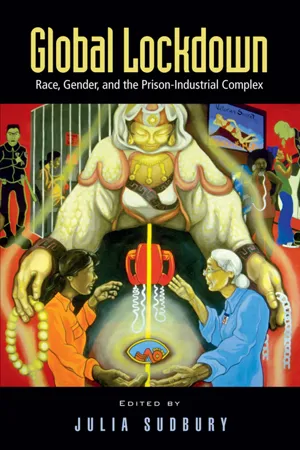
Global Lockdown is the first book to apply a transnational feminist framework to the study of criminalization and imprisonment. The distinguished contributors to this collection offer a variety of perspectives, from former prisoners to advocates to scholars from around the world. The book is a must-read for anyone concerned by mass incarceration and the growth of the prison-industrial complex within and beyond U.S. borders, as well as those interested in globalization and resistance.
- 324 pages
- English
- ePUB (mobile friendly)
- Available on iOS & Android
eBook - ePub
About this book
Information
Part I
Criminalizing Survival
CHAPTER 1
Domestic Enemies and Carceral Circles
African Women and Criminalization in Italy
The story of her departure—a story I repeat over and over—is something of a mystery to me. I do not know how she arrived in Italy or the circumstances of her life. She had been an inmate at Rebibbia Femminile in Rome for three years, this much I know. I also know that she had requested to be deported back to Nigeria at the end of her sentence and that she was very ill during her last year in prison. On the day she was to leave Italy she was confined to a wheelchair, in which she could only sit slumped over, too weak to hold her head up and too weak to utter a sound. During her exit medical examination the prison physicians determined that she had AIDS. The physicians wrote a letter to the prison officials disclosing their findings and making recommendations, saying they were uncertain whether she would survive her long journey home. Rather than deliver this letter themselves, however, the doctors placed the letter in the woman’s lap and called a guard to take her back to the prison ward.
It is possible that the physicians’ letter went unnoticed, or perhaps the prison officials felt no responsibility for this woman who was going to be deported. Even as they struggled to fit her and her wheelchair into the taxi that was called to take her to the airport, not a single administrator mentioned her condition or verbally expressed any concern about her health. They tucked her documents—plane ticket, passport, and letters confirming her release—into her breast pocket and paid the taxi driver enough to drop her off at the airport’s front entrance. A witness said that she could not even lift her head when the prison administrators and a few inmates waved their good–byes.
When she arrived at the airport, unescorted, maybe she was unable to speak, or perhaps the ticket agent refused to listen to her as she tried to explain the computer error. But the result was still the same: once the ticket agent typed in the woman’s name and saw that she was wanted for a crime that she had committed three years ago, the same crime for which she had been serving time, the ticket agent called the Carabinieri to come and arrest her. The Carabinieri didn’t think it unreasonable that a visibly ill woman in a wheelchair would be making a dash for the frontier to escape the law. In fact, they were so convinced that she was a fugitive that even after they found her letters from the courts and the prison administration, they held her in custody at the police station for more than five hours, then placed her in the back of their car and drove her back to Rebibbia Femminile, Rome’s only penal institution for women. When she arrived at the prison, it was late evening and most of the officials were gone for the day. The head of the prison police and an educatora (social worker) refused to accept the woman, telling the Carabinieri who brought her that because she had been released, she couldn’t stay at the prison because she could claim that the institution was holding her hostage.
The woman seemed not to have friends or family members in Rome. She was in critical need of medical attention, but she was now technically an “undocumented immigrant” in Italy and at that time it was illegal for her to seek medical care at a hospital. As Carabinieri, prison police, the social worker, and a prison clergyman stood over the woman, arguing about what to do with her, a nun, one of the first women to tell me this story, asked if she could take the woman back to her convent, where the sick woman could receive some food and basic care. The arguing officials thought it was a bad idea because this woman was, after all, a convicted criminal. In the end, they allowed the sister to take the woman to the convent, where she stayed for a week before she booked another flight from Rome to Nigeria. Although she safely boarded the plane, no one is certain if she survived the trip.
This essay is in part a questioning of this mysterious although true tale of a woman who cannot leave a country because of her assumed status as a criminal and dangerous individual. Her story not only signals a crisis, but also for the growing number of African women traveling through or migrating to Italy, it highlights an often silent reality in contemporary literature on globalization and transnationalism. We do not live in a world of unbounded borders. For many of us with suspicious and foreign-sounding names, dark skin, and lives that are led in other languages, we live with policed borders and demarcated territories. I explore the discourse of criminality that surrounds the lives of documented and undocumented immigrants in Italy. Academics, and sociologists and criminologists in particular, have long debated the problem of “immigrant criminality.” As I demonstrate in this chapter, there is an increasing culture of suspicion, hostility, and criminalization of immigrants, and particularly African women, in Italy.
Over the past several years, Europe has moved toward more repressive immigration laws and strict enforcement measures. The intensifying policing of national borders has created state-sanctioned practices of targeting particular immigrant groups, especially women from South America, sub-Saharan African countries, and nonimmigrant groups such as the Roma (gypsies), as potential “criminals.” In addition, in Italy and the rest of Europe (much like the United States), discourses on immigration are joined together with the rhetoric of crime and prevention in such a way that migrant populations are popularly viewed as being clandestine or “illegal” and therefore more prone to criminal behavior.
Not surprisingly, then, discourses on crime and on who commits it are saturated with the language of national citizenship, social class, gender, and race. Issues of immigration, like those of crime and criminals, are viewed as public policy dilemmas in which themes of immigrant criminality are so prevalent that, as Michael Keith notes, “The broad contours of the historical processes of criminalization of migrant minorities are now relatively uncontroversial.”1 Likewise, Biko Agozino argues that the societal imagination already regards immigrants as criminals because “spatial mobility is expected to imply anomie.”2 The climate of anti-immigrant rhetoric relies on the dual discourses of criminalization and cultural difference. In Italy, immigrants of color are very visible and their numbers are few (roughly 2.2 percent of the population), thus making them easy targets of the practical realities of criminalization. Furthermore, notions of racial and cultural difference can negatively affect public knowledge about immigrants and policing practices additionally fuel the public’s imagination and misperceptions.
The Criminalization of Immigrants
There are 1.5 million documented immigrants and an estimated 20 percent undocumented immigrants in Italy.3 With its population of 57.8 million, it is surprising that Italy has among the highest rates of immigrant imprisonment in southern Europe, following Greece and Spain.4 Emilio Reyneri suggests that both the hypervisibility of immigrants and the inexperience of the courts may lead to discriminatory arrests and imprisonment.5 In any case, as Alessandro dal Lago writes, “we know that often the over-representation of migrants in judicial statistics and crime rates is the product of their social weakness and, moreover, of the process of labeling.”6 It is within this context that the courts and the public broadly define what is “deviant behavior” when performed by an immigrant or other disagreeable character, such as Roma, and disregard the same behavior as an eccentricity when performed by a “citizen.”7 For example, while conducting fieldwork in Rebibbia Maschile Nuovo Complesso, I interviewed a Senegalese man who was serving a two-month sentence for driving without an Italian license (he was driving with a license from Senegal). Even the director of the Educatori, who was present during the interview, was astonished by both his arrest and the sentence and insisted to the Senegalese man that he was detained for another reason. As the director said, “It is impossible, you cannot be serving two months for this! You must have committed a crime.” Indeed, as prison matriculation documents and court transcripts confirmed, the Senegalese man was arrested for driving without an Italian license.
Labeling immigrants as criminal is prevalent in Italy, as Salvatore Palidda demonstrates in his research on the social construction of deviance and immigrant criminality.8 Palidda examines the arrest rates of Nigerians, Senegalese, Moroccans, Algerians, Tunisians, Albanians, Poles, and migrants from the former Yugoslavia in comparison with documented complaints brought against them by people in the community (presumably Italian citizens). On the whole, Palidda shows that although immigrants represented 23 percent of the total arrest population they represented 57 percent of the total population who had complaints brought against them.9 Moroccans, who are generally viewed as being the most criminally inclined immigrant group, had approximately 6,000 arrests for 1994 and slightly over 13,000 complaints brought against them. The Senegalese had 463 arrests in 1994 and over 4,126 complaints brought against them, whereas Algerians had 2,580 arrests and 2,757 complaints.10 Palidda’s research would seem to support evidence that indicates an increasing “culture of panic and emergency” with regard to immigration that has created social panic among the public, fed by the mass media and driven by anti-immigrant policies. In short, the non-EUropean Union (EU) immigrant in Italy is “a cultural type built through interactions occurring no[t] only between social actors but also between cultural representations.”11
Immigrants in Africa, particularly those from Latin America, and Eastern Europe, and nonimmigrants in communities such as the Roma, must grapple with public perceptions of their communities as criminal. It has been reported that 24 percent of the prison population is foreign.12 It should be pointed out that this percentage reflects all foreigners detained in Italian prisons, including citizens from the United States, Canada, and the United Kingdom, and other foreigners (not necessarily immigrants) who pass through Italy en route to other destinations. In 1998 almost 50 percent of those admitted to prison were foreigners and 90 percent were undocumented.13
The discourse of immigrant criminality and the overrepresentation of foreigners in penal institutions have led to the establishment of citizen committees in several large cities, particularly in the North. These committees, among other things, mobilize against street crime and have targeted migrants from
Morocco and street venders from Senegal.14 In conjunction with increasingly high arrest rates, Roma, Eastern Europeans, and immigrants of color in Italy struggle with a coalition of left and right wing activists forming citizen committees. In cities that have experienced economic restructuring (such as urban renewal projects), citizen committees have organized against street crime and in some cases the very presence of immigrants.15 As sociologist Dario Melossi informs us,
The attention of these “communitarian groups” focuses in particular on crime and deviance amongst recent immigrant groups and their visibility in the everyday life of their neighborhood. At the core of the problem there no longer seems to be simply a threat to one’s property or personal safety, but rather a generalized risk for the whole society, for an idea of order—of democratic order….16
To be sure, it is not only the right wing factions who are involved in community initiatives that target immigrants. A report in the Italian newspaper Corriere della sera captures the sentiment of a PDS (Democratic Party of the Left—formerly the Communist Party) leader in Turin and adds the newspaper’s own somewhat sardonic commentary,
“I believe that citizens are right when they protest against their letter box being filled with used condoms, or if they are surrounded by pushers when they are coming back home, or if they are forced to watch people having sex with whores, or because the mountain bikes of their sons are stolen and their wives are afraid to walk alone in the streets.” These are the words by Sergio Chiamparino, 46 years old, leader of the Turin PDS, father of a 16-year-old boy (now fearing for his new mountain bike), living in the well-known and dangerous Murazzi area, close to the center of the city. Some days ago Italian people living in the Murazzi [area] protested against Senegalese and Moroccan immigrants.17
As with many societies, Italian discourses about dangerous zones usually represent them as the areas where the highest number of disenfranchised people reside (including immigrants and the poor). The most “dangerous zones” in Rome and other Italian cities are usually the train stations and the area surrounding them and the outskirts of the city where immigrant and Roma communities are often forced to live in makeshift dwellings.
Women, Nationality, and Criminal Representations
In Italy, the discourse on immigrant criminality resides mainly in the areas of drugs and prostitution.18 Today these “deviant behaviors” are characterized as being almost “un-Italian” in nature. Especially among the police, but also in the general public, it is not uncommon that Tunisian and Moroccan men and Colombian and Nigerian women are considered drug traffickers or dealers, and women from West African nations, including, especially, Nigeria, and Eastern European women are seen as being solely responsible for prostitution. Although prostitution is not illegal in Italy, its practice criminalizes the practitioner in people’s minds. This perceived link between criminal behaviors and nationalities is so widespread that it has become a part of popular discourse. For example, it is not uncommon to hear “Nigerian” substitute for “prostitute,” and popular representations of prostitution are exhibited through (black) African female bodies.19
Sadly, this inclination to name all African sex workers “Nigerians” and all African women Nigerian and therefore sex workers grows out of the fact that the small number of sub-Saharan African women who traffic in prostitution tend to be largely Nigerian or at least African women entering Italy with Nigerian passports. As Agence France-Presse reporter Ljbomir Milasin documented with reference to street prostitution on July 28, 2000:
Earlier this month, Italy deported nearly 100 Nigerian immigrants, all b...
Table of contents
- Cover
- Half Title
- Title Page
- Copyright Page
- Table of Contents
- Acknowledgments
- Introduction: Feminist Critiques, Transnational Landscapes, Abolitionist Visions
- Part I: Criminalizing Survival
- Part II: Women in the Global Prison
- Part III: From Criminalization to Resistance
- Contributor Biographies
- Selected Bibliography
- Index
Trusted by 375,005 students
Access to over 1.5 million titles for a fair monthly price.
Study more efficiently using our study tools.
Frequently asked questions
Yes, you can cancel anytime from the Subscription tab in your account settings on the Perlego website. Your subscription will stay active until the end of your current billing period. Learn how to cancel your subscription
No, books cannot be downloaded as external files, such as PDFs, for use outside of Perlego. However, you can download books within the Perlego app for offline reading on mobile or tablet. Learn how to download books offline
Perlego offers two plans: Essential and Complete
- Essential is ideal for learners and professionals who enjoy exploring a wide range of subjects. Access the Essential Library with 800,000+ trusted titles and best-sellers across business, personal growth, and the humanities. Includes unlimited reading time and Standard Read Aloud voice.
- Complete: Perfect for advanced learners and researchers needing full, unrestricted access. Unlock 1.5M+ books across hundreds of subjects, including academic and specialized titles. The Complete Plan also includes advanced features like Premium Read Aloud and Research Assistant.
We are an online textbook subscription service, where you can get access to an entire online library for less than the price of a single book per month. With over 1.5 million books across 990+ topics, we’ve got you covered! Learn about our mission
Look out for the read-aloud symbol on your next book to see if you can listen to it. The read-aloud tool reads text aloud for you, highlighting the text as it is being read. You can pause it, speed it up and slow it down. Learn more about Read Aloud
Yes! You can use the Perlego app on both iOS and Android devices to read anytime, anywhere — even offline. Perfect for commutes or when you’re on the go.
Please note we cannot support devices running on iOS 13 and Android 7 or earlier. Learn more about using the app
Please note we cannot support devices running on iOS 13 and Android 7 or earlier. Learn more about using the app
Yes, you can access Global Lockdown by Julia Sudbury in PDF and/or ePUB format, as well as other popular books in Social Sciences & Criminology. We have over 1.5 million books available in our catalogue for you to explore.