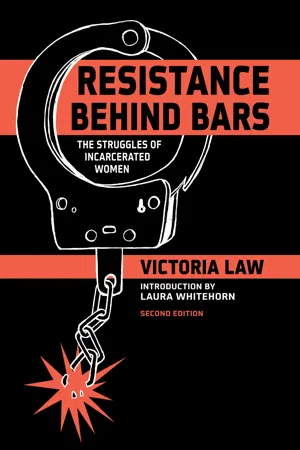
Resistance Behind Bars
eBook - ePub

Resistance Behind Bars

The Struggles Of Incarcerated Women

  1. 320 pages
  2. English
  3. ePUB (mobile friendly)
  4. Available on iOS & Android
eBook - ePub

Resistance Behind Bars

The Struggles Of Incarcerated Women

About this book

In 1974, women imprisoned at New York's maximum-security prison at Bedford Hills staged what is known as the August Rebellion. Protesting the brutal beating of a fellow prisoner, the women fought off guards, holding seven of them hostage, and took over sections of the prison.

While many have heard of the 1971 Attica prison uprising, the August Rebellion remains relatively unknown even in activist circles. Resistance Behind Bars is determined to challenge and change such oversights. As it examines daily struggles against appalling prison conditions and injustices, Resistance documents both collective organizing and individual resistance among women incarcerated in the U.S. Emphasizing women's agency in resisting the conditions of their confinement through forming peer education groups, clandestinely arranging ways for children to visit mothers in distant prisons and raising public awareness about their lives, Resistance seeks to spark further discussion and research into the lives of incarcerated women and galvanize much-needed outside support for their struggles.

This updated and revised edition of the 2009 PASS Award winning book includes a new chapter about transgender, transsexual, intersex, and gender-variant people in prison.

Frequently asked questions

Yes, you can cancel anytime from the Subscription tab in your account settings on the Perlego website. Your subscription will stay active until the end of your current billing period. Learn how to cancel your subscription.
At the moment all of our mobile-responsive ePub books are available to download via the app. Most of our PDFs are also available to download and we're working on making the final remaining ones downloadable now. Learn more here.
Perlego offers two plans: Essential and Complete
  • Essential is ideal for learners and professionals who enjoy exploring a wide range of subjects. Access the Essential Library with 800,000+ trusted titles and best-sellers across business, personal growth, and the humanities. Includes unlimited reading time and Standard Read Aloud voice.
  • Complete: Perfect for advanced learners and researchers needing full, unrestricted access. Unlock 1.4M+ books across hundreds of subjects, including academic and specialized titles. The Complete Plan also includes advanced features like Premium Read Aloud and Research Assistant.
Both plans are available with monthly, semester, or annual billing cycles.
We are an online textbook subscription service, where you can get access to an entire online library for less than the price of a single book per month. With over 1 million books across 1000+ topics, we’ve got you covered! Learn more here.
Look out for the read-aloud symbol on your next book to see if you can listen to it. The read-aloud tool reads text aloud for you, highlighting the text as it is being read. You can pause it, speed it up and slow it down. Learn more here.
Yes! You can use the Perlego app on both iOS or Android devices to read anytime, anywhere — even offline. Perfect for commutes or when you’re on the go.
Please note we cannot support devices running on iOS 13 and Android 7 or earlier. Learn more about using the app.
Yes, you can access Resistance Behind Bars by Victoria Law in PDF and/or ePUB format, as well as other popular books in Social Sciences & Criminology. We have over one million books available in our catalogue for you to explore.

Information

NOTES


1 Two of the girls were black lesbian lovers. In a scenario that would be repeated 13 years later in the case of the New Jersey Four, they had been out with friends when they encountered a cab driver who had tried to grab one of them. Her friends intervened, the cab driver called the police and the girls were arrested for assault. I don’t remember if the judge refused to set bail or if he set it too high for their families to pay, but both of my cellmates were subsequently sent to Rikers Island.
2 Angela Davis, Are Prisons Obsolete? (New York: Seven Stories Press, 2003), 20.
3 I kid you not. The Oregon Department of Corrections rejects anything that has been drawn or written with crayon.
4 Allen J. Beck and Paige M. Harrison, Prisoners in 2000, special report for the Department of Justice, August 2001, 1, http://bjs.ojp.usdoj.gov/content/pub/pdf/p00.pdf.
5 Heather C. West, Prison Inmates at Midyear 2009—Statistical Tables, Bureau of Justice, June 2010, 4, http://bjs.ojp.usdoj.gov/content/pub/pdf/pim09st.pdf.
6 Ibid., 2.
7 American Civil Liberties Union (ACLU), “ACLU Applauds Senate Reintroduction of Racial Profiling Bill, Urges Congress to Finally Pass Comprehensive Legislation Next Year,” December 19, 2005, http://www.aclu.org/racialjustice/racialprofiling/23090prs20051219.html.
8 Barbara Bloom, Barbara Owen, and Stephanie Covington, Gender-Responsive Strategies: Research, Practice, and Guiding Principles for Women Offenders (National Institute of Corrections, 2003) 8, http://www.nicic.org/pubs/2003/018017.pdf.
9 Tracy Snell and Lawrence Greenfeld, Women Offenders, special report for the Department of Justice, December 1999, 5, http://ojp.usdoj.gov/bjs/pub/pdf/wo.pdf.
10 Ibid.
11 C. W. Harlow, Education and Correctional Populations, special report for the Department of Justice, 2003.
12 Christopher J. Mumola, Incarcerated Parents and Their Children, special report for the Department of Justice, August 2000, 6.
13 Tracy Snell and Lawrence Greenfeld, Women Offenders, special report for the Department of Justice, December 1999, 5, http://ojp.usdoj.gov/bjs/pub/pdf/wo.pdf.
14 Heather C. West and William J. Sabol, Prisoners in 2007, Bureau of Justice Statistics, U.S. Department of Justice, December 2008, revised February 12, 2009, 21.
15 U.S. Department of Justice, Prior Abuse Reported by Inmates and Probationers, April 1999, 2. See also Doris J. James’ Profile of Jail Inmates, 2002, special report for the Department of Justice, July 2004, 10.
16 U.S. Department of Justice, Survey of State Inmates, 1991, May 1993, 6.
17 In 2004, the Rockefeller Drug Laws were amended. Under the Drug Law Reform Act (DLRA), prisoners with the most severe sentences could apply to be re-sentenced to a term allowed by the new law. The DLRA also increased good-time allowances for everyone else already serving drug sentences. The DLRA did not increase the power of judges to place addicts into treatment programs or provide money to increase the availability of community-based drug treatment. Instead, it expanded eligibility for prison-based drug treatment. One year later, the Legal Aid Society found that not only was the re-sentencing process much slower than expected, but that District Attorneys were often fighting re-sentencing and asking for higher sentences. Furthermore, the New York State Department of Correctional Services had not expanded its drug treatment program as required. (See Legal Aid Society, “One Year Later: New York’s Experience with Drug Law Reform,” http://www.drugpolicy.org/docUploads/DLRA_FactSheet_1.pdf.)
18 Women in Prison Project of the Correctional Association of New York, Imprisonment and Families Fact Sheet (New York: March 2007), http://www.correctionalassociation.org/WIPP/publications/families%20Fact%20Sheet%202007.pdf.
19 Marc Mauer, Cathy Potler, and Richard Wolf, Gender and Justice: Women, Drugs and Sentencing Policy (Washington, DC: The Sentencing Project 1999), http://www.sentencingproject.org/doc/File/Drug%20Policy/dp_genderandjustice.pdf.
20 Drug Policy Alliance, “Race and the Drug War,” http://www.drugpolicy.org/communities/race.
21 Renowned prison abolitionist Angela Davis was an associate professor at UCLA when she first became involved with prisoner support. Her participation in the Black Panther Party and Black Liberation movement led her to the struggle to free the Soledad Brothers and to her correspondence with George Jackson. The United Prisoners’ Union in California was formed in 1970 by attorneys and (male) ex-prisoners. By 1973, it had split into two groups: the Prisoners’ Union, which confined itself to prison issues, and the United Prisoners’ Union, which allied itself with the more radical Bay Area groups. See Eric Cummins, The Rise and Fall of California’s Radical Prison Movement, (Stanford, CA: Stanford University Press, 1994). In 1972, the American Civil Liberties Union formed the National Prison Project, which used class-action litigation and public education to defend prisoners’ rights. In 1971, prisoners at the maximum-security Green Haven Correctional Facility formed the Green Haven Prisoners Labor Union. Members petitioned the Public Employees Relation Board (PERB) of New York for recognition. PERB denied the petition, ruling that prisoners were not public employees and thus had no right to organize or collectively bargain under the Public Employees’ Fair Employment Act. [see Mark Dowie, “Unionizing Prison Labor,” Social Policy, 4 no.1 (July/August 1973): 56-60].
22 In 1969, Boston university professor Elizabeth Barker brought her university debating team to Norfolk Prison for a practice debate. “Beyond her expectations, the prisoner team bested the university team and, learning that she was an English professor, proceeded to deluge her with their poetry.” The experience influenced her to coordinate a series of college courses at the prison during the 1970s. (Dante Germanotta, “Prison Education: A Contextual Analysis,” in Schooling in a “Total Institution”: Critical Perspectives on Prison Education, ed. Howard S. Davidson (Westport, CN: Bergin & Garvey, 1995), 117. Throughout the 1970s, Peter Linebaugh taught Marxism in men’s prisons in New Hampshire, Massachusetts, Illinois and New York. (See Peter Linebaugh, “Freeing the Birds, Erasing Images, Burning Lamps: How I Learned to Teach in Prison,” in Schooling in a “Total Institution,” 65-89.) Karlene Faith taught a political science course to the men in California’s Soledad Prison in 1970. Upon learning that her students knew nothing about their female counterparts, Faith focused her attention on incarcerat...

Table of contents

  1. Cover
  2. Title
  3. Copyright
  4. Contents
  5. Introduction
  6. Author’s Introduction
  7. Overview
  8. Unlikely Communities
  9. Barriers to Basic Care
  10. Mothers and Children
  11. Sexual Abuse
  12. Education
  13. Women’s Work
  14. Grievances, Lawsuits and the Power of the Media
  15. Breaking the Silence
  16. Resistance Among Women in Immigrant Detention Centers
  17. Some Historical Background
  18. Glossary
  19. Resources
  20. Recommended Reading
  21. A Note on Transgender, Transsexual, Intersex and Gender-Variant People in Prison (New)
  22. Epilogue (New)
  23. Notes
  24. Index
  25. Acknowledgments