- 616 pages
- English
- ePUB (mobile friendly)
- Available on iOS & Android
eBook - ePub
About this book
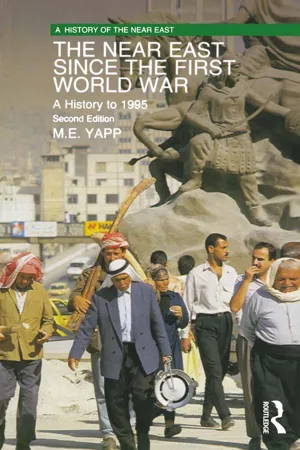
This clear, balanced and authoritative survey of the history of the region is now fully up to date again. The text contains a general regional introduction, followed by a series of country-by-country analyses, and a section which places the Near East in the international context. Professor Yapp' s new edition covers recent dramatic events including the end of the Cold War, the Kuwayt Crisis of 1990/91, and the continuing conflict in Israel, as well as assessing the huge social and economic changes in the region. It will be essential reading for students and scholars concerned with modern middle eastern history and politics of the middle east.
SECTION I
THE YEARS OF THE NOTABLES
CHAPTER ONE
Egypt to 1952
Geographically Egypt consists of a broad area of desert which occupies over 95 per cent of the country and a long valley formed by the Nile river. In the north the valley broadens into the Delta of Lower Egypt. All but 1 per cent of the population live in the Nile valley. In 1920 nearly 90 per cent of the population of 13 million was rural, living in villages; there was also a small nomadic bedouin population principally in the western desert although many of the bedouin were settled or semi-settled. One quarter of the population lived in towns, notably in Cairo which had a population of 900,000 and Alexandria (500,000). In the towns there was also a resident foreign European population of about 200,000, half of whom were of Greek origin and the remainder mainly Italian, British and French. Other significant foreign minorities were the Syrians and the Armenians. Over 90 per cent of the population was Muslim, nearly all Sunni. Egypt also possessed the largest indigenous Christian group in the Near East in the form of the Coptic community, resident mainly in the towns and in Upper Egypt, and a small Jewish community.
About 70 per cent of the working population was engaged in agriculture. Many of these were employed in growing foodstuffs but the most distinctive feature of Egyptian agriculture was the growth of cotton for the international market. In 1921 cotton landlords established the Egyptian General Agricultural Syndicate to improve their negotiating position with the cotton purchasers. Of the remainder of the population 20 per cent were employed in construction, services or transport and 8 per cent in manufacturing industry, which in 1920 was still dominated by foreign enterprises especially in textiles and continued to be so throughout the following years. The industrial labour force in 1920 was put at 250,000.
Until 1914 Egypt had been an autonomous province of the Otto man empire ruled by a hereditary ruler entitled khedive. In 1882 Egypt had been occupied by Britain and in 1914 Britain had ended Ottoman authority and declared Egypt a protectorate. The last khedive was deposed and his uncle put in his place with the title of sultan. In 1922 Britain issued a unilateral declaration of Egyptian independence having failed to negotiate an agreement with an Egyptian government. At the same time she reserved four points pending a treaty with Egypt. These reserved points concerned the Suez Canal, Egyptian defence and foreign policy, the Sudan and the capitulations (See MMNE, 344–5). Accordingly, the condition of Egypt was what may be termed neo-independence and a situation was created in which three groups shared or contended for power within Egypt. These were the Crown, the politicians and the British. The history of Egypt between 1922 and 1952 is dominated by their conflicts and cooperation.
The political framework was provided by the Egyptian constitution of 1923. This constitution was, like many Near Eastern constitutions, modelled on the Belgian constitution of 1831 and therefore ultimately on the unwritten English constitution. It was drafted not by a constituent assembly but by a commission appointed by the sultan who had not wanted a constitution but had been been obliged to give way to British insistence. Even so he was determined that he should retain substantial powers and although the drafters strove to produce a liberal document the outcome was a compromise. Egypt was to be a monarchy; in fact the ruler, Aḥmad Fu’ād, had already assumed the title of king in March 1922. The constitution and the accompanying electoral law provided for a two chamber parliament, the lower house indirectly elected by universal manhood suffrage, the upper chamber partly appointed and partly elected on a very narrow franchise. The king retained the power to appoint the prime minister, dismiss the government, dissolve or prorogue parliament, and all bills required his assent. He also retained powers over a range of appointments, especially religious, and over waqfs which embraced nearly one tenth of land under cultivation in Egypt.
The king also developed other instruments of power. He had his own palace staff, known from 1936 as the royal cabinet, to which he recruited influential politicians such as ‛Alī Māhir. Fu’ād’s son and successor, Fārūq, made considerable use of his own personal staff, including his ambitious former tutor, Aḥmad Ḥasanayn, and even his cooks, butlers and his Italian pimp, Pulli. Another important source of royal influence was the ulema. Fu'ād presented himself as the protector of al-Azhar and of the claims of the ulema in general against the secular minded politicians. His religious influence was both a useful source of propaganda through the mosque and a way into the streets where he could mobilize support.
The effect of the constitution was that the king could keep out of power any government which he did not like but he could not keep his own chosen government in power unless he won an election or governed without parliament. As every election under the 1923 constitution was won by his opponents this meant that Egypt was commonly ruled without a parliament. One way out of the dilemma was to replace the constitution and the electoral law by instruments more favourable to the crown and this was done in 1930 with the help of one of the most able of Egyptian politicians, Ismail Sidqi. Ministers were made responsible to the king, the electorate was greatly restricted by introducing financial and educational voting qualifications and professional men were disqualified from standing in rural areas. These changes were sufficient to induce the king’s opponents to boycott the elections, which Ṣidqī’s newly created People’s Party won. Sidqi ruled for three years. In 1935, however, Fu'ād was obliged to restore the 1923 constitution. Even so it was found possible in 1938 to rig the election so as to return a government of the monarch’s choice.
The death of Fu'ād in 1936 and the circumstance that his son and designated successor, Fārūq, was a minor, meant that for over a year the crown was effectively removed from politics. But from the end of 1937 the young Fārūq reasserted his influence and installed once more a succession of congenial governments which ruled until the power of the king was successfully challenged by the British in 1942. In 1944 Fārūq regained his freedom of action and from then until 1952 the crown was once more a central factor in Egyptian political life.
The second element in the Egyptian political scene was the politicians. The core of the Egyptian political class consisted of a number of wealthy absentee landowners. Egypt was a country of great landed estates. In 1939 fewer than 13,000 landowners owned more than 40 per cent of the cultivated area of Egypt. Wealthiest of all was the royal family which alone owned nearly one-tenth. The landowner politicians were well educated, often abroad and usually in France and commonly in law. Most were Muslims although there were some Christians but they were secular in outlook. Their ideology was that of Egyptian nationalism in the fashion articulated by the journalists and intellectuals, Aḥmad Luṭfi al-Sayyid and Muhammad Ḥusayn Haykal. The older distinction between notables of Turko-Circassian origin and those native Arabic-speaking Egyptians had largely disappeared although the Turkish language and Turkish styles of dress and behaviour were still common. ‛Adlī Yegen was clearly identifiable as a member of the old Turkish group and Fu'ād himself was a poor speaker of Arabic. But the breaking of the Ottoman connection in 1914 and subsequent changes in Turkey itself did much to eliminate the old Ottoman tradition in Egypt. Many notables had substantial interests in cotton cultivation but some had invested in industry. It is interesting that Egyptian industry was owned not by a new business class but by foreigners and notables. Although the notables were resident in Cairo they retained their power bases in their provinces and when they changed their political allegiances they took their provincial base with them. So, when Muhammad Malḥmūd left the Wafd Party his province of Buḥayra went with him to the new Liberal Constitutionalist party.
Landowners constituted the core of the political class but around them was a penumbra of professional administrators and politicians who had risen either through the bureaucracy or the professions, especially law and journalism, and whose evident abilities had recommended them as suitable recruits for the landowner-controlled political parties. Such men would often marry into the landowning notable class as did the two successive leaders of the Wafd Party, Sa‛d Zaghlūl, who married a daughter of Muṣṭafā Fahmi, a long serving prime minister during the period of British control, and Muṣṭafā al-Naḥḥās, who married into the great al-Wakīl family. And there was also a small number of traditional figures such as ‛Alī Sha‛rāwī, a wealthy landowner from Minya province who spoke only Arabic. Most of the notables were comfortable in French.
Notables engaged in politics principally because they required access to government patronage. They wanted to persuade government to protect their interests as landowners or industrialists with cheap credit or protective tariffs and during the great depression they secured such assistance. They also liked the prestige of government office and many were genuinely concerned to play a part in the development of their country. Some were concerned to enrich themselves. But the heart of the matter was patronage; notables wished to be able to reward their supporters by contracts, licences and jobs. At every turn of the political wheel in Egypt there was a change in the personnel of the administration as each party advanced its own supporters and their relatives in the central and provincial bureaucracy. Ties of kinship and region linked notables to their followers; political parties were alliances of the networks thus formed. It follows that notables did not welcome long periods of exclusion from government unless they controlled patronage networks outside the realm of government and as government expanded outside networks became fewer and smaller. The object of politics was to establish a position from which the notable could bargain his way into power. Political positions in Egypt were adopted not from principle or conviction but from expediency. The best model for the student of Egyptian politics between 1922 and 1952 remains the account of the relations between George III and his politicians by Sir Lewis Namier.
An analysis of Egyptian governments from 1922 to 1952 discloses the same characteristics which distinguished those of Iraq and Lebanon during the same period, that is the appearance of political instability and the reality of ministerial continuity. The average life of the 32 cabinets during that period was just under one year but the ministers who held office were drawn from a few individuals who merely took turns to occupy the various posts. Sixty per cent were landholders.
Of the several parliamentary political parties which existed in Egypt one, the Wafd Party, was in a class of its own. The Wafd had begun not as a party but, as the name indicates, as a delegation of Egyptian politicians who had endeavoured to open negotiations with Britain in 1919. In the words of its leader, Zaghlūl, it was “a delegation empowered by the nation and expressing its will about a matter which it has assigned to us. This matter is complete independence and we strive to this end alone.”1 The Wafd found it difficult to live down these high sentiments and become an ordinary political party after 1922. The Wafd found it repugnant to recognize the legitimacy of other political parties and declined to accept that they had any right to negotiate with Britain. Nor, with rare exceptions, would it form coalitions with other parties. Furthermore, the Wafd continued after 1922 to concentrate on the issue of independence almost to the exclusion of other issues. It is true that the Wafd put forward a detailed programme of social and economic reform in 1925 which gave the party a radical appearance but in practice this programme had a low priority. Partly this attitude of the Wafd was due to the towering influence of Zaghlūl who was a leader regarded by his followers with almost religious awe as someone under the direct protection of God. Zaghlūl found it easier to live with principles than compromise and his inability to work with Fu'ād ensured the exclusion of the Wafd from power despite its regular successes at elections. His successor, Naḥḥās, was of a more amenable disposition but there was something of Zaghlūl in him also and his relations with his colleagues were a history of disputes.
Like other parties the Wafd was dominated by landowners but among its leaders it also had several administrators, industrialists and financiers. For most of the Wafd’s history landowners composed 40 per cent of its leadership although the proportion fell well below this at times, notably in the mid 1930s. The party had a large following in urban areas among bureaucrats, the intelligentsia and workers, and considerable strength in rural areas through the support of provincial administrators, rural notables and village headmen. Unlike other parties the Wafd possessed a strong organization. In 1919 a central organization and provincial branches had been created to control the agitation against Britain. The provincial branches became the basis of a constituency organization but the central organization remained dominant and was controlled by a small group around Zaghlūl and Naḥḥās. Within the central organization was the mysterious and sinister secret apparatus which was supposed to plan assassinations and other nefarious activities. The early history of the Wafd and its later exclusion from power for long periods inclined the Wafd to promote extra-parliamentary agitation and violence and its rural and urban organization enabled it to arrange riots and other disturbances in village, street and college. In the 1930s it organized its young followers in a paramilitary group organization known as the Blue Shirts.
Other parliamentary political parties in Egypt originated in break-away movements from the Wafd. Most prominent among these during the 1920s was the Liberal Constitutionalist Party which was founded in 1922 although it had its beginnings in the split between Zaghlūl and ‛Adlī Yegen in 1921. Even more than the Wafd it was a party of big landowners but it was also the party richest in intellectual talent numbering among its members Luṭfī al-Sayyid and Ḥusayn Haykal. The Union Party (1925) of Ḥasan Nash’at was composed of large landowners willing to work closely with the palace. Another palace party which attracted large landowners and some of the urban middle class was the People’s Party of Isma‛īl Sidqi (1930), a former Wafdist. The 1937 Sa‛dist party was formed by a splinter group from the Wafd led by Maḥmūd Fahmi al-Nuqrāshī and Aḥmad Māhir. It included a number of industrialists and gave prominence in its programme to their needs. Another Wafd splinter was the Independent Wafd of Makram ‛Ubayd, the Coptic former general secretary of the party who had been dropped by Naḥḥās after ‛Ubayd criticized the corrupt practices of Naḥḥās’s wife’s family. Founded in 1942 the Independent Wafd espoused a radical programme. These other parties had no substantial party organization, especially at constituency level. If they were in power they used the government apparatus at election times; otherwise they were coalitions of factions and individuals.
The third element in the Egyptian political scene was the British. After 1922 British influence was maintained through the high commissioner (British ambasssador from 1936) and his staff in Cairo, through advisers with the Egyptian government in the departments of the interior, justice and finance, through command of the Egyptian army, through the British garrison in Egypt and through the British presence in the Sudan. If necessary British power could be supported by a naval demonstration in the Mediterranean. Of the four British high commissioners three were strong uncompromising men. Lord Allenby (1922–5) interfered in the making of the constitution and the formation of governments and was personally responsible, anticipating the approval of London, for the ultimatum delivered to the Egyptian government in 1924 after the murder of the British commander in chief of the Egyptian Army, Sir Lee Stack. Allenby demanded an apology, the prosecution of the assailants and an indemnity and coupled with these items further demands for the withdrawal of Egyptian troops from the Sudan, a large extension of the irrigated area in the Sudan (using Nile water), and an end to opposition to British upholding of the capitulatory privileges of foreigners. His successor, Lord Lloyd, 1925–9, also interfered in the formation of governments, declining to accept Zaghlūl as prime minister in 1926 unless he would accept the 1922 declaration and be respectful to the king. After Zaghlūl refused and ‛Adlī Yegen formed a government Lloyd insisted on excluding radical Wafdists from the coalition. Lloyd also defeated Egyptian attempts to interfere in the command of the Egyptian army. Lloyd’s successor, Sir Percy Loraine, 1929–34, was more conciliatory, but he was replaced by Sir Miles Lampson (later Lord Killearn), 1934— 46, who won a reputation for great severity during the Second World War although in his early years this reputation was undeserved.
The prominence of Britain in Egyptian public life was to some extent a self-inflicted wound for Egypt for it was Egyptian politicians who made the question of an Anglo-Egyptian treaty the principal item on the Egyptian political agenda and also made it almost impossible to reach a decision on the matter. As remarked above the Wafd refused to allow others to negotiate a treaty or to join in a concerted approach to Britain but was itself unwilling to offer sufficient concessions to secure a treaty. Although Zaghlūl showed himself more ready to compromise in government than outside he was neither prepared nor willing to offer enough to reach an agreement which would have substantially reduced British interference in Egypt. Zaghūl tried and failed in 1924 and the Wafd blocked the attempt by ‛Abd al-Khāliq Tharwat in 1927. In 1929 Muhammad Maḥmūd reaached agreement on a treaty more favourable to Egypt but Naḥḥās would not accept what he himself had not negotiated and in 1930 could do no better when he had his own opportunity. By now the British were reluctant to try for an agreement without the Wafd and accordingly discouraged Sidqi from serious negotiations. Only in 1936, with the crown out of the way and a Wafd government in power which was willing to allow other parties into a joint negotiating team, was an agreement at last negotiated.
Egyptian politics went through a minor revolution in 1935–6. In 1930 Fu'ād and Ṣidqī, under the pressure of the need for government action to combat the effects of the depression on Egyptian society and economic life and in despair at the political stalemate, had tried to force Egyptian politics into a new, more authoritarian mould. They had failed, Sidqi had resigned in 1933, ostensibly through ill health but in reality because he had lost Fu’ād’s confidence. His successors lacked his abilities and had no support except that provided by the palace. Nor did they even have a constitutional basis; Fu'ād abolished Ṣidqī’s 1930 constitution without restoring that of 1923 and so achieved his 1922 goal of dispensing with any legal restrictions on his power. Parliament was dissolved. In 1935 the government of Muḥammad Tawfīq Nasim was confronted by a Wafd-led coalition of almost all the politicians excluded from power and demands for a return to the 1923 constitution. Throughout 1935 there was unrest culminating in strikes and demonstrations in December. On 12 December Fu'ād at last fulfilled his April promise and reinstated the 1923 constitution. Nasim resigned and a coalition government under ‛Alī Māhir was formed in January 1936 to arrange for new elections. These elections, held in May 1936, were won by the Wafd and Naḥḥās became prime minister. The success of the Egyptian agitation was an important factor in setting off the wave of political protest in the Arab world which was a feature of 1936.
The Anglo-Egyptian treaty of 1936 was partly a consequence of the changes which had taken place inside Egypt. In addition to the factor of the restoration of the constitution the death of Fu'ād on 28 April 1936 meant that the crown could not interfere with negotiations. The treaty was also a consequence of changes in the international scen...
Table of contents
- Coverpage
- Half Title
- Title Page
- Copyright
- Table of Contents
- List of Maps
- List of Abbreviations
- Note: Names, Titles and Dates
- Preface to First Edition
- Preface to Second Edition
- Introduction: Social, Economic and Political Change in the Near East
- Section 1: The Years of the Notables
- Section II: The Years of Revolution
- Section III: The Near East in International Relations
- Section IV: The Near East, 1989–95
- Bibliographical Guide
- Glossary
- Lists of Rulers
- Maps
- Index
Trusted by 375,005 students
Access to over 1.5 million titles for a fair monthly price.
Study more efficiently using our study tools.
Frequently asked questions
Yes, you can cancel anytime from the Subscription tab in your account settings on the Perlego website. Your subscription will stay active until the end of your current billing period. Learn how to cancel your subscription
No, books cannot be downloaded as external files, such as PDFs, for use outside of Perlego. However, you can download books within the Perlego app for offline reading on mobile or tablet. Learn how to download books offline
Perlego offers two plans: Essential and Complete
- Essential is ideal for learners and professionals who enjoy exploring a wide range of subjects. Access the Essential Library with 800,000+ trusted titles and best-sellers across business, personal growth, and the humanities. Includes unlimited reading time and Standard Read Aloud voice.
- Complete: Perfect for advanced learners and researchers needing full, unrestricted access. Unlock 1.5M+ books across hundreds of subjects, including academic and specialized titles. The Complete Plan also includes advanced features like Premium Read Aloud and Research Assistant.
We are an online textbook subscription service, where you can get access to an entire online library for less than the price of a single book per month. With over 1.5 million books across 990+ topics, we’ve got you covered! Learn about our mission
Look out for the read-aloud symbol on your next book to see if you can listen to it. The read-aloud tool reads text aloud for you, highlighting the text as it is being read. You can pause it, speed it up and slow it down. Learn more about Read Aloud
Yes! You can use the Perlego app on both iOS and Android devices to read anytime, anywhere — even offline. Perfect for commutes or when you’re on the go.
Please note we cannot support devices running on iOS 13 and Android 7 or earlier. Learn more about using the app
Please note we cannot support devices running on iOS 13 and Android 7 or earlier. Learn more about using the app
Yes, you can access The Near East since the First World War by Malcolm Yapp in PDF and/or ePUB format, as well as other popular books in History & Middle Eastern History. We have over 1.5 million books available in our catalogue for you to explore.