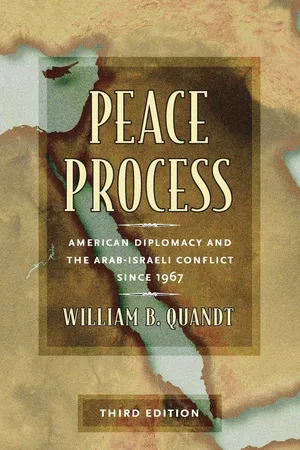
Updated through the first term of President George W. Bush, the latest edition of this classic work analyzes how each U.S. president since Lyndon Johnson has dealt with the complex challenge of Arab-Israeli peacemaking. There have been remarkable successes—such as the Egyptian-Israeli peace treaty—frustrating failures, and dangerous wars along the way. This book helps to situate the current Middle East crisis in historical context and point to some possible ways out of the impasse between Israelis and Palestinians. Quandt suggests a clear U.S. commitment to a two-state solution—one that would assure Israel of security and peace within the 1967 treaty-established borders, offer the Palestinians an early end to Israeli occupation of Gaza and most of the West Bank, and establish both a Jewish and Arab Jerusalem.
Written especially for classroom use, Peace Process is also an invaluable resource for policymakers and anyone interested in this vital region of the world.
Praise for previous editions of Peace Process
"Clearly written, carefully balanced and comprehensive in scope . . . should prove invaluable to all serious students of American foreign policy."—New York Times Book Review
"A major work, whether judged by the standards of classical diplomatic history or modern political science."—Foreign Affairs
"Provides fresh insights into the complexities of creating the process and defining the substance of American foreign policymaking."—Survival
"While objective to a fault, Quandt writes with an insider's knowledge of policymaking and decisions taken at the highest levels of government."—Middle East Policy
"Both a history and analysis of an evolving relationship between Israel and its Arab opponents."—Choice
"A major contribution to understanding the complexity of U.S. presidents' handling of the [Arab-Israeli] conflict. It should be compulsory reading for anyone studying the Middle East conflict, peacemaking and conflict resolution."—Journal of Peace Research
eBook - PDF
Peace Process
American Diplomacy and the Arab-Israeli Conflict since 1967
- 551 pages
- English
- PDF
- Available on iOS & Android
eBook - PDF
About this book
Information
Table of contents
- Front Cover
- Title Page
- Copyright Information
- Table of Contents
- Preface to the Third Edition
- Introduction
- Part I: The Johnson Presidency
- Yellow Light: Johnson and the Crisis of May-June 1967
- Part Two: The Nixon and Ford Presidencies
- Cross-Purposes: Nixon, Rogers, and Kissinger, 1969-72
- Kissinger's Diplomacy: Stalemate and War, 1972-73
- Step by Step: Kissinger and the Disengagement Agreements, 1974-76
- Part Three: The Carter Presidency
- Ambition and Realism: Carter and Camp David, 1977-78
- Forging Egyptian-Israeli Peace
- Part Four: The Reagan and Bush Presidencies
- Cold War Revival: Who's in Charge?
- Back to Basics: Shultz Tries Again
- Getting to the Table: Bush and Baker, 1989-92
- Part Five: The Clinton Presidency
- Clinton the Facilitator
- Clinton's Finale: Distractions, Hesitation, and Frustration
- Part Six: The Second Bush Presidency
- "With Us or Against Us": The Warrior President in His First Term
- Part Seven: Conclusion
- Challenges Facing Future Administrations
- Notes
- Selected Bibliography
- Index
- Back Cover
Trusted by 375,005 students
Access to over 1.5 million titles for a fair monthly price.
Study more efficiently using our study tools.
Frequently asked questions
Yes, you can cancel anytime from the Subscription tab in your account settings on the Perlego website. Your subscription will stay active until the end of your current billing period. Learn how to cancel your subscription
No, books cannot be downloaded as external files, such as PDFs, for use outside of Perlego. However, you can download books within the Perlego app for offline reading on mobile or tablet. Learn how to download books offline
Perlego offers two plans: Essential and Complete
- Essential is ideal for learners and professionals who enjoy exploring a wide range of subjects. Access the Essential Library with 800,000+ trusted titles and best-sellers across business, personal growth, and the humanities. Includes unlimited reading time and Standard Read Aloud voice.
- Complete: Perfect for advanced learners and researchers needing full, unrestricted access. Unlock 1.5M+ books across hundreds of subjects, including academic and specialized titles. The Complete Plan also includes advanced features like Premium Read Aloud and Research Assistant.
We are an online textbook subscription service, where you can get access to an entire online library for less than the price of a single book per month. With over 1.5 million books across 990+ topics, we’ve got you covered! Learn about our mission
Look out for the read-aloud symbol on your next book to see if you can listen to it. The read-aloud tool reads text aloud for you, highlighting the text as it is being read. You can pause it, speed it up and slow it down. Learn more about Read Aloud
Yes! You can use the Perlego app on both iOS and Android devices to read anytime, anywhere — even offline. Perfect for commutes or when you’re on the go.
Please note we cannot support devices running on iOS 13 and Android 7 or earlier. Learn more about using the app
Please note we cannot support devices running on iOS 13 and Android 7 or earlier. Learn more about using the app
Yes, you can access Peace Process by William B. Quandt in PDF and/or ePUB format, as well as other popular books in Geschichte & Geschichte des Nahen Ostens. We have over 1.5 million books available in our catalogue for you to explore.