eBook - ePub
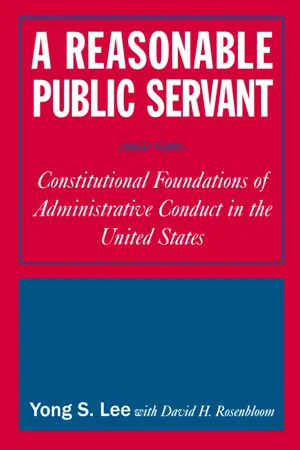
A Reasonable Public Servant
Constitutional Foundations of Administrative Conduct in the United States
- 299 pages
- English
- ePUB (mobile friendly)
- Available on iOS & Android
eBook - ePub
A Reasonable Public Servant
Constitutional Foundations of Administrative Conduct in the United States
About this book
An essential text for PA courses on Human Resource Management as well as Public Management and Law, this book illuminates the role of the reasonable public servant, who strives to perform authorized functions efficiently, yet in a manner that aligns with constitutional values embodied in the Bill of Rights. "A Reasonable Public Servant" provides a comprehensive review of Supreme Court opinions in explaining the reasonable conduct of a public servant and the development of clearly established constitutional and statutory rights that a reasonable public servant is expected to observe: property rights; procedural due process; freedom of critical speech; privacy; equal protection; and anti-discrimination laws. The author relies on the Court's opinions as the exemplar of public reason, and pays close attention to the manner in which the Court balances among competing value priorities - for example, the rights of a public servant as an employee as well as an individual citizen, and the efficiency needs of the government as an employer as well as a sovereign state. This book's detailed appendices include the U.S. Constitution, the Bill of Rights, and Title VII of the Civil Rights Act of 1964.
Trusted by 375,005 students
Access to over 1.5 million titles for a fair monthly price.
Study more efficiently using our study tools.
Part I
Constitutional Foundations of Public Service
1
The Constitution and a Reasonable Public Servant
In November 2004, the U.S. Office of Personnel Management (OPM) arranged for seventy federal executives to visit the National Constitution Center on Independence Mall in Philadelphia, Pennsylvania (Barr 2004). The executives were on a management retreat. What could they gain from visiting a museum dedicated to the U.S. Constitution? What does the Constitution have to do with public management? OPM Director Kay Coles James gave a short answer. The executives’ visit was part of a wider initiative to bring “heightened awareness and respect” to the oath all federal employees take to “support and defend the Constitution of the United States against all enemies, foreign and domestic” (Barr 2004, B2). A longer answer is that today “a reasonably competent” public servant “should know the law governing his [or her] conduct” (Harlow v. Fitzgerald 1982, 819). Much of that law is constitutional law; that is, law made by federal judges in the course of interpreting the Constitution’s words and applying them in individual court cases. Similarly, state judges make state constitutional law through their interpretation of the state constitutions. Today, constitutional law comprehensively regulates the public service at all levels of government in the United States. As James suggests, public servants should be guided by the Constitution in their decision making and other actions.
Understanding what the Constitution demands of them is a matter of basic job competence for public servants. This fundamentally sets them apart from the world of private sector management, whether for profit or not for profit. The Constitution regulates public servants’ dealings with clients, customers, subordinate employees, prisoners, patients confined to public mental health facilities, contractors, and individuals involved in “street-level” encounters (such as police stops, public school disciplinary actions, and health and workplace safety inspections) (Rosenbloom and O’Leary 1997). By contrast, the Constitution has no application to purely private relationships and activities other than 1) barring slavery and involuntary servitude (Thirteenth Amendment) and 2) restricting the actions of a limited class of private entities that are considered state (“governmental”) actors for constitutional purposes (Gilmour and Jensen 1998; Rosenbloom and Piotrowski 2005). When a public manager disciplines a subordinate—even a probationary one—for his or her speech, associations, religious displays in the workplace, or other constitutionally protected conduct, it raises constitutional issues that are completely alien to management in the private sector. Private sector employees might learn constitutional law in order to be good citizens; public servants must know it to be competent employees. A corollary is that because constitutional law plays a major role in the public service, so do the judges who make that law.
Achieving competence in the constitutional aspects of public service requires at least two types of significant study and effort. First, one must understand the broad principles on which constitutional law rests. These are discussed in the remainder of this chapter. Second, and a more comprehensive challenge, one must learn the constitutional requirements that currently govern public service in the United States. Parts I and II of this book provide the analysis and information necessary to understand how constitutional law has to be factored into the reasonable public servant’s job performance. They explain the potential liability of public servants and their employers for violating individuals’ constitutional rights and what constitutional procedural due process, free speech, privacy, and equal protection require. Part III takes the discussion of the reasonable public servant and equality further by analyzing federal policies against discrimination and sexual harassment in employment.
Although “[t]he Constitution is largely a document of the imagination” (Kurland 1976, 7), gaining an understanding of a few of its fundamental principles goes a long way toward making constitutional law relatively concrete and accessible. Three of these principles are especially important: contractarianism, incursions on constitutional rights must be necessary and bounded, and the Constitution is always a work in progress.
Contractarianism
From the perspectives of a public administrator seeking reasonable competence in constitutional law, the most fundamental principle is that the Constitution is a contract among “we the people” that both empowers and limits government. Empowerment enables the federal government to make and enforce laws regarding the economy, national security and defense, foreign affairs, and much more. However, as broad as the federal government’s powers may be, they are limited to those granted to it by the Constitution. Consequently, the federal government is said to be one of “enumerated” powers. The states’ powers, by contrast, are not limited to those that “we the people” delegated to them through the Constitution. They have “residual” or “reserve” powers associated with political sovereignty. The Tenth Amendment succinctly captures these principles: “The powers not delegated to the United States by the Constitution, nor prohibited by it to the States, are reserved to the States respectively, or to the people.”
A great deal of constitutional law assesses the scope of the federal government’s enumerated powers, such as the congressional power “[t]o regulate Commerce with foreign Nations, and among the several States, and with the Indian tribes” (Article I, section 8, clause 3). Historically, the federal courts have adjusted the scope of federal powers in conjunction with changes in the economy, society, and prevailing political ideas and ideologies.
Within the framework of the powers available to the federal government, empowerment also determines the roles and authority of Congress, the president, and the federal judiciary. Again, there are limits and voluminous constitutional interpretation. For instance, Article II vests the “executive power” in the president without saying precisely what that power includes. Some limits are found directly in the Constitution itself. The president cannot establish executive offices on his own, because these must be established by law (Article II, section 2, clause 2). Neither may the president withdraw money from the treasury except pursuant to statute (Article I, section 9, clause 7). Other limits on presidential power are established by judicial decision. For example, the president cannot authorize the indefinite detention of U.S. citizens considered to be enemy combatants without affording them a measure of constitutional procedural due process (Hamdi v. Rumsfeld 2004).
Many of the limitations on governmental power are framed as individual rights rather than as matters of federalism and the separation of powers. For instance, the First Amendment mentions “the right of the people peaceably to assemble”; the Fourth Amendment reads, “The right of the people to be secure in their persons, houses, papers, and effects, against unreasonable searches and seizures, shall not be violated”; and the Sixth guarantees “the right to a speedy and public trail, by an impartial jury.” More generally, the first ten amendments, which became effective in 1791, are called the Bill of Rights. In addition to the clauses mentioned above, the Bill of Rights guarantees freedom of religion, speech, and the press (First Amendment); “the right of the people to keep and bear Arms” (Second); the protections against double jeopardy, self-incrimination, the deprivation of “life, liberty, or property, without due process of law” (Fifth); and protection against excessive bail and fines and “cruel and unusual punishments” (Eighth). The Fourteenth Amendment, adopted in 1868, includes the right to “equal protection of the laws.” It also prohibits the states from depriving “any person of life, liberty, or property, without due process of law.” Incrementally, the Fourteenth Amendment’s due process clause—especially the term liberty—has been interpreted by the federal courts to “incorporate” (i.e., include) much of the Bill of Rights and apply its restrictions to the states and their political subdivisions.
Two points are particularly important regarding the nature of rights in the contract formed by “we the people.” First, they are framed as limitations on government action, not as positive actions government is obligated to take. The Bill of Rights is largely a list of “shall nots.” The rights protected by it are sometimes called “negative liberties,” or essentially the right to be left alone. At the federal level, positive rights, such as those to social welfare benefits, fair wages, and collective bargaining, are based on statute. The government is not constitutionally obligated to provide them, though the Constitution is relevant to their requirements for eligibility and termination. The state constitutions also frame rights in negative terms. However, they may also convey positive rights, such as the right to public education. In short, the Constitution provides a right to be secure in one’s house, but not a right to housing; a right to freedom of religion, but not to a church; a right to free speech, but not the means to make oneself heard; and so forth.
Second, and related, whereas the Constitution’s Preamble indicates that “We the People” did “ordain and establish” the constitutional government, we did not create all the rights that the Constitution protects. In constitutional theory, many of these rights preexisted formation of the government, or even civil society. The reason the Bill of Rights tells the government to leave us alone is that we already have many of the rights it mentions and do not want them to be abridged. The antecedent character of rights is perhaps nowhere stated more clearly than in the Ninth Amendment, which admonishes that “The enumeration in the Constitution of certain rights shall not be construed to deny or disparage others retained by the people.” Note that the amendment does not say the establishment or creation of certain rights, just the enumeration (or listing) of certain ones.1 Aside from their enumeration, there is nothing fundamentally different about these rights from the “others retained by the people.” Many of the enumerated ones are fundamental to liberty, but the amendment indicates that the nonenumerated rights should not be “disparaged.” Consequently, they must also be important, perhaps equally so. One may wonder whether, even in 1791, the right to bear arms was necessarily more important than the nonenumerated right to “bear and beget” children “free from unwarranted governmental intrusion” (Cleveland Board of Education v. LaFleur 1974, 640).
Enumerated rights are in the Constitution, but where can one find the nonenumerated ones? They cannot be derived from the state constitutions because the U.S. Constitution is the “supreme Law of the Land” (Article VI). They are perhaps best thought of as “natural rights.” They gain recognition in constitutional law as judges define them, often guided by centuries of Anglo-American common law2 in an effort to protect liberty. The natural rights background of U.S. constitutional theory is famously stated in the Declaration of Independence: “We hold these Truths to be self-evident, that all Men are created equal, that they are endowed by their Creator with certain unalienable Rights, that among these are Life, Liberty, and the Pursuit of Happiness—That to secure these Rights, Governments are instituted among Men, deriving their just Powers from the Consent of the Governed, that whenever any Form of Government becomes destructive of these Ends, it is the Right of the People to alter or to abolish it, and to institute new Government.…” Natural rights are not a constitutional creation. They are the birthright of all men and women, though they may go unrealized due to violation by other people and oppressive governments.
Because a core purpose of government is to protect rights, as the Declaration states, government cannot legitimately abridge them lightly, even when the benefits vastly outweigh the costs. This is the essence of contractarian constitutional theory and the constitutional law that flows from it. There is no better example than the “Takings Clause” of the Fifth Amendment, which reads “nor shall private property be taken for public use without just compensation.” No matter how many people might benefit from taking a piece of someone’s land, say to build a dam or a highway, government cannot have it without paying a fair price. If government cannot afford the property, then it cannot be taken even though the loss of benefits to the common good may be substantial.
When applied via the takings clause, such contractarian logic may seem unexceptional. Why should individual property owners shoulder an exceptional burden for the production of public goods? However, contractar...
Table of contents
- Cover
- Half Title
- Title Page
- Copyright Page
- Dedication
- Table of Contents
- Foreword
- Preface and Acknowledgments
- Part I. Constitutional Foundations of Public Service
- Part II. Constitutional Rights of a Public Servant
- Part III. Civil Rights of a Public Servant
- Part IV. Conclusion
- Appendix I: The Constitution of the United States of America
- Appendix II: The Bill of Rights and Additional Amendments
- Appendix III: Title VII of the Civil Rights Act of 1964, as Amended
- Glossary
- Index
- About the Authors
Frequently asked questions
Yes, you can cancel anytime from the Subscription tab in your account settings on the Perlego website. Your subscription will stay active until the end of your current billing period. Learn how to cancel your subscription
No, books cannot be downloaded as external files, such as PDFs, for use outside of Perlego. However, you can download books within the Perlego app for offline reading on mobile or tablet. Learn how to download books offline
Perlego offers two plans: Essential and Complete
- Essential is ideal for learners and professionals who enjoy exploring a wide range of subjects. Access the Essential Library with 800,000+ trusted titles and best-sellers across business, personal growth, and the humanities. Includes unlimited reading time and Standard Read Aloud voice.
- Complete: Perfect for advanced learners and researchers needing full, unrestricted access. Unlock 1.5M+ books across hundreds of subjects, including academic and specialized titles. The Complete Plan also includes advanced features like Premium Read Aloud and Research Assistant.
We are an online textbook subscription service, where you can get access to an entire online library for less than the price of a single book per month. With over 1.5 million books across 990+ topics, we’ve got you covered! Learn about our mission
Look out for the read-aloud symbol on your next book to see if you can listen to it. The read-aloud tool reads text aloud for you, highlighting the text as it is being read. You can pause it, speed it up and slow it down. Learn more about Read Aloud
Yes! You can use the Perlego app on both iOS and Android devices to read anytime, anywhere — even offline. Perfect for commutes or when you’re on the go.
Please note we cannot support devices running on iOS 13 and Android 7 or earlier. Learn more about using the app
Please note we cannot support devices running on iOS 13 and Android 7 or earlier. Learn more about using the app
Yes, you can access A Reasonable Public Servant by Lily Xiao Hong Lee,David H. Rosenbloom in PDF and/or ePUB format, as well as other popular books in Law & Sales. We have over 1.5 million books available in our catalogue for you to explore.