- 176 pages
- English
- ePUB (mobile friendly)
- Available on iOS & Android
eBook - ePub
About this book
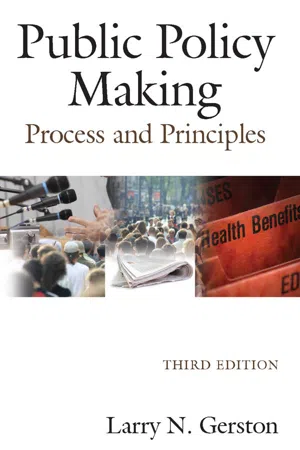
This brief text identifies the issues, resources, actors, and institutions involved in public policy making and traces the dynamics of the policymaking process, including the triggering of issue awareness, the emergence of an issue on the public agenda, the formation of a policy commitment, and the implementation process that translates policy into practice. Throughout the text, which has been revised and updated, Gerston brings his analysis to life with abundant examples from the most recent and emblematic cases of public policy making. At the same time, with well-chosen references, he places policy analysis in the context of political science and deftly orients readers to the classics of public policy studies. Each chapter ends with discussion questions and suggestions for further reading.
Information
1
The Context of Public Policy
Ever since 1956, Congress has periodically enacted legislation to provide the funding framework for interstate highway transportation. Few would argue with this commitment, given the necessity of roads to move massive amounts of commerce and people throughout the nation and points beyond. In 2005, after two years of contentious debate, Congress passed the Safe, Accountable, Flexible, Efficient Transportation Equity Act—A Legacy for Users (SAFETEA-LU). The bill authorized $286.4 billion over six years, and was passed by lopsided margins of 412–8 in the House of Representatives and 91–4 in the Senate. President George W. Bush signed the bill into law on August 10, 2005.
The policy-making process leading up to this landmark legislation swirled in contradictions. To begin with, the nation was already drowning in red ink, thanks to the combination of recently passed mammoth tax cuts and expensive wars in Afghanistan and Iraq. With these commitments, the national debt soared from $5.7 trillion to $8 trillion during the first four years of the Bush administration.1 Republicans, previously known for being proponents of smaller government, had led the way in expanding several domestic programs. Along with the general provisions, the highway bill contained more than 6,300 earmarks, or special projects, including the infamous “bridge to nowhere” in Alaska that became presidential campaign fodder in 2008.2 During the “mark up,” the process of determining what would and what would not be included in the package, Republican President Bush promised to veto any transportation bill beyond $258 billion, but in the end the president acquiesced to another $28.4 billion. The Democrats also sent mixed messages. Despite their reputation as the political party dedicated to environmentalism, they were only too happy to enact a bill that would supply tens of thousands of highway construction jobs—even if that meant more air pollution from more automobiles on the road. Contradictory messages from both sides notwithstanding, in the end the bill emerged with near unanimous support.
Welcome to the world of public policy making, where more times than not the political environment is framed in confusion, contradictions, and consternation. In order to make policy, decision makers often merge conflicting objectives into acceptable outcomes. It’s not a pretty process; yet, whatever difficulties the student or practitioner may have in understanding the concept of policy making, it is a process that must be reckoned with.
Public policy is a relatively new subfield in political science. Its development as an area of study emerged out of the recognition that traditional analyses of government decisions were incomplete descriptions of political activities. As the relationships between society and its various public institutions have become more complex and more interdependent, the need has developed for more comprehensive assessments of what governments do, how they put their decisions into practice, and why they pursue some policy alternatives over others.
Focus on the public policy process has become increasingly important with the emergence of modern society, technological innovation, and burgeoning international transactions. Prior to the seventeenth and eighteenth centuries, most polities were consumed with self-survival and potential threats from foreign enemies. Political organization and infrastructure were largely irrelevant for obvious reasons: there were few decisions to make, and those who made them were dictators, monarchs, small bands of rulers, or unrepresentative legislative bodies. During the nineteenth century, representative government began to evolve in some parts of the world. With increased political participation by larger portions of the public, government decisions assumed greater importance and legitimacy. Clashing values with respect to social, economic, and political questions had profound implications for politics and government. With these changes, governments began to focus on the problems of their citizens.
These changes did not go unnoticed by those who studied political phenomena in the United States. As this young country matured, so did the approaches to the study of government and politics. For the first half of the twentieth century, American political scientists were content to analyze government in the context of its three major branches: the executive, the legislative, and the judicial.3 While such studies were instructive about the powers of institutions, they were less than complete descriptions of the political process.
Fifty years later, political scientists expanded their perspectives of government activities. Some examinations centered on the informal relationship between interest groups and government, leading one scholar to conclude that political institutions “operate to order the relationships among various groups in society.”4 Other studies focused on the interdependence between government activities and diverse forces such as political parties or public opinion. Out of this evolution came the recognition of the symbiotic association between government and politics.5
Recent assessments in political science offer yet another slant on the powers and abilities of government bodies. Some contemporary scholars now argue that government is not designed to be merely responsive; nor, they assert, is government even neutral or benign. Instead, these writers contend that government institutions and officeholders possess powerful tools for altering traditional arrangements. Globalization—the explosion of economic, political, and technological relationships—has added yet another layer of interaction not only within but between nations.6 In light of the effects that policy makers have on society, we have come to appreciate that what comes out of government is as important as what goes in.7 This thinking brings us to the concept of public policy. Viewed as a multifaceted approach to the study of politics, public policy making shows the workings of modern government and the flow of political life.
In Search of a Framework
As an approach to understanding political change, public policy has almost as many definitions as there are policy issues. Institutionalists, those who concern themselves with the formal, observable building blocks of government, view public policy as a benign component of identified rules and procedures. As Lawrence Friedman writes, “in societies like ours … there arises an enormous demand—a need—for formal controls which have to come from some sort of organized government.”8 Behaviorists, scholars consumed with what people actually do, interpret public policy as the result of the interaction of powerful forces, some of which may be far removed from the halls of government. To that end, B. Guy Peters concludes that public policies emerge from a large number of programs, legislative intentions, and organizational interactions that affect the daily lives of citizens.9
The debate over parameters is more than an academic exercise or game, for it is the word process that differentiates public policy from other approaches to government and politics. A process is dynamic and ongoing and, as such, is constantly subject to reevaluation, cessation, expedition, or even erratic movement. Conceptually speaking, then, policy making exists in an open environment with neither a beginning nor an end, and with virtually no boundaries. What seems inconceivable as a policy issue one day may well be the focal point of heated debate the next. Within this nomadic context, our task is to examine public policy making as a concept, as a process, and as a mechanism of political change.
While there is little concurrence among scholars on the framework of the public policy–making arena, they tend to agree on a core of basic assumptions. Most obviously, government activities and commitments are crucial to the meaning of public policy. At the national level, defense, transportation, and agriculture are but a few major areas of historical concern to government. Other areas of interest, such as space exploration, the environment, biotechnology, and homeland security, are relatively new government concerns. However, the history of government engagement with a policy area is not as important as the attention itself. Without government involvement and direction, there is no public policy. States and local governments have public policy concerns in areas such as public education, transportation, and public safety. Some issues, moreover, slice through several levels of government.
Another point upon which analysts agree is that society and its resources are extensively affected by public policies. Whether we speak of consumers, the disabled, automobile drivers, handgun owners, or acquired immune deficiency syndrome (AIDS) victims, each of these constituencies and countless others are likely to be affected by many public policies. Some policies, such as defense, taxation, or public education, affect almost everyone. In fact, most people’s lives are directly influenced by many public policies simultaneously. However, only a few public policy commitments consciously concern people at any one time.
Finally, virtually all students and practitioners of public policy concur that policy making is a process. The search for, debate about, development of, application of, and evaluation of a given policy spring from a continuum of events, with a beginning that is almost impossible to pinpoint and an end that is rarely permanent. As Deborah Stone writes, “policy is more like an endless game of Monopoly than a bicycle repair.”10 Whatever the issue in question, scholars agree that public policy making has a perpetual, dynamic, and evolutionary quality.
A Working Definition of Public Policy
Aside from these basic areas of consensus, policy analysts differ greatly on the basis and limits of the public policy field. Consider three contemporary definitions from leading political scientists: Thomas Dye characterizes public policy as the study of “what governments do, why they do it, and what difference it makes.”11 Operating in a wider context, Michael Kraft and Scott Furlong add, public policy “is a course of government action (or inaction) taken in response to social problems.”12 Conversely, David Robertson and Dennis Judd take a more restrained course by casting government as the independent variable—that is, the crucial intersection of change—not only in terms of crafting current policies but with respect to future demands for different policies.13
These approaches and others all have merit and individually address key components of the policy-making process. However, for our purposes, we seek a definition that responds to the actions and exchanges of both people and governments in a dynamic, interdependent manner. Thus, public policy is defined here as the combination of basic decisions, commitments, and actions made by those who hold or influence government positions of authority. In most instances, these arrangements result from interactions among those who demand change, those who make decisions, and those who are affected by the policy in question. The determinations made by those in positions of legitimate authority—most commonly, one or more public offices in government—are subject to possible redirection in response to pressures from those outside government as well as from others within government.
The linkage between policy makers and policy receivers is vital to understanding the meaning and power of public policy. In a very direct sense, society benefits or suffers because of government activity. Sometimes, both experiences may occur simultaneously. At a minimum, the more controversial a proposed policy or policy area, the more likely it is that one part of society will benefit at the expense of another segment. Furthermore, the variety of potential public policy questions is so great that some government decisions emerging from the political process have greater impacts on society than others. The simple fact is that each public policy question has its own unique impact on those who lie in its path.
Public policies result from the blend of politics and government. David Easton defines politics as “the authoritative allocation of values.”14 Public policy, then, is as important in defining prevailing values (politics) as it is in defining solutions to prevailing problems (through government). In a very real sense, values predetermine public policies, although the values of some parts of society will often be more influential on a policy than the values of others.
Components of the Public Policy Process
The methods of public policy analysis differ from those used in the “hard” sciences. Social science revolves around needs, emotions, unanticipated events, and a good deal of irrationality. These characteristics are extremely difficult to quantify or duplicate, and they rarely produce consensus regarding any order of importance or rank. Such is not the case in other disciplines.
Although the formulas themselves may be complicated or esoteric, the laws of physics, mathematics, and other sciences have a predictabil...
Table of contents
- Cover
- Half Title
- Title Page
- Copyright Page
- Dedication
- Table of Contents
- Preface to the Third Edition
- Chapter 1 The Context of Public Policy
- Chapter 2 Triggering Mechanisms: Catalysts for Public Policies
- Chapter 3 The Public Agenda: Focal Point for Policy Decisions
- Chapter 4 The Policy Makers: Roles and Realities
- Chapter 5 Implementation: Converting Policy Commitments into Practice
- Chapter 6 Evaluation: Assessments and Directions
- Chapter 7 Public Policy Making in an Evolutionary Context
- Notes
- Index
- About the Author
Trusted by 375,005 students
Access to over 1.5 million titles for a fair monthly price.
Study more efficiently using our study tools.
Frequently asked questions
Yes, you can cancel anytime from the Subscription tab in your account settings on the Perlego website. Your subscription will stay active until the end of your current billing period. Learn how to cancel your subscription
No, books cannot be downloaded as external files, such as PDFs, for use outside of Perlego. However, you can download books within the Perlego app for offline reading on mobile or tablet. Learn how to download books offline
Perlego offers two plans: Essential and Complete
- Essential is ideal for learners and professionals who enjoy exploring a wide range of subjects. Access the Essential Library with 800,000+ trusted titles and best-sellers across business, personal growth, and the humanities. Includes unlimited reading time and Standard Read Aloud voice.
- Complete: Perfect for advanced learners and researchers needing full, unrestricted access. Unlock 1.5M+ books across hundreds of subjects, including academic and specialized titles. The Complete Plan also includes advanced features like Premium Read Aloud and Research Assistant.
We are an online textbook subscription service, where you can get access to an entire online library for less than the price of a single book per month. With over 1.5 million books across 990+ topics, we’ve got you covered! Learn about our mission
Look out for the read-aloud symbol on your next book to see if you can listen to it. The read-aloud tool reads text aloud for you, highlighting the text as it is being read. You can pause it, speed it up and slow it down. Learn more about Read Aloud
Yes! You can use the Perlego app on both iOS and Android devices to read anytime, anywhere — even offline. Perfect for commutes or when you’re on the go.
Please note we cannot support devices running on iOS 13 and Android 7 or earlier. Learn more about using the app
Please note we cannot support devices running on iOS 13 and Android 7 or earlier. Learn more about using the app
Yes, you can access Public Policy Making by Larry N. Gerston in PDF and/or ePUB format, as well as other popular books in Politics & International Relations & Economic Theory. We have over 1.5 million books available in our catalogue for you to explore.