- 196 pages
- English
- ePUB (mobile friendly)
- Available on iOS & Android
eBook - ePub
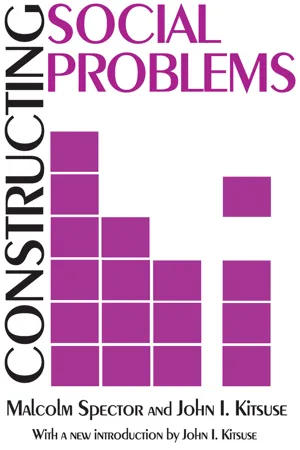
Constructing Social Problems
About this book
There is no adequate definition of social problems within sociology, and there is not and never has been a sociology of social problems. That observation is the point of departure of this book. The authors aim to provide such a definition and to prepare the ground for the empirical study of social problems. They are aware that their objective will strike many fellow sociologists as ambitious, perhaps even arrogant. Their work challenges sociologists who have, over a period of fifty years, written treatises on social problems, produced textbooks cataloguing the nature, distribution, and causes of these problems, and taught many sociology courses. It is only natural that the authors' work will be viewed as controversial in light of the large literature which has established a "sociology of" a wide range of social problems-the sociology of race relations, prostitution, poverty, crime, mental illness, and so forth. In the 1970s when the authors were preparing for a seminar on the sociology of social problems, their review of the "literature" revealed the absence of any systematic, coherent statement of theory or method in the study of social problems. For many years the subject was listed and offered by university departments of sociology as a "service course" to present undergraduates with what they should know about the various "social pathologies" that exist in their society. This conception of social problems for several decades has been reflected in the substance and quality of the literature dominated by textbooks. In 'Constructing Social Problems', the authors propose that social problems be conceived as the claims-making activities of individuals or groups regarding social conditions they consider unjust, immoral, or harmful and that should be addressed. This perspective, as the authors have formulated it, conceives of social problems as a process of interaction that produces social problems as social facts in society. The authors further propose that this process and the social facts it produces are the data to be researched for the sociology of social problems. This volume will be of interest to those concerned with the discipline of sociology, especially its current theoretical development and growth.
Information
1
Introduction
There is no adequate definition of social problems within sociology, and there is not and never has been a sociology of social problems. That observation is the point of departure of this book. It is our aim to provide such a definition and to prepare the ground for the empirical study of social problems. We are cognizant that our opening statement will seem extreme, perhaps shocking, to sociologists who have, over a period of fifty years, written treatises on social problems, produced textbooks cataloging the nature, distribution, and causes of those problems, and devoted many years to teaching courses listed as social problems. Indeed, how is our statement to be justified in view of the large literature which has established a "sociology of" a wide range of social problems—the sociology of race relations, prostitution, poverty, crime, mental illness, and so forth?
The term "social problem" has itself been more a rubric for presenting sociological wisdom to undergraduates than the focus of theory and research of a specified subject matter. It may be helpful to illustrate this view with two definitions from current texts that illustrate the way "social problem" is treated as a technical term. Our first example not only strains the limits of grammar, but contains terms so abstract that we have no idea how they might be specified empirically. Birenbaum and Sagarin offer the following definition:
A social problem exists when the collective society is rent by, at the very least, a public recognition that there is a sector of society, represented by its practices, which threatens or prevents others or themselves from estab- lishing or maintaining their claims to membership.
(1972:16)
Raab and Selznick present a second example. Their definition reflects the good will of the concerned citizen, but lacks the precision and clarity that are essential to any technical definition.
A social problem exists when organized society's ability to order relationships among people seems to be failing; when its institutions are faltering, its laws are being flouted, the transmission of its values from one generation to the next is breaking down, the framework of social expectations is being shaken.
(1959:6)
What constitutes "collective society," or a "public recognition"; which "practices," and how do they constitute "threats"; which "relationships," and how do we know when they "fail"; when are institutions "faltering," laws being "flouted," and so on? We shall not belabor the point that these examples of definitions of social problems are imprecise and ambiguous. Suffice it to say, it is evident that the usual care and craft that sociologists exercise in their research and theoretical writings have not been applied to their work on social problems.
Let us consider the example of crime. Sociologists have posed a variety of questions about crime. They have produced typologies of different kinds of crimes and criminals, examined rates of crime over time and in different geographical areas, and have analyzed the characteristics that differentiate criminals from noncriminals in their search for explanations of crime. They have evaluated efforts to prevent crime as well as to rehabilitate criminals. More recently they have examined the interactions between criminals, their victims, and the police, and they have published ethnographic studies of various criminal occupations. These are all aspects of the sociology of crime.
None of these studies, however, require the definition of crime as a social problem, and none specifically use this concept in their analysis of crime. To put it another way, what is added to our understanding of crime by pointing out that it is a social problem? Nothing is added unless invoking the concept is based on an explicit consideration of the question, "Is crime a social problem, and if so, what constitutes the social problem of crime?"
Although an answer to the first part of the question might seem to be an emphatic yes, what is the answer to the second part? What is it that makes crime a social problem? Is it the absolute number of crimes? Is it the types of crime committed? Is it the increase in the rate of some crimes or of crime in general? Does crime become a social problem when "the streets are no longer safe at night"? Is crime considered a problem because the police are inefficient in solving crime? Is the issue police corruption as manifested in payoffs, bribes, shakedowns, protection rackets, and violence, or in the collusion between the police and organized criminals? Is it that the crimes of the powerful and prominent are ignored, that social class or racial inequities exist in the criminal justice system? Is it that victims of rape are callously treated, and racial, ethnic, or age groups are harassed and brutalized? Is the social problem of crime indicated by the leniency of the courts in sentencing convicted felons? Or, is it that the rights of the accused to the due process of law are abridged by the criminal justice system? Is crime to be considered a social problem on any or all of these grounds? If these questions had been as thoroughly researched as the "sociology of crime" discussed above, we might be able to discuss, not crime, but the social problem of crime.
One sociologist has argued that one type of crime—organized crime—is not a social problem. A close examination of his argument will clarify the distinction we wish to make between the study of crime and the study of the social problem of crime. Donald R. Cressey worked as a consultant to the National Crime Commission, especially on the Task Force on Organized Crime. He became convinced that the organized criminal activities of the Mafia are more costly to the American public than all other kinds of crime combined. Yet he also rioted that there was very little public awareness of these costs and dangers, and little demand that "something be done about" the Mafia. In short, Cressey argues that organized crime is not a social problem and offers the following analysis:
First, information on organized crime has, by and large, been presented to the public in a sensational manner. Police, well aware of the sensationalism present in televised Congressional hearings involving unsavory characters; in newspaper accounts of the activities of "muscle men," "gorillas, " and "meat hooks"; and in popular books about "The Mafia Menace, " say that the public is misled because the mass media insist on playing "cops and robbers" and "gang buster." Newspapermen find it virtually impossible to depict the participants as anything but gangsters who prey principally on each other. For example, there are a few newspaper accounts in which Mr. Lucchese is called "Mr. Lucchese" or Mr. Ricca is called "Mr. Ricca. ..." "Mr. Lucchese," when he was alive, could possibly have been someone who was corrupting my labor union, but "Three Finger Brown" could only have been a somewhat fictitious character in a "cops and robbers" story. Similarly, usury is almost always called "the juice racket," and this terminology lets the reader believe that the activity has nothing to do with him or the safety of his community. . . . Most of us can understand the seriousness of usury, bankruptcy fraud, and bribery, but we have a hard time realizing that our friends and neighbors are, in the long run, the victims of "the juice racket, " "the scam racket, " or "the fix. " Probably of even more relevance to any prevailing skepticism is the fact that the murder of a La Cosa Nostra member by men acting under orders from the victim's "family Boss" is invariably described by the mass media as a "hit" or a "gangland slaying." In fact, a high proportion of such murders are executions of members who have secretly left the criminals' camp to join the forces of law, order, and decency. Calling the murder a "hit" makes it all but impossible for the reader to realize that control of a community's economic and political affairs by an alliance of criminals is serious business, certainly as serious as would be control of these affairs by Communists.
(1967:104-5)
Cressey then argues that organized crime is not defined as a social problem and that it probably will not soon be so defined. He presents three reasons why individuals, the general public, or civic groups do not demand reform or elimination of organized crime, do not aid the police in such work, and do not perceive the liabilities and dangers posed by La Cosa Nostra:
First, the American confederation of criminals thrives because a large minority of citizens demand the illicit goods and services that it has for sale. . . . Organized crime cannot become a social problem until a much broader segment of society perceives that the cost of the services pro- vided is too high.
(1967:107)
Second, a large proportion of the persons demanding illicit goods and services believe that they are being supplied by criminals who are unorganized and who, for that matter, are not very criminal. A nice old man who accepts a few bets from the patrons of his restaurant does not seem very dangerous. . . . "Gambling" cannot become a social problem until it is widely known that bookmakers are not gamblers . . . "organiza- tion, " not gambling, is the phenomenon to worry about.
(1967:108)
Third, "organized crime" is not against the law. What is against the law is smuggling and selling narcotics, bookmaking, usury, murder, extortion, conspiracy, and the like. . . . For this reason, data cannot be routinely compiled on organized crime in the way that they are routinely compiled on, say, burglary and automobile theft. But the issue involves more than questions of assembling data. The legal lacunae permit directors of illicit businesses to remain immune from arrest, prosecution, and imprisonment unless they themselves violate specific criminal laws such as those prohibiting individuals from selling narcotics ... it makes it difficult for a wide segment of society to perceive "organized crime" as a social problem.
(1967:108-9)
Cressey's analysis is more than a description of the absence of widespread definitions of organized crime as a social problem. He clearly believes that "objectively" organized crime exists, and his analysis is in part a complaint that it is not "subjectively" recognized and treated as if it existed. He clearly separates the exist...
Table of contents
- Cover
- Half Title
- Title
- Copyright
- Contents
- Acknowledgments
- Introduction to the Transaction Edition
- Chapter 1 Introduction
- Chapter 2 Functional and Normative Definitions
- Chapter 3 The Value-Conflict School
- Chapter 4 Social Problems and Deviance: Some Parallels
- Chapter 5 Social Problems as Claims-Making Activities
- Chapter 6 The Description and Analysis of Social Problems Activities: An Extended Empirical Example
- Chapter 7 The Natural History of Social Problems
- Chapter 8 Teaching Social Problems
- References
- Name Index
- Subject Index
Trusted by 375,005 students
Access to over 1.5 million titles for a fair monthly price.
Study more efficiently using our study tools.
Frequently asked questions
Yes, you can cancel anytime from the Subscription tab in your account settings on the Perlego website. Your subscription will stay active until the end of your current billing period. Learn how to cancel your subscription
No, books cannot be downloaded as external files, such as PDFs, for use outside of Perlego. However, you can download books within the Perlego app for offline reading on mobile or tablet. Learn how to download books offline
Perlego offers two plans: Essential and Complete
- Essential is ideal for learners and professionals who enjoy exploring a wide range of subjects. Access the Essential Library with 800,000+ trusted titles and best-sellers across business, personal growth, and the humanities. Includes unlimited reading time and Standard Read Aloud voice.
- Complete: Perfect for advanced learners and researchers needing full, unrestricted access. Unlock 1.5M+ books across hundreds of subjects, including academic and specialized titles. The Complete Plan also includes advanced features like Premium Read Aloud and Research Assistant.
We are an online textbook subscription service, where you can get access to an entire online library for less than the price of a single book per month. With over 1.5 million books across 990+ topics, we’ve got you covered! Learn about our mission
Look out for the read-aloud symbol on your next book to see if you can listen to it. The read-aloud tool reads text aloud for you, highlighting the text as it is being read. You can pause it, speed it up and slow it down. Learn more about Read Aloud
Yes! You can use the Perlego app on both iOS and Android devices to read anytime, anywhere — even offline. Perfect for commutes or when you’re on the go.
Please note we cannot support devices running on iOS 13 and Android 7 or earlier. Learn more about using the app
Please note we cannot support devices running on iOS 13 and Android 7 or earlier. Learn more about using the app
Yes, you can access Constructing Social Problems by Malcolm Spector,John I. Kitsuse in PDF and/or ePUB format, as well as other popular books in Social Sciences & Social Science Research & Methodology. We have over 1.5 million books available in our catalogue for you to explore.