eBook - ePub
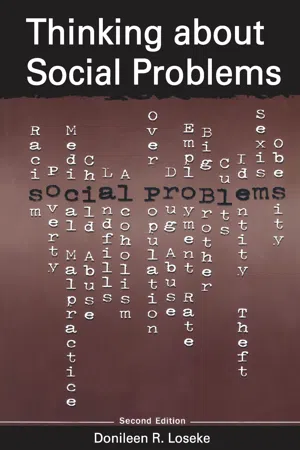
Thinking About Social Problems
An Introduction to Constructionist Perspectives
- 224 pages
- English
- ePUB (mobile friendly)
- Available on iOS & Android
eBook - ePub
Thinking About Social Problems
An Introduction to Constructionist Perspectives
About this book
The new second edition of this distinctive and widely adopted textbook brings into the classroom an overview of how images of social problems can shape not only public policy and social services, but also the ways in which we make sense of ourselves and others. It introduces two primary changes. First, some attention is devoted to the "new social movements" that emphasize social change through identity transformation rather than through structural change. Second, the text now also looks more closely at the importance of emotions in constructing public consciousness of social problems.When the first edition was published, Teaching Sociology noted, "Loseke does a superb job explaining the relationship between sociology and social problems in a text that is very well research and engaging, yet with tremendous attention to detail and accuracy... [W]ould provide a solid base for any social problems class." Contemporary Sociology wrote that the book is "engagingly well written in a personal, unpretentious style, and well informed by the author's knowledge of the professional literature."
Information
I
Issues in Studying Social Problems
1
Examining Social Problems
It’s 8:45 A.M., September 11, 2001. I’m thinking about examples of social problems to use in my class today while drinking coffee and watching the Today Show. This program is loaded with possibilities. Al talked about a tropical storm heading for my home in Tampa. Matt talked with a scientist about the health problems of elderly people who can’t afford their prescription medications. Katie talked with a representative of a group trying to stop the government from opening up huge areas in Alaska for oil drilling. I’ve seen a commercial for an upcoming Dateline challenging the effectiveness of school vouchers in giving students better education. So many possible examples of social problems. But in the middle of a sentence quizzing Congressman Condit’s lawyer about a missing congressional intern, Matt stops. The picture changes: a burning World Trade Center is on the screen. What are we watching? No one knows. I forget my thoughts about the social problems of hurricanes, medical insurance, environment, schools, unethical politicians. Horrified, I watch and by 11:00 A.M. I can’t think. I feel only horror, panic, fear. We can’t think about it until we make sense of what is happening.
This book is about social problems so I will begin simply with a question for you, the reader of these lines: What do you think are the ten most important social problems in the United States today?
Most certainly, since September 11, 2001, your list probably includes the multiple problems of war and terrorism. Your list also might include AIDS, crime, credit card theft, identity theft, child abuse, wife abuse, sexual abuse, alcohol abuse, drug abuse, animal abuse, homosexual rights, ability-impaired people’s rights, laboratory animal rights, racism, sexism, ageism, anti-Semitism, homophobia, unemployment, poverty, increasing college tuition, welfare, affirmative action, global warming, acid rain, toxic landfills, sport utility vehicles that use too much gasoline, tires that fall apart when driven at high speeds, illegal campaign contributions, voting machines that don’t work, corrupt politicians, divorce, men who don’t pay child support, single mothers, teenage pregnancy, schools that don’t teach, schools that don’t have money to hire teachers or buy computers, a lack of affordable child care, housing or medical care, medical malpractice, smoking, drinking, Satanic cults, obesity, teens who gun down classmates.
There are four important lessons in this small exercise in naming social problems. First, what we call “social problems” is not a stable category. In my newspaper delivered early in the morning on September 11,2001, there were many articles and opinion pieces about problems with the social security system, too costly medical prescriptions for the elderly, voting machines that don’t work, crime, and school failure. My paper on the next day included nothing about any of these. The social problems of one day simply disappeared the next as all attention was riveted on terrorism, national security, and war. It is likely that by the time you read these lines the list of things we worry about will have changed. Today’s worries are not necessarily tomorrow’s worries.
Second, there seemingly is no end to conditions in America that might be called social problems. Granted, crime and poverty tend to remain on the public’s and policymakers’ lists of problems, and racial inequality often is called this country’s most enduring social problem. But after these, the list is all but endless. Given time, you could think of more than ten problems confronting the United States today, and if you compared your list with those made by others, the number of items would grow. What we call social problems range from conditions isolated within one or another community (there tend to be large forest fires each year in Malibu, California; moose from the Adirondacks in Northern New York sometimes wander into small towns creating much havoc), to those affecting particular states (the budget problems in Florida because the state’s economy depends on tourists who stopped traveling after the terrorist attacks), to those in particular regions of the country (flooding in the Midwest, migrant workers in California, Texas, and Florida), to problems found throughout the entire nation (AIDS, inequalities, lack of low-cost day care for children), to those crossing international borders (human rights, world hunger, refugees without homes, overpopulation). The list is seemingly endless, ever changing.
A third lesson from this simple exercise in naming social problems is that social problems are about disagreements. You might believe that some of the problems I offered are not social problems at all, or that I failed to mention others that are far more important. Or, you and I might be thinking about very different things even if we did agree to include something on a list of important problems. If there is a problem called “homosexual rights,” for example, is this a problem of too many rights or too few? Is the problem of school prayer a problem of too much prayer or too little? Or, we might disagree on what, particularly, should be included in the problem. So, for example, we hear about the problem of “teenage pregnancy.” A married nineteen-year-old college student is a “pregnant teen,” but do we include such a woman in our worry? Or, we might agree that something is a problem, we might agree on what should be included in this problem, but still not agree about what causes it and therefore, what should be done to resolve it. Is the problem of teens who gun down their classmates a problem of schools? Parents? Mentally unbalanced teens? Peer pressure? A mass media saturated with violence? Guns? Social problems are about disagreements.
A fourth lesson from this simple exercise of naming social problems is that social problems are about conditions and they are about people in those conditions. A social problem called crime is about criminals and victims of crime. A social problem called poverty is about poor people. Terrorism involves terrorists. Whether explicit and obvious (the condition of unemployment and unemployed people) or implicit and subtle (the deindustrialization of America, which implies unemployed or underemployed workers), social problems are about conditions (something) and they are about people (somebody).
Another important lesson about social problems is not obvious from this exercise because I started by asking you to list important problems in the United States now. A critical characteristic of social problems is that each is located in a particular time and place. Social problems in the United States change: People in the late 1600s worried a great deal about the problem of “witchcraft.” We no longer have that problem but we worry about the problem of “mental illness.” Likewise, social problems are located in particular cultures. For example, although the United States and Japan both are industrialized, urbanized countries, social problems in these places are not the same. Consider how children who refuse to go to school in the United States are believed to have a personal problem. This same condition, children refusing to go to school, is called “school refusal” in Japan and people believe it is the consequence of bad schools and bad teachers. Likewise, while the federal government in the United States has taken a major role in combating child pornography, the Japanese government has not taken on such a role.1
As another example, consider the behaviors of “uncivil and aggressive behavior in workplaces.” We certainly have such behavior in the United States, but it is not generally accorded the status of a social problem. Yet in Great Britain such behaviors receive considerable attention and “bullying” is an important social problem. In brief, what is—and what is not—a social problem, and how the problem is responded to, depends on when and where the condition happens.2
Let me ask another question. Think of your list of the top ten American social problems. What do all of these conditions have in common? What do conditions as diverse as illegal drugs, unemployment, child abuse, and environmental ruin share? Stated otherwise, what is a social problem?
WHAT IS A SOCIAL PROBLEM?
While we rarely ask in our daily life what the term social problem means, studies conclude that Americans in general do have somewhat specific notions about the characteristics of conditions that should be categorized as social problems. There are four parts to this common public definition.3
First, we use the term social problem to indicate that something is wrong. In popular understanding, a social problem is not something like happy families, physically fit people, or schools that teach children to read. This is common sense: The name is social problem so it obviously refers to conditions evaluated as wrong because they create harm.
The second part of the definition of social problem sounds harsh and uncaring: To be given the status of a social problem the condition must be evaluated as widespread, which means that it must hurt more than a few people. If I lose my job, that is a personal trouble.4 It is a problem for me but it is not necessarily a problem for you or for anyone else. But if something causes many of us to lose our jobs, then it is a social problem. I think Jeffrey Dahmer can illustrate how we use the term social problem to categorize conditions we think are widespread. Jeffrey Dahmer was a man who killed—and then ate—young boys. Certainly we all would agree that killing and cannibalism are wrong. But Americans never mention the problem of cannibalism when polled about the country’s problems; cannibalism never is mentioned in social problems texts, it is not debated in the halls of Congress, we do not have social services to reform cannibals, we are not asked to donate money for the cause of stopping cannibalism. Why not? Because as hideous as it was that Jeffrey Dahmer killed and ate young boys, one cannibal among us is not enough to make cannibalism a social problem. Social problems are troublesome conditions we believe affect a significant number of people.
Third, the definition of social problem contains a dose of optimism. Social problem is a name we give to conditions we think can be changed by humans. Consider the condition of death. This certainly is a troublesome and widespread condition. But humans will die and that cannot be changed. Death is not a social problem. At the same time, there are many conditions associated with death that could be changed and therefore can be talked about as social problems: We could change when people die (disagreements about using medical technology to extend life or assisted suicide to end life) and how people die (the problems of care in nursing homes for elderly people, the problems of automobile and airplane crashes that cause early death). Likewise, earthquakes, hurricanes, and tornadoes are not social problems because nothing can be done to stop them. But there are many actual and potential social problems surrounding natural disasters such as the cost of insurance, failures of early-warning systems for disasters, and the response of officials to such disasters. Social problems is a term we use when we believe the troublesome condition can be fixed.
A social problem is a condition evaluated as wrong, widespread, and changeable. The fourth and final component of the definition is that social problem is a category for conditions we believe should be changed. This is very logical: If the condition is evaluated as wrong, if it occurs frequently, and if it can be changed, then it follows it should be changed. To say that something is a social problem is to take a stand that something needs to be done.
In our daily lives, we tend to use the term social problem to categorize conditions that we believe are troublesome, prevalent, can be changed, and should be changed. When I write social problem from now on this is what I mean.
With this basic definition, we can go on to the next question: What should we study about social problems? This question does not have a simple answer because social problems are about objective conditions and people (things and people that exist in the physical world) and they are about subjective definitions (how we understand the world and the people in it). Because it is not immediately apparent why the objective and subjective aspects of social problems can be separated, I will discuss each of them.
I begin with the commonsense framework of a type of person I will call a practical actor, a term I will use throughout this book to refer to a type of person like you or me in our daily lives. As practical actors, we go to school or work, we take care of our children (if we have them), and pay our bills (the best we can). Unlike scientists and other academics who study the world, we live in the world. While we might not have the education or int ellect of a nuclear physicist we are logical and try to make sense of our world. Practical actors most often are concerned with social problems as objective conditions.
SOCIAL PROBLEMS AS OBJECTIVE CONDITIONS
When members of the American public use the term social problems, we most frequently are interested in these as objective characteristics of the social environment. “Objective” means real, tangible, measurable. Within this objectivist perspective, social problems are about things we can see; they are about measurable and widespread conditions in the environment and they are about the living, breathing people who are hurt by these conditions (people we evaluate as victims) or who create these conditions (social structures, social forces, or people we evaluate as villains). Within this perspective, poverty is a condition where people do not have enough money to live a decent life, while poor people are people living in this condition; drunk driving is a condition where people with a high blood alcohol count drive, and drunk drivers are the people who do this. A series of practical questions emerge when we think about social problems as real conditions and real people: Who or what causes the condition? Who is harmed by it? What harm do they suffer? What can be done to stop this harm?
When experts study social problems in this way, they rely on objective indicators. These indicators include statistics about the condition (such as the number of school children who cannot read, the number of crimes committed, unemployment rates) and the people in it (measures such as the age, ethnicity, or gender of people causing social problems or harmed by social problems). At times, objective characteristics of people appear as complex psychological profiles: people who commit crimes are given various psychological tests and a profile of “criminals” is constructed; tests are given to heterosexuals to measure their “homophobia;” women victims of “wife abuse” are given tests and, from this, psychological profiles of “battered women” are constructed, and so on.
Such objective indicators are the basis of discussions in most social problems textbooks. Such texts most often are arranged in a series of chapters with titles such as problems in the economy, problems in government, problems of inequality (poverty, ethnicity, age, gender), and problems of deviance (sexual behavior, drug use, crime). Each chapter in these texts tends to contain a more or less standardized treatment of the problem at hand. Readers see objective indicators describing the extent of the problem (how widespread it is), what types of people are victims or villains, and the consequences of the problem for the victims. Various theories are used to explain the causes of the problem and this leads to statements about what can be done to resolve it.
While it makes sense to examine social problems as objective conditions involving flesh and blood pe...
Table of contents
- Cover
- Title Page
- Copyright Page
- Dedication
- Contents
- Preface to the Second Edition
- Part I: Issues in Studying Social Problems
- Part II: Constructing Packages of Claims
- Part III: From Social Constructions to Social Actions
- Appendix: Social Construction Theories and Issues
- References
- Index
Trusted by 375,005 students
Access to over 1.5 million titles for a fair monthly price.
Study more efficiently using our study tools.
Frequently asked questions
Yes, you can cancel anytime from the Subscription tab in your account settings on the Perlego website. Your subscription will stay active until the end of your current billing period. Learn how to cancel your subscription
No, books cannot be downloaded as external files, such as PDFs, for use outside of Perlego. However, you can download books within the Perlego app for offline reading on mobile or tablet. Learn how to download books offline
Perlego offers two plans: Essential and Complete
- Essential is ideal for learners and professionals who enjoy exploring a wide range of subjects. Access the Essential Library with 800,000+ trusted titles and best-sellers across business, personal growth, and the humanities. Includes unlimited reading time and Standard Read Aloud voice.
- Complete: Perfect for advanced learners and researchers needing full, unrestricted access. Unlock 1.5M+ books across hundreds of subjects, including academic and specialized titles. The Complete Plan also includes advanced features like Premium Read Aloud and Research Assistant.
We are an online textbook subscription service, where you can get access to an entire online library for less than the price of a single book per month. With over 1.5 million books across 990+ topics, we’ve got you covered! Learn about our mission
Look out for the read-aloud symbol on your next book to see if you can listen to it. The read-aloud tool reads text aloud for you, highlighting the text as it is being read. You can pause it, speed it up and slow it down. Learn more about Read Aloud
Yes! You can use the Perlego app on both iOS and Android devices to read anytime, anywhere — even offline. Perfect for commutes or when you’re on the go.
Please note we cannot support devices running on iOS 13 and Android 7 or earlier. Learn more about using the app
Please note we cannot support devices running on iOS 13 and Android 7 or earlier. Learn more about using the app
Yes, you can access Thinking About Social Problems by Donileen Loseke,Donileen R. Loseke in PDF and/or ePUB format, as well as other popular books in Social Sciences & Emotions in Psychology. We have over 1.5 million books available in our catalogue for you to explore.