49% of the world's population lives in small towns, villages and farms, yet until recent years criminological scholarship has focused almost exclusively on urban crimes. The Routledge International Handbook of Rural Criminology is the first major publication to bring together this growing body of scholarship under a single cover. For many years rural criminology has remained marginalized and often excluded from the mainstream, with precedence given to urban criminology: this volume intends to address that imbalance.
Pioneering in scope, this book brings together leading international scholars from fourteen different countries to offer an authoritative synthesis of theoretical and empirical literature. This handbook is divided in to seven parts, each addressing a different aspect of rural criminology:
Rurality and crime
Criminological dimensions of food and agriculture
Violence and rurality
Drug use, production and trafficking in the rural context
Intersections between rural and green criminology
Policing, justice and rurality
Teaching rural criminology
Edited by a world renowned scholar of rural criminology, this book explores rural crime issues in over thirty-five countries including Japan, Sweden, Brazil, Australia, Tanzania, the US, and the UK. This is the first Handbook dedicated to rural criminology and is an essential resource for criminologists, sociologists and social geographers engaged with rural studies and crime.
1 Introduction to the International Handbook of Rural Criminology
DOI: 10.4324/9781315755885-1
Joseph F. Donnermeyer
Rural criminology is the scholarly study of crime in the rural localities and among the rural peoples of societies around the world. Only recently did the world's population become a majority urban population (Population Reference Bureau 2007), yet ironically, rural criminology's development coincides with this rural-to-urban demographic tipping point. In the relatively short span of 20 years, the field of rural criminology has grown from the status of being mostly unknown to one that is now beginning to inform the broader field of criminology. Yet both its champions and those who care little for a criminological focus on the rural can make equally strong arguments that rural criminology remains marginalized and that it may never be more than the warm-up act before the headliner band – that is, an urban-focused criminology that rocks the audience with so-called ‘real’ theory, research and practice. Hence the questions: how did this urban bias arise, and why is it only now, in the middle of the second decade of the twenty-first century, that a handbook of this type is finally being published?
The urban bias
The word ‘bias’ in the above heading is not meant to suggest an active, conspiratorial-like antagonism or organized ‘prejudice’ against rural crime studies. Instead, synonyms such as ‘fixed’, ‘narrow-mindedness’, ‘partiality’, ‘warped’ and ‘skewed’ are the better definers of ‘bias’ when considering criminology's past relationship to rural criminology. Indeed, on display at any criminology conference is the hubris of individual scholars who snub theory and evidence that does not align with their predisposals about the nature and causes of crime. Individuals who exhibit an anti-rural haughtiness are not easily avoided at these criminological get-togethers, but the real source of the urban bias is better described by the old Durkheimian phrase ‘collective conscience’ (Durkheim 1933).
I look back again on my own and others experiences and can remember this collective consciousness in very concrete, specific ways. For example, about 20 years ago, I was asked to review a manuscript for a journal that is always ranked among the top 10 in criminology and criminal justice. The manuscript focused on a crime issue with sampled subjects from Midwestern US cities as large as Milwaukee and Indianapolis (metropolitan areas with one million plus inhabitants) to smaller places, which I presume is the reason I was asked to review the document. The editor was a professional, and for the second review sent each of the three reviewers the comments of the other two. Two of us were more positive in our judgment from the first read than the third reviewer, who flagrantly and falsely wrote that the manuscript had no significance because the research sites were ‘too small’ and not in ‘real’ cities such as Los Angeles. I was stunned, and I remember pondering at the time – where was this level of urban bias-as-ignorance bred? Places are diverse, and without diversity, comparative analysis, both statistical and qualitative, cannot be accomplished. All sciences require variation. Such extreme urban parochialism, one that limits criminological realities to only the world's largest megacities, breeds very bad science!
Then, there is a story of a valued colleague who proposed a rural crime course, only to have a faculty member at that university object without first engaging in a thorough discussion of what rural means in a postmodern world. For this faculty member, citing Weber and a panoply of other nineteenth- and twentieth-century social theorists, rural means the few remaining preindustrial and agricultural societies of the world, mostly untouched by the forces of modernity. Hence, rural is an insignificant vestige of the past, and clearly unworthy of a college-level course. There was no sense that economic, social and cultural changes have transformed all places on earth, whether they are densely populated or sparsely populated. That is why understanding the diversity of places is so important for the acquisition of a ‘criminological imagination’ (Young 2011). Perhaps this individual has always thought in teleological terms, assuming that all places are predestined to march along a single dimensional line, with rural like a nearly extinct species on one end of the continuum and urban representing an ever-evolving infinity on the other end. Even though the proportion of the world's population that is urban will continue to increase, throughout this century the rural population will number in the billions, and the places where they live will number in the tens of millions.
Finally, I realized one day that even though I am a long-term affiliate of the Criminal Justice Research Center at The Ohio State University, a center with faculty from over two dozen disciplines and from many other institutions of higher learning in North America, I have never been asked (and will likely never be asked) to present a rural crime topic in their seminar series (about six seminars are sponsored each academic year). I've asked twice, receiving a specific ‘no’ in reply, and queried a few other times, with those email communications lost in that mysterious realm that today goes by the nickname of ‘cyberspace’. There was a CJRC seminar on violence against rural women in southeastern Ohio by Walter DeKeseredy in 2004 when he was a faculty member at Ohio University (in fact, that is when Walter and I first met), but I could recall no other time, either before or after CJRC's founding in 1989, when it entertained a rural topic in its seminar series. Yet the rural region of southern Ohio is a center of drug abuse (methamphetamines, OxyContin, heroin), production and trafficking, and the state has a large, industrialized complex of agriculture that is subject to theft and other property crimes. Further, US Census information indicates that over two million of Ohio's population (the total is nearly 12 million) live in small towns and nonmetropolitan counties, and two million is larger than the total populations of 15 other US states.1 Again: where did this variety of nescience come from such that rural crime issues are virtually ignored?
Among all of the reasons that may account for this collective consciousness called ‘the urban bias’, two stand out the most. In postmodernist terms, they are the underlying subtext of a rural neglect. In the statistical language of factor analysis, they form the latent structure of a skewed-up urban.
The first are events associated with the development of US criminology during the first half of the twentieth century. Even though it can be claimed that the theory of social disorganization has rural roots, its articulation through the Chicago School of Sociology was meant to achieve a greater understanding of crime and place in the urban milieu, and as an expression of a shift (at the time) in the US and many other societies who changed in the short range of only a few generations from an agrarian, rural and preindustrial structure to one that is urban and industrial. That was how the work of Tönnies (1955) and other social theorists was interpreted by Wirth (1938), Shaw and McKay (1942) and the successors of the Chicago School up to this very day, and of criminology in general as American theories diffused to other countries (especially Australia, Canada and Great Britain), and as criminology in these other countries developed their own distinctive approaches to the scientific study of crime and criminal justice issues. Across the world, the gaze was almost exclusively urban.
The second reason, I argue, has to do with a seemingly innocuous event, known by only a few scholars in the world today. It was the secession of rural sociology from sociology in the mid-1930s in the US, splitting from the American Sociological Society (as it was called at the time) and forming its own professional organization, the Rural Sociology Society (RSS). By then, funding for rural sociology research was situated in Colleges of Agriculture within the land grant university system of the US, with much of the largesse for rural sociology research going for studies about the diffusion of agricultural innovations, rural community development and other issues of a non-criminological nature.
Criminology has always been closely tied to the discipline of sociology, especially in the US. However, the study of rural crime has never been a significant part of the Rural Sociological Society, despite the attention paid to it by Pitirim Sorokin, Carle Zimmerman and Charles Galpin in their comprehensive Systematic Sourcebook in Rural Sociology, published in 1931. Furthermore, Galpin is often credited with being the founding father of the sociological subfield of rural sociology. A few early rural sociologists conducted empirical studies of crime in the rural context, especially juvenile delinquency, but their work was descriptive and atheoretical. Hence, they did not borrow much from the theoretical developments of mainstream criminology. In turn, a perusal of the scattered rural crime scholarship by criminologists such as by Marshall Clinard (1942, 1944) finds that he and others did not reference much of the rural crime work (what little there was) published by rural sociologists.
Rural sociology's influence on rural criminology has always been limited, especially when compared to sociology's impact on criminology. This is despite the significant work by three former presidents of the Rural Sociological Society, namely Ken Wilkinson (1984) and associates (Wilkinson et al. 1984), Bill Freudenburg (Freudenburg and Jones 1991) and Richard Krannich (Krannich et al. 1989) on research about the crime impacts of resource development in the 1980s in the western region of the US (see Figure 1.1). For example, the Rural Sociology Society now publishes every 10 years a compendium of invited chapters about issues related to rural society and rural development. Coincidentally, the editors are mostly past presidents of RSS but do not include the three mentioned here. The first such publication (Dillman and Hobbs 1982) did include a chapter on rural crime. I was a co-author, with G. Howard Phillips, the founder of the National Rural Crime Prevention Center at The Ohio State University (Phillips and Donnermeyer 1982). The next three, published in 1991, 2003 and 2014, have no chapters devoted to any topic directly pertinent to rural crime. This is an incredible set of ‘nonevents’ given the more recent prominence in the RSS of two authors in this handbook. The first is Matthew Lee, who pioneered civic community theory (which is rural-based), and the other is Lisa Pruitt, who is a frequent attendee of RSS's annual meeting, presenting on the topic of substance use in the rural context. It is hard to imagine that the lack of invited chapters is a matter of oversight, but regardless of the reasons, it means that unlike mainstream criminology and its concomitant development with sociology, no such partnership existed between rural criminology and rural sociology.2
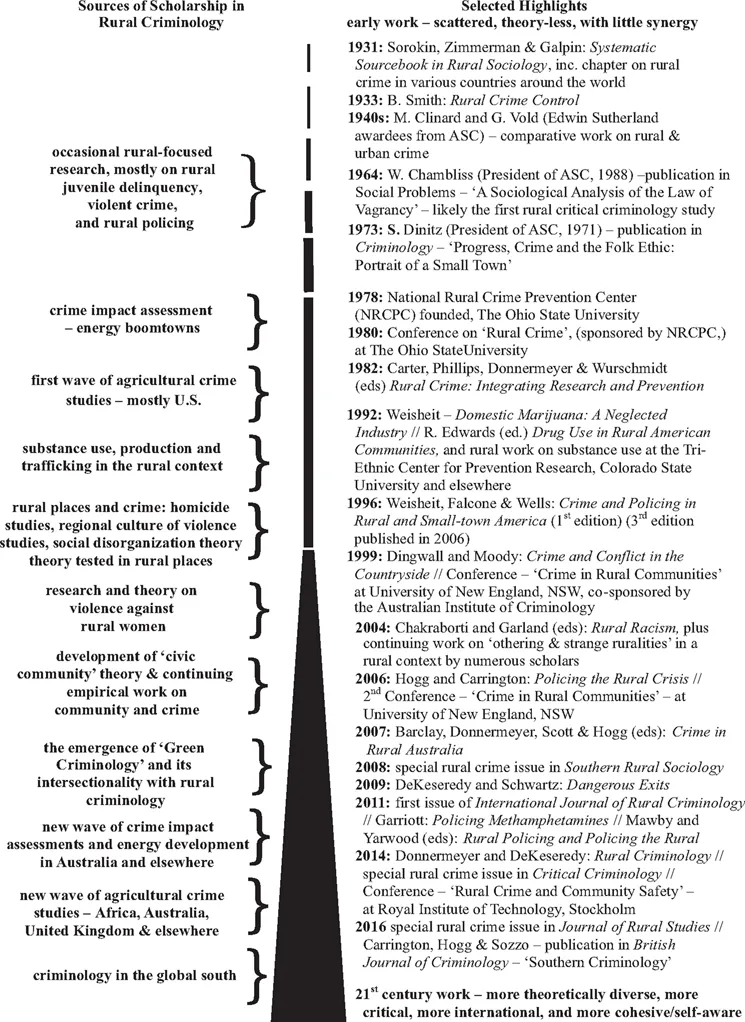
Figure1.1 Sources of scholarship and selected events in the development of rural criminology
A short history of rural criminology: false starts and eventual sustainability
Figure 1.1 presents a visual chronology of both important events in the development of rural criminology (right side), but also sources that helped spur its development (left side). It cannot include everything, but does attempt to highlight what I believe to be important publications and events in rural criminology's history. As well, the short historical narrative that follows is not inclusive, but attempts only to provide an overview. I admit in advance to a bias related to events and publications that influenced my career as a rural sociologist turned criminologist working at large, land grant universities in the Midwestern region of the US. There is much more to the story of rural criminology's development that I likely am not aware.
The history of rural criminology can be divided into three eras. The first era was mentioned above. Up until the mid-1970s, rural crime scholarship was scattered, and almost completely atheoretical. What is likely the first book dedicated exclusively to the topic of rural crime was written by a prominent scholar in police science and administration at the time, Bruce Smith, and published in 1933.3 Despite his work, the chapter devoted to rural crime by Sorokin, Zimmerman and Galpin, and the work of prominent criminologists such as Marshall Clinard (1944), George Vold (1941), William Chambliss (1964) and Simon Dinitz (1973), rural crime scholarship remained unorganized and its maturation stymied by a l...
Table of contents
Cover
Half Title Page
Title Page
Copyright Page
Dedication
Table of Contents
List of figures
List of tables
Acknowledgements
Notes on contributors
List of abbreviations
1 Introduction to the International Handbook of Rural Criminology
SECTION 1 Rurality and crime
SECTION 2 Criminological dimensions of food and agriculture
SECTION 3 Violence and rurality
SECTION 4 Drug use, production and trafficking in the rural context
SECTION 5 The intersection of rural and green criminologies
SECTION 6 Policing, justice and rurality
SECTION 7 Teaching rural criminology
Index
Trusted by 375,005 students
Access to over 1.5 million titles for a fair monthly price.
Study more efficiently using our study tools.
Frequently asked questions
Yes, you can cancel anytime from the Subscription tab in your account settings on the Perlego website. Your subscription will stay active until the end of your current billing period. Learn how to cancel your subscription
No, books cannot be downloaded as external files, such as PDFs, for use outside of Perlego. However, you can download books within the Perlego app for offline reading on mobile or tablet. Learn how to download books offline
We are an online textbook subscription service, where you can get access to an entire online library for less than the price of a single book per month. With over 1.5 million books across 990+ topics, we’ve got you covered! Learn about our mission
Look out for the read-aloud symbol on your next book to see if you can listen to it. The read-aloud tool reads text aloud for you, highlighting the text as it is being read. You can pause it, speed it up and slow it down. Learn more about Read Aloud
Yes! You can use the Perlego app on both iOS and Android devices to read anytime, anywhere — even offline. Perfect for commutes or when you’re on the go. Please note we cannot support devices running on iOS 13 and Android 7 or earlier. Learn more about using the app
Yes, you can access The Routledge International Handbook of Rural Criminology by Joseph F Donnermeyer, Joseph Donnermeyer,Joseph F Donnermeyer in PDF and/or ePUB format, as well as other popular books in Social Sciences & Agricultural Public Policy. We have over 1.5 million books available in our catalogue for you to explore.