- 276 pages
- English
- ePUB (mobile friendly)
- Available on iOS & Android
eBook - ePub
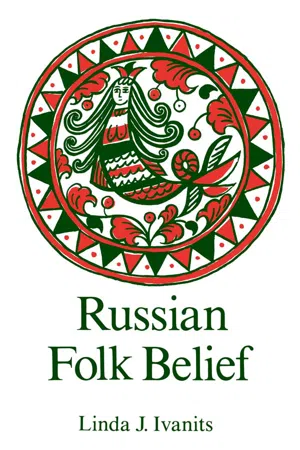
Russian Folk Belief
About this book
A scholarly work that aims to be both broad enough in scope to satisfy upper-division undergraduates studying folk belief and narrative and detailed enough to meet the needs of graduate students in the field. Each of the seven chapters in Part 1 focuses on one aspect of Russian folk belief, such as the pagan background, Christian personages, devils and various other logical categories of the topic. The author's thesis - that Russian folk belief represents a "double faith" whereby Slavic pagan beliefs are overlaid with popular Christianity - is persuasive and has analogies in other cultures. The folk narratives constituting Part 2 are translated and include a wide range of tales, from the briefly anecdotal to the more fully developed narrative, covering the various folk personages and motifs explored in Part 1.
Information
Part 1 Folk Beliefs about the Supernatural
DOI: 10.4324/9781315700953-1

1 The Pagan Background
DOI: 10.4324/9781315700953-2
Perhaps no period in the history of the search for folk traditions has yielded such wealth as that of the late nineteenth and early twentieth centuries in Russia. The feverish activity of this era resulted in most of the major collections of oral literature and in numerous accounts of Russian village life and belief. If one facet dominates this abundant and varied material, surely it is its archaic quality: one can only be astonished at the degree to which the Russian peasant succeeded in preserving his ancient, pre-Christian customs and worldview. Indeed, almost every ethnographic study of village life from this period made this point. In his classic work on the village of Budogoshcha, V. N. Peretts noted that a thousand years of Christianity had penetrated the peasant’s imagination only superficially and had not displaced his ancient beliefs in all sorts of “fantastic” spirits of nature.1 Speaking of the Sol ′vychegodsk District (Vologda Province), N. Ivanitskii made the extreme statement that his informant, a native of the village of Markovo and a peasant typical of that region, was a ”complete pagan“ who had heard something about God from his parents, but knew nothing whatsoever about Christ.2
Both the above studies pertain to out-of-the-way places in the Russian North, and there is no doubt that remoteness from centers of culture and trade fostered the preservation of ancient customs and beliefs. Nonetheless, one finds an abundance of similar statements for areas of Central and Southern Russia. V. Bondarenko, for example, writing about Tambov Province, noted that “under the cover of Christianity, still understood only in its external form, many remnants of paganism have been retained.”3 Here and there ethnographers made a point of stressing that the peasants knew their prayers and attended church; they then invariably proceeded to describe a roster of beliefs and rituals of a clearly pre-Christian stamp.4
The term most often used for the interweaving of pre-Christian and Christian elements in the belief and practice of the Russian peasant is dvoeverie, or “double faith.” The “double faith” of Christians addicted to pagan rites and superstitions is the brunt of the invective of many sermons of the first centuries of Russian Christianity, and it is the condition to which materials collected in the nineteenth and early twentieth centuries attest. Of course, it cannot be denied that in Western Europe as well elements of Christianity were grafted onto a pre-Christian heritage.5 Still, the Russian case is extreme. The Russian peasant, more than his European counterpart, was isolated culturally and, in many instances, geographically, from the mainstream of his nation’s development. Moreover, Russia experienced neither the intellectual upheaval of the Renaissance nor the purging of ancient superstitions of the Reformation. As G. P. Fedotov claims in his monumental study of Russian religious thought, The Russian Religious Mind, the peasant lived in the Middle Ages through the nineteenth century.6
The present work is a survey of the rich body of superstitions recorded by ethnographers and folklorists in the second half of the nineteenth and early twentieth centuries. It focuses in particular on beliefs about minor spirits, the so-called “lower mythology” of the folk, and about sorcerers, witches, and other persons thought to possess supernatural powers. Even on the verge of the Soviet era the Russian peasant retained his belief in spirits of the house and farmstead and of various aspects of nature. While these personages were the clear inheritance of the pagan era, Christianity too made its contribution. In certain biblical figures and saints it provided the peasant with a roster of personages toward which to direct his aspirations for a bountiful harvest and personal happiness and, in the figure of the devil, with a major culprit on which failures could be blamed. Popular Christianity, however, was often a far cry from official Orthodoxy, for, as we shall see, many of its personages seem to be thinly disguised reworkings of pagan deities.
But, even though the traditions and spirit world of the Russian peasant contained reflections of ancient beliefs, one cannot make direct connections between particular notions of the nineteenth-century peasant and the pagan of, say, tenth-century Rus′. Over the centuries ancient beliefs and rituals acquired many additional layers, and it is often difficult to determine what is a later accretion and what is truly ancient. One thing is certain: the Russian pagan and his nineteenth-century descendant were both farmers whose primary concerns were fertility and bounty. When the harvest failed, the peasant went hungry or, worse, starved. The various agricultural rituals of nineteenth-century village life provide a valuable, if circuitous, avenue to Russian paganism. In recent years Soviet folklorists have written a number of excellent monographs that go a long way toward elucidating the precise meaning of these celebrations.7 In addition, Soviet archeologist B. A. Rybakov has offered an interpretation of a fourth-century calendar for the region near Kiev that may allow us to make a reliable correlation between the festivities for the three-month period of peak agricultural activity in ancient Rus′ and the corresponding nineteenth-century holidays.8
Some knowledge of calendar rituals and the deities of Russian paganism is essential to an understanding of the worldview of the peasant. We shall therefore provide brief sketches of these areas before proceeding to a discussion of Russian folk belief in the nineteenth century.
Calendar Rituals
The seasonal celebrations of the Russian peasant had an agrarian stamp of an unmistakably pre-Christian nature. After Russia’s baptism, the timing of the ancient holidays corresponded to that of major liturgical feasts. In some cases (Christmas) the date of the pagan holiday was close to that of the Church feast and thus changed very little; in others the variable date of Easter caused a displacement of several weeks in the ancient celebration. The religious aspects of these holidays were confined mainly to church attendance and processions with icons and holy water; most of the festivities that took place in the village displayed an almost total absence of Christian motifs. The following were the major holidays around which the peasant’s agricultural year was organized in the nineteenth century.
Peasant calendar | Church calendar |
Yuletide (Sviatki, Koliada) | Christmas to Epiphany |
Shrovetide (Maslenitsa) | The eighth week before Easter |
Trinity (Rusal ′naia) Week | The week preceding Trinity Sunday |
Ivan Kupalo | John the Baptist (June 24) |
Harvest |
Besides the above, we might note: the “Welcoming of Spring” (March 1, 9, or 25), Palm (“Pussy willow”) Sunday (Verbnoe voskresen ′e), Holy (“Clean”) Thursday (Chistyi chetverg), Easter, Radunitsa (Tuesday of St. Thomas Week, the second week after Easter), and St. George’s Day (April 23).
Yuletude celebrations and the festivities of Ivan Kupalo’s Day occurred at the winter and summer solstices. Shrovetide, which in ancient times occurred near the spring equinox, became a mid-winter celebration, and the spring equinox, which occurred during Lent, was observed by a far less mirthful and ribald holiday, the “Welcoming of Spring.” The entire series of spring rituals celebrating the beginning and growth of vegetation was also affected by the timing of Easter. Most of these rituals were concentrated between Pentecost and Kupalo’s Day, a period of three to six weeks depending on the date of Easter, though a few occurred earlier, and, in places, the duration of the celebrations extended to St. Peter’s Day (June 29).9
Characteristic features of Yuletide were the singing of ritual songs (koliadki), the eating of certain foods, mummery, processions with persons masked as horses, bulls, or goats, mock funerals, and divinations. In addition, there were “evening gatherings” (posidel ′ki) and other merriments lacking any particular seasonal stamp. Great Russian koliadki, often sung on Christmas Eve (socket ′nik) by bands of costumed singers moving from household to household, contained invocations to “Koliada” (a personification of the season), praise of family members, wishes for a bountiful harvest and an increase in livestock, requests for handouts, and, sometimes, a threat in case of refusal. Handouts frequently took the form of little pastries in the shape of cattle and other livestock (korovki [korova—cow], kozuli [kozel/koza— goat]). Motifs connected with the nativity of Christ were usually absent in the koliadki.10 Mock funerals often involved carrying someone who pretended to be dead into the house and lamenting him in the midst of general laughter; sometimes a real corpse was used for this curious game. Among the ritual foods prepared for Yuletide celebrations were kut ′ia, a special porridge of whole grains, and pork. Kut ′ia was a part of the traditional Christmas Eve meal, and pork was normally served at the New Year. Some reports note that during the Yuletide season peasants lit bonfires and invited their dead ancestors to warm themselves, though by the nineteenth century this custom was not widespread. The New Year was a time for divinations; these concerned primarily young girls wishing to know if they would marry in the coming year.11
Perhaps the merriest seasonal holiday was Shrovetide, the carnival season preceding Lent that was characterized above all by dissoluteness and gluttony. Entertainments included sliding, horse racing, fist fighting, and mock battles; pancakes (bliny) were the most characteristic food. A straw effigy called “Maslenitsa” played a major role in the festivities. Peasants invoked and welcomed “Maslenitsa” at the beginning of the holiday and at its end they engaged in a rite of burning the dummy on a field outside the village. A number of rituals were connected with the returning sun: lighting bonfires, circling the village on horseback with a torch, and pushing a wheel that contained a pole with a flaming torch around the village. Important rites took place in the cemetery, where a funeral meal was held amidst wailing and laughter, and some of the foods were left for the deceased.12
While Yuletide and Shrovetide had their individual flavors, they shared certain motifs. The dependence of their timing on the yearly cycle of the sun and the importance of bonfires in the celebrations were, no doubt, remnants of an earlier solar cult correlating the sun’s cycle to the growth of vegetation.13 Scholars also stress that from ancient times fire has been used for ritual purification and the expelling of spirits that could cause illness or have a malign effect on the future harvest.14 Both Yuletide and Shrovetide were characterized by excessive eating and drinking, which has been understood as a magical use of like (abundance of rich foods) to produce like (fertility and bounty). Such ritual gluttony was largely absent from other holidays. Vladimir Propp explains its occurrence at these two times by noting that both holidays were, in a sense, celebrations of the new year: the folk agricultural calendar placed the beginning of the year near the winter solstice, but the Russian civil calendar, until 1348, reckoned the New Year from March. Thus, the magic of eating rich foods intensified the “magic of the first day.”15
Fertility motifs can be glimpsed in other aspects of these holidays. Wishes for prosperity in the koliadki and gifts of food for the singers can be viewed as attempts to ensure a desired result through a reenactment of it. Some commentators have called attention to the erotic element in processions with mock horses (often mares), goats, and bulls and in the custom of dressing as the opposite sex; such masquerading signals a break in normal laws of decorum and restraint and a license for obscene behavior and ribaldry.16 Thus, one can understand Yuletide songs and games and traditional Shrovetide obscenity as a magical attempt to ensure fecundity. In many cases fertility and funereal motifs were interwoven. Kut ′ia was a food characteristic of funeral meals, which gave Christmas Eve the ...
Table of contents
- Cover Page
- Half Title Page
- Title Page
- Copyright Page
- Dedication
- Table of Contents
- Foreword by Felix J. Oinas
- Preface
- Part 1 Folk Beliefs about the Supernatural
- Part 2 Folk Narratives about the Supernatural
- Note
- Bibliography
- Subject Index
- Place Name Index
- Name Index
- About the Author
Trusted by 375,005 students
Access to over 1.5 million titles for a fair monthly price.
Study more efficiently using our study tools.
Frequently asked questions
Yes, you can cancel anytime from the Subscription tab in your account settings on the Perlego website. Your subscription will stay active until the end of your current billing period. Learn how to cancel your subscription
No, books cannot be downloaded as external files, such as PDFs, for use outside of Perlego. However, you can download books within the Perlego app for offline reading on mobile or tablet. Learn how to download books offline
Perlego offers two plans: Essential and Complete
- Essential is ideal for learners and professionals who enjoy exploring a wide range of subjects. Access the Essential Library with 800,000+ trusted titles and best-sellers across business, personal growth, and the humanities. Includes unlimited reading time and Standard Read Aloud voice.
- Complete: Perfect for advanced learners and researchers needing full, unrestricted access. Unlock 1.5M+ books across hundreds of subjects, including academic and specialized titles. The Complete Plan also includes advanced features like Premium Read Aloud and Research Assistant.
We are an online textbook subscription service, where you can get access to an entire online library for less than the price of a single book per month. With over 1.5 million books across 990+ topics, we’ve got you covered! Learn about our mission
Look out for the read-aloud symbol on your next book to see if you can listen to it. The read-aloud tool reads text aloud for you, highlighting the text as it is being read. You can pause it, speed it up and slow it down. Learn more about Read Aloud
Yes! You can use the Perlego app on both iOS and Android devices to read anytime, anywhere — even offline. Perfect for commutes or when you’re on the go.
Please note we cannot support devices running on iOS 13 and Android 7 or earlier. Learn more about using the app
Please note we cannot support devices running on iOS 13 and Android 7 or earlier. Learn more about using the app
Yes, you can access Russian Folk Belief by Linda J. Ivanits in PDF and/or ePUB format, as well as other popular books in Theology & Religion & Ethnic & Tribal Religion. We have over 1.5 million books available in our catalogue for you to explore.