In this section we focus on letters, while in sections 1.2–1.8 we concentrate on sounds.
1.1 The Greek alphabet
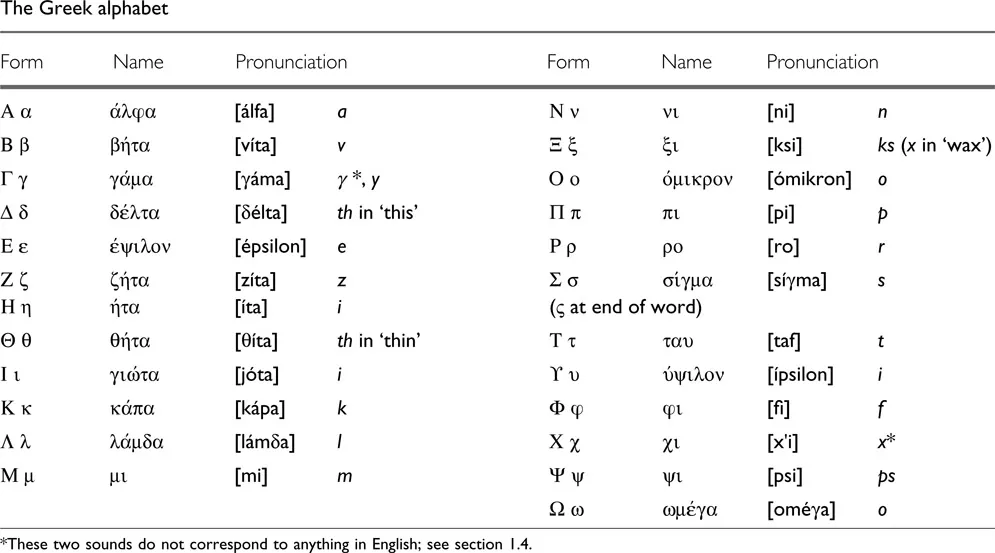
The Greek alphabet consists of twenty-four letters. The table on page 2 presents each letter (in upper and lower case) in alphabetical order, its Greek name, and its basic pronunciation (for further details of pronunciation see sections 1.2–1.6).
Anyone who knows how to pronounce the Greek letters can pronounce any written word in the language; this is unlike English, where we often don’t know how a word is pronounced unless we have heard it spoken. On the other hand, as in English, it is often impossible to tell how to spell a word that we have heard spoken.
Taken on their own, seven letters of the alphabet represent vowel sounds (α, ε, η, ι, ο, υ, ω), and seventeen represent consonant sounds (all the rest). But when some letters are combined together, they are pronounced differently. Each of the following combinations represents a single sound:
| αι | /e/ |
| ει | /i/ |
| οι | /i/ |
| ου | /u/ |
| υι | /i/ |
The combination αυ is pronounced [af] at the end of a word and before the following consonants: π, τ, κ, φ, θ, χ, σ, ξ, ψ, but [av] before a vowel or any other consonant (i.e. β, δ, γ, ζ, λ, ρ, μ, ν). Similarly, ευ is pronounced [ef] or [ev] in the same positions, and the rare combination ηυ is pronounced [if] or [iv].
Pairs of identical consonants are pronounced like a single consonant, except γγ, which is pronounced [(ŋ)g] or [(ŋ)g'] (see section 1.4). In addition, the following combinations of letters representing consonants are pronounced in a special way:
| γκ | like γγ (see above) |
| γχ | [ŋx] |
| μπ | [(m)b] |
| ντ | [(n)d] |
| τζ | [dz] |
Finally, σ is pronounced [z] before a voiced consonant (β, γ, δ, ρ, μ, ν).
Pronunciation
1.2 Vowels
The Greek sound system has five distinct vowels: /i, e, a, o, u/.
The vowel /i/ is pronounced between the English vowel in ‘bit’ and that in ‘beat’. The Greek vowel /i/ corresponds to six different spellings: ι, η, υ, οι, ει and υι, e.g. το παιδί [to peδí] ‘the child’, Ελένη [eléni] ‘Helen’, πολύ [polí] ‘very, much’, οι κόποι [i kópi] ‘the labours’, μπορεί [borí] ‘maybe’, υιοθετώ [ioθetó] ‘I adopt’.
The vowel /e/ is pronounced like the English vowel /e/ in ‘kept’ but it is pronounced slightly longer and with lips more open. The Greek /e/ corresponds to two different spellings: ε and αι, e.g. λένε [léne] ‘they say’, κλαίνε [kléne] ‘they cry’.
The vowel /a/ is similar to the a in ‘father’. It corresponds to the spelling α, e.g. η Mαρία [i maría] ‘Mary’.
The vowel /ο/ is pronounced between the English vowel in ‘pot’ and that in ‘bought’ but the lips are slightly more closed and more rounded. The vowel /o/ corresponds to two different spellings: ο and ω, e.g. το δώρο [to δóro] ‘the present’.
The vowel /u/ is somewhere between the vowels in the English words ‘put’ and ‘boot’. It corresponds to the spelling ου, e.g. του παιδιού [tu peδjú] ‘of the child’.
The vowel /i/ may lose its vowel quality and become non-syllabic if unstressed and followed by another vowel.
Non-syllabic /i/ is pronounced as [j] (like the y in ‘yes’) if it follows a voiced consonant [b, d, g, v, δ, γ, z, r, m], as in παιδιά [peδjá] ‘children’ (contrast παιδεία [peδía] ‘education’), or as voiceless [x'] (pronounced like the h in ‘huge’) if it follows a voiceless consonant [p, t, k, f, θ, x, s], as in ράφια [ráfx'a] ‘shelves’. This general reduction of /i/ to [j] or [x'] does not apply to words from the more formal vocabulary: compare βιολί [vjolí] ‘violin’ with βιολόγος [violόγos] ‘biologist’.
1.3 Combinations of vowels
Combinations of two or three vowels are possible, e.g. νεαρός [nearós] ‘young man’, νεοελληνικός [neoelinikόs] ‘modern Greek’. In words like ρολόι /rolói/ ‘clock, watch’, πάει /pái/ ‘it goes’ and λέει /léi/ ‘(s)he/it says’, where the unstressed /i/ follows a vowel, the /ói/, /ái/, /éi/ are pronounced as in the English words ‘toy’, ‘spy’, ‘stay’, respectively.
1.4 Consonants
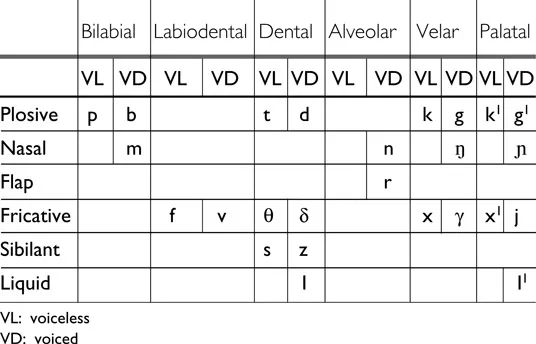
There are twenty-five consonant sounds, which we represent by the following symbols: p, t, k, b, d, g, f, θ, x, v, δ, γ, k', x’, g’, j, s, z, l, l’, r, m, n, ŋ.
The voiceless plosives [p], [t] and [k] are pronounced like their English equivalents in ‘spot’, ‘stay’ and ‘scot’ respectively. However, unlike their English counterparts, these Greek consonants remain without aspiration (expulsion of breath) even in initial position before a vowel.
The voiceless bilabial plosive [p] corresponds to the spelling π, e.g. ο πατέρας [opatéras] ‘the father’, κάπως [kápos] ‘somewhat’.
The voiceless dental plosive [t] corresponds to the spelling τ, e.g. το ποτό [topotó] ‘the drink’.
The voiceless velar plosive [k] corresponds to the spelling κ, e.g. καλός [kalós] ‘good’, ακόμη [akόmi] ‘still’. [k] has a variant [k’], which is pronounced like the first consonant in the English word ‘queue’, before the vowels /e/ and /i/, e.g. κέφι [k’éfi] ‘good mood’, εκείνος [ek’ínos] ‘that one’.
The voiced bilabial plosive [b] corresponds to the spelling μπ. It is optionally preceded by a short [m] when it is within a word, e.g. κουμπάρος [ku(m)báros] ‘best man’. This preceding nasal is generally absent when [b] occurs at the beginning of a word, e.g. μπότα [bóta] ‘boot’.
The voiced dental plosive [d] corresponds to t...