Routes to market
You can have the most amazing event, but if your target audience has not heard about it, then no one will turn up. Routes to market are all the activities an event undertakes to reach their audiences, and to get them to attend. Typically, an event will combine key components of the marketing mix, such as the processes and distribution, with the promotions mix to identify specific tools and techniques. We can draw a simple analogy with you deciding to visit your friend who lives 300 miles away. Will you go directly to them or stop off on the way to visit a tourism site or another friend? Will you go by plane, train, car or hitchhike? How long will it take you and how much will it cost? Will they be able to pick you up at the airport or train station? The decisions you make here are whether to travel directly or not, which transport method provides best value for money and possibly what might suit your friend. There is not necessarily a bad route, but some routes are better for you than others.
It is worth noting that if you have only one or two events, especially if they are fairly small or limited to a narrow target market, selecting your routes to market will probably not be that difficult. However, as management consultants Booz and Co (2010) identify, selecting the correct routes is a trickier task if you are rapidly growing, have a range of markets and operate across geographical areas.
Accenture (2014) have taken this basic idea of routes to market and suggested that organisations develop market ‘archtypes’. These ‘archtypes’ recognise that in a global economy grouping markets with similar commercial environments, consumer types and capabilities allows an organisation to develop fit-for-purpose strategies for each different audience. They are therefore looking for patterns in one market, which can be replicated in others, so that they are grouped together in part by routes to market.
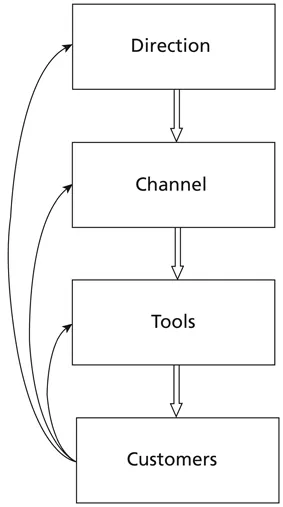
Figure 1.1 outlines the core four components which help you decide what might be the combination of activity for your best route to market for each event: direction; channel; tool; and customer.
Direction assesses whether you will reach the customer directly or indirectly via an intermediary. Most events will sell direct, so the customer phones up or visits the event website to pay for their tickets. However, without trying to be too pedantic, e-commerce could be direct or indirect; the former would be the case if the event is running the online sales themselves but the latter if they were using the services of an e-ticketing agency. Direction can also refer to whether the communication is designed to be just one-way, to inform and persuade the message receiver to attend, or two-way to deliberately engage in dialogue.
Figure 1.1 Selecting the best route to market
The channel is the means by which you will seek to reach your target attendees. We shall discuss these in more detail in Chapter 3, but for now it is worth noting that the most common promotional channels are:
- Advertising
- Personal selling
- Public relations
- The internet
- Sponsorship
- Sales promotion
- Direct marketing
- Trade shows and exhibitions.
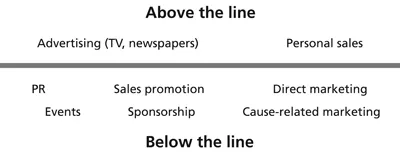
As Figure 1.2 shows, the first two channels, advertising and personal selling, are collectively referred to as above the line because a commission is paid. The other channels are below the line because although they obviously incur a cost it is not in the form of a commission. Though we must note that it is possible that commission is payable for an e-ticketing agency. As we shall see throughout this book it is unlikely, and indeed unwise, for an event to choose just one channel.
Very closely linked to channel is our third component, the exact tools to be used. Just selecting, for example, public relations and the internet as our channel does not alone provide enough insight into what precisely we will do and when. So, if we look at public relations, we may well decide to send out press releases and consult with key stakeholders such as local residents. Thus, before we announce our event via the media, we would have paved the way by talking to local politicians and resident organisations, and if need be made changes to our event. Similarly, if we decide to use the internet, we could use the event website, or communicate via social networks such as Twitter, Facebook, Hyves, Orkut and QZone. Selecting both the channel and tools decides precisely how an event will seek to reach its customers, and Table 1.1 explains what influences the thinking behind why a tool might be chosen.
There is an assumption that when thinking about their customers an event will consider the value proposition they are offering. This is essentially the value the customer will ascribe to the experience from attending an event. In essence, the event needs to construct a message that offers an attractive experience to the potential event attendee. Having sorted out their offer, the event communicator needs to identify to whom they will make it. Such targeting would typically be based on segmenting your audience, so are certain personal characteristics such as gender, age, where they live and income relevant to you? Or is there a behavioural pattern, such as past attendees, that makes some targets more likely than others?
In addition to the four factors that create an overall framework outlined in Figure 1.1, further variables may have an impact on the precise nature of the routes chosen. Table 1.2 outlines other variables which may be taken into account relating to the nature of, or context, that affects the message receiver rather than the construction of the message.
Figure 1.2 Above and below the line
Table 1.1 Selecting the right channel and tool
| Channel | Tools | Why selected | Type of events |
|
| Advertising | Newspaper
Radio
Television
Online ad
Trade | Read by target audience.
Size of audience.
Size of audience.
Reaches people beyond a geographic location.
Reaches suppliers and buyers in an industry. | Community-based but also larger regional events.
Larger regional events.
Larger regional and national events.
One that can be accessed online.
Trade shows, award ceremonies, networking events. |
| Personal selling | Event organiser
Sales team
Contract out | Limited budget.
Need to stand out in a competitive market/high-value tickets.
Limited skills. | Events with a small budget.
Business to business events/luxury events.
Big events, especially in entertainments. |
| Public relations | Media relations
Issues management
Community relations | Cheap and easy.
Avoids crises.
To gain support. | Any event, but especially those with smaller budgets or community-based.
Any event that might affect residents or political bodies. |
| The internet | Website
Email
E-newsletter
Weblog
Microblog
Social networking site | Cheap, wide distribution, complexity of message.
Cheap, targeted and interactive.
Targeted, cheap and persuasive.
To influence opinion.
Qui... |