eBook - ePub
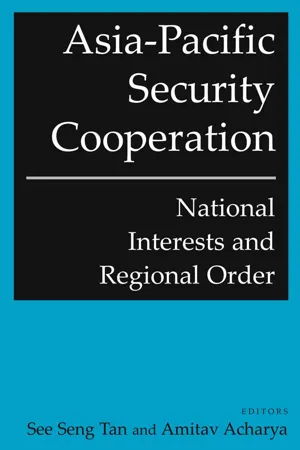
Asia-Pacific Security Cooperation: National Interests and Regional Order
National Interests and Regional Order
- 296 pages
- English
- ePUB (mobile friendly)
- Available on iOS & Android
eBook - ePub
Asia-Pacific Security Cooperation: National Interests and Regional Order
National Interests and Regional Order
About this book
New developments in the Asia Pacific are forcing regional officials to rethink the way they manage security issues. The contributors to this work explore why some forms of security cooperation and institutionalisation in the region have proven more feasible than others. This work describes the emergence of the professions in late tsarist Russia and their struggle for autonomy from the aristocratic state. It also examines the ways in which the Russian professions both resembled and differed from their Western counterparts.
Information
Part I
1 Security Cooperation in the Asia-Pacific
Evolution of Concepts and Practices
DOI: 10.4324/9781315706283-1
Security cooperation in the Asia-Pacific has been influenced by two sets of approaches: bilateral alliances on the one hand, and comprehensive and cooperative security on the other. These distinct modes of security cooperation can be distinguished by two key differences. Alliances are narrowly focused on military security and are by definition based on the notion that security should be promoted against potential or actual enemies. Traditional defense arrangements operate in an anarchical system where individual states are responsible for their own security. Security is approached in competitive and zero-sum terms. In contrast, the concepts of comprehensive and cooperative security adopt a broader understanding of security and, especially in the case of the latter, support the notion that security should be promoted “with others” as opposed to “against others.”1 Although comprehensive and cooperative security have been the key influence within multilateral structures in the Asia-Pacific, bilateral alliances have dominated the strategic architecture and have remained the cornerstone of security cooperation in the region. In the long term, however, the relevance of bilateral defense arrangements may be uncertain.
This chapter starts by discussing the study of alliances before comparing and contrasting various ideas on security that have been developed as alternatives to formal or tacit alliances; namely, collective, comprehensive, common, and cooperative security, as well as the notion of a security community. Based on this conceptual discussion, the second section analyzes the evolution of security practices in the Asia-Pacific. It indicates the central importance of bilateral alliances in the regional strategic environment both before and after the end of the Cold War. Moreover, it demonstrates that the Asia-Pacific has been receptive to comprehensive and cooperative security, in contrast, for instance, to collective security, through the operations of the Association of Southeast Asian Nations (ASEAN) and the ASEAN Regional Forum (ARF).2 These multilateral structures have aimed to complement, rather than compete with or replace, a bilateral approach to security cooperation.
Concepts in Security Cooperation
Governments enter military alliances so as to enhance their power positions and to react to rising hegemonies in the international system. Alliances may affect the distribution of power by maintaining the status quo in a specific region. States will conventionally align themselves with the weaker side in order to restrain the rising power. Such alliances are defensive. States may also enter offensive alliances in the interest of hegemony. Wight explains that “political alliances are always contracted with third parties in view; unlike friendships, they are necessarily, so to speak, self-conscious; their purpose is to enhance the security of the allies or to advance their interests, against the outer world.”3 An alliance becomes a collective defense arrangement, which can either take a bilateral or multilateral form, when it includes the principles of reciprocity and mutual defense. The classic example of a collective defense arrangement is the North Atlantic Treaty Organization, which was concluded during the Cold War to preserve the territorial status quo in Europe by defending Western European security from Soviet communism.4 To maximize their effectiveness, alliances should operate as flexible and temporary security arrangements, which implies that their participants must be willing to rapidly enter new alliances to preserve a balanced distribution of power. However, alliances can be influenced by ideology, which limits the flexibility of alliance formation.
The study of alliances, analyzed as an expression of balance of power politics, has been influenced by the work of Stephen Walt. In The Origins of Alliances (1987), he examines their formation as a reaction to threats rather than power. Walt points out that instead of viewing balancing or “bandwagoning” as reactions to rising external threats defined exclusively in terms of capabilities (aggregate power), it is “more accurate to say that states tend to ally with or against the foreign power that poses the greatest threat.”5 He argues that the level of threat needs to be determined not only in terms of power but also according to three other essential factors: geographic proximity, offensive power, and aggressive intentions.6 As a result, the balance-of-threat perspective makes it possible to distinguish benign from hostile hegemons. For instance, China is perceived in the Asia-Pacific as a menacing actor, whereas the United States, which remains the regional and sole global hegemonic power, inspires confidence among most regional players.7
Various conceptual ideas on security have been developed as alternatives to alliances. Let us mention some specific perspectives, namely, collective, comprehensive, common, and cooperative security, as well as the notion of a security community. The tragedy of World War I led to the emergence of collective security. As its strongest supporter, U.S. president Woodrow Wilson was convinced that this approach to security would provide the means to prevent future conflicts. Collective security was formally integrated in the League of Nations as one of its underlying principles.8 Charles and Clifford Kupchan explain that “under collective security, states agree to abide by certain norms and rules to maintain stability and, when necessary, band together to stop aggres-sion.”9 Collective security is regulated by moral and legal justifications and is “predicated upon the notion of all against one.”10 Rather than dependence on individual political and military considerations, collective security leads, in principle after the violation of international obligations, to an immediate and common response by all the participants of a collective security arrangement.11 In practice though, governments have generally opposed or abdicated the obligations associated with the principle of collective security. This has meant that examples of operational collective security are limited and that security has required the active role of a hegemon. The experience of the League of Nations and of the United States during the Gulf War of 1991 should, for instance, be noted. In the Asia-Pacific, there have been no efforts to develop a collective security system.
The notion of comprehensive security was first formulated in Japan in the 1970s. It focuses on political, economic, and social problems at different levels of analysis and offers therefore an alternative to traditional concepts of security, which concentrate exclusively on national defense and external military threats. It assumes that broadening the definition of the term itself beyond military issues can enhance security. Comprehensive security has also been recognized by some ASEAN states, primarily Indonesia, Malaysia, and Singapore, and has been included in their security doctrines.12 In contrast to the Japanese interpretation of the concept, the approach taken by the ASEAN states has primarily been inward looking. Lizée and Peou explain that ASEAN’s comprehensive approach “is based on the proposition that national security does not only reside in the absence of external military hostility but also in the presence of socio-economic development within national boundaries.”13 The inward-looking approach to domestic regime security and regional stability has been illustrated in the principles of national and regional resilience. The principles, advanced by the New Order in Indonesia, register an ambition to underpin domestic and regional stability with economic and social development. At issue is domestic regime security and consolidation.
Unlike collective security, which is based on a collective reaction to aggression, common security seeks primarily to offer an alternative to the use of force.14 This principle, as defined by the 1982 Report of the Independent Commission on Disarmament and Security Issues under the leadership of the late Swedish prime minister Olof Palme, needs to be located in the context of the Cold War. A key factor in common security is the mutual possession of nuclear weapons and the expectation of mutually assured destruction. The Palme report stressed that the nuclear deterrence doctrine led to a balance of terror and was no longer appropriate as a means of avoiding an East-West nuclear conflict. The Palme Commission report called on the adversaries to cooperate in an attempt to maintain stability and peace. Offering common security as an alternative, it argued that the two nuclear sides “must achieve security not against the adversary but together with him. International security must rest on a commitment to joint survival rather than on a threat of mutual destruction.”15 The report proposed various criteria for security policies, including that they “should be in the interest of both opponents,” “should be pursued by both opponents together,” and should “favor activities where the possibilities for and advantages of deception are limited.”16 Mikhail Gorbachev and others tried later to introduce the notion of common security to an Asia-Pacific setting. In a speech in Vladivostok in July 1986, Gorbachev called for the creation of an Asia-Pacific equivalent to the Conference on Security and Cooperation in Europe (CSCE), which was based on the notion of common security and was an outgrowth of the Helsinki Final Act of 1975.17 Common security, as defined by the Palme report, has not been applied to the Asia-Pacific, but remains an essential idea for the region. Indeed, its characteristics have strongly influenced the formulation of the concept of cooperative security in the post–Cold War era.
The principle of cooperative security is the key concept underlying the emergence of multilateralism in the Asia-Pacific in the post-Cold War period. Acharya explains that this principle includes the “rejection of ‘deterrence mind-sets’ associated with great power geopolitics of the Cold War.”18 Discussing its purpose, Dewitt writes: “The intent has been to replace the Cold War security structure . . . with a multilateral process and framework with the following attributes: it must be geared toward reassurance, rather than deterrence; it must at best replace or at least coexist with bilateral alliances; and it must promote both military and nonmilitary security.”19
Cooperative security may be compared to the concept of collective security as embodied in the League of Nations Covenant because it is intended to be comprehensive in membership, with security arrangements obtaining on an intramural basis. The fundamental difference, however, is that unlike collective security, cooperative security lacks the vehicles of economic and military sanctions.20 In fact, it deliberately eschews sanctions. Cooperative security operates through dialogue and seeks to address the climate of international relations rather than tackle specific problems. It relies on the promotion of standard international norms and principles to be adhered to by the various participants. Focusing on reassurance, cooperative security arrangements aim to develop a “habit of dialogue” among the participants and to promote confidence-building and possibly preventive-diplomacy measures. Therefore, although collective security primarily takes a reactive approach to rising sources of unrest, cooperative security focuses on confidence building and a preventive dimension, albeit not through problem solving.
Several similarities exist between the notions of common and cooperative security. These include a rejection of deterrence strategies and a broad definition of security that includes military and nonmilitary issues.21 Rejecting the perspective of the security dilemma, cooperative security supports the notion developed in the Palme Commission report that security should be promoted “with others” as opposed to “against others.” Both concepts are inclusive in their understanding of security, implying that they aim to engage all regional players without excluding political and economic systems or adversaries. Yet, predicting a more gradual institutionalization of relations in the Asia-Pacific, cooperative security is a more adaptable notion than common security: it favors a more gradual approach to the institutionalization of relations and recognizes the necessity of maintaining, at least at first, existing bilateral alliances. It acknowledges the importance of current “bilateral and balance-of-power arrangements in contributing to regional security and retaining them—indeed, for working with and through them—allowing multilateralism to develop from more ad hoc, and flexible processes until the conditions for institutionalized multilateralism become more favorable.”22 The notion of cooperative security also stresses the importance of flexibility, consensus building, and consultation. Finally, although the notion of common security developed in a context of nuclear weapons, this has not been the case with cooperative security.
It is important to discuss the characteristics of cooperative security when applied to multilateralism in the Asia-Pacific. The concept, which was first endorsed by the Canadian government in 1990, is based on four central principles.23 First, it assumes that the institutionalization of security relations in the Asia-Pacific will be slow and gradual. Second, the institutionalization of such relations is at first not aimed at replacing existing regional alliances, but rather at coexisting and working with them in the promotion of security. Indeed, cooperative security arrangements can be complementary to the existing security architecture. Ultimately, cooperative security is still expected to replace bilateral alliances and their narrow focus on military security. Third, cooperative security arrangements are based on the principle of inclusiveness, as they aim to promote a “habit of dialogue” among all regional states. Finally, the principle also includes an informal level of diplomacy, referred to as “track-two diplomacy,” which consists of constant communication between academics, nongovernmental organizations, and other nonstate actors in some dialogue with governments through, for example, the ASEAN Institutes of Strategic and International Studies (ASEAN-ISIS) and the Council for Security Cooperation in the Asia-Pacific (CSCAP).
Let us conclude this conceptual discussion of security cooperation by introducing the idea of a security community, first discussed by Karl Deutsch in 1957.24 On a security spectrum, this concept may be viewed as at the other end from a military alliance. Deutsch argued that a community could exist not only within the boundaries of a state, but also across states, and that peace and peaceful change could be expected within such international communities. A security community is characterized by the assurance that its members will not resort to violent means to resolve their disputes. Moreover, the members do not even prepare to resort to force against other members. Hence, a security community makes the use of force unthinkable, as one observes a complete and long-term convergence of interests between members in the avoidance of war. Security communities do not necessarily entail formal agreements or institutional arrangements. States in a community may not have actively sought its formation or their participation in it, and yet be engaged in one. It is fair to say that Canada and the United States, the Western European nations, and the countries in the Southern Cone of Latin America constitute examples of security communities. The Asia-Pacific has not yet evolved into a security community.
Evolution of Practices in Security Cooperation in the Asia-Pacific
Security Cooperation in the Cold War
System of Bilateral Alliances
During the Cold War, the San Francisco system or the “hub and spokes” model, grew out of the East-West ideological rivalry and featured a series of strong bilateral security agreements linking the United States to its regional allies. This model of regional security was bilateral, not multilateral, in nature. The U.S.-Japan Treaty of Mutual Cooperation and Security, signed during the San Francisco Conference in September 1951, was at the core of the “hub and spokes” model. The United States also signed a Mutual Defense Treaty with the Philippines in August 1951 and with the Republic of Korea in 1954, and pledged to ensure the security of Taiwan through the 1954 Mutual Defense Treaty and, after the rapprochement with the People’s Republic of China (PRC), through the Taiwan Relations Act of 1979. All these bilateral alliances were intended to preserve U.S. interests in the region and the defense of its allies by deterring any possible Soviet expansion. This system was based on nucle...
Table of contents
- Cover Page
- Halftitle Page
- Title Page
- Copyright Page
- Table of Contents
- Acknowledgments
- Introduction
- List of Acronyms and Abbreviations
- Part I
- Part II
- Notes
- About the Editors and Contributors
- Index
Trusted by 375,005 students
Access to over 1.5 million titles for a fair monthly price.
Study more efficiently using our study tools.
Frequently asked questions
Yes, you can cancel anytime from the Subscription tab in your account settings on the Perlego website. Your subscription will stay active until the end of your current billing period. Learn how to cancel your subscription
No, books cannot be downloaded as external files, such as PDFs, for use outside of Perlego. However, you can download books within the Perlego app for offline reading on mobile or tablet. Learn how to download books offline
Perlego offers two plans: Essential and Complete
- Essential is ideal for learners and professionals who enjoy exploring a wide range of subjects. Access the Essential Library with 800,000+ trusted titles and best-sellers across business, personal growth, and the humanities. Includes unlimited reading time and Standard Read Aloud voice.
- Complete: Perfect for advanced learners and researchers needing full, unrestricted access. Unlock 1.5M+ books across hundreds of subjects, including academic and specialized titles. The Complete Plan also includes advanced features like Premium Read Aloud and Research Assistant.
We are an online textbook subscription service, where you can get access to an entire online library for less than the price of a single book per month. With over 1.5 million books across 990+ topics, we’ve got you covered! Learn about our mission
Look out for the read-aloud symbol on your next book to see if you can listen to it. The read-aloud tool reads text aloud for you, highlighting the text as it is being read. You can pause it, speed it up and slow it down. Learn more about Read Aloud
Yes! You can use the Perlego app on both iOS and Android devices to read anytime, anywhere — even offline. Perfect for commutes or when you’re on the go.
Please note we cannot support devices running on iOS 13 and Android 7 or earlier. Learn more about using the app
Please note we cannot support devices running on iOS 13 and Android 7 or earlier. Learn more about using the app
Yes, you can access Asia-Pacific Security Cooperation: National Interests and Regional Order by See Seng Tan in PDF and/or ePUB format, as well as other popular books in Politique et relations internationales & Économie du travail. We have over 1.5 million books available in our catalogue for you to explore.