eBook - ePub
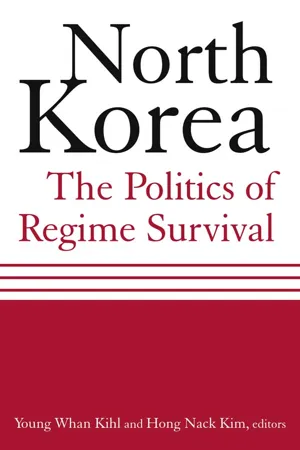
North Korea: The Politics of Regime Survival
The Politics of Regime Survival
- 336 pages
- English
- ePUB (mobile friendly)
- Available on iOS & Android
eBook - ePub
North Korea: The Politics of Regime Survival
The Politics of Regime Survival
About this book
Featuring contributions by some of the leading experts in Korean studies, this book examines the political content of Kim Jong-Il's regime maintenance, including both the domestic strategy for regime survival and North Korea's foreign relations with South Korea, Russia, China, Japan, and the United States. It considers how and why the Democratic People's Republic of Korea (DPRK) became a "hermit kingdom" in the name of Juche (self-reliance) ideology, and the potential for the barriers of isolationism to endure. This up-to-date analysis of the DPRK's domestic and external policy linkages also includes a discussion of the ongoing North Korean nuclear standoff in the region.
Information
———— 1 ————
Staying Power of the Socialist “Hermit Kingdom”
Young Whan Kihl
Since the death of its founding leader Kim Il Sung on July 8, 1994, the Democratic People’s Republic of Korea (DPRK or North Korea) has been a failing state trapped in a cycle of economic poverty and political repression. Whereas economic stagnation and food shortages brought about overall poverty to the nation, the DPRK under Kim Jong Il (who inherited power from his deceased father) has relied on coercion as an instrument of political rule, thereby turning North Korea into a land of authoritarian repression. These characteristics of North Korea as a failing state, led by a repressive regime, are bound to be manifest in its style of domestic politics and foreign relations, including its overall dealings with South Korea.1
Most of the former socialist-bloc countries, since 1989, have either collapsed or changed their policies, like China and Vietnam, by incorporating market-oriented incentives and economic principles. Only Cuba and North Korea have resisted this pressure to change and remain doggedly determined to pursue the socialist economic principles of central planning. Since July 2002, however, the Kim Jong Il regime of North Korea has also introduced certain measures of economic reform in an attempt to overcome the mounting and stagnant economic problems at home.
The DPRK seems to have little option but to open its “hermit kingdom” somewhat by increasing interaction with the outside world. Since 1995 North Korea has looked outward for humanitarian assistance in order to overcome chronic starvation at home. The DPRK has received food assistance from the United Nations World Food Program (WFP), for instance, to make up for the grain shortfalls arising from crop failures, which are both natural and man-made disasters. About one-third of its 23 million people are said to rely continuously on outside food aid, which has become at risk of dwindling due to donor nation’s growing sense of fatigue.2
The Political Economy of Reform
In addressing the subject of political economy of reform in North Korea, the socialist “hermit kingdom” seems to have resisted the change primarily for domestic political reasons but had to acquiesce to delayed reform for pragmatic reasons. It is not surprising, therefore, that the Kim regime decided to pursue the path rather belatedly that was traversed by other socialist countries in Asia, like China and Vietnam. North Korea took limited measures of reform with hesitancy.
Will Economic Reform Succeed or Fail
In July 2002 North Korea introduced limited measures for an economic reform of marketization.3 This ongoing reform, according to Marcus Noland (2004), has had the following four major components: (1) microeconomic policy changes to increase the importance of material incentives; (2) macroeconomic policy measures decentralizing decisionmaking; (3) the establishment of special economic zones; and (4) an aid-seeking strategy from abroad.4 These initiatives on economic reform followed an earlier policy move in 1998 to promote administrative decentralization.5
In an attempt to increase the role of material incentives, the DPRK has raised wage levels. Monthly payments to laborers on production lines were raised, for instance, from 110 North Korean won to 2,000 won on average. It also increased all commodity prices, with the price of rice set as the yardstick: rice purchased by the state from farmers rose from 80 jon to 40 won per kilogram, and the price of rice sold by the state to consumers jumped from 8 jon to 44 won per kilogram. (One won equals 100 jon.6) The purpose of these increases was to augment the volume of food entering the public distribution system. As a result, food prices to consumers dramatically increased, and within six months, the retail price of grain rose 40,000 to 60,000 percent.7
There has been a noticeable upsurge in small-scale retail activity, at least in the capital city of Pyongyang. But the agricultural reform in North Korea, as compared to that in either China or Vietnam, is less likely to be Pareto-improving (i.e., causing no one to be worse off) because of the relatively smaller proportion of the farm population in terms of the total population. The DPRK economy is more industrialized and urbanized today than was either China or Vietnam at the time of their agricultural reforms, and North Korea’s farm sector has been fully collectivized and state-owned.
In the industrial sectors, the state-owned enterprises (SOEs) have been instructed that they are now responsible for covering their own costs. They are also permitted to engage in international trade. This means that enterprises will no longer receive state subsidies (as happened in China and other socialist countries). Under the “militaryfirst” politics, however, the military and defense industries will continue to enjoy a privileged position within the economy.
The idea of establishing special economic zones (SEZs) was first introduced in 1991 in the Rajn-Sonbong region in the northeast. A plan exists for promoting SEZs in other regions, such as outside Siuiju in the northwest or Kaesong across the demilitarized zone (DMZ) north of Seoul. But the experiment has not been successful so far for a variety of reasons. Geographic isolation, poor infrastructure, onerous rules, and mismanagement have contributed to the failure of the SEZs in the socialist Hermit Kingdom, as shown by the fiasco of the Sinuiju SEZ launched in 2002.8
These measures of limited economic reform in North Korea, unless they are well managed, are unlikely to succeed and are likely to create more losers than winners. The unintended consequences of the economic mishap will be the possibility of greater unrest.9 With these socioeconomic changes, North Korea is also likely to move, as the economist Marcus Noland (2004) noted, from the realm of elite politics to a new era of an elite-mass politics.10
The last component of the reform strategy, that is, seeking aid from outside the country by “passing the hat,” has worked up to a point, as shown by the UN WFP assistance to the famine-stricken population in the North. But the foreign assistance program has reached the point of diminishing returns as aid donor’s fatigue has set in and as the lack of transparency and accountability in the aid-recipient country has become increasingly apparent. The DPRK’s aid-seeking policy is also hampered by the Kim Jong Il regime’s nuclear stalemate vis-à-vis the United States and the neighboring countries of Japan and South Korea.
In September 2002 the DPRK and Japan agreed, in principle, that Japan would provide a large sum of financial assistance to North Korea as part of the settlement of postcolonial claims. However, the negotiation on diplomatic normalization bogged down because of Tokyo’s demand for further clarification, and Pyongyang’s refusal to address issues of the North Korean abduction and release of twelve Japanese citizens.11 So long as the North Korean nuclear stalemate persists and remains unsettled, there will be no further progress on the normalization talks between Tokyo and Pyongyang, and the DPRK will not be able to receive Japanese funds for domestic economic development.
Domestic Sources and Base of the Kim Jong Il Regime
What are the sources of system viability and regime dynamics in North Korea? Is it the leadership, ideology, or the institution that gives North Korean communism staying power? Alternatively, is the post-Kim Il Sung regime on the last leg of a tortuous journey, nearing eventual death and dismemberment as a political entity? North Korea has survived despite the adversity of economic failure and severe food shortages. Many prophecies of doom and collapse of the North Korean state under its leader Kim Jong Il have proven to be either inaccurate or misleading. The North Korean system and regime, in fact, have continued to survive after the Cold War and, according to some, even thrived beyond the expectations of many pundits and experts. The question is why? How do we account for the continuation of the failing state of the DPRK?
The Party-Military Nexus
The basis of Kim Jong Il’s power in North Korea is his hold on the two key political institutions: the party and the military. The DPRK is a typical communist party-state and its ruling, monolithic, political party is called the Korean Workers’ Party (KWP, Choson Nodong-dang), which was founded by Kim Il Sung (1912–1994) in 1946.12 The military in North Korea is called the Korean People’s Army (KPA, Choson Inmingun) and claims to have been founded on April 24,1932, by Kim Il Sung at the tender age of twenty in order to fight against Japan as an anti-Japanese People’s Liberation War. The current KWP leader is Kim Il Sung’s son, Kim Jong Il, born in 1942, in a village outside Khabarovsk in the Soviet region of Siberia. At the time, his father was an officer of the Korean reconnaissance unit, attached to the Eighty-eighth Special Independent Brigade of the Soviet Red Army.13
In October 1997 Kim Jong Il became the top party leader in an unconventional manner. The established procedures would have required the KWP to call for a meeting of the Central Committee to elect its general secretary and to ratify this decision by the subsequent regularly scheduled party congress meeting. The KWP Charter stipulates, in Article 14 and section (a), that “the supreme leadership of party organization is as follows: (a) For the entire party, it is the congress; and between party congresses, it is the Central Committee elected by the party congresses” that are responsible for electing members of the collective leadership.
The KWP failed to convene its party congress to elect its collective leadership in 1997, however. In fact, the KWP congress has not been called into session for more than twenty-five years since the Sixth KWP Congress was held in 1980. At the 1980 meeting not only was Kim Il Sung reelected as the general secretary but also his son, Kim Jong Il, was elected as a new member of the KWP politburos (or the presidium). This party inner circle was led by his father and made Kim, the son, an official successor to the Great Leader Kim Il Sung.
The KWP was expected to hold a Central Committee plenary session to elect its general secretary. Kim Jong Il, however, became party general secretary in an unusual manner, because the KWP Central Committee (CC) and Central Military Commission (CMC) made a joint announcement on October 8, 1997, after a series of meetings of the representatives of party chapters held in each of the nine provinces and three major cities, as well as in the major government offices. It was by acclamation of the party cadres and the rank and file members throughout the country, rather than through the KWP CC or the KWP Congress, that a new “great leader” was chosen to lead the party. No election was held to choose the party’s general secretary.
For more than three years, from July 1994, the time of his father’s death, to October 1997, North Korea was ruled by Kim Jong Il as the supreme commander of the KPA. In December 1991 he had become a member of the KWP CMC. The rank and title of vice marshall of the KPA was bestowed upon Kim Jong Il despite the fact that he had not served in the military. He did not become chairman of the CMC, however, during this period. The speculation was that Kim declined to become the CMC chairman in deference to the memory of his deceased father who had held that post. The North Korean Yearbook published in December 1995 listed the supreme commander as the second highest office in the military commission, next to its chairman. The yearbooks published in 1996 and 1997, however, deleted the list of party and government hierarchies within the CMC.14
The result of all these political maneuvers is that as of 2005 Kim Jong Il rules the DPRK in his capacity as chairman of the National Defense Commission (NDC), which is a counterpart of the party’s CMC. He became chairman of the National Defense Commission in April 1993. This suggests that the Kim Jong Il regime had been a long time in the making. As noted above, the father-son political succession was unveiled ...
Table of contents
- Cover Page
- Half Title page
- Title Page
- Copyright Page
- Contents
- Figures
- Preface
- 1 Staying Power of the Socialist “Hermit Kingdom”
- I Domestic Politics and Political Economy
- II The Politics of Foreign Relations
- III Future Prospects
- Bibliography
- List of Contributors
- Index
Trusted by 375,005 students
Access to over 1.5 million titles for a fair monthly price.
Study more efficiently using our study tools.
Frequently asked questions
Yes, you can cancel anytime from the Subscription tab in your account settings on the Perlego website. Your subscription will stay active until the end of your current billing period. Learn how to cancel your subscription
No, books cannot be downloaded as external files, such as PDFs, for use outside of Perlego. However, you can download books within the Perlego app for offline reading on mobile or tablet. Learn how to download books offline
Perlego offers two plans: Essential and Complete
- Essential is ideal for learners and professionals who enjoy exploring a wide range of subjects. Access the Essential Library with 800,000+ trusted titles and best-sellers across business, personal growth, and the humanities. Includes unlimited reading time and Standard Read Aloud voice.
- Complete: Perfect for advanced learners and researchers needing full, unrestricted access. Unlock 1.5M+ books across hundreds of subjects, including academic and specialized titles. The Complete Plan also includes advanced features like Premium Read Aloud and Research Assistant.
We are an online textbook subscription service, where you can get access to an entire online library for less than the price of a single book per month. With over 1.5 million books across 990+ topics, we’ve got you covered! Learn about our mission
Look out for the read-aloud symbol on your next book to see if you can listen to it. The read-aloud tool reads text aloud for you, highlighting the text as it is being read. You can pause it, speed it up and slow it down. Learn more about Read Aloud
Yes! You can use the Perlego app on both iOS and Android devices to read anytime, anywhere — even offline. Perfect for commutes or when you’re on the go.
Please note we cannot support devices running on iOS 13 and Android 7 or earlier. Learn more about using the app
Please note we cannot support devices running on iOS 13 and Android 7 or earlier. Learn more about using the app
Yes, you can access North Korea: The Politics of Regime Survival by Young Whan Kihl,Hong Nack Kim in PDF and/or ePUB format, as well as other popular books in Politics & International Relations & Sales. We have over 1.5 million books available in our catalogue for you to explore.