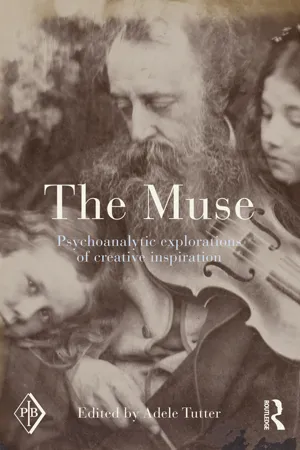
Psychoanalysts have long been fascinated with creative artists, but have paid far less attention to the men and women who motivate, stimulate, and captivate them. The Muse counters this trend with nine original contributions from distinguished psychoanalysts, art historians, and literary scholars—one for each of the nine muses of classical mythology—that explore the muses of disparate artists, from Nicholas Poussin to Alison Bechdel.
The Muse breaks new ground, pushing the traditional conceptualization of muses by considering the roles of spouse, friend, rival, patron, therapist—even a late psychoanalytic theorist—in facilitating creativity. Moreover, they do so not only by providing inspiration, but also by offering the artist needed material and emotional support; tolerating competitive aggression; promoting reflection and insight; and eliciting awe, anxiety and gratitude.
Integrating art history and literary criticism with a wide spectrum of contemporary psychoanalytic perspectives, The Muse is essential reading for psychoanalysts and psychotherapists interested in the relationships that enhance and support creative work. Fully interdisciplinary, it is also accessible to readers in the fields of art, art history, literature, memoir, and film. The Muse sheds new light on that most mysterious dyad, the artist and muse—and thus on the creative process itself.
In the 1650 self-portrait commissioned by his Parisian friend and patron, Paul Fréart de Chantelou, Nicolas Poussin poses himself in front of several stacked canvases; they reveal only a small portion of one painted surface, which shows a brilliantly lit profile bust of a woman (Figure 1.1). The remainder of this depicted canvas is masked by a superimposed painting to the right, a piece of furniture below, and the physical limit of the self-portrait to the left, a framing that also admits a cryptic pair of disembodied arms that reaches to embrace the evidently delighted woman. Complementing her golden hair, her burnished diadem is further and most unusually distinguished by what appears to be a seeing eye.
Figure 1.1Left: Nicolas Poussin, Self-Portrait, 1650, Musée de Louvre. Right: detail
Image: Web Gallery of Art
No such embedded figurative imagery exists in the earlier Berlin Self-Portrait, commissioned by another patron, Jean Pointel; indeed, with this exception, “pictures within pictures, familiar in seicento painting, do not appear in Poussin’s art” (Carrier, 1993, p. 16).2 Yet the cover of Anthony Blunt’s authoritative book on Poussin, an image of the self-portrait, cropped to exclude it altogether, reflects the marginal importance granted to what he reduced to an “ornament” (Blunt, 1967, p. 218). Following Blunt—who himself relied on Poussin’s early biographer, Bellori—art historians traditionally interpret the atypical embedded painting within a painting as representing an “allegorical group of painting and friendship,” as befitting a gift-depiction of the painter and his craft (p. 218). While other formulations pay a bit more attention to the embedded painting, they largely support the popular view of Poussin as a cerebral, rational painter, disinterested in presenting, in a public work, the private or the personal—a view the artist did little to discredit, but rather encouraged with his classicism and intellectual rigor.3 Indeed, “if the goal of classical artists is to be impersonal, then Poussin has succeeded all too well” (Carrier, 1993, p. 105).
In contrast to prevailing conceptualizations, I have shown that Poussin does in fact represent his wife, Anna Marie Dughet, in his art (Tutter, 2011). Here, I extend these findings and argue that Anna Marie and the multiple critical roles she played in Poussin’s life—in sickness and in health—are commemorated in his art, if camouflaged within allegorical and peripheral guise. Representing an array of female characters that comprise the breadth and depth of womankind, Anna Marie was Poussin’s muse: in his eye, the embodiment of the eternal feminine. In particular, the analysis of the Louvre self-portrait opens a window onto an entirely different view of painter and the painting, which I will argue is in effect a portrait of the painter and the woman he considered his muse—an integral part of the self that the artist chose to portray.
Works of art within works of art often serve a special function, distilling and clarifying the meanings of the greater effort of which they form a part. Just as Freud (1900 [1953]) observed for dreams within dreams, Grinstein (1956) and Balter (2006) show that works of art within works of art can point to an underlying meaning concealed or disavowed by the greater work—e.g. the play-within-a-play in Hamlet—the additional representational layer providing the distance necessary to overlook or otherwise minimize the embedded representations. Might this be the case for Poussin’s self-portrait? Returning to it, note that the profile of the lady and the arms that embrace her are but a fragment of a much larger composition; evidently, she is part of a much larger story. Examination of the painter’s oeuvre suggests that we have seen her before.
At the age of 26, Poussin left his native France to settle in Rome. Fifteen years later, he left his happy home in 1640 to serve a fairly miserable two-year period in Paris as premier peintre du roi to the court of Louis XIII. It was a mandate he dreaded and postponed for over a year, in no small part because it meant being away from his wife. Shortly before leaving, Poussin painted The Continence of Scipio (Figure 1.2). The story, a theme of his own choosing, is from Livy: to everyone’s surprise, Scipio Africanus, a celebrated Roman military commander on campaign in Spain, orders that a gift from his troops—a captive native, “a grown maiden of a beauty so extraordinary that, wherever she went, she drew the eyes of everyone”—be returned to her betrothed, the Celtiberian chieftain Allucius (Livy XXVI, 20:1). In Poussin’s rendering, a comely young woman behind Scipio honors this munificent display of integrity, reaching on tiptoe to crown him with a laurel wreath. This detail derives neither from Livy nor from previous depictions of the theme, but from a winged figure of Victory who crowns a seated general (Blunt, 1967). But Poussin’s maiden has no wings, and is very clearly a mortal being. Her classical profile follows that of the embedded painting: note in particular the long, chiseled nose, the small mouth with its shapely lips, the fullness of the softly modeled chin, the large, prominently outlined round eye, and the curly, reddish golden hair.
While the soldiers in Scipio are dressed and armored with meticulous accuracy, the fortress in the background recalls the more modern Castel Sant’Angelo, a landmark not in Scipio’s Rome, but in Poussin’s, suggesting that the story of Scipio remained germane to the painter in his own place and time. One could hypothesize that Poussin found Scipio’s dilemma reminiscent of his own reluctant obligation to relinquish the comforts of home in order to fulfill the mandate of his king. In both cases, their sacrifice was advantageous: just as Poussin benefited from the compensation and the prestige of his royal appointment, Scipio’s munificence had the (likely intended) benefit of winning the Spanish over to the Roman side. The learned Poussin—who had received the benefit of a sound classical education in his native France—would surely have known that, after the grateful Allucius collected his fiancé, he returned to report, as if scripted, “to Scipio with fourteen hundred picked horsemen” (Livy XXVI, 20:14). Surely this new allegiance was unhindered by the “generous amount of gold” that Scipio awarded Allucius along with his returned fiancé—the ransom money that Scipio had accepted from his fiancé’s parents (Livy XXVI, 20:12). By crowning Scipio as victor, Poussin subtly alludes to his moral and military victories. On a less calculating level, one might also imagine that he responded to Scipio’s righteous renunciation—the kind of moral victory over desire also demanded of a man afflicted with syphilis.
Figure 1.2Upper: Poussin, The Continence of Scipio, 1640, The Pushkin Museum of Fine Art. Lower: detail
Image: WikiPaintings
Poussin was one such man. Yet this and other aspects of his private life are not thought to have been intruding upon or even influencing his art. Fostered by a lack of biographical data, his rather exquisite privacy has been breached only by explorations of his relationships with patrons and fellow intellectuals and artists in Rome and in Paris. Much less has been written about his more personal life. While his letters paint the portrait of a savvy, often jealous painter preoccupied with the business of satisfying patrons and making a living, save for his fierce devotion to and concern for his wife, they reveal far less about his married life and his childlessness, concerns presumably impacted on by his long struggle with venereal disease—issues that few writers give more passing than a passing mention.4
Although 10 years separate the maiden in white in Scipio from the female figure in the 1650 self-portrait, the distinctive profile reappears one year later, in Poussin’s 1651 London Moses Saved from the Water (Figure 1.3). Put afloat in a basket on the Nile to escape the Pharaoh’s summary execution of infant boys, Moses is followed by his vigilant sister, Miriam, who engineers his “discovery” by the Pharaoh’s daughter and her ladies-in-waiting. In the painting, Miriam looks up at Pharaoh’s daughter as if to ask, “Shall I get one of the Hebrew women to nurse the baby for you?” (New International Version, Exodus 2:7). This will be, of course, their mother. Miriam, her curls loosened, and in simple white robes that recall the crown-bearer in Scipio, resembles the now-familiar profiled woman. And so does the lady-in-waiting that helps her to support Moses’s basket, and regards him with the same open-mouthed pleasure (Figure 1.3, detail). The lady-in-waiting’s right arm disappears underneath Miriam’s left arm in an illusion of a sort of Siamese twinning; if not for its skin color, this arm could belong to either woman, reinforcing the connection between the two figures. In fact, save for her glowing, milky skin and sumptuous robes, she could be Miriam’s twin, but it is exactly these features—including the color of her gown, sky-blue, shot through with gold iridescence—that replicate in precise detail those of the profiled figure in the self-portrait.
Figure 1.3Upper: Poussin, Moses Saved from the Water, 1651, National Gallery, London. Lower: detail
The enigmatic lady reappears in the 1655 Saint Peter and Saint John Curing the Lame Man (Figure 1.4). At the right edge of the painting, a young temple attendant approaches the central grouping. On her head she balances a basket containing an ewer and basin. Unlike the rest of the assembled, she exhibits no astonishment or fear, but is serenely unperturbed by the miracle in process—St Peter and St John exhorting a man, “lame from birth,” to, “in the name of Jesus Christ of Nazareth, walk” (Acts 3:1–6). Like Miriam, the temple attendant has a “twin,” the female figure at the far left, who also carries a basket and calmly retreats into the shadow of a pillar.
Given the temple setting, the first attendant likely carries the “clay pot” and “fresh water” for ceremonial purification rituals performed there, stipulated after the resolution of “unclean conditions,” including sin, menstruation, childbirth, and, most interestingly, infectious “defiling skin diseases” (Leviticus 14:3–8). The second attendant’s basket carries two birds, which surely reference the “two live clean birds” required for various sacrifices, including that specified for the last stage of ceremonial purification.5 If, as its architectural set suggests, we approach St Peter and St John as a theatrical drama, the narrative might begin with the temple attendant entering at stage right with materials for healing and purification rituals, and might end with her double exiting at stage left to prepare for the final sacrifice. At the temple steps, a destitute beggar woman with her baby raises her arms in abjection to the well-dressed man who hands her a coin—an indication, perhaps, that the lame man is not the only one who aided here.
This exercise allows a potential metaphorical interpretation of St Peter and St John, his gratitude for the healing of Poussin’s own “defiling skin disease,” his syphilis. Between 1628–1629, Jacques Dughet, a fellow French expatriate, housed and cared for him as he would his own.6In 1630, Dughet’s daughter, Anna Marie, who nursed Poussin, married him, despite his diseased status. In 1651, when Poussin painted Moses Saved, his health had begun to aga...
Table of contents
Cover
Half Title
Title Page
Copyright Page
Dedication
Table of Contents
Illustrations and Credits
Contributors
Author’s Preface
Acknowledgements
Introduction: Mnemosyne, Mother of the Muse
1 A Memory on your Palette: Poussin’s Eternal Feminine
2 Hortense Fiquet Cézanne, as painted by her Husband, Paul
3 Van Gogh’s Arlesian Muses
4 Spilling It Out: Dalí’s Signature
5 “Herb and Dorothy” Vogel: The Art Collector as Muse
6 Rebecca in the House: Musings on Identification
7 The Muse as Rescuer and Inspiration: Saul Bellow’s Ravelstein
8 An Unlikely Muse: Anne Sexton and Martin Orne
9 Alison Bechdel’s Mystic Muse: A Psychoanalytic Allegory
Index
Trusted by 375,005 students
Access to over 1.5 million titles for a fair monthly price.
Study more efficiently using our study tools.
Frequently asked questions
Yes, you can cancel anytime from the Subscription tab in your account settings on the Perlego website. Your subscription will stay active until the end of your current billing period. Learn how to cancel your subscription
No, books cannot be downloaded as external files, such as PDFs, for use outside of Perlego. However, you can download books within the Perlego app for offline reading on mobile or tablet. Learn how to download books offline
Perlego offers two plans: Essential and Complete
Essential is ideal for learners and professionals who enjoy exploring a wide range of subjects. Access the Essential Library with 800,000+ trusted titles and best-sellers across business, personal growth, and the humanities. Includes unlimited reading time and Standard Read Aloud voice.
Complete: Perfect for advanced learners and researchers needing full, unrestricted access. Unlock 1.5M+ books across hundreds of subjects, including academic and specialized titles. The Complete Plan also includes advanced features like Premium Read Aloud and Research Assistant.
Both plans are available with monthly, semester, or annual billing cycles.
We are an online textbook subscription service, where you can get access to an entire online library for less than the price of a single book per month. With over 1.5 million books across 990+ topics, we’ve got you covered! Learn about our mission
Look out for the read-aloud symbol on your next book to see if you can listen to it. The read-aloud tool reads text aloud for you, highlighting the text as it is being read. You can pause it, speed it up and slow it down. Learn more about Read Aloud
Yes! You can use the Perlego app on both iOS and Android devices to read anytime, anywhere — even offline. Perfect for commutes or when you’re on the go. Please note we cannot support devices running on iOS 13 and Android 7 or earlier. Learn more about using the app
Yes, you can access The Muse by Adele Tutter in PDF and/or ePUB format, as well as other popular books in Art & Art Theory & Criticism. We have over 1.5 million books available in our catalogue for you to explore.