![]()
1 Marketing communications as a strategic marketing tool
Introduction
Environmental turbulence: the effect of new media forms
Changes to marketing communications over time
Barriers to successful integration of marketing communications elements
Retailer influence, product, services, business-to-business and social marketing
Summary
Review questions
Recommended reading
Case study 1.1: Graduates Yorkshire recruitment
Notes
After studying this chapter, you will be able to:
• Provide an overview of the role of marketing communications within the overall marketing mix
• Provide a brief overview of the development of, and controversy surrounding, the concept of integrated marketing communications (IMC)
• Review the major barriers to successful integration of marketing communications
• Discuss the marketing communications challenges presented by services and social marketing compared to tangible products
• Debate the impact of new and emerging media forms on traditional marketing communications activity
Introduction
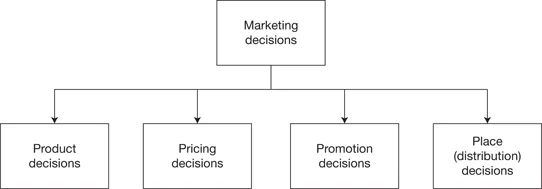
Marketing communications does not occur in isolation, but rather is part of a wider overall marketing mix.1 It has traditionally been portrayed under the term promotion as a part of the ‘4Ps of marketing management’, as shown in Figure 1.1.
Figure 1.1 Traditional marketing management decisions2
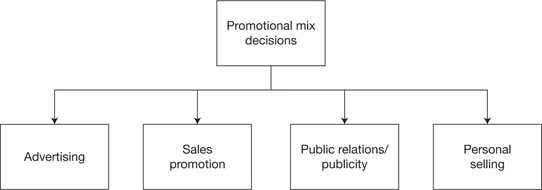
Promotion in its turn is usually shown as in Figure 1.2, with separate functions that reflect the reality of distinct, independent organizations performing specialist functions without significant coordination of their activity. Thus it is possible for advertising to attempt to project an exclusive, quality-based image while at the same time price-based sales promotions could be used; the two communication activities projecting very different images to consumers and often occurring without linkages to other marketing activity, including packaging.3 This separation of function and activity ignores the fact that consumers integrate information, including marketing communications and information from other sources including the media and via retail outlets where a manufacturer may have limited control over marketing communications. This will occur whether the marketing or advertising organization makes a conscious effort to integrate messages from sources under their direct control or not, with the result that messages can be put together in unexpected ways – which may even be harmful to the brand.4
Figure 1.2 Traditional promotional mix decisions2
To be fully effective, integration starts at the initial strategic planning level and is far more than just ensuring a common look or feel to messages sent via different channels. Figures 1.1 and 1.2, however, are overly simplistic in that they do not reflect the complexities of the processes involved. Even within the promotional mix decision process, Figure 1.2 implies that each of the four subsets are separate activities and does not capture instances where there may be considerable overlap between the functions, such as when advertising may be the vehicle by which sales promotion activity is communicated, or the use of the Internet for far more than just advertising messages.
THINK BOX
Marketing communications and product types
Using Figures 1.1. and 1.2, map out the marketing communications activity of:
1. a ‘fast moving consumer good’ (FMCG) product such as bread;
2. a soft drink such as Coca-Cola or Pepsi against bottled water and energy drinks;
3. a durable product such as a refrigerator;
4. a service provider such as an airline or an organization offering packaged holidays.
In what ways are their marketing communications strategies likely to be similar and in what ways are they likely to be different – and why?
Environmental turbulence: the effect of new media forms
Most importantly, the functions shown in Figure 1.2 do not reflect the reality of communication vehicles today, particularly interactive media forms. Among these are hybrid media forms such as advergames that reflect a blurring between entertainment and persuasion in which branded products or services are frequently an integral component of a (usually) Internet-based game.5 The aim is to offer entertainment, interaction and emotional connection between the game and the brand featured within it in a way that traditional mass media cannot do.6 Figure 1.2 also does not capture the way social media function (see Chapter 9 for a detailed discussion). In addition, the effects and effectiveness of the growing use of product placements in television programmes and in movies (see Chapter 10 for a discussion of hybrid media forms) have yet to be determined across product and service categories.
The promotional mix shown in Figure 1.2 needs to be re-conceptualized to show the changing nature of the marketing communications vehicles that may be considered. Direct and database communication methods need to be considered as a distinct form of communication, as do Internet-based and interactive media forms. New communication forms will continue to evolve and any diagrammatic presentation of the promotional mix options is likely to be subject to regular revision. However, with this must come a greater understanding of what the message receiver does with the various messages received; this area remains significantly under researched.7
Successful campaigns are not always dependent on large advertising budgets and the use of mass media such as television, as the following example shows. This case won the best small budget category and an overall silver award at the 2008 IPA Effectiveness Awards.
MINI CASE: RADLEY
Source: Institute of Practitioners in Advertising: Best Small Budget & Silver, IPA Effectiveness Awards 2008. Case material provided by the World Advertising Research Centre (WARC) www.warc.com.
Radley is a relatively small brand of handbags with a small advertising budget in a fragmented and fickle fashion market. It has a small base of loyal purchasers but faced major challenges in increasing market share, particularly given the perceptions of their bags being functional and good quality but not stylish.
Share of voice was unlikely to be more than 3 per cent, so a truly original idea was needed to help the brand stand out from its much larger competitors such as Dolce & Gabbana and Gucci. The focus of the creative activity from 2007 onwards was chosen as:
“Truly Radley Deeply”
Distinctive advertisements such as those shown on page 5 ran in colour newspaper supplements, weekly women’s magazines such as Grazia and...