- 224 pages
- English
- ePUB (mobile friendly)
- Available on iOS & Android
eBook - ePub
About this book
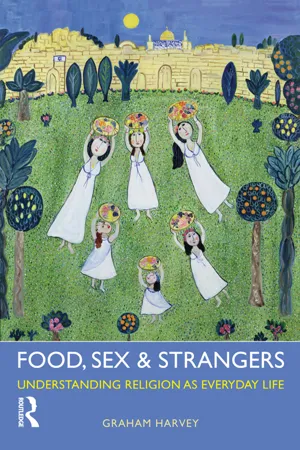
Religion is more than a matter of worshipping a deity or spirit. For many people, religion pervades every part of their lives and is not separated off into some purely private and personal realm. Religion is integral to many people's relationship with the wider world, an aspect of their dwelling among other beings - both human and other-than-human - and something manifested in the everyday world of eating food, having sex and fearing strangers. "Food, Sex and Strangers" offers alternative ways of thinking about what religion involves and how we might better understand it. Drawing on studies of contemporary religions, especially among indigenous peoples, the book argues that religion serves to maintain and enhance human relationships in and with the larger-than-human world. Fundamentally, religion can be better understood through the ways we negotiate our lives than in affirmations of belief - and it is best seen when people engage in intimate acts with themselves and others.
Information
1. Of god and goats
I have sometimes set my students the task of presenting ideas about where they would take visiting space aliens who ask to be shown religion. I ask them to imagine such unlikely beings saying, “We have been observing Earth and have seen sports, politics, catering, tourism and botany, but we want to observe the thing you call religion. What can you show us?” Once they get the idea, students are usually good at this. They just need to get past the idea that religion cannot be seen because it is defined as “belief in god”. Since most of my British students suppose that belief is something private, interior or personal, and that god is transcendent, neither are actually observable. My students and I find that we can do better than this. We start thinking about what people do and boldly determine to focus on religion as an everyday activity. Then we get creative. We wonder if the visiting aliens might use their senses differently and need to hear or smell religion. The competitive sonic environment of Jerusalem or the olfactory overload of temples where animals are sacrificed and incenses are wafted serve as prompts to this thought-experiment.
It is not only students who have trouble thinking about what religion might be. Many academics, even those employed to research and teach about religions, seem to find it hard to get out and see, smell, hear, taste or touch religion happening. This book might help them and their students to achieve this. It is about what we might study when we stop thinking of religion as peculiar beliefs and the strange expression of those beliefs. It seems simple enough to decide to study a particular religion (Buddhism or Paganism for example), but what is it that makes these things religions? Is Buddhism everything that Buddhists do? What about when they are washing dishes or shooting guns? Are those acts ones that scholars of religion should study or should they leave them to other people? Where can we go when we want to encounter religion? To what should we pay attention when we get there?
I am not the first person to ask questions about the meaning of the term “religion” and about the focus of the study of religions. However, I am not completely satisfied with the answers that some of my colleagues have given. I want us to try again. Too much of what passes for debate about religion and/or religions is undermined by unfortunate presuppositions. These not only lead us to devote too much attention to strange beliefs but also encourage us to misunderstand the nature of scholarship. What I propose to do in this book is tackle these entangled issues and seek a positive way forward.
STRANDS OF THE ARGUMENT
The conclusion of Food, Sex and Strangers: Understanding Religion as Everyday Life is already in the title. It is that religion has everything to do with the relationships that constitute, form and enliven people in everyday activities in this material world. In particular, it is human relationships with other species that are the key to understanding real world religion. It is possible that religion began as a kind of interspecies etiquette – especially when members of one species needed to eat members of another. Religion continues today when people eat or do not eat together, when they engage or do not engage in sexual activities, when they include or exclude strangers from their communities.
To reach conclusions like these we need to reject the deeply ingrained notion that religion is belief in god. This should not be the chief focus of the academic study of religion. Some people may believe in deities, non-empirical realities, miracles and other mysteries. Some may insist that faith is more important than rational proof. But these are facts about aspects of some religions rather than data for defining religion. They are not the central matter deserving our attention. To put this another way: religion is no more accurately defined as “believing in god” than it is defined as “sacrificing goats”. Religious people might do either or both of these things, but it is a mistake to think that the word “religion” always and everywhere means believing in god or sacrificing goats. I pursue this line of thought especially in Chapters 1–4. Since other scholars have already said quite clearly that defining religion as “belief in god” has misdirected attention to the wrong phenomena, I set out what some of the ignored phenomena might be. I support the proposal that we ought to pay far more attention to religion as an everyday matter. If we (scholars of religion) took seriously those religious people who say that religion includes everything they do, perhaps we should say something about washing-up as a religious act.
It is an intriguing fact that academic books often collude with religious books in largely ignoring everyday activities. A second strand of this book’s argument is that a heavy weight of tradition tends to determine what we treat as significant. Religion is defined as personal beliefs in or about deities because centuries of effort and violence have enshrined such an idea. It is part of the constitution of modernity, shaped by the European Christian Reformation, but most forcefully determined by the rise of states and all the considerable changes that entailed (Cavanaugh 1995; King 2007).1 While I will note some previous challenges to the ongoing influence of this history on academic approaches to religion, I will devote more attention to seeking different perspectives and positions from which to study religion.
What I propose here is to try to do more than point out errors, detours and barriers to understanding whatever we decide “religion” means. I want to know what a study of everyday religion would be like when it resists modernity’s gravitational pull. I experiment with starting again “elsewhere”. This is an idea I first tested in editing a textbook that focused attention on the everyday lived reality of religions: Religions in Focus (Harvey 2009a) – about which more is said in the following section. In Food, Sex and Strangers the “elsewhere” theme is vital and generative. It is a mechanism that aids us to leave an illusory world in which religion is belief and scholars seek to be god-like in their objectivity. Thinking “elsewhere” aids efforts to understand what everyday religion is like in the real world of movement, change, matter, weather, hedgehogs, cocoa-bushes, flints, shining guest ants and myriad other persons, each with their symbionts and constraints, and each with their ways of respecting and/or resisting others. This is a world in which religion is lived by people who eat, make love, host guests and worry about strangers. It is a world in which religion matters to people who perform it (for themselves and/or for others) as they and the world they inhabit continue to evolve and change. It is a world of relationships and performances energized by the possibilities arising from intimacy and imagination.2
More is at stake than noticing that religion is an everyday activity performed by relational and material persons in a relational and material world. As importantly, scholarly activities are also relational and material practices. The dangerous illusion of god-like objectivity is out of date, badly jarring against the evident signs of our scholarly embodiment, emplacement, relationality and necessary participation. That is to say, the “elsewhere” real world which we all truly inhabit is the world of Darwinian evolving relationality and quantum participation. Our research and teaching about religion are likely to be more effective if we practise being in that real world and doing our academic job in tune with a science that has escaped Descartes’ deluded dualism and other follies. In Chapter 4 I challenge some of what I perceive to be wrong with the ways religion is often theorized, as much by allegedly critical or scientific scholars of religion as by religionists. Chapter 5 demonstrates my indebtedness to other scholars who have engaged with significant aspects of the real world beyond modernism’s not-yet-post-Reformation illusions. I indicate some of the matters that should permit an appropriately twenty-first century scientific approach to our subject matter.
Building on this, Chapters 6–11 exemplify a series of “elsewheres” (outlined in more detail below) which not only offer data about religion but also provoke consideration of ways of knowing, analysing and debating religion. Celebrating the work of colleagues who have pioneered relational definitions and approaches, these chapters present positive suggestions for engaging with real-life religion. By careful attention to what people tell us, we may find new critical terms and issues deserving yet more work. That is, these chapters are about both subject matter and approaches that deserve revisiting by scholars interested in religion.
The three strands of the book (the recognition of the problem of defining religion as belief, the critique of existing approaches to studying and the experiment of going “elsewhere”) come together in a concluding chapter. This proposes that the activity called religion is something people do in everyday ordinary life as well as in occasional ceremonies. Religion has everything to do with the material world in which we humans live in multi-species communities. It is about systems of etiquette in this real, relational world. Unfortunately, a fantasy world in which humans are considered unique has dominated modern imaginations. To think differently about religion we now need to start again elsewhere.
ELSEWHERE
In Religions in Focus (Harvey 2009a), “elsewhere” was used to direct attention towards the everyday lives of “ordinary” religious people (who are often extraordinary). Rather than being constrained by official statements by preachers or ideologues, the book focused on the ways in which religious people perform or speak about their religions. In this, it followed the encouragement of pioneers like Leonard Primiano (1995, 2012) and Meredith McGuire (2008). Sometimes, contributors to the book wrote about those marginalized from leadership roles or about minority or migrant groups. We always tried to write about the ways in which people live religion (even when they are preachers or ideologues). Going “elsewhere” to find our examples to open our chapters, we wrote about Zoroastrians in America, Christians in the English Midlands, Jews in Germany, Hindus in South Africa, and so on.
Religions in Focus does not focus on scriptures, creeds, sermons or manifestos. It refuses to define religions by what authoritative books or preachers say people should think and do. Rather, it concentrates on what people actually do. It does not give definitional priority to the past or to the founders or great leaders of religions, but enquires into what people actually do today. Often this can include acknowledging leaders, citing scriptures and/or responding to speeches, but sermons and creeds do not define religion as it is lived. Sometimes it is a struggle not to give the impression that religion is best observed when religious people are doing elaborate ceremonies. Nonetheless, while Religions in Focus discusses marriages and meditation, festivals and fasts, it also presents protests, meals and patterns of home-ownership in diaspora and in religiously central places. That is, these activities are religion, not just religiously informed acts. The Religions in Focus project will develop to produce more books about the actual living of contemporary religion, all starting “elsewhere”.
Meanwhile, the real work of Food, Sex and Strangers will also begin (and stay) elsewhere. It is important to consider where you study from. Perspective and position are not random, and do have powerful effects on what you see, hear, feel, taste, smell and otherwise experience. A river is different under the surface of the water from the way it is above it or beside it. A fish is different in water and in air. A human or a heron hunting a fish is different from a human or a heron calmly admiring a river or a fish from a safe (for the fish) distance. I am not only saying “be careful with your baggage, practice epoché, reflect on your preconceptions”, although this can be good advice and is important to the practice of research (see Harvey 2011a). However, we need this advice because we have laboured for so long under the impression that we can research and write from nowhere. We have encouraged the pursuit of something we have called “objectivity” and forgotten that this idea was drawn directly from attempts to imitate the omniscient god of some kinds of medieval Christian theology.
I probably should not say “this is clearly nonsense”. Some of my best colleagues in the discipline have tricked themselves into thinking the pursuit of objectivity is a secular, non-religious quest. Any hint that this modern version of imitating a transcendent deity is not desirable (let alone possible) is likely to be taken as a confession that I have stepped beyond academia’s disciplined boundaries. But I am exaggerating. Plenty of scholars have recognized that the placeless objectivity of the apparently absent researcher (the kind who never tells you that they were in the middle of a fiesta or a ritual) is both nonsensical and unhelpful. Many academics in recent years have demonstrated that there are many good ways of doing scholarly work differently. It is now quite common to read about scholarly presence when and where things happened, or narratives about scholarly reflection on what happened to them while doing research. These more dialogical and reflexive approaches sometimes seem more common outside of the study of religions than within it.
This said, Ingold challenges his anthropological colleagues to resist James Clifford’s separation of fieldwork from writing-up, or ethnology from ethnography (see Ingold 2011: 241, discussing Clifford 1990: 52). Nonetheless, despite the increased presence of researchers among their hosts, the more negative parts of Food, Sex and Strangers are about the failure of supposedly more objective scholars to proffer a definition of religion that is, in reality, much different to the early modern Christian one they imagine they have challenged. “The postulation of non-empirical and counter-intuitive realities” sounds to me quite like “belief in god”. So, having belaboured a subsidiary point about objectivity, I return to considering “elsewhere”.
Being increasingly dissatisfied with (divine and secular) “objective” distance I have sought to find a series of places in which I can try to see how religion is or has been lived as an everyday activity. I have deliberately travelled to a number of geographical elsewheres for research purposes. In particular, in preparation for writing this book (and with the generous financial support of the British Academy), I have been to Aotearoa (New Zealand),3 Hawai’i and Nigeria. My previous research among Jews and Pagans has also taken me “elsewhere”. It is not geography that is important, and neither are exoticism or primativity invoked. The people I have been privileged to learn from are not strangers to globalized modernity (“most-modernity” as several indigenous friends have called it). Rather, they are “elsewhere” because their discussion of religion is not alienated from the social world, everyday reality, “ordinary” people, vernacular practice, bodily performance or action (Primiano 1995, 2012; McGuire 2008; Vásquez 2011). “Elsewhere” is away from “believers” and “those who believe in them” (to paraphrase Latour 2010). I have made efforts to be away from the world religions paradigm because if we stay with it we might as well only study theology, texts, founders, beliefs and transcendence. We can do better than that. I am honoured to have learnt from and work with colleagues who demonstrate the great value of interdisciplinary, reflexive and dialogical research and teaching about lived religion. Colleagues interested in indigenous religions often exemplify the best of such emerging practices and my desire to follow them may explain why so much of this book concerns indigenous knowledges.
Since religion seems quite as ubiquitous as the performances and ideas we merrily label (and eagerly debate) as ethnicity, class, gender and sexuality, I have found myself usefully “elsewhere” even while on holiday. For example, I scrawled rather than typed an early draft of this introduction after strolling through an olive grove belonging to good friends (Michael and Richard) while Molly (my wife) and I enjoyed a restful holiday in Aups in Provence. There, the façade of the church nearest the marketplace was badly damaged by Protestant Christians during the Wars of Religion in 1574, and was more recently emblazoned with the French Republican motto: liberté, egalite, fraternité. Despite being on holiday, I wondered what “religion” meant to the combatants in the “Wars of Religion” and to the later, painterly Provençal Republicans. Conversations over excellent meals (always accompanied by local gold-medal-winning olive oil and good wines) often touched on matters of religion(s): from Jewish perspectives on Israel/Palestine to the possibilities afforded by the early Roman calendar for structuring a contemporary life. In response to my attempt to summarize the argument that religion is not best defined as “belief in god”, I was offered yet more alternatives to consider and some radical challenges that have encouraged me to hone the argument. Elsewhere may be everywhere, but it still requires some effort to get there and even more to be there fully and return changed.
The specific “elsewheres” of this book are real world lives and activities. Chapter 6 begins with a Maori definition of religion and considers the importance of taboo and mana. Chapter 7 considers indigenous North American interspecies relationships, clans, rituals and knowledges. In Chapter 8, the diversity of Yoruba and other African-originated ways of being in relation to a world full of competing and cooperating power is considered. A large annual pilgrimage introduces Chapter 9’s re-examination of kashrut (the system of kosher foods and behaviours) in Judaism. Chapter 10 is about the enchantment and eclecticism of contemporary Pagans. The point of all these “elsewheres” is not that they present facts that do not fit the dominant “belief in god” definition of the world religions paradigm but that they challenge a rethinking of all religions. This might begin to explain why Chapter 11 is called “Christians do religion like other people” even though Chapter 3 provocatively asserts that “Christianity is not a religion”. The journey between Chapter 3 and Chapter 11 is important, and the varied “elsewheres” justify the seeming contrariness of the chapter titles.
LIMBERING UP FOR THE JOURNEY
Before we embark on this journey together – trying to start and remain elsewhere – I cheekily ask you to join me in some limbering up exercises. Their purpose is to prepare us to be elsewhere so that we might alter our thinking radically. Some of these exercises are about paying attention to what might count as the data ...
Table of contents
- Cover
- Half Title
- Title Page
- Copyright Page
- Dedication
- Table of Contents
- Preface
- 1. Of god and goats
- 2. Religioning elsewhere
- 3. Christianity is not a religion
- 4. Talking like a pirate
- 5. Real world
- 6. Doing violence with impunity
- 7. Respecting relations
- 8. Things full of meaning
- 9. Purity and pilgrimages
- 10. Enchantment and emplacement
- 11. Christians do religion like other people
- 12. Religion is etiquette in the real world
- Bibliography
- Index
Trusted by 375,005 students
Access to over 1.5 million titles for a fair monthly price.
Study more efficiently using our study tools.
Frequently asked questions
Yes, you can cancel anytime from the Subscription tab in your account settings on the Perlego website. Your subscription will stay active until the end of your current billing period. Learn how to cancel your subscription
No, books cannot be downloaded as external files, such as PDFs, for use outside of Perlego. However, you can download books within the Perlego app for offline reading on mobile or tablet. Learn how to download books offline
Perlego offers two plans: Essential and Complete
- Essential is ideal for learners and professionals who enjoy exploring a wide range of subjects. Access the Essential Library with 800,000+ trusted titles and best-sellers across business, personal growth, and the humanities. Includes unlimited reading time and Standard Read Aloud voice.
- Complete: Perfect for advanced learners and researchers needing full, unrestricted access. Unlock 1.5M+ books across hundreds of subjects, including academic and specialized titles. The Complete Plan also includes advanced features like Premium Read Aloud and Research Assistant.
We are an online textbook subscription service, where you can get access to an entire online library for less than the price of a single book per month. With over 1.5 million books across 990+ topics, we’ve got you covered! Learn about our mission
Look out for the read-aloud symbol on your next book to see if you can listen to it. The read-aloud tool reads text aloud for you, highlighting the text as it is being read. You can pause it, speed it up and slow it down. Learn more about Read Aloud
Yes! You can use the Perlego app on both iOS and Android devices to read anytime, anywhere — even offline. Perfect for commutes or when you’re on the go.
Please note we cannot support devices running on iOS 13 and Android 7 or earlier. Learn more about using the app
Please note we cannot support devices running on iOS 13 and Android 7 or earlier. Learn more about using the app
Yes, you can access Food, Sex and Strangers by Graham Harvey in PDF and/or ePUB format, as well as other popular books in Theology & Religion & Comparative Religion. We have over 1.5 million books available in our catalogue for you to explore.