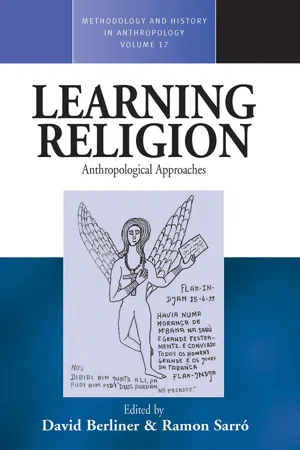
As we enter the 21st century, it becomes increasingly difficult to envisage a world detached from religion or an anthropology blind to its study. Yet, how people become religious is still poorly studied. This volume gathers some of the most distinguished scholars in the field to offer a new perspective for the study of religion, one that examines the works of transmission and innovation through the prism of learning. They argue that religious culture is socially and dynamically constructed by agents who are not mere passive recipients but engaged in active learning processes. Finding a middle way between the social and the cognitive, they see learning religions not as a mechanism of "downloading" but also as a social process with its relational dimension.
eBook - ePub
Learning Religion
Anthropological Approaches
- 248 pages
- English
- ePUB (mobile friendly)
- Available on iOS & Android
eBook - ePub
About this book
Trusted by 375,005 students
Access to over 1.5 million titles for a fair monthly price.
Study more efficiently using our study tools.
Information
Chapter 1
ON LEARNING RELIGION: AN INTRODUCTION
David Berliner and Ramon Sarró
Religion, Recollection and Learning
A Biblical text (Acts of the Apostles, 8: 31–32) tells us that immediately after Pentecost, when the Holy Ghost inspired Jesus’ disciples to spread the good news, Philip, one of the apostles, saw the eunuch of the queen of the Ethiopians reading the Book of Isaiah. ‘Do you understand what you are reading?’ asked Philip. ‘How can I, unless someone instructs me?’ replied the eunuch. Then Philip carefully read the text with him and explained that what they were reading was in fact the announcement of the coming of Jesus. The eunuch not only understood then what he had been reading (and told), but also asked to be baptized with water. Something somewhat similar happened two thousand years later when a Russian woman we met told us she used to read the Bible a lot, but had not understood it. She only understood it when her boyfriend, a Jehovah’s Witness, explained the meaning of the texts to her. Not only did she then ‘understand’ the Bible, but she also converted from the Orthodox Church to the Jehovah’s Witnesses’ religion.
These relatively simple occurrences could exemplify some of the aspects we wanted to explore when in September 2005, under the aegis of the Wennergen Foundation for Anthropological Research, we organized a symposium, rather intriguingly called ‘learning religion’, at the Institute of Social Sciences, Lisbon. We have here a man and a woman who respectively celebrate a religious action routinely (reading a holy text without ‘understanding’ it) and an instructor who fills this ritual action with ‘meaning’, which then leads to their finally experiencing a transformation we would normally refer to as ‘conversion’. Of course both the eunuch and the Russian woman had already had some instruction, otherwise they would not have spent their time reading such solemn texts. Yet, the experience of suddenly ‘understanding’ something when someone else brings an explanation from outside and forces a new reading of one’s routine is not only a characteristic of conversion narratives, but in many ways it may be essential to religion itself.
Already in the first century BC, the Roman thinker Cicero in his De Natura Deorum (II: 72) had established a solid distinction between those who conducted a religious ritual routinely just because they were asked or instructed to do so but paid no attention to it (Cicero called them ‘superstitious’, a word whose meaning has changed enormously) and those who followed it attentively and consciously. These were called ‘religious’ – or so Cicero claimed – because they did what in Latin was called relego: to do something in full consciousness (‘observing’ a cult, as the English has it), a concept sometimes translated as ‘re-reading’ and sometimes, probably more accurately, as ‘recollecting’.1 For Cicero, a religious person was one who not only performed a rite, but also conducted it carefully. As some contemporary colleagues would put it, ‘orthopraxis’ is for many religious people more important than orthodoxy, but it must be taken into account that Cicero’s suggestion was that this ‘orthopraxis’ should not become mechanical but remain conscious, otherwise it would then be mere superstitio. So one had to conduct rites with full attention and with full intention.
Some readers could disagree and insist that the two cases in point do not exemplify Cicero’s relego but rather give it a ‘serendipitous’ twist: it is when re-reading the texts with the (should we say misleading?) help from Philip or a boyfriend that our protagonists suddenly ‘understood’ what they had been reading and entered a different religion to that in which they had been socialized. However, if we follow Emile Benveniste (1969), who for many years has provided the most reliable hermeneutic of these Ciceronian concepts, the disagreement would be ironed out. For him, the idea that relego implied a new rendering of an old practice (be it a rite or a text) was implicit in the concept. He translated relego by the obsolete French verb recollecter and glossed it as ‘going back to a previous synthesis in order to recompose it’ (Benveniste 1969, Vol. 2: 271; our translation). A religious person should constantly read the foundations of his or her beliefs and apply them to new situations, always revisiting, like a chameleon, the trodden path with renewed intent to move forward. The basic foundations of a religious system may be very solid, but they can be ‘observed’ in very different ways by different actors or even by the same actor at different times, as Clifford Geertz proved in his classic comparison of two Muslim settings (Geertz 1971). Of course, the fact that relego implied some re-reading does not solve the problem of conversion (which in any case is not the problem this volume addresses), but we think that in many cases even conversion could be more fruitfully seen as a process of recollection and reinterpretation of one’s past than as a biographical ‘rupture’.
As is well known, Cicero’s etymological exploration (probably whimsical) of ‘religion’ was later contested by Christian apologetics, most notably Lactantius (third century) and later Augustine (fourth century), for whom the Latin word religio stemmed (probably whimsically too) from the verb religo (to re-bind), because religion means binding someone to the divinity (for further reading on these etymologies, see Meslin 1988: 24–42; Smith 1998: 269–70). This set a characteristically theological (Christian) way of thinking about religion that has been a problem not only for theologians, but also for historians of religion, anthropologists and other social scientists (Asad 1993). Indeed we cannot reduce religion to inner devotion (although this should not be neglected either) and, to our understanding, Cicero’s exploration seems much more descriptive and open to other religions than Lactantius’ or Augustine’s inner re-binding. In any case, the most interesting thing about these two etymologies may be that they both coincide on one thing: the reiterative aspect of religion. Whether we recollect or we re-bind, whether the etymology of religion is relego or religio, we are fundamentally talking about some kind of repetitive action (Latour 2002). No matter how it is defined, religion has to do with reiteration: of words, actions, intentions or memories. How it repeats and replicates itself over time and space is what we ethnographers are here to find out.
However, finding out about this is not an obvious matter either at the theoretical or methodological level. In many ways this volume, just as the 2005 Lisbon conference on which it is based, is the direct outcome of this difficulty and the concomitant need to start clearing up the path. Both of us have done fieldwork and have written about roughly the same area (coastal Guinea), enveloped in the same environment marked by strong secrecy, legacies of iconoclastic Muslim movements and socialist ‘campaigns of demystification’ and by the pervading presence of spiritual agencies despite the absence of formal institutions of religious learning (Berliner 2005b, 2005c; Sarró 2002, 2007b). It may not come as a surprise that Guinea also offered a field site for Christian Højbjerg, who has also worked on transmission of religious knowledge and has developed a theory of the ‘robustness’ of religious notions to explain the tenacity of religious representations even when religious institutions are officially banned (Højbjerg 2002b), as well as for Michael McGovern, author of a PhD dissertation on the impact of anti-ritualist policies in the making of contemporary Guinean subjectivities (McGovern 2004). Richard Fardon (1990) once wrote that anthropological paradigms are often inscribed in regional areas. Without claiming to have invented a new paradigm in Guinea, there is no doubt that the specific religious history in this country led us to think through issues of learning and transmission in religion and to discover, alas, that despite anthropologists’ long-standing interest in religion, we still lacked the methodological tools to start tackling the topic of its learning. We thought that organizing a conference with some of the best specialists in religious knowledge would be a good way to make a start. It was a good idea.
Anthropologists have defined ‘religion’ in many ways, and although we do not want to convert this introductory chapter into a list of definitions, it may be useful to recollect some trends that have accompanied our discipline since the nineteenth century. Edward Tylor’s classic and succinct definition of religion as ‘belief in spiritual beings’ has been a powerful one and although today it may sound slightly too obvious, we must keep in mind that in its days it was meant as a provocation against a legion of scholars who argued that unless you had a temple, a holy scripture, a priestly class and (only) one high god, you could not really claim you had ‘religion’ (Tylor 1903 [1871], Vol. 1: 424; for a contextualization of Tylor’s definition, see Pals 1996: 16–29 and Stringer 1999). Despite its own inner problems (what exactly is a ‘belief’? what kind of being is a ‘spiritual’ one?), Tylor’s definition, together with its concomitant concepts of ‘animism’ and ‘intellectualism’ proved to be sufficiently thought-provoking tools for anthropology. Not only did they give rise to much debate and research about what makes religion something different from any other human activity, but in fact today they are also coming back and articulating fresh research on why and how it is possible for people to believe in non-sensorial entities that, for the lack of a better word, we might as well call ‘spiritual’, although ‘supernatural’ would probably be a more neutral term (for contemporary cognitive approaches to ‘animism’, see Guthrie 1993, Boyer 1996, and much of the cognitive approaches to religion reviewed in the next section).
Another angle that has proved quite consistent is one that views religion as a sentiment of dependence from – or of belonging to – a superior force. This idea was very dear to German Protestant thinkers, from Schleiermacher (1994 [1799]) to the founders of modern comparative history of religions such as Friedrich Max Müller (1878) and a little later Rudolf Otto (1956 [1918]), but it had its clearly non-religious variant in the Durkheiman line of analysis (Durkheim 1995 [1912]). The approach is still being fruitfully explored by contemporary authors who see religion as, among other things, a system of subordination to both superhuman entities and an encompassing ideological system (for a paradigmatic example, see Bloch 1992). Symbolic anthropology of the 1960s, which was probably more strongly influenced by Weber than Durkheim, gave rise to new definitions of religion, such as that of Clifford Geertz (1969; see his recent reappraisal in Geertz 2005). That religion was a system of symbols through which people constructed a meaningful world also had its imprint on the history of religions, especially in the anthropologically-oriented version of Jonathan Z. Smith and his followers, a school that has learnt to use anthropology in very enriching ways (Smith 1976, 1989, 2002) and has in turn given feedback to anthropological analyses of ritual and religion (see, for example, Ray 2000).2 There are undoubtedly many other approaches that should be taken into account. We might as well decide that the exercise of trying to define ‘religion’ is futile and should be given up, as seem inclined Talal Asad (1983), William Arnal (Arnal 2000) and other contemporary scholars of religion. There are indeed many things one can say about religion. One can even deny its existence as a ‘thing’ to be studied3 or, more intriguingly, that it exists for other people, as in the case of an Orthodox Christian who said he could not discuss religion with Protestants because, according to him, they did not have religion (Sarró 2007a). But one thing we definitely cannot do is claim that whatever it is that we, or the people we have mentioned, call ‘religion’ (be it their inner convictions or their social institutions) is something that just came ‘out of the blue’. People live in society, and it is in society they are socialized and learn to be grown-ups – religious grown-ups, sometimes.
There is little doubt then that no matter how well- or ill-defined they are, religious dynamics have been a profusely explored area in the history of anthropology. Religion, beliefs and rituals have been a cherished area of anthropological analysis and reflection even since the days of Frazer’s and Tylor’s insistence on the explanatory role of beliefs; ever since Durkheim’s seminal influence on British functionalism and French structuralism when he showed that religion is fundamental in creating a sense of coherence and belonging to a social group; ever since Evans-Pritchard’s study on the Azande showed that ‘witchcraft’ was not a string of irrational ideas but rather a system of logically coherent beliefs and practices4 and ever since anthropologists realized that in colonial situations people often went to religion in order to recreate their sense of cosmos and their dignity either in Melanesian ‘cargo cults’ or in African and American prophetic movements.5 Religion has grown up with anthropology, and in fact it would require ‘bad faith’ to claim that the connection between religion and education has been completely neglected. Durkheim, for a start, saw religion as fundamentally a mechanism to enable social agents to become well adapted to social groups and he even wrote that the kind of transformation achieved by religion, i.e. ‘conversion’, is – or should be at any rate – similar to the transformation all educators try to effect upon their pupils (Durkheim 1938, quoted in Giddens 1972: 205–15). Durkheim’s major study on religion (Durkheim 1995 [1912]) was based on Australian societies where initiation played a significant role in education and processes of coming of age, and together with the parallel influence of Arnold van Gennep’s work on rites of passage (van Gennep 1960 [1909]), they triggered an anthropological interest in initiations that eventually yielded such extraordinary results as Audrey Richards’ study on female initiation among the Bemba (Richards 1956) and Victor Turner’s study on boy’s initiation among the Ndembu (Turner 1967), to mention just two exemplary analyses of the interface between religion and the making of moral agents in a community. The same interface, of course, has been analysed by anthropologists working on literate societies, and here we should mention the names of Eickelman (1974) and Brenner (2000) as two very important contributors to the study of religious education in Muslim societies.
In the last few years studies of memory and the transmission of the past have blossomed in anthropology (for a critical review, see Berliner 2005a). These studies focus on history as it is lived, on how remembrances shared and transmitted by social groups cling to our past and how we are shaped by it. Some of these recent works have concentrated on the study of ‘collective religious memory’ (in the sense first given by Halbwachs 1994 [1925]: 243–300). This is particularly clear in the powerful study by Jun Jing (Jing 1996), in which he describes memories from the Chinese communist persecution era and the contemporary ‘resurgence of popular religion’ by a people ‘trying to rebuild their life after grievous assaults on their cultural identity, sense of history, and religious faith’ (Jing 1996: 22). This may be a paradigmatic case, but there are other detailed ethnographies testifying to how religious practices can be treated as sites of memory to be transmitted. Without making an exhaustive list, we could here remember, as token examples, the detailed accounts of Maurice Bloch in Madagascar (1998), Paul Stoller in Niger (1995) and Marianne Ferme and Rosalind Shaw in Sierra Leone (Ferme 2001; Shaw 2002).
However, despite the laudable efforts and ethnographic accounts on the interface between religion, transmission and learning, there has been in anthropology, as David Parkin (pers. comm.) has put it: ‘the assumption that religion just happens to people’ and to forget that much time and effort is invested in instructing people. In 1938, Meyer Fortes insightfully noted that ‘a great deal of information has been accumulated about what is transmitted from one generation to the next … Of the process of education – how one generation is “moulded” by the superior generation, how it assimilates and perpetuates its cultural heritage – much less is known’ (1970: 14). Since he wrote this, numerous authors have been interested in the diversity of knowledge systems and in the processes of transmission of knowledge, especially in the field of the anthropology of education (Middleton [ed.] 1970; Spindler 1997). Their works, which are too numerous to mention in detail here, deal with the transmission of historical knowledge (Borofsky 1987; Crook 1996; Price 1983; Stobart and Howard 2002), apprenticeship and the transmission of savoirs faires (for a comprehensive bibliography, see Herzfeld 2004), as well as the role of schooling in the transmission of literary knowledge (Bloch 1998; Spindler 1997). However, at least until recently, not many anthropologists were interested in the construction of religious knowledge though there were some well-known exceptions such as the innovative studies of transmission of knowledge in initiatory rituals in Papua New Guinea by F. Barth (1975, 1987) or, more recently, Danièle Hervieu-Léger’s work on transmission (Hervieu-Léger 1997). But apart from these, most contemporary studies of resurgent and syncretistic religions usually take for granted, or give only secondary importance to, the processes of transmission and learning. The precise way religious concepts about supernatural beings are acquired and practices linked to them are learnt has remained largely understudied by anthropologists, despite the above-mentioned anthropologies of learning, education and apprenticeship. Only recently have anthropologists started to think seriously about how the acquisition of religion happens in people’s mind. This has been possible thanks to the progress of a rather new discipline: the cognitive approaches to religion, a field in expansion to which we now turn our attention.
Explaining Religious Transmission
In recent years, issues of learning and transmission of religious ideas and rituals have received considerable attention in the burgeoning field of cognitive studies. Still marginalized and of little importance for many anthropologists, these cognitive perspectives on religion are nowadays getting an increasing amount of attention in European and American anthropological circles. Indeed, some anthropologists such as Atran (2002), Bloch (1998, 2005), Hirschfeld (1996) and many others have highlighted the crucial role of cognitive psychology in providing new concepts and methods for our discipline, and not only for religion. French anthropologist Dan Sperber is considered by many to be the father of the cognitive explanatory programme in anthropology, mainly because of his epidemiological model of cultural transmission (Sperber 1996).
Most cognition-oriented anthropologists of today are interested in religion, i.e. in making use of relevant findings of cognitive sciences to illuminate the field of anthropology of religious representations and practices (Boyer 1994, 2001a, 2001b; Højbjerg 2002b; Whitehouse 2001, 2004, 2005). Allied with philosophers such as Lawson, religionists such as McCauley (Lawson and McCauley 1990; McCauley and Lawson 2002) and psychologists such as Barrett (2004), they propose to ‘formulate new theories about a wide range of religious materials’ (McCauley and Whitehouse 2005: 2) by borrowing data from cognitive linguistics, evolutionary psychology and cognitive psychology. Although each of these scholars has his or her own perspective, most of them react against what they call ‘the methodological sloppiness of interpretivism and, more generally, of the postmodern critique’ (Whitehouse 2005: 25), calling for an epistemological return to the general and the explanatory in religious studies (Boyer 1994; Lawson and McCauley 1990; McCauley and Lawson 2002). They see themselves as theorists about patterns rather than ‘interpreters of meanings’ of religion – more to do with explaining than interpreting religion (McCauley 2003; see also Lawson and McCauley 1990: 12–31). Rather than engaging with anthropologists, they seem in general to be more willing to enter into dialogue with cognitive sciences, a discipline that by and large has not been interested in religious issues (McCauley and Whitehouse 2005: 3).
Reading Boyer, Whitehouse or McCauley and Lawson, the emphasis is clearly placed on the cognitive mechanisms of transmission, i.e. how cognitive properties constrain the formation and transmission of religious repre...
Table of contents
- Cover
- Title Page
- Copyright
- Contents
- Acknowledgements
- 1. On Learning Religion: An Introduction
- 2. Learning to Believe: A Preliminary Approach
- 3. Menstrual Slaps and First Blood Celebrations: Inference, Simulation and the Learning of Ritual
- 4. The Accidental in Religious Instruction: Ideas and Convictions
- 5. On Catching Up With Oneself: Learning to Know That One Means What One Does
- 6. How Do You Learn to Know That it is God Who Speaks?
- 7. How to Learn in an Afro-Brazilian Spirit Possession Religion: Ontology and Multiplicity in Candomblé
- 8. Learning to be a Proper Medium: Middle-Class Womanhood and Spirit Mediumship at Christian Rationalist Séances in Cape Verde
- 9. Copyright and Authorship: Ritual Speech and the New Market of Words in Toraja
- 10. Learning Faith: Young Christians and Catechism
- 11. What is Interesting about Chinese Religion
- 12. The Sound of Witchcraft: Noise as Mediation in Religious Transmission
- Notes
- Bibliography
- Notes on Contributors
- Index
Frequently asked questions
Yes, you can cancel anytime from the Subscription tab in your account settings on the Perlego website. Your subscription will stay active until the end of your current billing period. Learn how to cancel your subscription
No, books cannot be downloaded as external files, such as PDFs, for use outside of Perlego. However, you can download books within the Perlego app for offline reading on mobile or tablet. Learn how to download books offline
Perlego offers two plans: Essential and Complete
- Essential is ideal for learners and professionals who enjoy exploring a wide range of subjects. Access the Essential Library with 800,000+ trusted titles and best-sellers across business, personal growth, and the humanities. Includes unlimited reading time and Standard Read Aloud voice.
- Complete: Perfect for advanced learners and researchers needing full, unrestricted access. Unlock 1.5M+ books across hundreds of subjects, including academic and specialized titles. The Complete Plan also includes advanced features like Premium Read Aloud and Research Assistant.
We are an online textbook subscription service, where you can get access to an entire online library for less than the price of a single book per month. With over 1.5 million books across 990+ topics, we’ve got you covered! Learn about our mission
Look out for the read-aloud symbol on your next book to see if you can listen to it. The read-aloud tool reads text aloud for you, highlighting the text as it is being read. You can pause it, speed it up and slow it down. Learn more about Read Aloud
Yes! You can use the Perlego app on both iOS and Android devices to read anytime, anywhere — even offline. Perfect for commutes or when you’re on the go.
Please note we cannot support devices running on iOS 13 and Android 7 or earlier. Learn more about using the app
Please note we cannot support devices running on iOS 13 and Android 7 or earlier. Learn more about using the app
Yes, you can access Learning Religion by David Berliner, Ramon Sarró, David Berliner,Ramon Sarró in PDF and/or ePUB format, as well as other popular books in Theology & Religion & Religion. We have over 1.5 million books available in our catalogue for you to explore.