![]()
Part I
A Midsummer Night's Dream
Love looks not with the eyes but with the mind
(A Midsummer Night’s Dream, I, i, 240)
Games to begin
Games
• The Heartbeat Circle
• Throwing the face
The Heartbeat Circle
Begin every session with a Heartbeat Circle. This gives the children an opportunity to transform their faces and voices within a safe environment, allowing them to experience brief moments of acting from the very beginning of the workshop. The repetition involved in the game offers invaluable practice for the children to observe and explore different facial expressions for themselves. The game is based upon the rhythm of the heartbeat taken from the iambic pentameter, which underpins Shakespeare’s verse, and is shown to have a calming, almost meditative, effect on the children. The game is simultaneously demonstrated, played and shared at the same time.
Demonstration/playing with the children
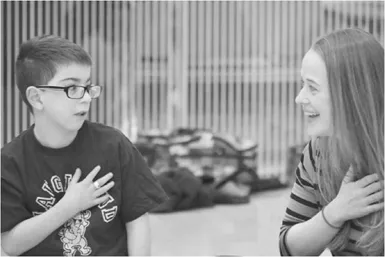
Sitting around the circle, everyone places their hands on their hearts and slowly beats out the rhythm of a heartbeat together, creating a collective pulsing sound as a group. Once this rhythm has been established, start to say and repeat the word ‘Hello’ using the heartbeat rhythm to naturally underpin the words: ‘Hel-lo, Hel-lo, Hel-lo.’ Everyone in the circle joins in and the atmosphere is easy and enjoyable. Try to make eye contact with everyone in the group and during these initial minutes take the opportunity to learn about the children. How are they today? How difficult is it for them to keep the rhythm? Are they willing to speak? Can they make eye contact? Are they relaxed and comfortable?
Photo 3 Making Heartbeats (photo © Jirye Lee)
After about a minute say ‘Now rest your hands’ and place your hands in front of you on the floor encouraging the children to do the same. Suggest to the group that you give yourselves a ‘round of applause’, by clapping your hands in the shape of a circle in front of you, making a ‘round’. Cup your hands when clapping as this makes a duller sound and is easier on the ear. This small routine of finishing a game with a quiet round of applause creates a boundary from which the children understand the game has ended and can be used after each game or exercise.
Now establish the rhythm with the collective heartbeat again, but this time take turns to say ‘Hello’ one person at a time, starting with yourself and continuing around the circle, everyone keeping the heartbeat rhythm alive using their hands on their hearts. If after encouragement a child doesn’t want to join in, they can pass. Once the round has returned to you finish the turn with ‘Now rest your hands’ and once more suggest a round of applause.
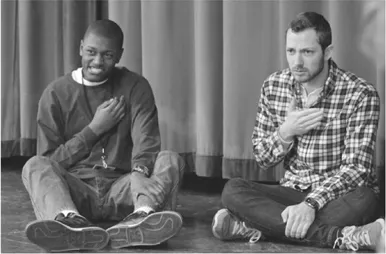
Next choose a particular facial expression, selecting initially between happy, sad or angry. You can say for example ‘let’s make an angry face’ and encourage everyone to try. Never ask the children to feel angry, just ask them to make an angry face. Actors are often asked to imagine something that brings on a particular feeling whether it is something from their own life or something they conjure up that will make them feel sad, happy, angry, etc. This is not the direction you want to take with the children, rather you want them to understand what an emotion looks like and for them to try to replicate the outward picture. Begin by demonstrating with your own face so that they may try to mirror what you provide. It is very possible that the children begin to feel the emotion they are showing, but the fundamental point is not to begin with the inner feeling but rather to start with the outer facial expression.
Now start the ‘Hello’ circle again and during this next round of ‘Hellos’ encourage everyone to keep the chosen expression in their face and voice whilst making the heartbeat rhythm, saying ‘Hello’ one by one around the circle. The ‘Hello’ should sound and feel completely different now that it has an expressive feeling behind it. Initially for some of the children there will be no difference at all. This is another opportunity to learn what the children are capable of in terms of understanding facial expressions and creating them. Make several rounds of ‘Hellos’ practising different expressions.
Finally offer the children the chance to ‘take a circle’. One child sits on the cross in the middle and chooses an expression for the whole group, for example happy. You then encourage everyone to assume a happy expression. Remember, don’t ask them to feel happy, simply to make the face. Establish the rhythm once again, making sure that there is a steady pulsing wall of sound, creating a safe environment within which to play. The child in the middle proceeds to say ‘Hello’ to everyone in turn around the circle, maintaining the happy face and voice. Each person says ‘Hello’ in return, also keeping the happy face and voice, giving everyone the chance to make their particular ‘Happy Hello’.
Once the child in the middle has exchanged ‘Hellos’ with everybody, rest your hands and then give a warm round of applause. Repeat this exercise so that each child has had a chance to take a circle. It may be slow work but it is time well spent. After the three initial faces – happy, sad and angry – have been established you can add three more: fearful, surprised and disgusted. Additional faces can be added at any time, which introduce and illuminate the predominant features of a character. ‘Mischievous’ is an excellent face with which to introduce Puck whilst ‘lovestruck’ is a useful face for the characters in A Midsummer Night’s Dream who have had their eyes ‘tricked’. Both mischievous and lovestruck are popular choices with the children and you can introduce them early on to support the first games in the book. Once every child has taken a circle, the group is ready to play ‘Throwing the face’.
Photo 4 Making angry heartbeats (photo © Jirye Lee)
At the end of each session spend the last few minutes making a ‘Good-bye Heartbeat Circle’ by swapping ‘Hellos’ for ‘Goodbyes’. Keep this as a group activity, there is no need or time for each child to take a circle. Choose a calming expression with which to say goodbye, the idea is to send the children back to the outside world with increased tranquility and confidence – a final round of ‘angry goodbyes’ wouldn’t seem quite right. As before with the ‘Hellos’, take this opportunity to make eye contact with the group and use these last few minutes to see how the children are. There is usually a marked difference between the ‘Hellos’ at the beginning and the ‘Goodbyes’ at the end, when the children have relaxed during the session, found their voices and are more willing to be playful.
Heartbeat Circle for non-verbal children
You can adapt the Heartbeat Circle for non-verbal children and those with very low cognition. At best it offers a calming womblike experience, which becomes almost meditative and can last up to twenty minutes. The children’s anxiety can be potentially soothed by the predictable prospect of each steady beat that is offered in the rhythm. Encourage willing parents, teachers and actors to join the children and sit around the circle, one child per accompanying adult if possible.
Demonstration/playing with the children
Everyone who can places their hands on their hearts and slowly beats out the rhythm of a heartbeat together. Once the rhythm is established, the adults begin to say ‘Hello’, exactly as you do with the regular Heartbeat Circle. The idea is for the children to join you in the rhythm and to begin to make sound if possible; they will need encouragement, guidance and praise.
If the children can’t physically make the heartbeat by themselves, guide their hand to their heart and beat out the rhythm together. Get comfortable with the child and continue making the heartbeat with them; a close physical relationship is essential and your confidence with the child is key. Some children are immediately at ease with the heartbeats whilst others feel happier having the rhythm made on their backs. Playing with a child for the first time I say something along the lines of ‘I’m going to make contact with you using my hand, is that o...