eBook - ePub
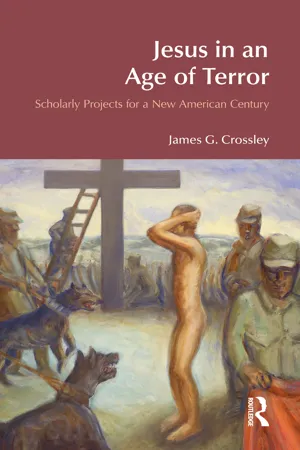
Jesus in an Age of Terror
Scholarly Projects for a New American Century
- 224 pages
- English
- ePUB (mobile friendly)
- Available on iOS & Android
eBook - ePub
About this book
New Testament and Christian origins scholarship have historically been influenced by their political and social context. 'Jesus in an Age of Terror' applies the work of critical and media theorists to contemporary Christian origins and New Testament scholarship. Part one examines the influence of the mass media on the writing of contemporary biblical scholars, whose political views - as demonstrated in their 'biblio-blogging' - are shown to have striking similarity to the media s depiction of the 'war on terror' and conflict in the Middle East. Part two argues that the Anglo-American cultural mis-representation of Islam as the 'great enemy' has led New Testament and Christian origins scholarship to collude with intellectual defences of the war in Iraq. Part three examines the influence of the media's approach to Palestine and Israel on biblical studies, exploring the shift towards widespread support for Israel in contemporary scholarship.
Information
Part I
Christian Origins and New Testament Studies in Ideologically and Historically Contaminated Contexts
Cultivated theory can bolster uncomplicated bigotry.
Amartya Sen1
There is however, a brighter side to the amount of energy and money that the establishment pours into the business of “managing” public opinion. It suggests a very real fear of public opinion. It suggests a persistent and valid worry that if people were to discover (and fully comprehend) the real nature of the things that are done in their name, they might act upon that knowledge. Powerful people know that ordinary people are not always reflexively ruthless and selfish. (When ordinary people weigh costs and benefits, something like an uneasy conscience could easily tip the scales.) For this reason, they must be guarded against reality, reared in a controlled climate, in an altered reality, like broiler chickens or pigs in a pen.
Arundhati Roy2
Chapter 1
Introduction: Reading the History of New Testament and Christian Origins Scholarship
Far from more or less accurate repetitions of an ancient object, modernity’s depictions of original Christianity must be read as a working through of its own identity.
Ward Blanton1
This chapter will briefly introduce the ways in which New Testament and Christian origins scholarship have historically been embedded in their social, political and cultural contexts. The purpose of this chapter is to summarize some relatively non-controversial arguments made by several scholars, including myself, in order to provide a historical context whereby it can be seen clearly that scholarship is embroiled in the major political disputes of its day. The next chapter will provide a contemporary context where we will see scholars explicitly airing their political views. These first two chapters will be the foundation for the rest of the book because the subsequent chapters will then look at the more subtle ways in which politics and ideology continue to infiltrate New Testament and Christian origins scholarship.
Before we turn to a social history of New Testament and Christian origins scholarship, I will first look at a suitable model for analysing the role of politics and ideology among academics which will also form the basis for much of this book.
Manufacturing Consent: Christian Origins Scholarship in Context
Any group dominated by people with overarching similar interests will obviously have such interests reflected in its literary and rhetorical output. Edward Herman and Noam Chomsky showed this with reference to intellectuals and the mass media in their development of a “propaganda model.”2 The propaganda model shows that the press is not really an important tool of democracy and it is not really disagreeable, argumentative or subversive of political power, at least not in any significant sense. The function of the mass media is to provide support for the special interests that dominate the state and private activity. This is reflected in their choices, emphases, and omissions. It is the powerful who fix the assumptions of media discourse and decide what is allowed to be seen and heard, often with the support of academics. Disagreements reflect disagreements among the elites. Although individuals may hold very different views from the agenda of the mass media, these views will not be seriously reflected in the overall agenda or agendas. Fundamental dissent is largely missing from the press: it is more likely to be squeezed towards the back pages or left to some marginalized press. Censorship, then, effectively becomes self-censorship behind the rhetoric of free and open debate. Hence Herman and Chomsky borrow the loaded phrase “manufacturing consent.”
As this analysis is focused on the media, I will apply and modify it in the next chapter on biblical scholars as bloggers. However, Herman and Chomsky’s work is obviously applicable to a variety of areas, including scholarship, particularly as it analyses how dominant groups control the presentation of data. I have tried to do this elsewhere with reference to gospel scholarship and I have also analysed the ways in which the results of New Testament scholarship reflect the interests and ideology of the dominant participating groups.3 Moreover, while Chomsky’s work may have focused most heavily on the elite media, he has also shown that propagandistic tendencies are present in intellectual scholarship, even if those tendencies are more difficult to find.4
For example, echoing Gramsci on intellectuals as “experts in legitimation,”5 Chomsky looks at the ways in which respectable scholarship either serves the needs of elite culture or avoids anything too critical of elite culture. Universities are dependent not just on tuition money but also on outside funding such as wealthy alumni, corporations, and the government, groups, in other words, with similar basic interests (see further Chapters 3, 4 and 5). Consequently, if universities stop serving such interests, there will be trouble. Chomsky is, of course, aware that things are not that simple and he does note that dissidents can be found but ultimately the problematic figures will be weeded out or made to conform. Chomsky regularly points to the contrast with the hard sciences. Basic scientific knowledge prevents scientists doing outdated science because scientific progress has been too great. This, Chomsky argues, is “very different from the social sciences and the humanities – you can tell falsehoods forever in those fields and nothing will ever stop you, like you don’t have Mother Nature around keeping you honest.”6
If there are going to be significant challenges to the political and economic system, there will likely be an attempt at marginalization, as seen in cruder forms such as purges in 1950s USA.7 Chomsky gives explicit examples of academics told straight out not to publish on certain topics but the methods of control are more subtle and closely related to the subtle means of control in the propaganda model. The control of power can be done by denying or ignoring basic facts and by setting the agenda so that certain positions are “obviously” off-limits. Chomsky famously showed this in American Power and the New Mandarins, illustrating the ways in which academic historical analysis repeated the dominant liberal or anti-anarchist discourse when discussing the Spanish Civil War or how elite opinion in the US on foreign policy in South-East Asia was unquestioningly repeated by leading analysts.8
One major example is the early career of Norman Finkelstein – a perennial example of how the education system has functioned to exclude certain views – and his demolishment of Joan Peters’ fraudulent and now infamous book, From Time Immemorial. Peters claimed, with the usual social scientific and scholarly paraphernalia, that Palestinians were in fact recent immigrants to the Jewish settled areas of former Palestine with the implication that there were really no Palestinians. The book got masses of positive reviews in the US where the issue of Israel/Palestine is particularly sensitive. However, Finkelstein noted that it was full of fraudulent detail and wrote an article demonstrating this. Yet after sending it off for publication no one bothered responding and it ended up in an obscure left wing journal.
Finkelstein was ostracized at Princeton and could get no support for his career. Finkelstein then followed up the details of Peters’ book and found an exceptionally high level of fraudulent detail. Yet still he was being told not to bother following it up and continued to struggle to get the thesis published. When he finally did manage to get the book published, Chomsky sent it to major non-American journals, notably in the UK and in Israel. Though Finkelstein’s work was not referenced, it did influence several such reviews which demolished Peters’ book. As these non-American reviews were read by American academics, there was lots of scholarly backtracking.9 Of course, since then we could go on to further mistreatments of Finkelstein, with de Paul’s intellectually absurd but ideologically obvious denial of tenure to Finkelstein merely being the latest episode.
In terms of academia, Chomsky is scathing of certain academics presented as radical, particularly certain views associated with Marxist theory and strands of postmodernism. Marxism and Freudianism can be deemed intellectual fakery because they function as theology or organized religion, coming close to acting as if the figurehead is some kind of god who got virtually everything right. Instead, Chomsky argues, people should be asking which parts of say, Marx, are worth preserving and discussing further.10 But as for areas of Marxism such as “dialectics,” Chomsky says he simply does not understand them and suggests that overly complex intellectual language has more to do with creating an intellectual niche to preserve intellectual power. As Chomsky puts it more bitterly: “when words like ‘dialectics’ come along, or ‘hermeneutics,’ and all that stuff that is supposed to be profound, like Goering, ‘I reach for my revolver.’”
Unsurprisingly, then, Chomsky is scathing of some leading postmodernist thinkers. He claims that when he reads Derrida, or Lacan, or Althusser, “I just don’t understand it. It’s like words passing in front of my eyes: I can’t follow the arguments, I don’t see the arguments, anything that looks like a description of a fact looks wrong to me… I think it’s all fraud.”11 Intriguingly, Chomsky (who is extremely critical of the French intellectual scene) says of Lacan that he was a “conscious charlatan, and was simply playing games with the Paris intellectual community to see how much absurdity he could produce and still be taken seriously. I mean that quite literally. I knew him.”12
Chomsky is partly hostile because he views such “radical” scholarship as a betrayal of popular movements and functioning as a kind of intellectual vanguard, hence the attraction of Leninism to many academics. Whatever we make of Chomsky’s critique – and it would be very interesting to know how many sympathetic academics there are out there! – it should be noted that Chomsky adds an important function of unnecessarily complex “radical” scholarship for our present purposes: the higher education system can “get people to sell out even while they think they’re doing exactly the right thing.” It is possible to enter academia and be radical as long as the questions are framed correctly in order not to ask the right questions. The scholar may feel like they are not selling out by acting as, for instance, a Marxist economist, but in reality the individual has been neutralized.13
An analysis of the political control of higher education that complements Chomsky’s analysis was developed by Edward Said and is particularly important because Said’s critique of scholarship has regularly involved social-scientific study of the Middle East and Israel, areas of direct significance for the study of Christian origins and issues in contemporary Anglo-American foreign policy. As Said famously argued, the development of “Orientalism” was a way of studying Arabs, Asians or any kind of “other” as different, exotic, inferior, undemocratic, backward and so on, was tied in with Western imperialistic ambitions, from the British through to the contemporary US. As we will see, whatever the faults of Said’s analysis, it is very clear that it has powerful explanatory force for analysing contemporary scholarship. Said also showed that Orientialism, which, as we will see, has a long history within biblical studies, is not “more biased than other social and humanistic science, it is simply as ideological and contaminated by the world as other disciplines.”14 Moreover, Said also showed that Orientalism – applicable to other culturally dominant motifs – is both implicit and explicit in all aspects of the culture studied, from film and advertising to politics and academia. In terms of the scholarship on Christian origins we may not always find explicit reference to the various themes to be discussed in this book but we should not be surprised if scholarly themes echo major themes elsewhere in contemporary culture.
These kinds of analyses have continued up to the present, including the present “war on terror.” As Derek Gregory has shown, US centred colonialism is not simply reproduced though geopolitics, geoeconomics, foreign policy, corporate demands and so on but, crucially for present purposes, also through “mundane cultural forms and cultural practices that mark other people as irredeemably ‘Other’ and that licence the unleashing of exemplary violence against them…these imaginative geographies lodge many more of us in the same architectures of enmity.” Gregory aptly adds that we should not allow the “spectacular violence” of recent times “to blind us to the banality of the colonial present and to our complicity in its horrors.”15 In a volume Gregory co-edited on “violent geographies,” intellectual thought associated with specific “culture areas” and the “war on terror” are analysed in some depth.16 This issue and that of imagined geographies will become important in Part II when we look at the ways the Mediterranean is used as a “culture area” in the anthropological study of Christian origins yet strangely merges into the “Middle East,” accompanied by some outrageous stereotypes of “the Arab” and language also used in the Anglo-American political media right up to and including the “war on terror.”
As the study of Christian origins does not always discuss explicitly the various key issues, it is necessary to infer or deduce such issues from context and see how similar trends and themes are found in what may seem to be different cultural contexts. This may mean in some cases – though certainly not all – that the study of Christian origins will produce watered-down versions of colonial trends and themes but they are, I hope to show, clear enough. This should be no surprise either as biblical studies is as every bit embedded in the cultural-political trends of its day as any other aspect of contemporary culture.
In objection to this, it might be countered that a great deal of recent scholarship has been dedicated to showing the radical nature of Christian origins and the New Testament. Jesus was a social revolutionary, Jesus and Paul challenged the power of the Roman Empire, Jesus did not like economic exploitation and neither should we, and so on. N. T. Wright even claims (wildly, it has to be said) that “in the real world…the tyrants and bullies (including intellectual and cultural tyrants and bullies) try to rule by force, only to discover that in order do so they have to quash all rumours of resurrection, rumours that would imply that their greatest weapons, death and deconstruction, are not after all omnipotent.”17
One response to all this might legitimately be: so what? For a start, Hollywood has plenty of c...
Table of contents
- Cover
- Half Title
- Title
- Copyright
- Dedication
- Contents
- Acknowledgements
- Preface
- PART I CHRISTIAN ORIGINS AND NEW TESTAMENT STUDIES IN IDEOLOGICALLY AND HISTORICALLY CONTAMINATED CONTEXTS
- PART II NEO-ORIENTALISM: ORIENTALISM, HIDEOUSLY EMBOLDENED
- Part III "JEWISHNESS," JESUS AND CHRISTIAN ORIGINS SINCE 1967
- Notes
- Bibliography
- Index of References
- Index of Names
Trusted by 375,005 students
Access to over 1.5 million titles for a fair monthly price.
Study more efficiently using our study tools.
Frequently asked questions
Yes, you can cancel anytime from the Subscription tab in your account settings on the Perlego website. Your subscription will stay active until the end of your current billing period. Learn how to cancel your subscription
No, books cannot be downloaded as external files, such as PDFs, for use outside of Perlego. However, you can download books within the Perlego app for offline reading on mobile or tablet. Learn how to download books offline
Perlego offers two plans: Essential and Complete
- Essential is ideal for learners and professionals who enjoy exploring a wide range of subjects. Access the Essential Library with 800,000+ trusted titles and best-sellers across business, personal growth, and the humanities. Includes unlimited reading time and Standard Read Aloud voice.
- Complete: Perfect for advanced learners and researchers needing full, unrestricted access. Unlock 1.5M+ books across hundreds of subjects, including academic and specialized titles. The Complete Plan also includes advanced features like Premium Read Aloud and Research Assistant.
We are an online textbook subscription service, where you can get access to an entire online library for less than the price of a single book per month. With over 1.5 million books across 990+ topics, we’ve got you covered! Learn about our mission
Look out for the read-aloud symbol on your next book to see if you can listen to it. The read-aloud tool reads text aloud for you, highlighting the text as it is being read. You can pause it, speed it up and slow it down. Learn more about Read Aloud
Yes! You can use the Perlego app on both iOS and Android devices to read anytime, anywhere — even offline. Perfect for commutes or when you’re on the go.
Please note we cannot support devices running on iOS 13 and Android 7 or earlier. Learn more about using the app
Please note we cannot support devices running on iOS 13 and Android 7 or earlier. Learn more about using the app
Yes, you can access Jesus in an Age of Terror by James G. Crossley in PDF and/or ePUB format, as well as other popular books in Theology & Religion & Biblical Studies. We have over 1.5 million books available in our catalogue for you to explore.