- 264 pages
- English
- ePUB (mobile friendly)
- Available on iOS & Android
eBook - ePub
About this book
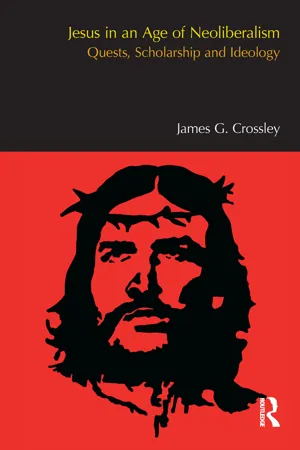
'Jesus in an Age of Neoliberalism' analyses the ideology underpinning contemporary scholarly and popular quests for the historical Jesus. Focusing on cultural and political issues, the book examines postmodernism, multiculturalism and the liberal masking of power. The study ranges across diverse topics: the dubious periodisation of the quest for the historical Jesus; 'biblioblogging'; Jesus the 'Great Man' and western individualism; image-conscious Jesus scholarship; the 'Jewishness' of Jesus and the multicultural Other; evangelical and 'mythical' Jesuses; and the contradictions between personal beliefs and dominant ideological trends in the construction of historical Jesuses. 'Jesus in an Age of Neoliberalism' offers readers a radical revisioning of contemporary biblical studies.
Information
Topic
Theology & ReligionSubtopic
ReligionChapter 1
INTRODUCTION: JESUS QUESTS AND CONTEXTS
Historical-Jesus research, if it aims to be scientific, must always engage not only in ideological construction but also in ideological criticism… I understand ideology first in the broader sense as a practice and politics of meaning-making.– Elisabeth Schüssler Fiorenza1
Introduction
An outsider to the discipline of biblical studies might be forgiven for thinking that locating scholarship in cultural contexts ought to be a relatively commonplace enterprise. Not so in historical Jesus scholarship at least, certainly not to any serious extent. As Ward Blanton rightly claimed, ‘most contemporary accounts of biblical scholarship seem to me to be oblivious to the peculiar cultural logics of our own time’.2 That said, the recent work of Blanton, along with, among others, the work of William Arnal, Shawn Kelley, Halvor Moxnes, Elisabeth Schüssler Fiorenza, R. S. Sugirtharajah, and this writer on political, ideological and philosophical readings of the history of scholarship may suggest that things are beginning to change, though there is little sign that traditional New Testament scholarship has taken too much notice of scholarship of such direct relevance.3 However, we may now be at a point where there is a genuine opportunity for different kinds of historical, political, ideological and philosophical readings of Jesus scholarship to make an impact beyond their niche audiences because it is becoming increasingly clear that the conventional analysis of the quests for the historical Jesus has failed in providing a coherent and convincing contextualization of scholarship, particularly in the numbering of distinct chronological quests. What I want to do first is to show why the standard numbering of quests ought to be abandoned before providing an outline of some ways analyses of the quests for the historical Jesus might be developed in future.
How Many Quests for the Historical Jesus?
Conventionally, the Quest for the Historical Jesus has been divided into three different sub-quests: ‘Old Quest’, ‘New Quest’ and “Third Quest’. There is a related and relatively self-explanatory category of ‘No Quest’. The ‘Old Quest’ is typically deemed to be eighteenth- and nineteenth-century historical Jesus scholarship, often characterized by the nineteenth-century so-called ‘liberal lives’ of Jesus. It is widely believed that Schweitzer’s influential Von Reimarus zu Wrede at the turn of the twentieth century brought an end to this first quest. Schweitzer’s apocalyptic prophet was so devastating that he is typically thought to have ushered in an era of ‘No Quest’, or at least minimal interest in the historical Jesus with Bultmann’s seemingly anti-historical, form critical approach and theological existentialism dominating. The ‘New Quest’ is typically deemed to have been inaugurated by Käsemann in 1953, ushering in an era of largely Protestant historical Jesus studies, and a Jesus quite different from his Jewish context in particular, and carried out by Bultmann’s students. The ‘Third Quest’, dated from the 1970s onwards, is typically deemed to be more ‘historical’ and less ‘theological’, or at least with a range of diverse scholars from religious and non-religious backgrounds, with Jesus seen more embedded in his cultural context, an emphasis on his ‘Jewishness’ and a use of a wider range of interdisciplinary methods.
While these categorizations are widely held in contemporary scholarship, they have been shown to be inadequate, rightly in my view, by scholars such as Stanley Porter, Maurice Casey, Clive Marsh, Dale Allison and Fernando Bermejo Rubio.4 The pre-Schweitzer era – lasting a suspiciously long two centuries – did not ignore the Jewish context of Jesus (see Reimarus!), was not all Renan-style romanticizers, witnessed Weiss’s fierce prophet of end times and so on. The era of No Quest was anything but, with plenty of historical Jesus books published, including the popular and notorious work of the Nazi scholar Grundmann and historical Jesus work by plenty of well-known writers (e.g. Dodd, Jeremias, Headlam, Goguel, Loisy, Klausner, Vincent Taylor, T. W. Manson, Montefiore and even Bultmann). The so-called New Quest did not lack scholars appreciative of Jewish contexts of Jesus, as might be expected from scholars like Sandmel, and Jeremias, for all his faults, was still at least interested in, and knowledgeable of, Jewish contextu-alization of Jesus’ teaching. Quite how Brandon’s study of Jesus and the zealots and Winter’s analysis of the trial of Jesus, to name but two, fit into the New Quest category is not easy to establish. As to the so-called Third Quest scholars coming from diverse backgrounds, this has always been the case, from Strauss, Renan and Reimarus, through Klausner, Tyrell and Brandon to Casey, Vermes, Sanders and Meier. As for interdisciplinary approaches, for every Crossan, Herzog and Horsley there is still a Meier, Sanders and Vermes.5
There is much more to the counter arguments than this, but this summary should already show just how problematic the Received History really is. How else, then, can we analyse historical Jesus scholarship? Dale Allison suggests the following concerning categorizing the quest for the historical Jesus:
it has not been very helpful to divide all the post-Schweitzerian activities into chronological segments or different quests. It is much more useful to lay aside the diachronic and take up the synchronic, to abandon periodization for a typology that allows us to classify a book, whether from the 1920s or the 1990s, with those akin to it.6
This seems fair enough, but I think there is a case to be made for an alternative chronological approach which does not resort to the periodization of the quest for the historical Jesus in the sense which Porter, Casey, Marsh, Allison, Bermejo Rubio and others have between them demolished. Alternatively, what I aim to do is something quite simple, though largely overlooked, and show how historical Jesus scholarship reflects the cultural, social, historical and so forth contexts of its time. This does not mean that there is necessarily a sharp difference between a Jesus book of the 1920s and the 1990s – there are, as noted, plenty of similarities between scholarly Jesuses past and present. However, all the scholarly Jesuses are obviously part of their own times and can be recognized as such.
That scholarship is as much embedded in contemporary culture as anything else is clear as major examples ought to show. People are increasingly aware of the Nazi quest for the historical Jesus and how the Aryan Jesus is so obviously part of that cultural context, while Shawn Kelley’s important work has shown how related concepts became embedded even in the most liberal New Testament scholarship.7 When Günther Bornkamm wrote about Bolsheviks in his discussion of Jesus and the kingdom of God, while also devoting more space to Marxist interpretations (which were not then taken seriously in New Testament scholarship) of the Sermon on the Mount than even Schweitzer or Bornkamm’s favoured Lutheran tradition, scholarship was presented with an explicit example of the historical Jesus in the Cold War.8 Of course, some examples of cultural influence are more subtle than others. One of the more notable features of scholarship since the 1970s is the massive emphasis on Jesus’ Jewishness and how Geza Vermes’ Jesus the Jew would become a scholarly cliché. As I argued in Jesus in an Age of Terror, one of the key reasons for this massive emphasis is (Anglo-) American cultural, religious and political support for Israel – and intensified interest in the Holocaust – post-1967 and the Six Day War. Scholarship has also followed the general pattern of a limited pro-Israeli, ‘pro-Jewish’ stance by consistently placing Jesus over against Judaism constructed in scholarship, even if there is a regular attitude of superficial positivity and sympathy in discussing Judaism. Bermejo Rubio, with justified bitterness, has since remarked in relation to historical Jesus scholarship that ‘Unless we are to assume that supposedly learned and sensitive people need forty years to react to a hideous atrocity, the claim that the Holocaust has conditioned the progress in scholarship is nothing but wishful thinking.’9
The remainder of this book will focus mainly on Jesus scholarship over the past forty years, the period which has seen the rise of two major trends in ‘the West’ (as well as their numerous offshoots): neoliberalism and postmodernism. Before we turn to the impact of these trends on the historical Jesus in scholarship and culture, the rest of this chapter will now outline something which might loosely be called ‘methodology’, or better, the perspectives which will inform this study.
Contexts
While I have long had some (secret) sympathy with Adorno’s critique of the ‘culture industry’, I always accepted it was not quite right for the standard reasons. The well-known criticisms of the culture industry – that it attributes too much influence to power imposed from above, that people can actually be coercive, that there are plenty of people who are indifferent or resist, that liberal capitalist contexts are more complex than the basic culture industry would suggest and that high culture is hardly immune from capitalist trends – are well taken. I have also had greater sympathy with Gramscian ideas about ideology, negotiations and tacit acceptance from different subordinated groups along with his analysis of ‘common sense’. These may not be quite what Adorno, Horkheimer and others had in mind as qualifications, but necessary these qualifications were and are. Yet, along with a constant historicizing of our cultural contexts, the generalizing idea of the importance of dominant cultural trends affecting the ways in which we live and think retains its significance.
All this may well explain, in part, the use of specific thinkers and their ideas underlying the arguments in this book: David Harvey’s detailed analyses of capitalism and neoliberalism and their links and overlaps with the emergence of postmodernism and postmodernity; Wendy Brown’s analysis of the double-edged nature of ‘tolerance’ and its links with imperialism; Noam Chomsky and Edward Herman’s work, inspired in part by Gramsci and having obvious affinities with Althusser on ideological state apparatuses, on the subtle (and not-so-subtle) influence of political ideology, framing and omitting of ideas, and the general manufacture of consent through the corporate media, intellectuals and education; and Slavoj Žižek’s cultural analysis of the impact of these kinds of issues on contemporary thinking, the ways in which multicul-turalism is framed and how dominant liberal ideas are perpetuated.
An aside on ‘context’ is required to try and avoid the seemingly inevitable misunderstandings. As with Jesus in an Age of Terror, this present book will locate scholarly, as well as not-so-scholarly, ideas concerning Jesus in a broad cultural context which will mean extended analyses of contemporary culture, politics and ideology. My guess is that this is both alien and yet familiar to the more conventional historical critic of the Bible. It may be alien because extended analyses of contemporary culture, politics and ideology are not commonplace in conventional reviews of historical Jesus scholarship, or biblical studies scholarship more generally. It may be familiar because contextual-izing the historical Jesus in terms of (say) eschatology, purity or Cynic philosophy, regularly involves extended analyses of eschatology, purity or Cynic philosophy in the ancient world. In this sense, this book is no different. This analogy with conventional historical criticism can be pushed further because I am reading scholarly literature as historical or (some forms of) literary criticism would read the biblical texts in their ancient cultural contexts. Instead of lengthy exegesis of Gospel texts, here I will exegete scholarly texts and general scholarly positions in their modern contexts. Methodologically, the sort of historical study I am pursuing here is not necessarily dramatically removed from conventional biblical scholarship; if anything, it is simply the chronology and focus of study that is different. Though I would stretch fieldwork beyond conventional scholarship, the primary source material for this sort of study tallies with Russell McCutcheon’s explanation of his fieldwork as a scholar of religion:
Because I study the ways scholars construct religion, I do fieldwork in publications and at national and international conferences on religion, where the methodological and theoretical hegemony in the field is often most evident. So, to the question, ‘Where do you get your hands dirty?’ I can honestly answer that I do it as a participant-observer-analyst of the scholarly pro...
Table of contents
- Cover
- Half Title
- Title Page
- Copyright Page
- Table of Contents
- Preface
- Acknowledgements and Pre(r)amble
- 1. Introduction: Jesus Quests and Contexts
- Part I: From Mont Pelerin to Eternity? Contextualizing an Age of Neoliberalism
- Part II: Jesus in an Age of Neoliberalism
- Part III: Contradictions
- Bibliography
- Index of Ancient Sources
- Index of Authors
- Index of Subjects
Trusted by 375,005 students
Access to over 1.5 million titles for a fair monthly price.
Study more efficiently using our study tools.
Frequently asked questions
Yes, you can cancel anytime from the Subscription tab in your account settings on the Perlego website. Your subscription will stay active until the end of your current billing period. Learn how to cancel your subscription
No, books cannot be downloaded as external files, such as PDFs, for use outside of Perlego. However, you can download books within the Perlego app for offline reading on mobile or tablet. Learn how to download books offline
Perlego offers two plans: Essential and Complete
- Essential is ideal for learners and professionals who enjoy exploring a wide range of subjects. Access the Essential Library with 800,000+ trusted titles and best-sellers across business, personal growth, and the humanities. Includes unlimited reading time and Standard Read Aloud voice.
- Complete: Perfect for advanced learners and researchers needing full, unrestricted access. Unlock 1.5M+ books across hundreds of subjects, including academic and specialized titles. The Complete Plan also includes advanced features like Premium Read Aloud and Research Assistant.
We are an online textbook subscription service, where you can get access to an entire online library for less than the price of a single book per month. With over 1.5 million books across 990+ topics, we’ve got you covered! Learn about our mission
Look out for the read-aloud symbol on your next book to see if you can listen to it. The read-aloud tool reads text aloud for you, highlighting the text as it is being read. You can pause it, speed it up and slow it down. Learn more about Read Aloud
Yes! You can use the Perlego app on both iOS and Android devices to read anytime, anywhere — even offline. Perfect for commutes or when you’re on the go.
Please note we cannot support devices running on iOS 13 and Android 7 or earlier. Learn more about using the app
Please note we cannot support devices running on iOS 13 and Android 7 or earlier. Learn more about using the app
Yes, you can access Jesus in an Age of Neoliberalism by James G. Crossley in PDF and/or ePUB format, as well as other popular books in Theology & Religion & Religion. We have over 1.5 million books available in our catalogue for you to explore.