![]()
Part I
Overview of consumer behaviour
Part I comprises nine chapters offering introductory insights of the behavioural expressions of consumers. Chapter 1 by Kuan-Huei Lee illustrates the theoretical background of consumer behaviour. To elaborate the concept, internal and external factors, situational and market factors influencing consumer behaviour are dealt with. The chapter further elaborates the psychographic representations of consumer requirements for effective marketing of products. It also evaluates the latest trends in consumer research to collect information for developing useful marketing strategies. In order to highlight the chapter content, a case study on local food and local life experience during the slow food movement is described.
Korstanje Maximiliano and Hugues Séraphin investigate the psychology and sociology of consumption to predict consumers’ decision making in chapter 2. The chapter further analyses the changes percolating into tourism consumption from sociology by highlighting the main contributions and limitations of renowned policymakers and practitioners of the field. To underline this the main findings and limitations of the studies of three senior sociologists, who dedicated their lives to studying consumption of tourism, Dean MacCannell, John Urry and Kevin Meethan, are thrashed out.
Chapter 3, authored by Ronnie Ballantyne, Finlay Kerr, Shirley Rate and Luiz Moutinho, looks forward to illustrate the concepts of need recognition and motivation in the consumer decision-making process. Their elaborations try to explore the dynamic process of moving from a basic need and desire to a more fully formed motivation to visit a specific tourism destination or to undertake a particular tourism activity. The chapter further talks about the experience-driven consumers who are popularly called Prosumers and Transumers.
Jennifer Kim Lian Chan and Azilah Kasim illuminate the factors affecting tourist buying behaviour in chapter 4. The chapter argues that consumer experiences are a distinct offering from services and they create distinct memories and feelings through the sensory, emotional, cognitive and behavioural aspects of the tourists. Tourism and hospitality consumption has hedonic, emotional and imaginary effects of consumption and occupies a central place for influencing consumer behaviour. Other consumption factors such as the personal (buying motives, habits, tourist characteristics), psychological, environmental, situational and the quality of experience also shape the buying behaviour. Hence the chapter scrutinises the concept of experiences and tourist buying behaviour from the decision-making, experiential and behavioural perspectives.
Chapter 5, contributed by Gabrielle Walters and Shanshi Li, scans the psychological construct of tourist behaviour by highlighting the emotional engagement of tourists. It further reviews the recent trends of scientific emotion measurement by presenting the methodological techniques employed by tourism researchers to understand the role and influence of emotion on tourist behaviour. The chapter outlines psychophysiological methods to measure tourists’ intuitive and unconscious emotional responses that inspect the correlations between individuals’ psychological activities and corresponding physiological reactions such as an increase in heart rate and blood pressure. Psychophysiological measures of emotion can capture the unconscious emotional experiences of the consumers.
Information plays a crucial role in the decisions of consumers, therefore understanding information search behaviour is key to marketing any tourism and hospitality product more effectively. Chapter 6 by Gaitree (Vanessa) Gowreesunkar and Saurabh Kumar Dixit walks around the vital information search behaviours of consumers. Different information search models formulated by different researchers are scrutinised from the hospitality and tourism perspective. The chapter also elaborates the steps involved in the information-seeking procedure, the cost of information and the limitations of information search.
Chapter 7 by Roy C. Wood presents an alternative impression of consumer behaviour, different from its popular view in the existing body of knowledge. He starts the discussion by highlighting reflections of consumer behaviour with respect to hospitality businesses. He further outlines the decision-making process involved in dining out or availing oneself of accomodation in a hotel. To support his deliberations the author employs evidence-based information drawn from a variety of public domain sources.
Ann Hindley and Xavier Font in chapter 8 evaluate the ethical issues of consumer behaviour in travel and tourism. The chapter further throws light on ethical theory by defining ethical consumption and ethical consumerism besides outlining the nature of the ethical business and the ethical consumer. The authors also review the role of society’s different actors in promoting ethically responsible consumer behaviour. Finally, the chapter summarises issues of ethical tourism and describes the ethical tourist by offering an explanation of the barriers to behaviour change hindering responsible consumer behaviour.
Chapter 9 by Clare Hindley and Melanie Kay Smith deals with the analysis of cross-cultural theory and research as applied to the tourism and hospitality industry. The chapter enables readers to understand that tourist behaviour is not only affected by motivation, demographics and lifestyle but also through culture and nationality. The case studies on halal tourism, the impact of Generation Y on the hospitality industry and guests of different nationality visiting spa hotels are used to exemplify the significance of these factors for consumer behaviour.
![]()
1
Conceptual Foundation of Consumer Behaviour
Kuan-Huei Lee
Introduction
The study of consumer behaviour covers the process by which each individual selects, uses and purchases a good or service to fulfil one’s own interests or desires. The concept of consumer behaviour includes the marketing of products and services. The essence of marketing is to satisfy consumers’ needs, create values and retain customers. Marketing strategies are formulated based on assumptions about consumer behaviour. The research to study consumer behaviour is called consumer research and is a form of market research which tries to understand the reasons why consumers acquire a specific good or service in order to formulate marketing strategies for a specific market.
Although consumers present differences in their purchasing choices, these choices are relatively stable over time, and thus predictable. Since most product and service offerings must be planned well in advance of consumer purchase, marketers need to understand why and how consumers react in any purchase situation. Therefore, the study of consumer behaviour is important to marketers to better design marketing strategies that can create higher consumer value. Consumer value can be perceived as the straightforward relationship between all the benefits a consumer derives from a product or service and all the costs of acquiring those benefits:
The higher the consumer value, the higher the probability that the customer is satisfied by the product or service. Marketing strategies are formulated based on assumptions about how consumers are aiming to maximize the consumer value. Providing superior consumer value requires the organization to understand, anticipate and react to the consumer’s needs before its competitors.
Technology has changed how businesses sell and how consumers buy products, for example the online shop ‘Taobao’ of China contains over 760 million product listings and generated over US$ 1.5 trillion in 2013. Businesses do not necessarily need a physical space to display products and receive customers. Technology has helped to enhance communication with customers, and collect and analyse data with more efficiency and accuracy.
Overview of consumer behaviour
Consumer behaviour is linked with decision making of each individual by the time to make a consumption choice. Decision making is a process by which the consumer ponders different sets of options to decide upon the best alternative to fulfil his/her consumption need.
After studying a group of 25 consumers in longitudinal research about their vacation decisions, Decrop and Snelders (2005) found the decisions made by consumers are influenced primarily by personal factors, interpersonal factors and situational factors. For Decrop and Snelders, when a consumer makes a decision, it is influenced by the environmental factors (culture, social network and geo-physical environment), which are structural components that include all other factors. Then, the consumer is influenced by primary and secondary personal factors including age, family situation, occupation, personality and lifestyle. Thirdly, personal factors include many interpersonal influences that affect group decision making. Finally, situational factors are key issues when final decisions are made.
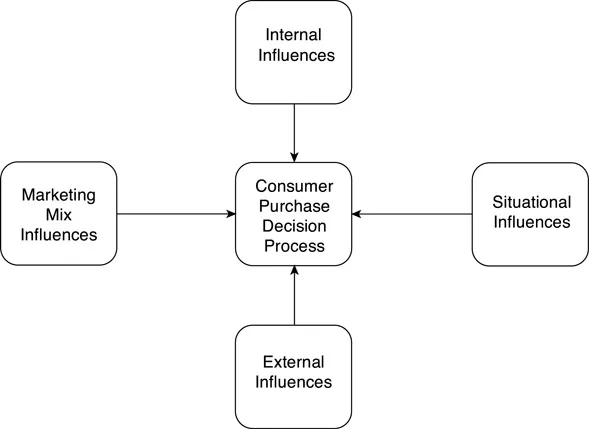
In general, there are four types of factors that influence consumer purchase decisions: internal, external, situational and marketing mix (Figure 1.1). Each of these factors is explained below.
Internal factors
Figure 1.1 Overview of consumer behaviour
Cognitive psychology deals with how people gain, process and store information. Every time that a consumer makes a purchasing decision, the consumer is influenced by his/her own perception, attitude, values and personality. This information is then transformed into knowledge and used to direct the consumer’s attention towards behaviour. Fishbein’s (1967) behavioural intention model suggests any purchasing action of the consumer towards a product is brought by his/her own values that formed the knowledge about the product together with prior experience about the product.
External factors
Consumers are influenced by family members, reference groups, social class, cultures and subcultures when making a purchasing choice. The following is an explanation of each of the factors:
- Family: a family is formed by two or more persons that are linked by blood, marriage or adoption residing together. Family members usually live together and might have strong influence in the decision making of any purchasing item. In a typical household with children, the decision making could exhibit the following patterns:
- Husband-dominated decisions: husband is the primary decision maker
- Wife-dominated decisions: wife has more influence than husband
- Children-dominated decisions: children are the dominant decision maker(s)
- Joint decisions: all members’ influence is equal in the decision making
- Autonomic decisions: any member of the family is the primary decision maker.
There is an increasing number of different components to the members of a family; more non-traditional families and non-family households can now be found such as childless couples, unmarried couples, divorced single parents, and gay couples. - Reference groups: reference groups are groups that have a high degree of credibility and serve as sources of comparison, influence and norms for individuals’ opinions, values and behaviours. Consumers are influenced by how these reference groups think and how they behave. Different reference groups that influence the consumption behaviour of consumers could be friendship groups, shopping groups, virtual communities and advocacy groups.
- Social class: social class is the division of individuals of a society into a hierarchy of distinct status classes, each individual of the same class having relatively similar status. There is no common standard for how classes should be divided; factors such as lifestyle, consumption, patterns, hobbies and media exposure can be homogeneous within and heterogeneous among social classes. If using disposable income as the factor to divide social classes, one may distinguish affluent consumers, middle-class consumers and downscale consumers.
- Culture and subculture: culture is the collective values, norms, customs and beliefs shared among a group of individuals. Culture is often known as the ‘invisible hand’ that monitors the actions and behaviours of individuals of a particular society. Culture can be expressed in different ways, for example through forms of learning, languages and symbols, rituals, and enculturation and acculturation. A subculture is a specific group that share certain values, beliefs and customs within a larger society. An individual’s ethnicity, gender, religion, geographic location or age could be one stem of subculture. Most people belong to more than one subculture group which provides alternative ways to segment the market.
Situational factors
Situational factors are external to the consumer and removed from the characteristics of the product that influence consumer purchase decisions. Many contextual factors affect our choice: one’s mood on the day, time pressure when the purchase is taking place and the role of the salesperson might be factors that influence the decision making. With fast access to the Internet, consumers today are much more informed and can find instant feedback from other users online.
A consumption situation that includes the seller, the buyer, a product or service is affected by other factors before, during and after the purchase transaction takes place. By understanding the relationship of these situational factors, marketers can plan accordingly through the marketing mix to reach targeted consumers.
Market factors
The four Ps of the marketing mix are marketing factors controllable by the marketer and consist of the following four elements:
- Product: a good, service or idea to satisfy the consumer’s needs
- Price: the amount of money which is exchanged for the product
- Place: a means of getting the product into the consumer’s hands
- Promotion: a means of communication between the seller and the buyer.
Marketers can use different strategies to present these four elements in the marketing mix. There are two different approaches that marketers can use in the product positioning, which refers to the place that the product occupies in the mind of consumers according to specific attributes different to competitors’. The first approach is head-to-head positioning, which is direct competition with competitors on similar product attributes; the second approach is differentiation positioning, presenting the product in a smaller market niche with product attributes different to those of the competitors.
Price is an indicator of value from the consumer’s standpoint. The higher the price is, the higher the expectation from consumers towards the product. Pricing has a direct effect on the organization’s profit since the decision influences both total revenue and total cost for the firm (Profit = Total Revenue – Total Cost).
The marketing channel is involved in the delivery of the product to consumers. The design of an effective marketing channel depends on how consumers make d...