- 240 pages
- English
- ePUB (mobile friendly)
- Available on iOS & Android
eBook - ePub
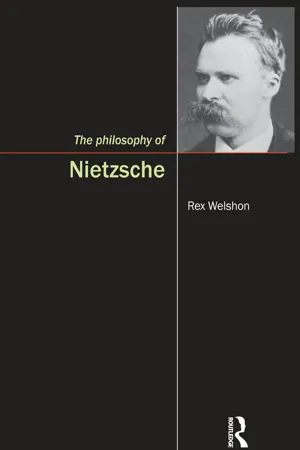
The Philosophy of Nietzsche
About this book
This important new introduction to Nietzsche's philosophical work provides readers with an excellent framework for understanding the central concerns of his philosophical and cultural writings. It shows how Nietzsche's ideas have had a profound influence on European philosophy and why, in recent years, Nietzsche scholarship has become the battleground for debates between the analytic and continental traditions over philosophical method. The book is divided into three parts. In the first part, the author discusses morality, religion and nihilism to show why Nietzsche rejects certain components of the Western philosophical and religious traditions as well as the implications of this rejection. In the second part, the author explores Nietzsche's ambivalent and sophisticated reflections on some of philosophy's biggest questions. These include his criticisms of metaphysics, his analysis of truth and knowledge, and his reflections on the self and consciousness. In the final section, Welshon discusses some of the ways in which Nietzsche transcends, or is thought to transcend, the Western philosophical tradition, with chapters on the will to power, politics, and the flourishing life.
Information
Topic
PhilosophySubtopic
Epistemology in PhilosophyChapter 1 Morality
DOI: 10.4324/9781315710501-2
Morality is that branch of philosophy that studies what is good and what is right. It immediately divides into two sub-disciplines: meta-ethics and normative ethics. Meta-ethics is concerned with analysing moral concepts and claims, and normative ethics is concerned with identifying and explaining moral values. Nietzsche is primarily concerned with meta-ethical issues, although some of his most amazing claims against morality are directed to substantive, normative claims of morality. Nietzsche is probably the most trenchant critic of morality in the philosophical tradition (the only close competitor is the French existentialist Jean-Paul Sartre). The following passage from Twilight of the Idols is entirely representative of his assessment of morality: “Moral judgment belongs, as does religious judgment, to a level of ignorance at which even the concept of the real, the distinction between the real and imaginary is lacking” (TI VII 1). Nietzsche has no truck with any moral views that precede his own, except in so far as they are exemplars of wrong-headedness, stupidity, blindness and viciousness. He thinks that every moral system hitherto developed is hopelessly naive, as in the case of English utilitarianism, a boneheaded misreading of human psychology, as in the case of Stoicism, malicious slavery, as in the case of Christianity, or foggy and grey, as in the case of Kant.
For those of us who are steadfast in our adherence to universalizable moral codes, reading Nietzsche can be a brutally disruptive experience, as we find cherished assumptions repeatedly laid on the table and smashed to bits. For those of us who are already sceptical about morality, on the other hand, reading Nietzsche’s tirades will only confirm much of what we already suspect. But his criticisms should be famous for more than their malevolence, for they are in turns infuriating, psychologically and sociologically astute and, in many ways, depressing. And although his criticisms sometimes miss their mark, the impression we are left with after understanding his views is that he is probably right about many of the issues he takes on.
In this chapter, we shall investigate Nietzsche’s criticisms of moral systems by outlining what he variously calls “herd” or “slave” morality. We shall seek to understand what Nietzsche thinks the herd is, show how morality uses the fears of the herd to motivate the real world–apparent world distinction, and discuss the selling points for particular moral views used by the morality salesmen once that distinction is made. According to Nietzsche, the edifice of morality is nothing but a shell game: moralists offer arcane and esoteric explanations for the discrepancy between the way things are in this world and the way things are in their “real world” and thus prop themselves up as protectors of that real world.
The Genealogy of Morals
Morality presumes to provide us with a guide to how to live. Nietzsche agrees that this is the proper function of morality. However, he is convinced that what we have inherited from our moral thinkers is a catastrophically wrong-headed guide. In fact, in morality values are inverted so that what is called morally good is not really good and what is called morally evil is not really bad. Nietzsche lays the blame for this inversion of values squarely on the shoulders of a particular social class, the weak, and their compatriots, the religious. Thus begins his lifelong war with morality and Christianity.
Nietzsche discussed morality in every book he wrote, but his most extended discussions of it occur in Beyond Good and Evil and The Genealogy of Morals. In Beyond Good and Evil he discusses but does not explain in any detail the slave revolt in morality, a claim about the origins of moral values and moral thinking that is uniquely Nietzschean and that forms the core of his critique of morality. Contemporary European moral thinking is, he thinks, debased and poisoned by the influence of society’s weakest and most ignoble elements, the herd. This claim is explained in detail in The Genealogy of Morals. It is a remarkable argument.
The Genealogy of Morals is Nietzsche’s most recognizably philosophical book. Composed in 1887, near the end of his productive life, and intended as a sequel to Beyond Good and Evil (published the previous year), The Genealogy of Morals is an extended argument in defence of a clear thesis. That thesis is that a critique of moral values will reveal that their value lies almost exclusively in the support they provide for the herd or slave elements of a society and not, as is claimed on their behalf, the ethical guidance they provide for all of us. As a consequence, it is a mistake to think that moral values are disinterested or not self-interested and it is another mistake to think that they are universally binding. They are, instead, thoroughly self-interested and are binding only on those for whom they promise to provide some relief from the suffering of life.
He begins soberly enough in the preface with the acknowledgement that what will follow may not be pleasant, but he suggests that truth’s ugliness is of no concern to the philosopher. Here, Nietzsche is anything but anti-rational, as some have suggested. He is proposing a critique of moral values, that is, a rational assessment of the value of moral values. He will show that, despite their puffed up self-importance, moral values are only one kind of ethical evaluation possible. (Note the distinction between morality and ethics that we draw here. We shall say that ethics is the study of right and wrong behaviour and that morality is one way of establishing what is right and wrong. As artificial as this distinction may be, we want to make some such distinction because Nietzsche nowhere abandons ethical evaluation; it is an issue found in every one of his books. By distinguishing morality from ethics, we can reserve the former for the object of his scorn while allowing him the logical space within which to develop his alternative views.)
The body of The Genealogy of Morals is divided into three essays, each with its own topic. In the first essay, Nietzsche investigates the history of moral values by contrasting the distinction between good and bad, on the one hand, and good and evil, on the other. In the second essay, he analyses the emergence of the psychological capacity for guilt and bad conscience, a cornerstone for the development of modern moral values. And in the third essay, he investigates the implications of the ascetic moral values of chastity, humility and poverty. Let us look at the argument in greater detail.
Essay I
The question of Essay I is this: how did herd morality become the dominant form of ethical evaluation, so dominant that we do not even recognize that it is a perspective of a particular class of people rather than something that is universal in scope? Genealogy is designed to answer this question. Genealogy is a uniquely Nietzschean enterprise, a peculiar kind of history, but, at its simplest, a quite familiar form of reasoning. With certain contemporary phenomena as its objects of explanation, genealogy devises hypotheses about the causal antecedents of those phenomena and then tries to confirm the hypotheses. In this, genealogy is not markedly different from other kinds of history. What makes it peculiar in comparison with most other history is fourfold. First, genealogy denies that contemporary practices represent an improvement over what caused them. Secondly, genealogy does not think that contemporary practices can always be read back into the distant past or be found intact in their current form at the point of their original emergence. Thirdly, genealogy denies that the inception of ethical evaluation has much in common with its contemporary descendant. Fourthly, genealogy is unabashedly perspectival and engaged in a way that typical histories pretend not to be. Nietzsche is quite happy to allow that his is not an objective history of moral values. He does not think there can be such a thing.
The second and third aspects of genealogy are interesting divergences from typical histories. With these differences, Nietzsche distinguishes himself from anyone who uses our contemporary social practices to explain the inception and development of the chain of social practices that culminates in these social practices. Nietzsche actually avails himself of two equally significant methodological points. First, from the contemporary social value of some characteristic we cannot infer that that characteristic had that value when it first developed. Secondly, from the archaic social value of some characteristic we cannot infer that that characteristic has that value now. He uses the first point against the so-called “historians of morality”; the second he deploys against those who would uncritically endorse any version of the noble savage model of human flourishing.
We do not question the value of morality because we assume that moral values are valuable for everyone. Nietzsche rejects this assumption. Far from being universal, moral values are, he thinks, valuable only for some. Far from being immutable, moral values are an historical product, contingent creations of particular groups of people, designed to serve their interests. Far from being intrinsically valuable, moral values are, where they are valuable at all, valuable instrumentally. Genealogy also shows that their emergence is explained not, as moral defenders would have it, as our recognition of some universally held “moral sense” whose dimensions and structure are delineated by moral concepts but, rather, as the result of a struggle between the herd and the nobility, a struggle that the herd – the slaves – have won.
Typical histories of morality begin with the present and read it back into time. In the first section of Essay I, Nietzsche has a good laugh at the expense of English moral historians who, convinced of the truth of utilitarianism and social Darwinism, read them back into history and place them at the embryonic stages of moral development. Utilitarianism was the dominant form of moral theory in the nineteenth century and, in its contemporary guise as decision theory, it remains the moral theory most frequently discussed by philosophers. According to utilitarianism, the moral good is maximal net happiness or pleasure. Maximal net happiness or pleasure is what we aim at when we make ethical decisions and is that which serves as the criterion of goodness of our actions. Given two actions, that with the maximal net happiness is the better of the two, and so it is the morally right thing to do. Social Darwinism is the claim that evolutionary development guarantees both that only those individuals who are best adapted to their social environment will live long enough to pass on their genes and that, as a result, those gene lineages that have survived the longest and are most widely distributed are the best adapted. (This sort of thinking is, whatever Nietzsche thinks about it, independently a ridiculous misreading of Darwin, for whom evolutionary explanation restricted itself to only some kinds of properties, and for whom there were a variety of causal forces at play in evolutionary development, some of which had little, if anything, to do directly with survival to mating age.)
The moral historians alluded to here in the preface and first essay of the The Genealogy of Morals are accused of thinking that we moderns are the cream of the evolutionary crop and that, since maximal net happiness is what the utilitarian’s moral theory claims is morally good, it must be that when moral values first developed they did so as the result of a similar line of reflection. Nietzsche finds both claims preposterous. There is, he thinks, absolutely no reason to think that the modern European is the best that evolution can muster. On the contrary, he thinks that the modern European is mediocre and vicious. And, being a well-trained classical philologist, he is in a peculiarly well-qualified position to counter the utilitarian potted history of morality. He thinks that, at the beginnings of evaluation, there was nothing like nineteenth-century utilitarian considerations in the reflections that resulted in the creation of moral values. His explanation of the origin of moral values is quite different: there are two senses of “good”, to each of which there is an opposing term. In the first sense of “good”, call it “noble good”, the opposing term is “bad”. In the second sense of “good”, call it “moral good”, the opposing term is “evil”.
Nietzsche thinks that the evaluative distinction between good and bad originated within the noble classes of a society. Those who were blessed by birth or by attainment to be members of the highest castes of society – that is, those with the greatest privileges and the noblest spirits – called themselves good and those lower in social rank bad (GM I 2). Nietzsche offers etymological evidence for this hypothesis: “schlecht”, the German word for “bad”, is related to “shlicht”, the German word for “plain” (GM I 4). We might trace a similar history with the English words “bad” and “base”. Nietzsche hypothesizes that the nobility, who in earliest days were identical with what he calls the masters, first designated themselves as good and the rest as bad.
The masters are truthful among themselves (GM I 5), spontaneous, open and trusting, unable to take injuries seriously, self-controlled (GM I 10), delicate, loyal, prideful, and friendly (GM I 11). But when they are not among themselves they are little better than animals:
There they savor a freedom from all social constraints, they compensate themselves in the wilderness for the tension engendered by protracted confinement and enclosure within the peace of society, they go back to the innocent conscience of the beast of prey, as triumphant monsters who perhaps emerge from a disgusting procession of murder, arson, rape, and torture, exhilarated and undisturbed of soul, as if it were no more than a students’ prank, convinced they have provided the poets with a lot more material for song and praise. One cannot fail to see at the bottom of all these noble races the beast of prey, the splendid blond beast prowling about avidly in search of spoil and victory; this hidden core needs to erupt from time to time, the animal has to get out again and go back to the wilderness: the Roman, Arabian, Germanic, Japanese nobility, the Homeric heroes, the Scandinavian Vikings – they all shared this need.(GM I 11)
This is one of the most notorious passages in Nietzsche’s writing, for the reference to the blond beast was used by the German Nazis to justify their eugenic project of creating a master race of Aryans. They should have read Nietzsche more closely: the blond beast of prey does not refer to Germans or blond Europeans at all but to the lion, and the lion in noble humans. It is glaringly obvious that he does not mean to be identifying the blond beast of prey with the blond Germans; after all, he includes Arabs and Japanese among the blonds.
The contrary value of the noble sense of good is bad. Bad consists in the denial of noble values and bad people are those who exemplify such ignoble values. The ignoble slaves are dishonest, strategic, distrustful, resentful, uncontrolled, crude, disloyal, humble and unfriendly. They are common, base, weak, sycophantic and greasy people.
It would be a mistake to think that, simply in virtue of their being the best their society has to offer, the masters of The Genealogy of Morals have an unlimited supply of value or that they exemplify the best any society has to offer. Nietzsche thinks to the contrary that the masters are irredeemably limited by their intellectual dullness and their inability to see beyond their own self-glorification. It is a great temptation to read Essay I of The Genealogy of Morals as valorizing the masters as ideals for all historical epochs and for all cultures. This is a mistake. The masters are one, extremely crude, example of a kind of human that justifies humanity, but they lack all psychological depth and are not in the least bit interesting (GM I 6). To think that the masters of Essay I provide a contemporary ideal is to ignore what two thousand years of Christianity has bred in us – psychological depth and character – and to try to revert back to an early phase of our development. Any contemporary attempt to “rediscover” the blond beast within us is doomed to fail. Our image of what that life could be were we only a master is hopelessly distorted by selectivity, biased representation and a longing to escape the tedium of contemporary life. We might find something by roaming wild places, looking for blood and honour, tanning deer hides to make our own clothes, drinking bad wine, banging drums, dancing and attacking people. However, the conditions that made the masters exemplars of their time – poorly developed technology, an ineffective economic system, primitive psychology – make the attempt to revert now to their example little more than a wrong-headed anachronism. It is also likely to get us arrested, which just makes the point: we are no longer who they were.
On the one hand, then, we have a contrast b...
Table of contents
- Cover Page
- Half-title Page
- Series Page
- Title Page
- Copyright Page
- Dedication Page
- Table Of Contents
- Acknoweldgements
- Abbreviations
- Introduction
- 1 Morality
- 2 Religion
- 3 Nihilism
- 4 Metaphysics
- 5 Truth
- 6 Logic and epistemology
- 7 Psychology
- 8 The will to power
- 9 Life, virtue, politics
- Guide to further reading
- Index
Trusted by 375,005 students
Access to over 1.5 million titles for a fair monthly price.
Study more efficiently using our study tools.
Frequently asked questions
Yes, you can cancel anytime from the Subscription tab in your account settings on the Perlego website. Your subscription will stay active until the end of your current billing period. Learn how to cancel your subscription
No, books cannot be downloaded as external files, such as PDFs, for use outside of Perlego. However, you can download books within the Perlego app for offline reading on mobile or tablet. Learn how to download books offline
Perlego offers two plans: Essential and Complete
- Essential is ideal for learners and professionals who enjoy exploring a wide range of subjects. Access the Essential Library with 800,000+ trusted titles and best-sellers across business, personal growth, and the humanities. Includes unlimited reading time and Standard Read Aloud voice.
- Complete: Perfect for advanced learners and researchers needing full, unrestricted access. Unlock 1.5M+ books across hundreds of subjects, including academic and specialized titles. The Complete Plan also includes advanced features like Premium Read Aloud and Research Assistant.
We are an online textbook subscription service, where you can get access to an entire online library for less than the price of a single book per month. With over 1.5 million books across 990+ topics, we’ve got you covered! Learn about our mission
Look out for the read-aloud symbol on your next book to see if you can listen to it. The read-aloud tool reads text aloud for you, highlighting the text as it is being read. You can pause it, speed it up and slow it down. Learn more about Read Aloud
Yes! You can use the Perlego app on both iOS and Android devices to read anytime, anywhere — even offline. Perfect for commutes or when you’re on the go.
Please note we cannot support devices running on iOS 13 and Android 7 or earlier. Learn more about using the app
Please note we cannot support devices running on iOS 13 and Android 7 or earlier. Learn more about using the app
Yes, you can access The Philosophy of Nietzsche by Rex Welson in PDF and/or ePUB format, as well as other popular books in Philosophy & Epistemology in Philosophy. We have over 1.5 million books available in our catalogue for you to explore.