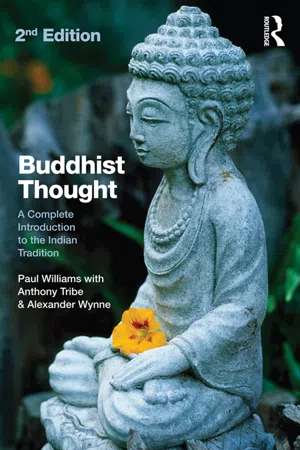
This book serves as an accessible and reliable survey for students wishing to gain familiarity with the basic ideas of Buddhist philosophical and religious thought, and with some of the recent research in the field. It guides readers towards a richer understanding of the central concepts of classical Indian Buddhist thought, from the time of Buddha to the latest scholarly perspectives and controversies. Abstract and complex ideas are made understandable by the authors' clear and engaging style. The second edition has been fully revised in light of new scholarship, in particular on Mah?y?na Buddhism and Tantric Buddhism, an often neglected and inadequately understood topic. As well as a detailed bibliography this authoritative resource now includes recommended further reading, study questions, a pronunciation guide and extensive glossary of terms, all aimed at helping students to develop their knowledge and appreciation of Buddhist thought.
eBook - ePub
Buddhist Thought
A Complete Introduction to the Indian Tradition
- 276 pages
- English
- ePUB (mobile friendly)
- Available on iOS & Android
eBook - ePub
Buddhist Thought
A Complete Introduction to the Indian Tradition
About this book
Information
1 The Doctrinal Position of the Buddha in Context
Preliminaries
‘Buddhism’, with its derivatives like ‘Buddhist’, are, of course, English words. They have parallels in other European languages, like ‘Buddhismus’ and ‘Bouddhisme’. They refer for speakers of the English (German, French) language to the ‘-ism’ which derives from the (or a) Buddha. The Buddha (Sanskrit/Pāli: ‘Awakened One’) is thought by Buddhists to be one who has awakened fully to the final truth of things, and thus freed, liberated, himself once and for all from all forms of suffering. He is also one who, out of supreme compassion, has taught others the way to attain liberation themselves. Buddhas are not born that way, and they are certainly not thought to be eternal gods (or God). Once (many lifetimes ago) they were just like you and me. They strove through their own efforts, and became Buddhas. A Buddha is superior to the rest of us because he ‘knows it how it is’. We, on the other hand, wallow in confusion, in ignorance (Sanskrit: avidyā, Pāli: avijjā). Thus we are unhappy and suffer.
This use of the English ‘-ism’ termination in ‘Buddhism’ can be taken to refer to the system of practices, understandings (‘beliefs’), experiences, visions, and so on undergone and expressed at any one time and down the ages which derive from, or claim to derive from, a Buddha. The minimum for becoming a Buddhist is spoken of as three times ‘taking the triple-refuge’ in the proper formulaic way prescribed by the Buddhist traditions. In its broadest sense this ‘taking refuge’ is firmly taking the Buddha as the final spiritual refuge, the final (and only final) place of safety. He has seen in the deepest possible way and taught to its fullest extent how things truly are, and he has thus liberated himself from the suffering and frustrations which spring from living in a state of confusion and misunderstanding of the true nature of things. It is taking refuge also in the Dharma. The Dharma is how things truly are and the way to incorporate an understanding of how things truly are into one’s being in the deepest possible way, as expressed and taught by a Buddha. One takes refuge also in the Sangha, the community of practitioners who are in their different ways and at different levels following and realising the Dharma.
Significant in the above is the notion of practising the Dharma, the Dharma which derives from the (or a) Buddha, and coming to see things the way they really are. While belief is of course a prerequisite for any spiritual path (and this is not denied by Buddhists), Buddhists like to place the primacy not on belief as such but on practising, following a path, and knowing, directly seeing. There is no significant virtue simply in belief. This direct ‘seeing things the way they really are’ is held to free the person who thus sees from experiences most people would rather be freed from. These are experiences like pain, frustration, anguish, sorrow – experiences which are classed by Buddhists under the broad Sanskrit term duḥkha (Pāli: dukkha), that is, suffering, unfulfilment and imperfection. Thus any person who is liberated is finally and irrevocably liberated from all unpleasant experiences. Buddhism is therefore a soteriology. In other words it is concerned with bringing about for its practitioners liberation, freedom, from states and experiences held to be negative, unpleasant and not wanted. Being liberated is by contrast a state that is positive, pleasant and wanted. The primary orientation of Buddhism, therefore, is towards the transformative experience of the individual, for there are no experiences that are not experiences of individuals. Buddhism is thus also concerned first and foremost with the mind, or, to be more precise, with mental transformation, for there are no experiences that are not in some sense reliant on the mind. This mental transformation is almost invariably held to depend upon, and to be brought about finally by, oneself for there can also be no transformation of one’s own mind without on some level one’s own active involvement or participation. Buddhism is thus a highly individualistic path of liberation. One is bound by one’s own mind, and it is by working on one’s own mind that one becomes liberated, attaining the highest possible spiritual goal. The transformation is from mental states Buddhists consider as negative to states considered by Buddhists to be positive. That is, it is a transformation from greed, hatred, and delusion, and all their implications and ramifications, to the opposites of these three negative states – nonattachment, loving kindness, and insight or wisdom, and all their implications and ramifications. It is this that liberates. What is meant and entailed by these negative and positive states, what is understood when one ‘sees things the way they really are’, what sort of ‘seeing’ is necessary, and how to bring that about, will form the content of Buddhism.1
I have referred to ‘Buddhism’ as what speakers of European languages (or ‘the West’) think of as the ‘-ism’ that derives from the (or a) Buddha. While one could scarcely be both an orthodox Christian and, say, a Muslim or Hindu at the same time, it is perfectly possible to be a Buddhist and at the same time have recourse to and make offerings to Hindu gods, or other local gods of one’s culture. Many, probably most, Buddhists do this. This is because what it is to be a Buddhist, and what it is to be e.g. a Christian, or a Muslim, are different. And if to be a Buddhist and to be a Christian are different, then Buddhism and Christianity qua ‘religions’ are different. Richard Gombrich has succinctly summed up what Buddhism is all about:
For Buddhists, religion is purely a matter of understanding and practising the Dhamma [Sanskrit: Dharma], understanding and practice which constitute progress towards salvation. They conceive salvation – or liberation, to use a more Indian term – as the total eradication of greed, hatred and delusion. To attain it is open to any human being, and it is ultimately the only thing worth attaining, for it is the only happiness which is not transient. A person who has attained it will live on so long as his body keeps going, but thereafter not be reborn. Thus he will never have to suffer or die again. For Buddhists, religion is what is relevant to this quest for salvation, and nothing else.
(Gombrich 1988: 24)
Traditionally Buddhists throughout the Buddhist world consider that the universe contains more beings in it than are normally visible to humans. Buddhists have no objection to the existence of the Hindu gods, although they deny completely the existence of God as spoken of in e.g. orthodox Christianity, understood as the omnipotent, omniscient, all-good, and primordially existent creator deity, who can be thought of as in some sense a person. Nevertheless one cannot as a Buddhist take refuge in Hindu gods, for Hindu gods are not Buddhas. That is, they are not enlightened. What this means is that Hindu gods, for all their power, do not see the final way things are, the final truth of things. They do not see it as it is. Power does not necessarily entail insight, and for Buddhists the Hindu gods, unlike Buddhas, do not have that liberating insight. Thus, because they are not liberated Hindu gods too ultimately suffer. They have been reborn as gods due to their good deeds in the past (as we have been reborn human for the same reason), and gods too (like us humans) die, and are reborn elsewhere. We may ourselves be gods in our next lives, and, Buddhists would say, we certainly have been infinite times in the past, in our infinite series of previous lives. Gods may be reborn as humans (or worse – the round of rebirth includes e.g. animals, worms, ghosts and sojourns in horrible hells as well). But none of this entails that Hindu gods do not exist.2 Therefore, none of this entails that Hindu gods cannot exert powerful influence on human lives and activities. There is thus no problem in Buddhists making offerings to Hindu gods, with requests for appropriate favours.
Throughout the Buddhist world there is one very particular way of contacting the gods and asking for their favours. This is through possession. In many Buddhist countries (such as Sri Lanka, Thailand, Burma or Tibet), and also countries strongly influenced by Buddhism (such as China and Japan) there are people who are both Buddhists and also go into a type of trance. In this trance they are possessed by a god, who may give advice or medical assistance, for example. The only problem with all this would come if a Buddhist took refuge in a god, implying that the god had the key to final liberation. The gods concern only the worldly (Sanskrit: laukika). The Buddhas are beyond the world (lokottara), both in terms of their own status and also in terms of their final concerns in helping others. Thus whereas one would not expect to see an orthodox Christian making offerings to Hindu gods, prostrating to them, making requests of them, or going into a trance and being possessed by them, there is no contradiction to Buddhism in Buddhists doing this. To be a Buddhist for Buddhists is not the same sort of phenomenon as being a Christian is for Christians. Allegiance in different religions does not have the same sort of exclusivity. This is not an example of ‘Buddhist syncretism’, or ‘popular Buddhism’, or even ‘Buddhist tolerance’. Not all religions operate the way we expect them to on the basis of the religion or religions with which we are most familiar. As Lance Cousins puts it:
It is an error to think of a pure Buddhism, which has become syncretistically mixed with other religions, even corrupted and degenerate in later forms. Such a pure Buddhism has never existed. Buddhism has always coexisted with other religious beliefs and practices. It has not usually sought to involve itself in every sphere of human ritual activity, since many such things are not considered ‘conducive to’ the path, i.e. not relevant to the spiritual endeavour. Its strength perhaps lies in this very incompleteness. … [These other practices, such as contacting local gods] may be practised if desired so long as the main aim is not lost. … [As far as the soteriological goal, liberation, is concerned they] are irrelevant.
(Cousins 1998: 372)
As far as we know this has always been the case in Buddhism. There was no period in the past when it was different, or expected to be different. The great Indian Buddhist King Aśoka (third century BCE) made offerings to non-Buddhist teachers and religions. He no doubt also made offerings to non-Buddhist gods.3 When householders in ancient times met and were impressed by the Buddha and ‘took refuge’ in him, we need not assume that they thereby ceased entirely to make offerings to other teachers or gods. In their villages they were therefore ‘Hindus’ as well as ‘Buddhists’ (if one must use these modern Western classifications). But if they really saw the Buddha as enlightened, and accepted that his teachings differed from those of other teachers, they would no longer take refuge in those other teachers as final sources of truth and liberation. They would be likely to think of the Buddha as their special teacher, the teacher in whom they put their trust for the final concerns of their life, the teacher whom they would most like to see helping them on their deathbed.
The Brahmanical Doctrinal Background
In the quotation from Richard Gombrich above we saw that from the Buddhist point of view ‘religion is what is conducive to salvation’. On the other hand, we might think that making offerings to Hindu gods, whether or not they are worth taking refuge in, is nevertheless indeed ‘religious’. But by ‘religion’, of course, Gombrich (or his Singhalese informants) means here specifically Buddhism. ‘Religion’ is Buddhism, and Buddhism, to a Buddhist, is characterised as what is conducive to salvation, liberation. The term translated by Gombrich above as ‘religion’ is sāsana, the Teaching, the expression used in e.g. the Theravāda Buddhist tradition of Sri Lanka to refer to ‘Buddhism not just as a doctrine but as a phenomenon in history, a whole religion’ (Gombrich 1988: 3). Buddhism as a religion in history was founded in ancient India and even the truth as articulated in history, Buddhism itself, it is thought by Buddhists, will eventually cease to exist due to forces of irreligion. As a matter of fact Buddhism in mainland India itself had all but ceased to exist by the thirteenth century ce, although by that time it had spread to Tibet, China, Japan and Southeast Asia. But eventually all Buddhism will cease in this world. Nevertheless, at some point in the future a sāsana will again be established by another Buddha, as indeed its establishment in India this time round was in fact a re-establishment. And so on, and so on, apparently throughout all eternity.
Each time a sāsana is established it is due to a rediscovery. But what exactly is rediscovered each time? The answer is the Dharma. This is a further term sometimes used by Buddhists for what in the West is called ‘Buddhism’. But ‘Dharma’ cannot of course refer simply to Buddhism as a religion, since we have seen that the Dharma is the second of the three refuges taken by Buddhists, alongside the Buddha and the Sangha. Buddhism as a religion has to include all three refuges. Rather the Dharma is Buddhism as content, that is, what is actually taught by Buddhism as a religion. It consists of the truths, both concerning how things really are, and the way to practise in order to bring about cognition of how things really are. As articulated as part of the sāsana, the Dharma consists of the teachings of the Buddha, and thereby of Buddhism. That certain things are really, really, true is central to Buddhism. Buddhists claim that it is really true, for example, that most things form part of a causal flow, and physical matter is not in any sense one’s true Self (ātman; see below). Buddhists claim too that the state of unenlightenment is ultimately duḥkha, i.e. an unsatisfactory, unfulfilled state, and there is no omnipotent, omniscient, all-good, and primordially existent creator deity, who can be thought of as in some sense a person. That certain practices truly bring about the results they claim to bring about – that, for example, the eightfold path as taught by the Buddha if followed properly with single-minded devotion will eventually lead to liberation (Sanskrit: nirvāṇa, Pāli: nibbāna) – is also central to Buddhism. These are objective truths, as truths they are always true, and their truth is quite independent of the existence of Buddhas or indeed any beings existing capable of realising those truths. They form the Dharma, the content of the Buddha’s teaching. Buddhism is built on the absolute objectivity of truth, and Buddhists claim that the Dharma (their Dharma) is that absolutely objective truth. As Nārada Thera puts it:
The original Pāli term for Buddhism is Dhamma … The Dhamma is that which really is. It is the doctrine of reality. It is a means of deliverance from suffering and deliverance itself. Whether the Buddhas arise or not the Dhamma exists from all eternity. It is a Buddha that realizes this Dhamma, which ever lies hidden from the ignorant eyes of men, till he, an Enlightened One, comes and compassionately reveals it to the world.
(Nārada 1980: 162)
The word ‘Dharma’ is nevertheless an important word of the Indian cultural context within which Buddhism arose. In using ‘Dharma’ for his teaching the Buddha intentionally chose a term which was intended to indicate to others that he truly knew and taught how things finally are. Where others disagree, they do not have the Dharma. What they teach is in that respect its negation, Adharma. Let us look more closely then at the Indian context that produced the teachings, the Dharma of the Buddha.
First a note on the words ‘Brahmanism’ and ‘brahmanic(al)’ as used here and in the works of other scholars when writing on early Indian religion. We still find it commonly said that the Buddha was a ‘Hindu reformer’. This is misleading. The Buddha rejected the final religious authority directly, indirectly, or ideologically, of the social class of brahmins and their primordial scriptures, the Vedas, so important to Hinduism throughout history. And much of what we nowadays call ‘Hinduism’, such as the centrality of the gods Śiva, or Viṣṇu, the ideas of Śaṃkara’s Advaita Vedānta, the themes of the Bhagavad Gītā, Tantric practices, and so on developed after the time of the Buddha. Nothing remotely like the Hinduism currently practised in modern India existed at the time of the Buddha. Indeed some of the aforementioned features of Hinduism were influenced positively or negatively by Buddhism itself. The religious practices and beliefs actually current at the time of the Buddha are associated in early Buddhist texts with two broad groups of practitioners in many fundamental ways radically different from each other. On the one hand we have the brāḥmaṇas, that is, (in Anglicised spelling) the brahmins. On the other hand we have the śramaṇas (Pāli: samaṇas), the renouncers of society, the ‘drop-outs’. The religion of the brahmins was pre-eminently a religion of householders, in origins and interests a religion of villagers and very much a set of religious practices geared to the primacy of harmonious ordered social relationships and ‘prosperity in this world and the next’. It had evolved out of the religious ideas and practices of the Āryas, migrating speakers of Indo-European languages, who reached India sometime during the second millennium BCE from their home base presumed to be in the grasslands of southern Russia near the Caspian Sea. The Āryas brought with them horse-drawn chariots, an early form of the Sanskrit language, and perhaps from before arriving in India and anyway soon afterwards the earliest (as yet unwritten and orally transmitted) scriptures of Indian religion, the Ṛg Veda. Over many centuries the Vedic scriptures expanded (still not written down), eventually reaching by the time of the Buddha four collections, the Ṛg, Sāma, Yajur and (originating a little later than the others) the Atharva Vedas. Each of these Vedic collections was divided into verses (saṃhitā), ritual manuals (brāhmaṇas – not to be confused with the same word when used for ‘brahmins’), ‘forest books’ (āraṇyakas), and eventually also upaniṣads, the books that expound in particular some of the more esoteric and philosophical aspects...
Table of contents
- Cover
- Half Title
- Title Page
- Copyright
- Dedication
- Contents
- Preface
- Acknowledgements
- 1. The doctrinal position of the Buddha in context
- 2. Mainstream Buddhism: the basic thought of the Buddha
- 3. The nature and origins of Mahāyāna Buddhism
- 4. Some schools of mainstream Buddhist thought
- 5. Mahāyāna philosophy
- 6. The Buddha in Mahāyāna Buddhism
- 7. Mantranaya/vajrayāna – tantric Buddhism in India
- Further reading and websites
- Some exam and study questions
- Sanskrit and Pāli pronunciation guide
- Glossary of Buddhist terms
- Map of some important sites in Buddhist India
- Notes
- Bibliography of works cited
- Index
Trusted by 375,005 students
Access to over 1.5 million titles for a fair monthly price.
Study more efficiently using our study tools.
Frequently asked questions
Yes, you can cancel anytime from the Subscription tab in your account settings on the Perlego website. Your subscription will stay active until the end of your current billing period. Learn how to cancel your subscription
No, books cannot be downloaded as external files, such as PDFs, for use outside of Perlego. However, you can download books within the Perlego app for offline reading on mobile or tablet. Learn how to download books offline
Perlego offers two plans: Essential and Complete
- Essential is ideal for learners and professionals who enjoy exploring a wide range of subjects. Access the Essential Library with 800,000+ trusted titles and best-sellers across business, personal growth, and the humanities. Includes unlimited reading time and Standard Read Aloud voice.
- Complete: Perfect for advanced learners and researchers needing full, unrestricted access. Unlock 1.5M+ books across hundreds of subjects, including academic and specialized titles. The Complete Plan also includes advanced features like Premium Read Aloud and Research Assistant.
We are an online textbook subscription service, where you can get access to an entire online library for less than the price of a single book per month. With over 1.5 million books across 990+ topics, we’ve got you covered! Learn about our mission
Look out for the read-aloud symbol on your next book to see if you can listen to it. The read-aloud tool reads text aloud for you, highlighting the text as it is being read. You can pause it, speed it up and slow it down. Learn more about Read Aloud
Yes! You can use the Perlego app on both iOS and Android devices to read anytime, anywhere — even offline. Perfect for commutes or when you’re on the go.
Please note we cannot support devices running on iOS 13 and Android 7 or earlier. Learn more about using the app
Please note we cannot support devices running on iOS 13 and Android 7 or earlier. Learn more about using the app
Yes, you can access Buddhist Thought by Paul Williams,Anthony Tribe,Alexander Wynne in PDF and/or ePUB format, as well as other popular books in Philosophy & Eastern Philosophy. We have over 1.5 million books available in our catalogue for you to explore.