- 160 pages
- English
- ePUB (mobile friendly)
- Available on iOS & Android
eBook - ePub
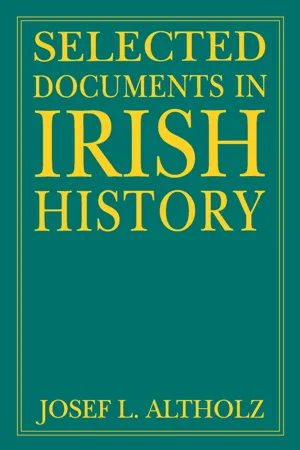
Selected Documents in Irish History
About this book
The first collection of readings designed to supplement Irish History courses, this book includes 42 religious documents, historical statutes, acts of Parliament, speeches, proclamations, poems, and other selections fundamental to understanding Ireland's rich history.
1
St. Patrick: Confessio
St. Patrick undoubtedly led an effective mission in Ireland from the 430s; legend credits him with converting the whole island. The historical facts are uncertain, and perhaps irrelevant: in Ireland, myth often makes history. Patrick’s own Confessio is just what that word meant in the Middle Ages: not so much an autobiography as a confession of faith, an apology or self-justification, ultimately a cry of the heart.Reproduced by kind permission from ARTHURIAN PERIOD SOURCES (General Editor John Morris), volume 9 St. Patrick (edited and translated by A.B.E. Hood), published in 1978 by Phillimore & Co., Ltd., Shopwyke Manor Barn, Chichester, West Sussex, England.
1. I, Patrick, a sinner, quite uncultivated and the least of all the faithful and utterly despicable to many, had as my father the deacon Calpornius, son of the late Potitus, a priest, who belonged to the town of Bannavem Taburniae; he had a small estate nearby, and it was there that I was taken captive. I was then about sixteen years old. I did not know the true God and I was taken into captivity in Ireland with so many thousands; and we deserved it, because we drew away from God and did not keep His commandments and did not obey our priests who kept reminding us of our salvation; and the Lord brought on us the fury of His anger and scattered us among many peoples even to the ends of the earth, where now I in my insignificance find myself among foreigners.
2. And there the Lord opened up my awareness of my unbelief, so that I might, however late, remember my faults and turn with all my heart to the Lord my God, who had regard for my lowly estate and took pity on my youth and ignorance.…
16. But after I reached Ireland, well, I pastured the flocks every day and I used to pray many times a day; more and more did my love of God and my fear of Him increase, and my faith grew and my spirit was stirred, and as a result I would say up to a hundred prayers in one day, and almost as many at night; I would even stay in the forests and on the mountain and would wake to pray before dawn in all weathers, snow, frost, rain; and I felt no harm and there was no listlessness in me—as I now realise, it was because the Spirit was fervent within me.
17. And it was in fact there that one night while asleep I heard a voice saying to me: ‘You do well to fast, since you will soon be going to your home country;’ and again, very shortly after, I heard this prophecy: ‘See, your ship is ready.’ And it was not near at hand but was perhaps two hundred miles away, and I had never been there and did not know a living soul there. And I soon ran away and abandoned the man with whom I had been for six years, and I came in God’s strength, for He granted me a successful journey and I had nothing to fear, till I reached that ship.…
23. And again a few years later I was in Britain with my kinsfolk, and they welcomed me as a son and asked me earnestly not to go off anywhere and leave them this time, after the great tribulations which I had been through. And it was there that I saw one night in a vision a man coming as it were from Ireland (his name was Victoricus), with countless letters, and he gave me one of them, and I read the heading of the letter, ‘The Voice of the Irish,’ and as I read these opening words aloud, I imagined at that very instant that I heard the voice of those who were beside the forest of Foclut which is near the western sea; and thus they cried, as though with one voice: ‘We beg you, holy boy, to come and walk again among us,’ and I was stung with remorse in my heart and could not read on, and so I awoke. Thanks be to God, that after so many years the Lord bestowed on them according to their cry.…
41. And how has it lately come about in Ireland that those who never had any knowledge of God but up till now always worshipped idols and abominations are now called the people of the Lord and the sons of God, and sons and daughters of Irish underkings are seen to be monks and virgins of Christ?.…
58. And so may God never allow me to be separated from His people which He has won in the ends of the earth. I pray to God to give me perseverance and to deign to grant that I prove a faithful witness to Him until I pass on, for my God’s sake.…
62. But I beg those who believe in and fear God, whoever deigns to look at or receive this document which the unlearned sinner Patrick drew up in Ireland, that no-one should ever say that if I have achieved anything, however trivial, or may have shown the way according to God’s good pleasure, it was my ignorance at work, but consider and accept as the undeniable truth that it would have been God’s gift. And this is my declaration before I die.
2
Muirchu’s Life of St. Patrick
Muirchu’s life of St. Patrick, written two centuries later, is the oldest to survive. It displays a characteristic mixture of the factual and the miraculous.Reproduced by kind permission from ARTHURIAN PERIOD SOURCES (General Editor, John Morris), volume 9 St. Patrick (edited and translated by A.B.E. Hood), published in 1978 by Phillimore & Co., Ltd., Shopwyke Manor Barn, Chichester, West Sussex, England.
These few items concerning St. Patrick’s experience and miraculous powers were written down by Muirchu maccu Machtheni under the direction of Aed, bishop of the town of Sletty.
1. Patrick, who was also called Sochet, was of British nationality, born in Britain, the son of the deacon Calpurnius, whose father, as Patrick himself says, was the priest Potitus, who came from the town of Bannavem Taburniae, not far from our sea; we have discovered for certain and beyond any doubt that this township is Ventre; and the mother who bore him was named Concessa.
At the age of sixteen the boy, with others, was captured and brought to this island of barbarians and was kept as a slave in the household of a certain cruel pagan king. He spent six years in captivity, in accordance with the Jewish custom, in fear and trembling before God, as the psalmist says (Psalms 54, 6), and in many vigils and prayers. He used to pray a hundred times a day and a hundred times a night, gladly giving to God what is due to God and to Caesar what is due to Caesar and beginning to fear God and to love the Lord Almighty; for up to that time he had no knowledge of the true God, but at this point the Spirit became fervent within him.
After many hardships there, after enduring hunger and thirst, cold and nakedness, after pasturing flocks, after visits from Victoricus, an angel sent to him by God, after great miracles known to almost everyone, after divine prophecies (of which I shall give just one or two examples: ‘You do well to fast, since you will soon be going to your home country,’ and again: ‘See, your ship is ready,’ though it was not near at hand but was perhaps two hundred miles away, where he had never been to)—after all these experiences, as we have said, which can hardly be counted by anyone, in the twenty-third year of his life he left the earthly, pagan king and his works, received the heavenly, eternal God and now sailed for Britain by God’s command and accompanied by the Holy Spirit in the ship which lay ready for him; with him were barbarian strangers and pagans who worshipped many false gods.…
8. And so, when a suitable opportunity so directed, with God’s help to accompany him he set out on the journey which he had already begun, to the work for which he had long been prepared—the work, that is, of the Gospel. And Germanus sent an older man with him, namely the priest Segitius, so that Patrick would have a witness and companion, since he had not yet been consecrated to the rank of bishop by the holy lord Germanus. For they were well aware that Palladius, the archdeacon of Pope Celestine, the bishop of the city of Rome who then held the apostolic see as forty-fifth in line from St. Peter the apostle, that this Palladius had been consecrated and sent to convert his island, lying as it does in frozen wintriness. But God prevented him, because no one can receive anything from this earth unless it has been given him from heaven. For these wild, uncivilised people did not take kindly to his teaching, nor did he himself want to spend time in a land which was not his own; he returned to him who sent him. But on his return journey from here, after making the first sea crossing and proceeding by land, he died in the land of the British.
9. And so, when the word came of the death of St. Palladius in Britain, since Palladius’ disciples, Augustine, Benedict and the others, returned to Ebmoria with the news of his death, Patrick and his companions turned aside to a wonderful man, a very important bishop called Amator, who lived nearby. And there St. Patrick, knowing what was to happen to him, received the rank of bishop from the holy bishop Amator, as also Auxilius and Iserninus and others received lesser orders on the same day as St. Patrick was consecrated. They received the blessings, everything was performed in the customary way, and the following verse of the psalmist was also sung, especially appropriate for Patrick: ‘You are a priest for ever, in the manner of Melchisedek.’ (Psalms 109.4). Then in the name of the holy Trinity the venerable traveller went on board the ship which had been prepared and reached Britain; and as he made his way on foot he avoided all detours, except for the ordinary business of travelling (for no one seeks the Lord by idleness), and then he hurried across our sea with all speed and a favourable wind.
10. Now in the days in which these events took place in the aforesaid area there was a certain king, the fierce heathen emperor of the barbarians, who reigned in Tara, which was the Irish capital. His name was Loegaire, the son of Niall and the ancestor of the royal house of almost the whole of this island. He had had wise men, wizards, soothsayers, enchanters and inventors of every black art who were able in their heathen, idolatrous way to know and foresee everything before it happened; two of them were favoured above the rest, their names being Lothroch, also called Lochru, and Lucetmael, also known as Ronal.
These two repeatedly foretold by their magical arts that there would come to be a certain foreign practice like a kingdom, with some strange and troublesome doctrine; a practice brought from afar across the seas, proclaimed by a few, adopted by many and respected by all; it would overthrow kingdoms, kill kings who resisted, win over great crowds, destroy all their gods, and after driving out all the resources of their art it would reign for ever and ever. They also identified and foretold the man who would bring and urge this practice in the following words, often repeated by them in a sort of verse form, especially in the two or three years preceding Patrick’s arrival. This is how the verse ran; the sense is less than clear because of the different character of the language:
‘Adze-head shall come, with his crook-headed staff and his house with a hole in its head. He shall chant blasphemy from his table, from the eastern part of his house, and all his household will answer him: ‘So be it, so be it!’ (This can be expressed more clearly in our own language.) ‘So when all these things happen, our kingdom, which is heathen, shall not stand.’
And this is just as it later turned out. For the worship of idols was wiped out on Patrick’s arrival, and the catholic faith in Christ filled every corner of our land. So much for this topic; let us return to our subject.…
22. nd St. Patrick, according to the Lord Jesus’mmand going and teaching all nations and baptizing them in the name of the Father and of the Son and of the Holy Ghost, set out from Tara and preached, with the Lord working with him and confirming his words with the following signs.
3
Pangur Ban
Celtic Ireland was not all saints. Its poetry included epics far from saintly (and far too epic to include here) and short poems, of which this anonymous piece about a scholar and his white cat is a charming example.Source: Robin Flower, The Irish Tradition (Oxford: Clarendon Press, 1947), 24–25. Reprinted by permission of Oxford University Press.
I and Pangur Ban my cat,
‘Tis a like task we are at:
Hunting mice is his delight,
Hunting words I sit all night.
Better far than praise of men
‘Tis to sit with book and pen;
Pangur bears me no ill will,
He too plies his simple skill.
‘Tis a merry thing to see
At our tasks how glad are we,
When at home we sit and find
...Table of contents
- Cover
- Half Title
- Title Page
- Copyright Page
- Table of Contents
- Preface
- 1. St. Patrick: Confessio
- 2. Muirchu’s Life of St. Patrick
- 3. Pangur Ban
- 4. The Bull Laudabiliter, 1155
- 5. Treaty of Windsor, 1175
- 6. Statutes of Kilkenny, 1366
- 7. Poynings’ Law (1494)
- 8. Act of Uniformity, 1560
- 9. Edmund Spenser: A View of the State of Ireland (1595)
- 10. Tyrone’s Demands (1599)
- 11. Plantation of Ulster, 1610
- 12. Confederation of Kilkenny, 1642
- 13. Oliver Cromwell: The Capture of Drogheda (1649)
- 14. Treaty of Limerick, Civil Articles, 1691
- 15. Penal Law, 1703
- 16. Irish Parliament Act, 1719
- 17. Repeal of the Declaratory Act, 1782
- 18. Catholic Relief Acts, 1778, 1782, 1793
- 19. The United Irishmen (1791)
- 20. Act of Union, 1800
- 21. Robert Emmet: Speech from the Dock (1803)
- 22. Roman Catholic Emancipation Act, 1829
- 23. Alexis de Tocqueville: Journey in Ireland (1835)
- 24. Daniel O’Connell: Speech at Mullingar, May 14, 1843
- 25. Thomas Francis Meagher: Speech, July 28, 1846
- 26. Fenian Oath (1859)
- 27. “God Save Ireland” (1868)
- 28. Resolutions of the Home Rule Conference, 1873
- 29. Charles Stewart Parnell on the Land Question, 1880
- 30. Irish Parliamentary Party Pledge, 1885
- 31. William Ewart Gladstone: First Home Rule Bill Speech (1886)
- 32. Douglas Hyde: “The Necessity for De-Anglicising Ireland” (1892)
- 33. Solemn League and Covenant, 1912
- 34. Proclamation of the Irish Republic, 1916
- 35. Government of Ireland Act, 1920
- 36. Irish Free State Agreement Act, 1922
- 37. Constitution of the Irish Free State (1922)
- 38. Constitution of Éire (1937)
- 39. Eamon de Valera: Reply to Churchill on the Ports (1940)
- 40. “Bloody Sunday” (January 30, 1972)
- 41. The Anglo-Irish Agreement, 1985
- 42. The Agreement (1998)
- About the Editor
Trusted by 375,005 students
Access to over 1.5 million titles for a fair monthly price.
Study more efficiently using our study tools.
Frequently asked questions
Yes, you can cancel anytime from the Subscription tab in your account settings on the Perlego website. Your subscription will stay active until the end of your current billing period. Learn how to cancel your subscription
No, books cannot be downloaded as external files, such as PDFs, for use outside of Perlego. However, you can download books within the Perlego app for offline reading on mobile or tablet. Learn how to download books offline
Perlego offers two plans: Essential and Complete
- Essential is ideal for learners and professionals who enjoy exploring a wide range of subjects. Access the Essential Library with 800,000+ trusted titles and best-sellers across business, personal growth, and the humanities. Includes unlimited reading time and Standard Read Aloud voice.
- Complete: Perfect for advanced learners and researchers needing full, unrestricted access. Unlock 1.5M+ books across hundreds of subjects, including academic and specialized titles. The Complete Plan also includes advanced features like Premium Read Aloud and Research Assistant.
We are an online textbook subscription service, where you can get access to an entire online library for less than the price of a single book per month. With over 1.5 million books across 990+ topics, we’ve got you covered! Learn about our mission
Look out for the read-aloud symbol on your next book to see if you can listen to it. The read-aloud tool reads text aloud for you, highlighting the text as it is being read. You can pause it, speed it up and slow it down. Learn more about Read Aloud
Yes! You can use the Perlego app on both iOS and Android devices to read anytime, anywhere — even offline. Perfect for commutes or when you’re on the go.
Please note we cannot support devices running on iOS 13 and Android 7 or earlier. Learn more about using the app
Please note we cannot support devices running on iOS 13 and Android 7 or earlier. Learn more about using the app
Yes, you can access Selected Documents in Irish History by Josef L. Altholz in PDF and/or ePUB format, as well as other popular books in History & Irish History. We have over 1.5 million books available in our catalogue for you to explore.