- 240 pages
- English
- ePUB (mobile friendly)
- Available on iOS & Android
eBook - ePub
David Armstrong
About this book
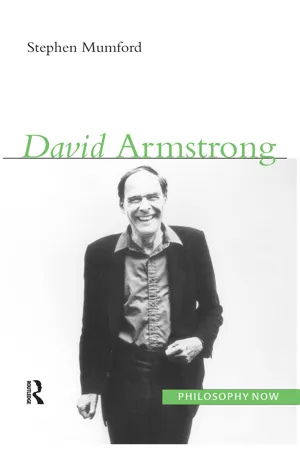
David (D. M.) Armstrong is one of Australia's greatest philosophers. His chief philosophical achievement has been the development of a core metaphysical programme, embracing the topics of universals, laws, modality and facts: a naturalistic metaphysics, consistent with a scientific view of the natural world. It is primarily through his owrk that Australian philosophy, and Australian metaphysics in particular, enjoys such a high reputation in the rest of the world. In this book Stephen Mumford offers an introduction to the full range of Armstrong's thought. Mumford begins with a discussion of Armstong's naturalism, his most general commitment, and his realism about universals. He then examines his theories of laws, modality and dispositions, which make up the basics of Armstrong's core theory. With this in place, Mumford explores his ideas on perception, mind and belief before returning to metaphysics in the last two chapters, looking at truth and the new view of instantiation. The book is a dispassionate, fair and unbiased account of Armstrong's thought. Although Armstong's is a body of work that Mumford regards highly and of real significance, he nevertheless highlights areas of weakness and issues about which there is room for further debate.
Information
Topic
PhilosophySubtopic
Mind & Body in PhilosophyChapter 1
Naturalism
A philosopher who gives a systematic account of the whole world will usually have some fundamental commitment that drives and unites its various elements. David Armstrong is one who does offer a grand vision of the world. His work shows how that vision accounts systematically for philosophically difficult phenomena such as properties, laws, truth, the mind and knowledge. These are some of the key problems that philosophy should aim to solve.
Three general commitments drive Armstrong’s philosophy. He is a naturalist, a physicalist, and he thinks that the world is a world of states of affairs. This last view should be called factualism. These commitments form the background against which his sizeable body of work can be set. In various places, he offers philosophical accounts of perception, universals, laws of nature and causation, modality and truthmaking. These can all be understood as naturalistic theories where some problematic area of philosophy is explained in terms of states of affairs, all of which are physical states of affairs. Our first aim is to understand these three commitments better.
In one place he gives explicit endorsement of three theses (N&R: 126):
- The world contains nothing but particulars having properties and being related to each other
- The world is nothing but a single spatiotemporal system
- The world is completely described in terms of a (completed) physics.
The first thesis is a commitment to an ontology of states of affairs. Some call these Tractarian facts. Such factualism will not be a primary concern in this chapter, though something can be said about the place of this commitment among his others. I will do this, briefly, in the next section before moving on to the main topics of this chapter: Armstrong’s naturalism (thesis 2) and his physicalism (thesis 3).
First philosophy
A state of affairs is a particular bearing, a property, for example: an apple being red; an electron having negative unit charge, a person believing Sydney to be the capital of Australia (falsely). Armstrong thinks that the whole world consists of nothing more than such states of affairs. Some people prefer to call these things facts, although they are not facts in the sense of being true propositions. They are certainly intended to be things in the world, in non-propositional reality, like Wittgenstein’s (1921) facts in the Tractatus. According to a factualist, the whole of reality can be thought of in such terms: one gigantic collection of states of affairs or facts. States of affairs will be the smallest units of existence. They seem to have components – particulars and universals – but these are not themselves capable of independent existence outside those facts. The simplest, smallest thing that exists in the world will be a simple state of affairs. A simple state of affairs consists in a simple particular instantiating a simple property. Many complicated issues are involved in this ontology. We will need to understand what is a universal, what is a particular, and what is instantiation. We will need to know what it is that makes any of these simple. But I will not say more here about states of affairs because the subject will get a chapter all of its own (Chapter 6) and we will need to build up to that difficult topic gradually. Besides, our concern here is with the generalities of Armstrong’s philosophy so that we can understand what drives all the detailed argument that awaits us.
Armstrong sees the commitment to states of affairs as his commitment of “first philosophy”. Naturalism and physicalism are his most fundamental doctrines but first philosophy, to use Aristotle’s phrase, is concerned with ontology or the most general categories of all (NoM: 160–61). First philosophy is about what sorts of thing there are in general: whether there are particulars, universals, causes, laws, numbers, substances and so on. In committing to an ontology of states of affairs, Armstrong is saying that all the things that need to be accounted for can be accounted for in terms of such states of affairs. Armstrong accepts that there are causes, for instance, but he has an account in terms of states of affairs that shows what causes are. Similarly he can account for universals, particulars, laws and numbers in terms of states of affairs. A large portion of Armstrong’s work is the development of this programme.
The rest of this chapter is about the other fundamental commitments, of which naturalism is the most fundamental. It is what guides the rest of the philosophy. The exact nature of naturalism is hard to pin down, however. While it seems to be Armstrong’s most basic commitment, and the one that determines his choice of philosophical topics, and his solutions to them, it is a subject he only occasionally discusses directly. It is always there, and allusion to naturalism is made in various places, but the discussion is invariably brief. Like all of our most fundamental assumptions, arguments in its favour cannot be deep or lengthy. There is nothing more basic that could be employed in its justification. Often, therefore, we can only state our fundamental commitments, making them transparent and clear, and perhaps give some rough indication of why they are sensible.
Forebears
From where did Armstrong get these basic commitments? What is his background? He is, of course, an Australian philosopher and, it can be argued, a distinctly Australian philosopher. A major figure who probably more than any other shaped twentieth-century Australian philosophy is John Anderson, not so much for his personal output as for the powerful influence he had over his students, many of whom went on to fill other Australian academic posts. The influence that Anderson had over Armstrong is not so easy to specify, though. Anderson was for a long time a radical while Armstrong was not. By the time Armstrong was being taught, however, Anderson had jettisoned a significant portion of his radicalism. And while Armstrong was influenced by his ideas, he reacted strongly against Anderson’s methods, which he saw had the effect of recruiting followers. Armstrong saw no role for this in philosophy. But there was nevertheless a real and lasting philosophical influence of Anderson on Armstrong, which is evident most obviously in their shared commitment to naturalism.
There were other important influences on Armstrong during his career. After Anderson, the next figure to mention would be C. B. (Charlie) Martin. Armstrong and Martin were briefly colleagues at Melbourne and later again at Sydney. From Martin, Armstrong took the truthmaker principle, which would stay with him throughout his philosophical life, often being deployed in many of his arguments. He also gained from Martin an interest in dispositions, seeing that they played an important role in explaining many problematic phenomena. He would dissent from Martin’s treatment, however, largely developing an alternative to Martin’s ontology of real causal powers. This dissent seems, in no small part, down to Armstrong’s discovery of the categorical: a notion to which he was introduced by H. H. Price when undertaking graduate studies in Oxford. While Armstrong remained a thoroughly straight-talking Australian philosopher, this idea gained in England became a key part of his position in mind and metaphysics.
Let us now return to the main idea of naturalism. In attempting to pin down this doctrine, Anderson offers us little help. He was not a vastly productive philosopher by current standards, and his main work, which was to be a book on logic, remained uncompleted (Franklin 2003: 19). He was also not given to simple statements of his view. Some of the best summaries come, therefore, from his former students. Mackie summed up Anderson’s philosophy thus:
His central doctrine is that there is only one way of being, that of ordinary things in space and time, and that every question is a simple issue of truth or falsity, that there are no different degrees or kinds of truth. His propositional view of reality implies that things are irreducibly complex, and we can never arrive at simple elements in any field. Anderson rejects systematically the notion of entities that are constituted, wholly or partly, by their relations: there can be no ideas or sensa whose nature it is to be known or perceived, no consciousness whose nature it is to know, no values whose nature it is to be ends or to direct action. Knowledge is a matter of finding what is objectively the case; all knowledge depends on observation and is fallible; . . .
(Mackie 1962: 265)
Most of the Andersonian doctrines outlined in this passage appear in Armstrong’s work at some point. Being is univocal and it is what the world of spacetime, and only the world of spacetime, has. Neither being nor truth comes in degrees. The propositional structure of reality shows itself in Armstrong’s ontology of states of affairs, which he explicitly credits to the influence of Anderson (WSA: 3). Anderson’s subject–predicate logic corresponds to the basic entities of the world, being irreducible complexes of particulars and universals. Nothing can be constituted in whole or in part by its relations, for all real relations are external (WSA: 1); that is, they exist extra to their relata. Additionally, Armstrong gained his direct realism about perception from Anderson (1984: 15).
Perhaps most importantly, Armstrong’s brand of realism about universals came from Anderson. He gave the following account of his teacher’s view:
Anderson held that the world was the spatio-temporal world, and that nothing else existed except this world. Not only was there no God, or non-spatial minds, but there were no “abstract” entities in the Quinean/North American sense of that term: entities over and above the spatio-temporal world. So among the other things which Anderson excluded, there were no Platonic forms or realm of universals descried by the eye of reason. Realism about universals for Anderson meant that different things in the spatio-temporal world could have the same quality or property, or be of the same kind or sort. It was a thoroughly down to earth (down to space-time) form of realism.
(1984: 41–2)
As well as adopting and developing such an Andersonian vision, Armstrong also took from him a view of what topics were important in philosophy. Armstrong’s life work in philosophy developed naturalistic accounts of mind, metaphysics, truth and knowledge. In contrast, he largely avoided areas of philosophy such as ethics and aesthetics, except where he might try to justify leaving them alone (for example, Armstrong 1982). Ethical and aesthetic values seem to have no place in the objective world of spacetime, where one fact is as significant or insignificant as another. If one is to study nature, therefore, rather than just the narrow concerns of man, values will not be a high priority. Anderson did have something to say of morals but argued that they cannot intrinsically be action guiding (Franklin 2003: 39–41), as that would be for them to have a relational nature. The naturalist philosopher will prefer, therefore, to stick to what we can know and what is a part of the natural world.
The statement of naturalism
What exactly is the position of naturalism? It would be helpful if we could find a simple and clear statement of the naturalistic thesis that Armstrong supports. We certainly find statements of this kind – a number of them – spread over the range of his work. They suffice in their rough and ready form to give us an idea of the background to his work. One very simple statement of the position is as follows:
Naturalism I define as the doctrine that reality consists of nothing but a single all-embracing spatio-temporal system.
(NoM: 149)
He presents similar statements in a variety of other places, for example:
It is the contention that the world, the totality of entities, is nothing more than the spacetime system.
(WSA: 5)
However, while such statements are simple and to the point, they may seem rather brief and leave us little the wiser. They are bare and abstract presentations of the view. What, we may wonder, is the nature of this spacetime? What can be contained within it and what is excluded from it? What is time and what is space? What are the entities of which the spacetime system is the totality? Armstrong did not try to answer these questions. He has a principled reason for remaining silent. The nature of spacetime is a problem that Armstrong thinks is best left to science, which is the proper empirical investigation of the natural world. The nature of spacetime is an a posteriori matter, not to be decided by the a priori methods of philosophy, which employs reason alone. What exists is a matter for science to decide. Philosophers can decide the categories of things that exist, when they do first philosophy; but what, if any, things exist within those categories can only be decided by the empirical evidence. Armstrong will therefore think it right to state naturalism in a very abstract way. The world can be seen as a totality of, in some way occupied, spacetime points. Armstrong takes these to be a structure of states of affairs. They are the basic or fundamental particulars bearing simple properties, which is to say that they are the simple states of affairs.
The doctrine of naturalism has a positive and negative aspect. The positive aspect is that there is a world of spacetime. The negative aspect is that there is nothing more than a world of spacetime. Idealists will deny the positive aspect; that is, they deny the reality of the spacetime world. Those who deny the negative aspect of the doctrine are a diverse bunch. Only once one sees what Armstrong opposes to the doctrine of naturalism does one start to get a more concrete idea of what he thinks the doctrine is about.
Some may attempt to deny the doctrine for religious reasons, if they think there exists a God, spirits or heaven. This is usually understood as a claim that there is a supernatural realm in addition to the natural one. God and heaven are outside space and time although they, in some sense to be outlined by the theist, sit above it (the super in supernatural). Non-theists have, however, also tried to deny the doctrine of naturalism. An early philosophical denial is found in Plato with the theory of the Forms. Things such as squareness or justice could not be found in the world of spacetime, although their shadows or imperfect copies could be. The universal, the Form, existed in a transcendent world, now usually called the Platonic realm. Some have thought that other abstract objects might inhabit such a realm. Numbers might be there, as they seem to have a transcendent existence, beyond space and time, and perhaps propositions might be there. But Armstrong would deny all this so he is obliged to offer naturalistic accounts of universals, numbers and propositions. Another denial of naturalism, or a kind of naturalism, would be David Lewis’s modal realism. Lewis proposes a plurality of worlds, many of them more or less like ours (Lewis 1986). If we are to account for modality, or the truth of counterfactual and causal claims, Lewis thinks we have to grant that our world is just one of countless many and that these different worlds are spatiotemporally discontinuous. This is against the spirit of Armstrong’s naturalism, which admits just the one world of spacetime. A Lewisian might protest that each of these worlds could be a separate naturalistic world of spacetime. That the worlds are spatiotemporally distinct, nevertheless, does not seem to be a spatiotemporal fact itself. So for there to be a plurality of worlds there would have to be further, non-natural facts about their separateness. What are the gaps between these “island universes”? What keeps worlds apart? Armstrong’s commitment to naturalism is strong enough for him to look for other accounts of modality, counterfactuals and causes, where the truth-makers for all such claims can be found in this world. Armstrong’s naturalism is an immanentist thesis. All that there is is around us and accessible to us. There are no further hidden, supernatural, disconnected or transcendent realms.
An argument for naturalism?
But how safe is the thesis of naturalism? Is there an argument for it or is it mere assumption? As I have already indicated, there is little that you can do to justify your most fundamental assumptions. Often they are accepted simply on the basis of how productive they are or how much sense they allow one to make of things. But these factors are of a pragmatic nature: they are about how useful one’s assumptions are rather than a guarantee of their truth. As a realist, Armstrong is not likely to be satisfied with purely pragmatic considerations. It will be good, therefore, if we can say at least something further to justify our main commitments.
Armstrong does offer some more justification. He sets out first to defend the positive part of the position: the claim that there is a spatiotemporal system. This positive component of the doctrine Armstrong declares “fairly secure” and “uncontroversial” (WSA: 7). The world certainly does appear to us, both superficially and scientifically, to be a spatiotemporal system. Only philosophers and theists have ever denied that the reality and the appearance are the same. We can name Leibniz, Parmenides, Hegel, Bradley and some Eastern religions as...
Table of contents
- Cover
- Half Title
- Title
- Copyright
- Contents
- Preface
- Abbreviations
- 1. Naturalism
- 2. Universals
- 3. Laws of nature
- 4. Possibility
- 5. Dispositions
- 6. States of affairs
- 7. Sensations and perceptions
- 8. Metaphysics of mind
- 9. Knowledge and belief
- 10. Truthmaking
- 11. Necessity
- Bibliography
- Index
Trusted by 375,005 students
Access to over 1.5 million titles for a fair monthly price.
Study more efficiently using our study tools.
Frequently asked questions
Yes, you can cancel anytime from the Subscription tab in your account settings on the Perlego website. Your subscription will stay active until the end of your current billing period. Learn how to cancel your subscription
No, books cannot be downloaded as external files, such as PDFs, for use outside of Perlego. However, you can download books within the Perlego app for offline reading on mobile or tablet. Learn how to download books offline
Perlego offers two plans: Essential and Complete
- Essential is ideal for learners and professionals who enjoy exploring a wide range of subjects. Access the Essential Library with 800,000+ trusted titles and best-sellers across business, personal growth, and the humanities. Includes unlimited reading time and Standard Read Aloud voice.
- Complete: Perfect for advanced learners and researchers needing full, unrestricted access. Unlock 1.5M+ books across hundreds of subjects, including academic and specialized titles. The Complete Plan also includes advanced features like Premium Read Aloud and Research Assistant.
We are an online textbook subscription service, where you can get access to an entire online library for less than the price of a single book per month. With over 1.5 million books across 990+ topics, we’ve got you covered! Learn about our mission
Look out for the read-aloud symbol on your next book to see if you can listen to it. The read-aloud tool reads text aloud for you, highlighting the text as it is being read. You can pause it, speed it up and slow it down. Learn more about Read Aloud
Yes! You can use the Perlego app on both iOS and Android devices to read anytime, anywhere — even offline. Perfect for commutes or when you’re on the go.
Please note we cannot support devices running on iOS 13 and Android 7 or earlier. Learn more about using the app
Please note we cannot support devices running on iOS 13 and Android 7 or earlier. Learn more about using the app
Yes, you can access David Armstrong by Stephen Mumford in PDF and/or ePUB format, as well as other popular books in Philosophy & Mind & Body in Philosophy. We have over 1.5 million books available in our catalogue for you to explore.