For upper-level and/or graduate level Primatology or Biological Anthropology courses.Socioecology of Adult Female Patas Monkeys and Vervet in Kenya, East Africa provides students with a glimpse into a research project from start to finish. It discusses basic issues of studying primates and explores one of the major theories that has defined primatology for several decades. This text not only contributes detail on primate behavior, but also on the ecological variables that influence primate behavior. These are often difficult to measure, but the unique environment at the study site enabled the author to address questions that are much more difficult to answer elsewhere.

- 192 pages
- English
- ePUB (mobile friendly)
- Available on iOS & Android
eBook - ePub
The Socioecology of Adult Female Patas Monkeys and Vervets in Kenya
About this book
Information
CHAPTER
1
1
The Research Question
General ecological theory maintains that whereas male mammals are reproductively limited mainly by the number of mates available to them, a female’s reproductive success is limited by the availability of foods to her (Trivers 1972; Wrangham 1980). Therefore, patterns of food distribution and abundance are likely to exert a strong influence on a female mammal’s behavior. I undertook this study of vervet and patas monkeys in Kenya to test hypotheses derived from models based on these assumptions, which attempt to explain social behavior among adult female primates (Isbell 1991; van Schaik 1989; Sterck, Watts, & van Schaik 1997; Wrangham 1980). These models make predictions about the types of dominance hierarchies adult female primates will exhibit based on the distribution and abundance of foods available to them. The models assume that food availability influences competition among females and that such competition results in particular dominance styles. Feeding competition includes supplants at feeding sites or aggression during feeding (Isbell & Young 2002). Female primates are expected to compete aggressively when foods are both limited and usurpable (e.g., occurring in small patches) and despotic dominance hierarchies are predicted to emerge (Isbell 1991; van Schaik 1989; Wrangham 1980). To test the hypotheses derived from these models, I investigated the feeding behavior, social behavior, and food resources available to free-ranging vervet and patas monkeys from June 1993 to August 1995 at Segera Ranch, Laikipia, Kenya. The nature of the study site provided an excellent opportunity to examine contest competition and dominance relationships among adult females in two closely related species that use the same food resources.
STUDY SPECIES—VERVETS AND PATAS MONKEYS
Vervets and patas monkeys are members of the tribe Cercopithecini (subfamily Cercopithecinae, family Cercopithecidae), which consists of the African guenons. Guenons are a fairly recent radiation of Old World monkeys, probably evolving within the last one million years (Leakey 1988). Mating systems of forest guenons of the genus Cercopithecus [this excludes vervet and patas monkeys, talapoins (Miopithecus), and Allen’s swamp monkey (Allenopithecus)] range from female defense polygyny (i.e., one male monopolizes reproductive access to females) to promiscuity with multimale influxes (Cords 1988). Most guenons exhibit male intolerance of other adult males (with vervets being an exception), female defense of home ranges, and a lack of male interaction with nonreceptive females (Rowell 1988). Patas monkeys exhibit most of the aforementioned traits, whereas vervets are characterized only by female defense of home ranges.

Adult male vervet. (Photo by the author)
Vervet and patas monkeys are closely related primate species (Disotell 2000; Gautier 1988; van der Kuyl et al. 1995; Martin & MacLarnon 1988; Ruvolo 1988) that have been reported to hybridize in captivity (see Lernould 1988; Matsubayashi et al. 1978). They are considered more closely related to one other than to other guenons based on chromosomal banding pattern evidence (Disotell 1996), morphological traits (Strasser & Delson 1987), and protein electrophoretic data (Ruvolo 1988). Anatomically and morphologically, vervet and patas monkeys exhibit many similarities. Each has been classified as semiterrestrial (Kingdon 1988) and as showing hand and foot adaptations geared toward terrestrial locomotion (Kingdon 1988; Strasser 1992). Patas monkeys have traditionally been classified separately from other guenon species based on such morphological characters as their long limb length.
Both patas and vervets are characterized as having overlapping home ranges with conspecific groups, aggressive intergroup interactions involving adult females, distinct mating and birthing seasons, female-resident social groups, and seasonally restricted food sources (Table 1–1). Differences between the two species include size of day and home ranges, size of within-group spread, body size, and number of adult males resident in social groups. Notable to this study, vervet and patas monkeys are characterized by marked differences in female-dominance relationships. Vervets exhibit a linear and stable dominance hierarchy (Cheney & Seyfarth 1990; Isbell & Pruetz 1998; Whitten 1983; Wrangham 1981), whereas dominance among female patas monkeys is more egalitarian and individualistic (Isbell & Pruetz 1998; but see Nakagawa 1992). While patas monkeys are characteristically described as savanna-dwelling or savanna-woodland–dwelling primates (Chism & Rowell 1988; Hall 1965; Isbell et al. 1998; Struhsaker & Gartlan 1970), vervets are described as inhabiting riverine or gallery forest woodlands (Chism & Rowell 1988; Gartlan & Brain 1968; Pickford & Senut 1988; Struhsaker 1967b).
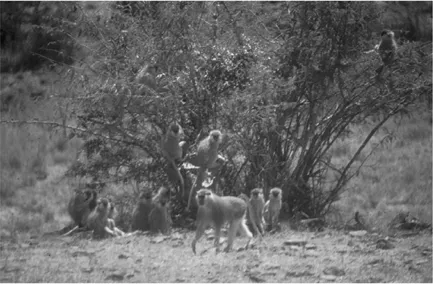
Adult male patas monkey (foreground). (Photo by the author)
Table 1–1 Vervet and Patas Monkey Social Structure, Behavior, and Morphology
| Patas Monkeys | Vervets | |
| Social structure | ||
| Similarities | Male dispersal | Male dispersal |
| Overlapping home ranges | Overlapping home ranges | |
| Group size means: 19 (N = 9), 26 (N = 3), 17.8 (N = 5), 36 (N = 10) | Group size mean: 25 | |
| Differences | Unstable female dominance hierarchy | Stable female dominance hierarchy |
| Non-linear female dominance hierarchy | Linear female dominance hierarchy | |
| One-male social group | Multimale group | |
| Home ranges not defended | Defended home ranges | |
| Behavior | ||
| Similarities | Distinct mating season | Distinct mating season |
| Distinct birth season | Distinct birth season | |
| Omnivorous diet | Omnivorous diet | |
| Acacia important in diet | Acacia important in diet | |
| Seasonal food resources | Seasonal food resources | |
| Semi-terrestrial | Semi-terrestrial | |
| Differences | Large day range, 4,220 m, 3,830 m | Small day range, mean 1,555 m |
| Large home range, mean 2,770 ha, N = 2 | Small home range, 178 ha | |
| Various sleeping sites | Regularly used sleeping sites | |
| Patchy woodland | Continuous woodland | |
| Morphology | ||
| Differences | Larger body size (12 kg adult male, 7 kg adult female) | Smaller body size (5.6 kg adult female, 7 kg adult male) |
| Longer limb length | Shorter limb length (relative to body size) | |
| Females mature earlier (2.5 years) | Females mature later (3.5 years) | |
| Males ~45% larger | Males ~20% larger |
Table of contents
- Cover
- Half Title
- Title Page
- Copyright Page
- Dedication
- Table of Contents
- List of Figures
- List of Tables
- Preface
- Acknowledgments
- 1 The Research Question
- 2 Measuring Primate Behavior and Ecology
- 3 Foods Available to Vervet and Patas Monkeys
- 4 Feeding Behavior of Patas and Vervet Monkeys
- 5 Food Availability’s Influence on Competition and Dominance in Vervets
- 6 Comparing Vervet and Patas Monkeys in Whistling-Thorn Woodland
- 7 Testing Predictions of Models of Female Primate Behavior and Ecology
- References
- Index
Trusted by 375,005 students
Access to over 1.5 million titles for a fair monthly price.
Study more efficiently using our study tools.
Frequently asked questions
Yes, you can cancel anytime from the Subscription tab in your account settings on the Perlego website. Your subscription will stay active until the end of your current billing period. Learn how to cancel your subscription
No, books cannot be downloaded as external files, such as PDFs, for use outside of Perlego. However, you can download books within the Perlego app for offline reading on mobile or tablet. Learn how to download books offline
Perlego offers two plans: Essential and Complete
- Essential is ideal for learners and professionals who enjoy exploring a wide range of subjects. Access the Essential Library with 800,000+ trusted titles and best-sellers across business, personal growth, and the humanities. Includes unlimited reading time and Standard Read Aloud voice.
- Complete: Perfect for advanced learners and researchers needing full, unrestricted access. Unlock 1.5M+ books across hundreds of subjects, including academic and specialized titles. The Complete Plan also includes advanced features like Premium Read Aloud and Research Assistant.
We are an online textbook subscription service, where you can get access to an entire online library for less than the price of a single book per month. With over 1.5 million books across 990+ topics, we’ve got you covered! Learn about our mission
Look out for the read-aloud symbol on your next book to see if you can listen to it. The read-aloud tool reads text aloud for you, highlighting the text as it is being read. You can pause it, speed it up and slow it down. Learn more about Read Aloud
Yes! You can use the Perlego app on both iOS and Android devices to read anytime, anywhere — even offline. Perfect for commutes or when you’re on the go.
Please note we cannot support devices running on iOS 13 and Android 7 or earlier. Learn more about using the app
Please note we cannot support devices running on iOS 13 and Android 7 or earlier. Learn more about using the app
Yes, you can access The Socioecology of Adult Female Patas Monkeys and Vervets in Kenya by Jill D.E. Pruetz in PDF and/or ePUB format, as well as other popular books in Biological Sciences & Ecology. We have over 1.5 million books available in our catalogue for you to explore.