Part One contains three chapters that review the evolution of English and its role as the lingua franca of business; the impact of globalism on public relations; and the changes in social and traditional media, as well as ethical and legal issues affecting public relations writers worldwide.
This is the interactive, ever-changing world of global English. At the beginning of the twenty-first century, rarely has a language and its culture enjoyed such an opportunity to represent the world. In crude numbers alone, English is used, in some form, by approximately 2 billion people on earth, one-third of the planet, and only outnumbered by the speakers of Chinese, approximately 350 million of whom also speak some kind of English.
—Robert McCrum, author of Globish: How English Became the World’s Language
1.1 Introduction to the World of English
The morphing of “global” and “English” into “globish” reflects the ubiquity of English in the new millennium. English has become the world’s lingua franca—the most commonly used language by people who speak other languages to communicate collectively—in international business and in the public relations field. Popular movies and music, academic conferences and scientific research, international diplomacy and economics, international sports competitions, multinational1 corporations, and global advocacy groups all have one thing in common: English. English is now the required language of business for several multinational corporations, as well as for international maritime and air traffic control. English also dominates the Internet, as the language of approximately 80% of electronically stored information worldwide (Mydans, 2007). More than half of the world is predicted to gain some level of proficiency in English by 2050 (“Triumph of English,” 2001).
Public relations agencies and in-house corporate communication departments also have been impacted by worldwide technological innovations, as well as by social, economic, and political changes. For organizations to thrive in a competitive marketplace, they must diversify in international markets. New opportunities abound in economies around the globe—and a rising number of consumers, business executives, and journalists are reading English, particularly on the Web, and conversing in English as the common language for business.
New talent and seasoned public relations practitioners can now easily connect with a global audience in English with the borderless quality of the Internet. They also need to communicate with users of multiple media platforms for information and news who prefer simpler, more direct and less commercial language in an increasingly distracted and cluttered environment. According to Nielsen Company (2010), blogs and social networking sites are visited by three-quarters of global consumers who access the Internet.
The proliferation of English also means that people, regardless of their location, from many walks of life—academics, diplomats, intellectuals, journalists, business executives, government officials, nonprofit directors, and public relations professionals—need to have proficiency in the language to communicate in the global arena.
Naomi Buck (2006), a Toronto-born journalist who has lived in a number of countries, reflected on the ubiquity of English in public debate—and the disadvantages of not having a voice in English to reach a broader audience. Buck also provided a colorful description of the language’s evolution:
Maybe some comfort can be taken in the fact that English has been sashaying, reconnoitring and kowtowing its way around the world for a long time. It knows how to beg, borrow and steal but also how to integrate, share and age—with grace and not. (para. 16)
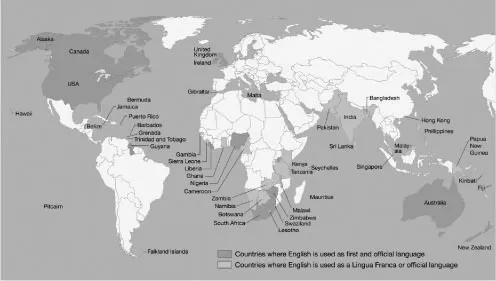
Linguist David Crystal summed up the situation: “Global English can lead to Global Understanding” (2001a, p. 27). Approximately 335 million people speak English as a first language in 101 countries (Lewis, Simons, & Fennig, 2015). English is spoken in more countries than any other language—people from American Samoa to Zimbabwe speak English as a national or official language (see Figure 1.1). In addition, English serves as the de facto national working language in Bahrain, Bhutan, the Maldives, and the United Arab Emirates, as well as in other countries by substantial immigrant groups.
Figure 1.1—Map of the Contemporary English-Speaking World. Source: © Svein-Tore Griff With.
Although the total number of countries in the world is debated due to disputed territories, a widely used number is 193, based on the member nations of the United Nations, which includes its most recent member country, South Sudan, in 2011 (United Nations, 2015a), or 195, including the UN’s two non-member observer states (the Holy See, which is the jurisdiction in Rome of the Catholic Church, and the State of Palestine). Currently, the International Olympic Committee is represented by 205 National Olympic Committees, including 192 United Nations members (with the exception of South Sudan) and one of its observers, Palestine. The 12 other non-United Nations members or observers include Cook Islands, Kosovo, Hong Kong (as an administrative region of China), Taiwan, as well as four U.S. territories, three British territories, and one Netherlands territory. The National Olympic Committees maintain responsibility for supervising the bidding process of host cities, as well as developing, selecting, and sending teams in their nations to compete in the international Olympic Games (Olympic.org, 2015).
1.2 English Evolves from More Than 350 Languages
The history of English is a fascinating narrative on how a language spoken by tribes in northwest England about 2,000 years ago spread around the globe. Authors McCrum, Cran, and MacNeil of The Story of English (1986) explain why:
The story of all languages is full of surprises. The year the Anglo-Saxons first crossed the sea to the former Roman province of Britannia, in AD 450, the odds against English becoming a world language were about a million to one. (p. 48)
Understanding the evolution of English can help us better appreciate how the language thrives today. Let us start by looking at your knowledge of the language by trying to answer the following questions:
- Can you identify the Latin roots of English-language words, such as the Latin equivalents of both, stars and outer space, all, and city? See the Pre-English period in the next section.
- Can you name a few Anglo-Saxon words that are still used in English? See Early Old English.
- Can you identify a few English words with Viking roots? See Later Old English.
- How many thousands of French words influenced English? See Middle English.
- Which British monarch was the first to set up trading posts around the world? See Early Modern English.
- When was the first English-language printed book published? See Early Modern English.
- Can you estimate how many words Shakespeare added to the English vocabulary? See Early Modern English.
- When did Noah Webster publish the first American-English dictionary? See Modern English.
- What developments have influenced the spread of English since the mid-20th century? See Late Modern English.
1.2.1 English from the Roman Empire to Today
According to linguist David Graddol (1997), English has evolved over the following seven time periods:
- Pre-English period (before A.D. 450)
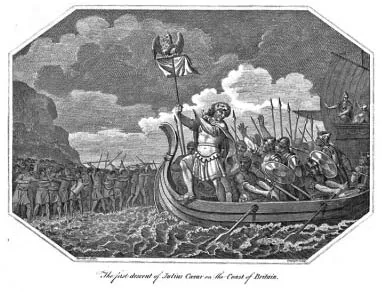
Latin became the lingua franca in administration and education when Julius Caesar and the Roman Empire invaded Britain in 55 B.C. (see Figure 1.2). The Celtic-speaking population in Britain then spoke two main branches similar to today’s Gaelic and Welsh. The names of places such as Chester and Manchester derive from castra, the Latin word for camp (McCrum et al., 1986). English words with Latin origins remain today. Ambi (both), astro (stars and outer space), omni (all), and urb (city) are just a few examples. - Early Old English (c. 450 to c. 850)
Germanic tribes from Continental Europe—Angles, Saxons, and Jutes—invaded Britain in A.D. 449, influencing the development of Early Old English. Basic Anglo-Saxon words have evolved and are still used today: is, here, the, there, and you, as well as words reflecting farming, celebrations, and emotions—earth, field, sheep, glee, laughter, and mirth (McCrum et al., 1986). This period also sparked the “Anglo-Saxon love of ambiguity, innuendo and word-play” (McCrum et al., 1986, p. 62), with a rich oral tradition of storytelling and new English literature. Today’s readers would be bewildered trying to read the original Anglo-Saxon epic poem of Beowulf (see Figure 1.3), yet the legend continues to live on in contemporary film and games. Figure 1.2—“The First Descent of Julius Caesar on The Coast of Britain” Engraving by Grainger. Source: Image courtesy of antiqueprints.com.
- Later Old English (c. 850 to 1100)
The Viking invasion of Scandinavian peoples brought over other linguistic influences to the development of English. King Alfred, known as Alfred the Great, was instru -mental in having Latin texts translated into English and setting up English-language education (see Figure 1.4). Up to 900 words of Viking origin remain i...