International thought is the product of major political changes over the last few centuries, especially the development of the modern state and the industrialisation of the world economy. While the question of how to deal with strangers from other communities has been a constant throughout human history, it is only in recent centuries that the question of 'foreign relations' (and especially imperialism and war) have become a matter of urgency for all sectors of society throughout the world. This book provides the first comprehensive overview of the evolution of Western international thought, and charts how this evolved into the predominantly Anglophone field of International Relations. Along the way several myths of the origins of International Relations are explored and exposed: the myth of the peace of Westphalia, the myths of Versailles and the nature of the League of Nations, the realist-idealist 'Great Debate' myth, and the myth of appeasement. Major approaches to the study of international affairs are discussed within their context and on their own terms, rather than being shoe-horned into anachronistic 'paradigms'. Written in a clear and accessible style, Ashworth's analysis reveals how historical myths have been used as gatekeeping devices, and how a critical re-evaluation of the history of international thought can affect how we see international affairs today.
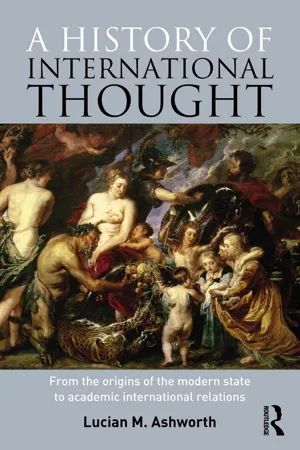
eBook - ePub
A History of International Thought
From the Origins of the Modern State to Academic International Relations
- 310 pages
- English
- ePUB (mobile friendly)
- Available on iOS & Android
eBook - ePub
A History of International Thought
From the Origins of the Modern State to Academic International Relations
About this book
Information
1 Introduction
To discover from the history of thought that there are in fact no such timeless concepts, but only the various different concepts which have gone with various different societies, is to discover a general truth not merely about the past but about ourselves as well.1
Man has no nature, just history.2
This chapter explores the nature of international thought and international relations, stressing the problems we have in defining what the international is. In providing an introduction to the study of international thought it will explore a number of issues that are important to understanding the study of the international:
1 The role of history and historical accounts as gatekeeping devices. The stories we tell about the origins of things are not neutral, but are highly politically charged narratives that can be used to promote some ways of thinking, while marginalising others.
2 Texts from the past change their meanings over time, and as the concerns of the readers of the text change. In order to understand a particular text from the past it is important to try and read it on its own terms, rather than just imposing our own concerns and prejudices on it. This is not as easy as it sounds.
3 There are two under-analysed assumptions in IR that directly affect the way that we interpret the history of international thought. These are: (a) The way that certain historical myths continue to be repeated in IR, despite the fact that they have been refuted in scholarly publications. The worst of these is the myth of the realist—idealist debate. Forcing all ideas into realist and idealist straitjackets stops us from being able to see the richness and diversity of international thought. (b) That what we know as international thought is, almost entirely, a western interpretation of the world.
This book divides international thought into three phases. The first, explored in Part I, involves the creation of an inter-state system as a byproduct of the formation of the modern western state from the sixteenth century onwards. The second, examined in Part II, follows the development of a self-conscious analysis of the international during and after the industrialisation of society. The third, the development of IR as a university subject after 1945, is summarised in Chapter 8. This book concentrates on the first two phases.
In their send-up of English history, originally published in 1931, Sellar and Yeatman declared that history is what you could remember. Theirs was the only ‘memorable’ history because it was made up of the partially remembered stories of English history overheard in ‘golf-clubs, gun-rooms, green-rooms, etc’.3 What Sellar and Yeatman were satirising was not history per se, but rather the way that people construct definite narratives out of half-digested historical ‘facts’. Throughout 1066 and All That the text is broken up by declarations that a certain person or event is a good or bad thing. The whole story is tied to what is the defining feature of whether something is memorable or not: whether it relates to Britain being ‘top nation’. Thus, the American War of Independence results in America having no more history, because America was now no longer ‘memorable’. While Sellar and Yeatman were satirising a specifically British Whig history4 that when they wrote was already under attack from a new generation of historians, what is uncomfortable about their approach is that we are all guilty of these kinds of distortions and over-simplifications (a Whig history is one that is written not to understand the past, but to give support to current positions in the present). Historical narratives, tottering on a flimsy base of knowledge, are frequently used to justify certain positions, policies or preferences. Often the shrillness of our claims on an issue is directly proportional to our lack of knowledge of the historical case at its base. Most recently, and since history teaching in schools around the world have come under the control of national curricula, these narratives have been used to justify the existence of specific sovereign states. Yet, these narratives are not exclusive to state-based nationalisms, and can be found among all human collectivities. Even academic fields of study are not immune to this process.
International Relations (IR) has its own set of standard Whig histories. These revolve around the idea of the first great debate and the dichotomy of realism and idealism. The construction of a conflict between realist and idealist approaches peppers many textbooks, and allows lecturers of introductory IR courses to present a simple history of IR that sees it as a long struggle between idealist and realist paradigms. This great debate is often located in the inter-war period, but it is also sometimes placed in the post-1945 period. The fact that there is no agreement on when this ‘Great Debate’ took place should send warning signals through teachers of introductory courses. Like all good myths the realist—idealist debate is based upon a kernel of historical evidence. Brian Schmidt has located a realist—idealist debate among US foreign policy studies in the late 1940s, while ‘realist’ and ‘idealist’ were terms that were traded (often with different and conflicting meanings) between the wars. There is even evidence of a debate resembling the realist—idealist debate before the First World War.5 On balance, though, the realist—idealist ‘Great Debate’ over-simplifies the past by ignoring the rich diversity of pre-1950s IR, and imposing anachronistic conditions on to the past. A similar process operates in International Political Economy (IPE), where the myth of a complete separation between the study of politics and economics prior to the 1970s has written out both liberal and socialist political economy approaches to the international that were active prior to 1950.6
This book is an attempt to bring some historical rigour to these stories that we tell about the international. I do not presume to be telling the whole and complete story, though. Like Bertrand Russell, I believe that the more we know the less certain we are about the truth. All histories are interpretations and present a particular biased angle, which can be due to factors such as the cultural baggage of the author or the evidence available. There is, however, a major difference between narratives based on flimsy and misleading evidence, and histories (however biased or misleading they still are) that endeavour to understand and uncover as much of the past as humanly possible. Well informed histories, however subject to their own biases, at least provide us with an attempt to recreate the past, and offer a firm foundation for scholarly debate. The central goal of this book is to provide as much understanding of the history and origins of international thought as possible within the confines of a single work. In order to do this I try as far as possible to understand these ideas within the context of their own times. This is more of a struggle than it may at first appear because the past at one level is irredeemably lost to us. Our evidence for the past is always fragmentary and limited to certain forms of evidence that tend to survive better than others. Thus, while we know much about late Republican Rome from the archaeological record and the surviving writings of the period, we are limited by the loss of other forms of evidence, such as the perspectives of the slaves or the mindsets of the citizens themselves that were the context in which the surviving evidence existed and made sense. Added to this there are our own views and contexts. Our own views on slavery, so different from the Roman, mean that we either tend to judge their society by our own standards (as the film Spartacus did), or we unconsciously ignore the unpalatable aspects that interfere with our interpretation of an idealised past (as the equally classic film Cleopatra did).
That said, there are also very good reasons for studying the past in general, and the history of ideas in particular. First, whether we like it or not, political arguments based on historical precedent or narratives are a central feature of our society. Positions are justified by reference to historical narratives, and thus the spread and acceptance of historical narratives form an effective gate keeping device, where they are used not to understand the past, but to prevent ideas that do not fit the story from being accepted. Second, the predominant tendency in IR theory to read past theorists only in terms of present day concerns and categories limits our understanding of the richness of texts, as well as the tendency of these texts to be interpreted differently by different generations. Related to this is our failure to understand two aspects of a text: its relation to the possible intent of the author, and the way that the attitudes of a particular audience in space and time reinterpret a text. Texts, in short, are not static and unproblematic sources. Third, the placing of a text within its historical context helps reveal the complexities of human existence, and guards us against simplistic formulae for human action that merely extrapolate the particular concerns and prejudices of groups in space or time. In terms of the history of international thought, this imperative to study ideas within a broader historical context has sharpened with the development of international political theory (IPT). The development of a more philosophically nuanced IR theory via IPT means that IR now needs to undergo the same revolution in thought that political theory went through with the debates about the nature of the history of ideas in the late 1960s and early 1970s. In short, we must match our deepening philosophical understanding with an equally deep understanding of how historical context affects the way that we read philosophical insights. The next section confronts this issue.
What this book is … and what it is not
Over the last few years there has been a growing body of literature in IR called international political theory (IPT). IPT has been defined as ‘that aspect of the discourse of International Relations which addresses explicitly issues concerning norms, interpretation, and the ontological foundations of the discipline’.7 In other words, it is an understanding of the underlying theoretical foundations of IR and international thought. Applying analysis taken from political theory, IPT has added to our understanding of the history of IR through a deeper analysis of the international thought of past theorists and philosophers within a broader context of the analysis of questions of justice, war, power and sovereignty. While IPT often analyses past thinkers, the primary focus is not to understand those thinkers in terms of their context and place within the history of ideas (although it is not precluded from doing so), but rather to understand those authors in terms of the broader perennial questions that they are involved with asking. Thus, an analysis of A.T. Mahan would be less about the contexts and debates in which his ideas evolved, and more to do with how he can help us answer questions about sovereignty, colonialism and war.
To a certain extent this development of IPT has brought IR into line with the development of political theory. This alignment, however, opens up a question about the relationship between theory and historical context. From the late 1960s onwards political theorists have faced and debated the question of the role of historical context in the interpretation of political theory and past theorists. The first salvoes in this debate were fired by Quentin Skinner in 1969 and have since been organised into what became known as the Cambridge School of political theory.8 While I do not want to go into the details of this debate here, I do want to stress the point that the Cambridge School helped open up political theory to the history of ideas, and especially to criticisms of the construction of ‘traditions’ in political thought that owed more to an ahistorical ‘spurious persistence’9 based upon flawed understandings of the context of political thinking. This is not to say that the Cambridge School is not without its critics, indeed Skinner's original 1969 article was the subject of a robust response in 1974 by Parekh and Berki. Even then, Parekh and Berki did not cast doubt on Skinner's argument on the importance of historical context, rather they took issue with how Skinner had employed and (in their view) overstated it. For Parekh and Berki there were different degrees of importance for context depending on the nature of the thinker and the form of his or her work. There were attempts by past thinkers to address what are seen as perennial problems of human existence, and so sometimes we can read them in the same way as we would read a more recent writer.10 Yet, in the final analysis Parekh and Berki replace Skinner's more bullish support for the understanding of the intentions and context of a thinker with an acceptance of the inability to escape the present, and an acceptance that historical and contextual understanding is always shifting and is never stable. The bottom line that emerges from this exchange is the complexities of the relationship between a text, its writer and their historical context. Any attempt to understand political theory requires us to understand how it interacts with both its historical context and with the audience in the present.
The success of IPT in IR has, therefore, brought with it an imperative to engage with the historical context and linkages of international thought. Greater awareness of the role of political theory in international thought requires us to consider the importance of methods of thought associated with the history of ideas too. This is where the history of international thought comes in. Its importance lies placing international theory within its historical context, and thereby acting as a support for the study of IPT. This is not the end of the matter, though. The history of international thought also acts as a critique (and even a criticism) of current narratives and practices that use historical narratives as a means of bolstering or demolishing certain current theoretical arguments in IR. For example, it is not uncommon — both in IR and...
Table of contents
- Cover
- Half Title
- Title Page
- Copyright Page
- Table of Contents
- Preface
- 1 Introduction
- Part I International relations before the study of International Relations
- Part II The emergence of the discipline of International Relations and the great crisis of humanity
- Part III Conclusion: international relations in living memory and lessons for the future
- Bibliography
- Index
Trusted by 375,005 students
Access to over 1.5 million titles for a fair monthly price.
Study more efficiently using our study tools.
Frequently asked questions
Yes, you can cancel anytime from the Subscription tab in your account settings on the Perlego website. Your subscription will stay active until the end of your current billing period. Learn how to cancel your subscription
No, books cannot be downloaded as external files, such as PDFs, for use outside of Perlego. However, you can download books within the Perlego app for offline reading on mobile or tablet. Learn how to download books offline
Perlego offers two plans: Essential and Complete
- Essential is ideal for learners and professionals who enjoy exploring a wide range of subjects. Access the Essential Library with 800,000+ trusted titles and best-sellers across business, personal growth, and the humanities. Includes unlimited reading time and Standard Read Aloud voice.
- Complete: Perfect for advanced learners and researchers needing full, unrestricted access. Unlock 1.5M+ books across hundreds of subjects, including academic and specialized titles. The Complete Plan also includes advanced features like Premium Read Aloud and Research Assistant.
We are an online textbook subscription service, where you can get access to an entire online library for less than the price of a single book per month. With over 1.5 million books across 990+ topics, we’ve got you covered! Learn about our mission
Look out for the read-aloud symbol on your next book to see if you can listen to it. The read-aloud tool reads text aloud for you, highlighting the text as it is being read. You can pause it, speed it up and slow it down. Learn more about Read Aloud
Yes! You can use the Perlego app on both iOS and Android devices to read anytime, anywhere — even offline. Perfect for commutes or when you’re on the go.
Please note we cannot support devices running on iOS 13 and Android 7 or earlier. Learn more about using the app
Please note we cannot support devices running on iOS 13 and Android 7 or earlier. Learn more about using the app
Yes, you can access A History of International Thought by Lucian Ashworth in PDF and/or ePUB format, as well as other popular books in Política y relaciones internacionales & Relaciones internacionales. We have over 1.5 million books available in our catalogue for you to explore.