eBook - ePub
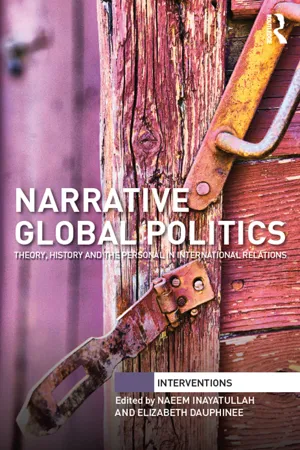
Narrative Global Politics
Theory, History and the Personal in International Relations
- 212 pages
- English
- ePUB (mobile friendly)
- Available on iOS & Android
eBook - ePub
Narrative Global Politics
Theory, History and the Personal in International Relations
About this book
This volume harnesses the virtual explosion of narrative writing in contemporary academic international politics. It comprises a prologue, an epilogue, and sixteen chapters that both build upon and diversify the success of the 2011 volume Autobiographical International Relations . Here, as in that volume, academics place their narratives in the context of world politics, culture, and history. Contributors explore moments in their academic lives that are often inexpressible in the standard academic voice and which, in turn, require a different way of writing and knowing. They write in the belief that academic IR has already begun to benefit from a different kind of writing—a stylae that retrieves the I and explicitly demonstrates its presence both within the world and within academic writing. By working within the overlap between theory, history, and autobiography, these chapters aim to increase the clarity, urgency, and meaningfulness of academic work. Highlighting the autoethnographic and autobiographic turn in critical international relations, this work will be of great interest to students and scholars in international relations, IR theory and global politics.
Information
1 Permitted urgency
A prologue
“Art,” says philosopher R.G. Collingwood, “makes for itself two claims.” First, that it is the “activity of pure imagination.” And, second, that it “somehow reveals the truth concerning the ultimate nature of the real world” (Collingwood, 1963: 87).
Like fiction, we may read these essays, initially, for pleasure. Our writers attend to the shape of their prose because they recognize that form also delivers content. They are not indifferent to their aesthetic decisions; they know that it matters how they tell their story––it matters to the reader, to the writer, and especially to the innermost needs of the story (Collingwood, 1963: 253). Change the form, move it toward fiction, and suddenly the writer too becomes a reader, a receiver of her own subtle pedagogy. Change the form and the reader can feel, think, and experience the story. Elizabeth Dauphinee executes this strategy in her The Politics of Exile (2013). She is undone by her own pedagogy.
The overlap with fiction, however, does not quite draw the fuller sketch. Whether we call it autobiography, autoethnography, or narrative, the forms presented here cannot be reduced to fiction. Even if we worship at fiction’s altar, deeming it superior to academic production, we may still secretly assess it as an ideographic portrait, as “mere” fiction. Fiction’s insights are not, we might assume, transferable to our actual world. These essays rupture that secret assessment.
How so? How is it that these essays do their work? Our most honest answer is that we are not sure—even if Naeem Inayatullah has tried to formulate this how (Inayatullah 2013a; 2013b). This prologue allows us another chance to respond. These essays do their work by addressing theoretical problems as autobiography. They probe questions that are central to the academic vocation: How do racism, sexism, classism express themselves not merely as abstract forces but as exact moments and precise movements in actors’ lives? If structures exist by dint of memory traces that trigger repetitive actor actions, what are those memory traces? How do those traces emerge as action? How exactly do structures and institutional patterns make our actions complicit? What counts as an act when a retrospective look at a life produces a sense mainly of compliance to abstract forces? Does knowledge of structures, institutions, and our complicity in them allow for change? If during encounters something is always lost in translation, what is communicated and what miscommunicated? If the violence of the nation is homologous to violence between individuals, what moves between and across levels to reproduce violence? How do we make a meaningful life? Do institutions learn? Do individuals? What might such learning look like? In what ways do aesthetics and politics overlap?
The curved trajectories by which our authors aim their stories at these questions are, we submit, a kind of directness. In every essay, what is addressed is pain—pain at injustice, pain at loss, pain at an inability to redress and repair, pain resulting from the simultaneous dread and awe the world produces in us. The arcs of their storytelling address this aching not as the product of a fictive world, but what each story regards as an actual one. They do not allow either the easy jettisoning of a fictive world, nor the distance-induced catatonia of our usual academic prose. Instead, we receive something that overlaps with both: academic probing with the storytelling’s tangential arcs.
These arcs are best seen as modes of travel. If academic prose moves in conventional Euclidian lines, then narratives bend and are bent by space-time. Gravity re-asserts itself. Travelers, theorists, and storytellers, who are one and the same, must move. Logically, they first move outward to then move inward. One builds a bridge to oneself via the world at large; one knows and heals oneself by means of knowing and healing others. One distances oneself from oneself as but a moment in which one grasps the larger world outside. We might say that these encounters are, as Levinas (1991) posed, first philosophy. We travel to encounter others and, in so doing, we encounter ourselves.
What the distancing moment of our usual academic posture tends to forget is the next leg in the route, the return trip. We grasp the outer world with the precise tools of science, in order to return to intimacy. An intimacy now infused with a broader and more encompassing interpretation than if one had never left at all. The world is a wound and yet filled also with tragic beauty. Our travels, our theories, our stories, bring this awareness home to us. Here, we find theory’s fuller purpose realized—constructing and embodying an extensive architecture of understanding. Inside, outside, inside/outside.
We can read these chapters for pleasure. And then we can read them for the academic questions they pose and “solve.” Read this way, we may find that these narratives combine the strengths of fiction with those of academic prose.
* * *
The settings for these essays are wide-ranging. They include cities such as New York, Toronto, Vancouver, Stockholm, Portland, Nairobi, Lucknow, Singapore, and Jacksonville, Florida. They include larger entities such as Tanzania, China, USA, UK, Canada, Bosnia, India, Sweden, Japan, Egypt, Kenya, Guyana, Brazil, Ecuador, and Uruguay. They take on race relations, fear of one’s own repudiated racism, the uncovering of one’s own orientalism; the use of art to move beyond orientalist tropes; the violence at the heart of family; the pain of not finding traces of your lineage in the archives of the state; the loss of a politics of immediacy after trauma; the loss of aesthetic resolve produced by formal politics and by everyday life; the fear of losing culture and language across generations; the elusive and unwilling slips into modernity; assessments of intellectual lives and careers; the complex overlap between sexual identity, politics, and building social science in the periphery; and the value of traveling ever more directly toward the world’s remotest corners, and to the remote corners of ourselves.
* * *
We have come some distance in the five years since the field of international relations embarked on a journey to integrate narrative. For example, as a result of working on their chapters a number of authors in this collection have expressed their desire to produce book-length manuscripts. These imagined longer manuscripts, it seems, are not something they can do without. They are eager to find the time, space, and support by which they can be realized. Such firmness of desire makes us wonder if others have already buried in their desk drawers completed but hidden manuscripts. Or, perhaps there are those who would embark on such projects if only they could find something they could interpret as permission.
In addition, in producing this volume as well as three issues of Journal of Narrative Politics, we found that submissions were not limited to academics, to those in the fields of political science or international relations, or to those with steady academic jobs. Instead we received and published materials from those more situated in anthropology, geography, writing, languages, comparative religions, gender studies, philosophy, Indigenous studies, poetry, and popular culture, as well as from professional artists and those from outside academia. We have published materials by non-academics, undergraduates, graduates, and junior faculty as well as established scholars.
This inclusiveness results, we believe, from our project’s call: that writing be clear with a penchant for the artful and theoretically informed use of everyday language. In serving as writers and editors for the last five years, we have learned that responding to this call requires no less effort but a different kind of skill than writing the usual academic article. We remain convinced that everyone possesses such skills. Everyday language is, after all, our daily bread and butter. However, it takes work—almost always in collaboration—to assess and hone such skills. In this way, our project, like any intervention, contains a pedagogical component. We learn and teach our way through this process even without steady markers or sure parameters.
The most important lesson we have learned is that permission is the necessary component in evoking and instituting this project. We take it to be true that everyone is striving to say something—something they need to say. Something that can express itself as narrative and as theory. This permitted urgency is the hallmark of these remarkable essays.
References
Collingwood, R.G. (1963) Speculum Mentis. London: Oxford.
Dauphinee, E. (2013) The Politics of Exile. New York: Routledge.
Inayatullah, N. (2013a) “Distance and intimacy: Forms of writing and worlding,” in A. Tickner and D. Blaney (eds), Claiming the International, Abingdon, UK: Routledge, 194–213.
Inayatullah, N. (2013b) “Pulling threads: Intimate systematicity in The Politics of Exile,” Security Dialogue, 44 (4): 331–345.
Levinas, E. (1991) Totality and Infinity, Dordrecht, Netherlands: Kluwer Academic.
2 The reluctant immigrant and modernity1
It is the present that thinks the past; that makes this past whole. We are but bits and pieces of raw material, disparate and unconnected minutiae of everyday life made available, and only then, woven into some recognizable structured totality called I. Thoughts, feelings, ideas, experiences, all hatched long ago can be embraced or disavowed. I exist somewhere between the voices of my education and the burden of history. What follows, therefore, is, and can only be, a kind of negotiated settlement.
The village Cornelia Ida is about ten miles up the Atlantic Coast, on the West Coast of the Demerara River.2 It is bounded by limitless water to the north and sugarcane fields far into the deep distant south. I grew up there and next door at Anna Catherina until I left for Canada in a routine act of what academics call labor migration. After 20 years in Canada I moved to the United States, exactly in the heart of the global panopticon, Washington, DC.3 A long journey indeed, especially when I include the bit that my fore-parents were from India.4
I begin with a confession of sorts—that you may leave the village in the Third World, but you are never forever gone.5 And even after decades of trying to fall into the rhythms of the new world, the unconscious won’t allow it because the stamp of the village is stubborn and strong, and will not leave me alone. There is just too much deep in that soil, like in the graveyard that now keeps family, villagers, and my mother.6 Like the trees I planted with these same hands with which I now write; like the two-bedroom flat-house I painted blue when I was barely 11.7 And also, too many entanglements of laughter, of hopes, of watching the rush of flames and smoke rise from the burning sugarcane fields in the distance, signaling that all is well, that men are at work, the factory is grinding, girls are buying frocks and books, men are cocked behind pool cues after a cold sip of El Dorado rum, and then in the moments between play, dance to a tune from Ek Phool Do Mali, winding low, looking like Bollywood’s Sanjay Khan, handkerchief flared around the neck.8
This is the place where on hot tropical nights you touch the moon with your bare indentured slave-descended hands, watch the shooting stars with your own brown eyes, where you may look deep into the night, and now and again, well into the crimson platform of dawn. Night laughter never dies. And then the rhythm of Saturday morning markets at Leonora, by turns fanciful and abject, the details of faces, crevices and dimples, faces of the barefooted friends with whom I ran the chure line, and played gun-shooting.9 I know now that when you leave, the village lives on in you, and against you. It becomes that inescapable agent, like an albatross—following you, chasing you down cold abstract highways, making it difficult for you to leave those dense, noisy relations of intimacy and settle in foreign lands constructed around relations of anonymity. It stalks you with the warning that the new modern land is erected through affections of convenience. Too brutal I suspect, but I am not the sole author of this finding. The village is Plato’s demiurge. And thus, my Third World village is still there, nigh erect, two thousand miles below this cold mid-Atlantic wind, standing there like a night watchman, waiting, waiting for a return.
All of us who have left our villages, towns, and countries, for reasons somewhere between fear and hope, or between deprivation and desire, carry with us this burden, this weight on our backs, even though of what specifically, I am not sure. I am one of them. I plead guilty to the groundings with the Gemeinschaft, the groundings with my brothers, with rice fields, cows, and hammering tropical rain. And still, I see a kind of dark, beautiful, and intensely private truth in these dislocations. Remember Naipaul? The gold of the imagination turns into the lead of reality.
There is nothing special about Cornelia Ida, this village of about a thousand planted souls. Flat and undifferentiated, it never attracted anyone from afar. Jejune the critic might say. And yet, I developed a relationship with this place that is still so alive and well. It began with the Atlantic Ocean, not even a quarter of a mile from the rugged backstreet of CI. Water, my element. Water, I found out, has a mind of its own, capable of moods, of attitudes. When the tide is out, the ocean is flat and still like sheets of glass, disdainfully indifferent to eyes unknown, and then with the dance of the moon it would turn and start behaving like an angry boar, and with gathering momentum come in magnificent swells, massive pounding waves. The Dutch had built a seawall to keep the beast out, but by my time it had collapsed into heaps of history for those who cared to ask. Those broken, jagged protrusions form an archive of the ingenuity of the Dutch and some of the worst forms of coloniality (see Quijano, 2007; Tlostanova and Mignolo, 2012). Sustained domination is impossible without some measure of genius.
The next imperial power, Britain, built another wall––ten feet tall, sturdy, rough and defiant, like a concrete Maginot Line, snaking its way through mangrove and mud. I liked that seawall, for it became a window to the outside world. Before I left those shores, it was the only place from where I might look outwards.
I had a favorite spot on the seawall. It was to the immediate right of the drainage koker facing the endless water.10 There was sand, flat brown sand, but no beach, no concept of beach, no picnic, no colorful umbrellas, no parking spots, not a changing room, no tourists, no cameras, no clicks. I used to sit there sometimes after my high school class on West Indian history, or a fiery anti-imperialist speech on the radio by a big-one, and try to figure out from which direction they came —the African slaves, the Indian and Chinese indentured servants, the Dutch, the Spanish, the French, and then the British. It was hard to figure out where I am in relation to all the brutalities of centuries gone, through the geography and history I was encountering. I was there, sometimes forlorn, grasping for some spatial reference, sometimes with a quiet rising expectation of exiting the geography I walked on. The one or two te...
Table of contents
- Cover
- Half Title
- Title Page
- Copyright Page
- Dedication
- Table of Contents
- List of figures
- Notes on contributors
- Acknowledgements
- 1 Permitted urgency: a prologue
- 2 The reluctant immigrant and modernity
- 3 Dissolutions of the self
- 4 Simultaneous translation: finding my core in the periphery
- 5 The intimate architecture of academia
- 6 The banality of survival
- 7 Letters to Yvonne: words and/as worlds
- 8 Your East Africa, my Pacific Northwest: a commercial view of Tanzania from an unfamiliar vantage
- 9 Loss of a loss: Ground Zero, Spring 2014
- 10 Contradictions
- 11 “Was will das Weib?” Politics, film, desire
- 12 What might still sputter forth
- 13 auto/bio/graph
- 14 The smell of wood: recuperating loss in a country of forgetting
- 15 Immobility, intimacy, movement: translating death, life, and border crossings
- 16 Suicide, the only politically worthy act
- 17 Dancing modernity: an epilogue
- Index
Trusted by 375,005 students
Access to over 1.5 million titles for a fair monthly price.
Study more efficiently using our study tools.
Frequently asked questions
Yes, you can cancel anytime from the Subscription tab in your account settings on the Perlego website. Your subscription will stay active until the end of your current billing period. Learn how to cancel your subscription
No, books cannot be downloaded as external files, such as PDFs, for use outside of Perlego. However, you can download books within the Perlego app for offline reading on mobile or tablet. Learn how to download books offline
Perlego offers two plans: Essential and Complete
- Essential is ideal for learners and professionals who enjoy exploring a wide range of subjects. Access the Essential Library with 800,000+ trusted titles and best-sellers across business, personal growth, and the humanities. Includes unlimited reading time and Standard Read Aloud voice.
- Complete: Perfect for advanced learners and researchers needing full, unrestricted access. Unlock 1.5M+ books across hundreds of subjects, including academic and specialized titles. The Complete Plan also includes advanced features like Premium Read Aloud and Research Assistant.
We are an online textbook subscription service, where you can get access to an entire online library for less than the price of a single book per month. With over 1.5 million books across 990+ topics, we’ve got you covered! Learn about our mission
Look out for the read-aloud symbol on your next book to see if you can listen to it. The read-aloud tool reads text aloud for you, highlighting the text as it is being read. You can pause it, speed it up and slow it down. Learn more about Read Aloud
Yes! You can use the Perlego app on both iOS and Android devices to read anytime, anywhere — even offline. Perfect for commutes or when you’re on the go.
Please note we cannot support devices running on iOS 13 and Android 7 or earlier. Learn more about using the app
Please note we cannot support devices running on iOS 13 and Android 7 or earlier. Learn more about using the app
Yes, you can access Narrative Global Politics by Naeem Inayatullah,Elizabeth Dauphinee in PDF and/or ePUB format, as well as other popular books in Politik & Internationale Beziehungen & Geschichte & Theorie der Politik. We have over 1.5 million books available in our catalogue for you to explore.