Deeper City is the first major application of new thinking on 'deeper complexity', applied to grand challenges such as runaway urbanization, climate change and rising inequality. The author provides a new framework for the collective intelligence – the capacity for learning and synergy – in many-layered cities, technologies, economies, ecologies and political systems.
The key is in synergistic mapping and design, which can move beyond smart 'winner-takes-all' competition, towards wiser human systems of cooperation where 'winners-are-all'. Forty distinct pathways 'from smart to wise' are mapped in Deeper City and presented for strategic action, ranging from local neighbourhoods to global finance.
As an atlas of the future, and resource library of pathway mappings, this book expands on the author's previous work, City-Region 2020. From a decade of development and testing, Deeper City combines visual thinking with a narrative style and practical guidance. This book will be indispensable for those seeking a sustainable future – students, politicians, planners, systems designers, activists, engineers and researchers.
A new postscript looks at how these methods can work with respect to the 2020 pandemic, and asks, 'How can we turn crisis towards transformation?'
every day I cycle past The Ark, a cluster of muddy tents and smoking fires, a camp of homeless people under a flyover in central Manchester. Some are upbeat through the wind and rain, but many show the scars of abandonment and abuse – ‘much of the glue that has held British society together … has been deliberately removed and replaced with a harsh and uncaring ethos.’1As I write, the authorities and landowners, keen for Manchester to attract global investors, are preparing another ‘re-eviction’ … (and see the Arks of the future in Chapter 11).
This book starts and ends with the Arks, large or small, wherever they are found. Some ideas came from community groups around 1990, in beat-up post-industrial places across the north of England. The notion of a ‘Community Development Charter’ took shape as a way to avoid conflict and build collaboration. With help from institutes, consultants, activists and universities, we began to figure out how to draw simple maps of complex conflicts and look for potential synergies in the regeneration game. But with a financial crisis the wind changed, and shortly after the focus shifted to a new ‘S’-word – ‘sustainability’ …
A decade later, we looked for ways to transform whole cities, and their supply chains of energy and water and materials. But all over Europe, the same syndromes came up – technology, producers, consumers, designers, government, education or infrastructure, were all divided, conflicted or lost in translation. Again we tried to figure out ‘mappings’ on flipcharts and whiteboards, crude and simple, but enough to see the power games, find missing links, sketch new business models. An even bigger crisis in 2008 stopped the program along with many others, and the tide turned towards short-term survival.
A decade later, we were trying to connect the ‘outer political’ with the ‘inner personal’, amidst turbulence and unravelling. In the UK, Hungary, USA, India, Philippines, Brazil and many other countries, ‘the people’ seemed to be voting for extremism, intolerance and self-harm. This was a massive challenge to a world already on the threshold – climate change, technology disruption and debt crisis, to name a few existential threats – and a great opportunity for demagogues and plutocrats. It was also an opportunity for learning how to draw maps or mappings, of deeper human values and societal orders, especially those beyond the ‘expert’ rational view of things – and with maps or mappings, maybe, we could better navigate the storms ahead.
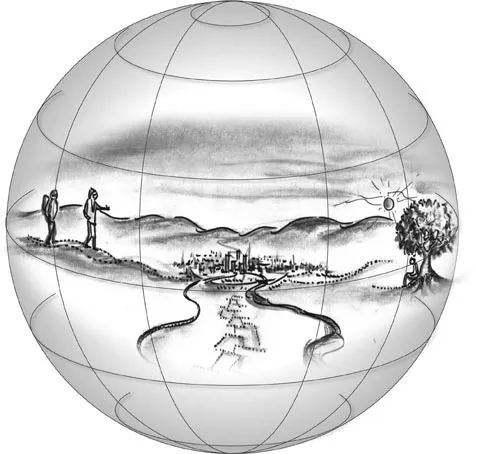
Gradually the ideas in this book began to crystallize, on countless clipboards and whiteboards and power-points. (I got a lot of practice drawing ellipses, good for sketches of round tables and the layers of a Deeper City). There were many false starts, side turnings and attempts at funding half-formed ideas which didn’t fit into standard boxes. There were many more inspirational moments, with many collaborators in many countries, mapping and designing many pathways for the future.
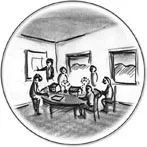
Facing forward, we see extremely ‘interesting times’ of great peril and promise. In technical terms it seems unlikely that catastrophic damage to our life-support systems can be avoided – we are not only deep into climate change, toxic overload and mass extinction, but also in various stages of denial, outrage, grief and blame. So just to survive the coming storms, it’s clear that new ways of thinking are needed. But this calls for more than rational ‘know-what’ thinking (as the cartoon characters are here to point out), it’s about deeper layers of ‘know-how, know-who and know-why’.
So, this book is a journey, a quest, a thought experiment, on the possibility of human co-evolution. It’s about ‘mapping’ the landscape, ‘designing’ the pathways (here are 40 examples to get started), ‘navigating’ the storms and ‘growing’ the seeds of collaboration. It’s even more about ‘healing’ the traumas of the past, ‘gardening’ on a small planet, or ‘delving’ into deeper myths. Moreover, it’s about ‘collaboration’ on complex systems, and ‘learning’ how on earth 7–10 billion people can live together. With all that maybe we could design better pathways ‘from smart to wise’, for this troubled and turbulent 21st century?
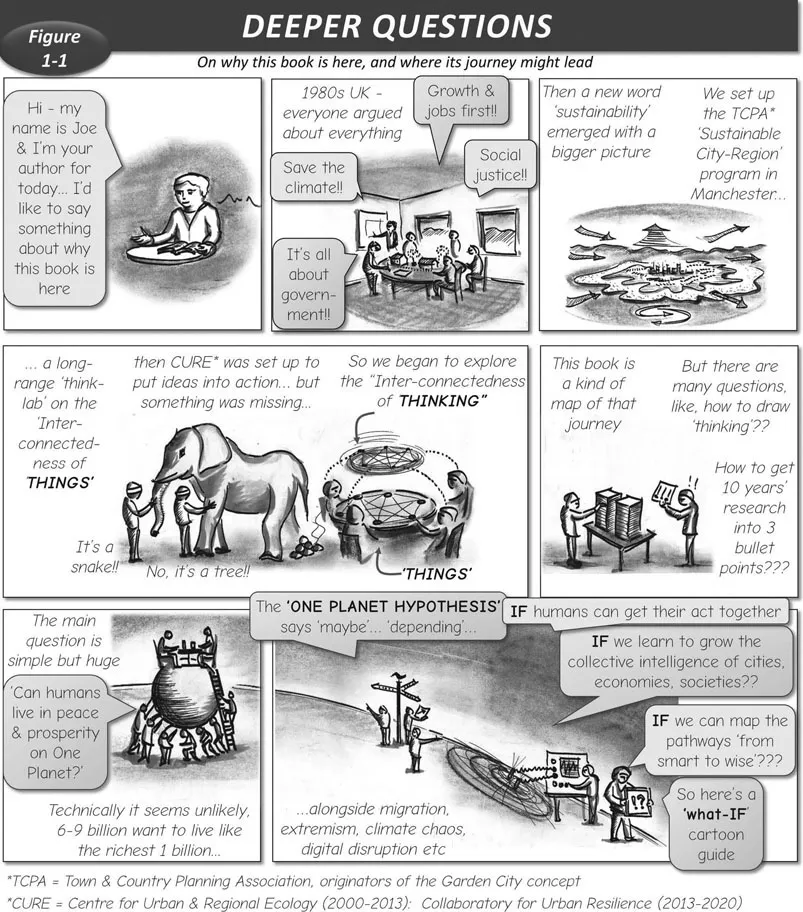
1-1What’s the big idea? Deeper questions
So with that on the table, welcome, and here’s to put up some bigger ideas, with deeper questions, of why this book is here, how it works and who it’s for (see Deeper questions, Figure 1-1).
Humanity has a problem. Our power for self-destruction, as with kids playing with loaded guns, seems far greater than our ability to manage it. Climate change, feral finance, invasive technology, hyper-urbanization, obscene inequality, rampant corruption, elite power grabs, or plain military conflict – these are all catastrophically open questions. To live with 7–10 billion people on one small planet in peace and prosperity, it seems we need a step change in the inter-connected brain, the collective societal intelligence, the collaborative ‘know-how’ and ‘know-why’. This calls for more than ‘clever’ production of obsolete stuff which goes to landfill. It calls for more than ‘smart’ cities which extract data for private profit. This calls for the human dimension – ‘wise’ (or at least ‘wiser’), in all possible ways.
So, the whole book is basically a journey of discovery, in search of three deeper kinds of questions:
What would this collective intelligence look like, in ‘wiser’ kinds of cities, economies, ecologies, technologies or political systems?
Which pathways might lead towards it, and how to get them started?
And most topical – how to combat the forces of aggressive and predatory power, money, corruption, inequality, paranoia, intolerance or self-destruction of many kinds?
And for the difference between ‘smart’ and ‘wise’? Maybe ‘smart’ is winning an argument with your partner – ‘wise’ is knowing when not to argue …
Or another angle on ‘wise’, on that which makes us human, which shows up in the species name homo sapiens, literally meaning ‘wise person’ …
Who is this book for?
The book is basically for people seeking and/or creating a sustainable future, from local to global – designers, inventors, policy-makers, researchers, entrepreneurs, artists, activists, or anyone who wants to be part of the way forward … As for who are ‘we’? this means firstly the readers of this book. This version assumes some knowledge of sustainability, economics and politics: other versions would be geared for school-kids, activists, businesses or policy-makers. ‘We’ also means the ‘multitude’, the collective of human society. The text talks about ‘we’ … this is my personal way of conversation at large, to say ‘we can explore’, and so on. Also, the ideas here are not just from one author, but the combined effort of many teams, consortiums, partnerships, networks. And the bigger ‘we’ is actually the world, as we are all in this together.
Where is the book based?
For practical reasons the two main case studies are Manchester (shorthand for Greater Manchester and its wider city-region), and the UK (see CITY-STATE-PLANET, Figure 2-3). There are examples from around the world, and a review of six cities in DEVEL-OPMENTAL-III(Figure 10-2), but a truly international view would be another project. Over-arching these is the third case study, the planetary level, a global Collaboratorium (‘laboratory of collaboration’) with humans on the inside, presented here as a hypothesis for the grandest of all challenges.
What can the book cover, or not? It can only sketch outlines for each of 40 pathway mappings – each one is a huge societal challenge, which deserves a book on its own. (As systems designer my main role is to mobilize the ‘experts’ in each field to talk to each other). But there’s a reason to put all these sketches together, which is to explore the common threads and interconnections between them. We use a stock example, the ‘Low-Carb City’, which shows how reality is highly inter-connected. To make progress on this Low-Carb City we have to somehow put together many layers – economics, politics, technology, land-use, communities and so on – it seems almost every one of the 40 pathways here is involved somehow. The question is who can put all this togeth...
Table of contents
Cover
Half Title
Title Page
Copyright Page
CONTENTS
LIST OF ILLUSTRATIONS
ACKNOWLEDGEMENTS
1 PROLOGUE
2 PROSPECTS
3 TOOLKITS
4 CITIES
5 ECONOMIES
6 ECOLOGIES
7 TECHNOLOGIES
8 POLITICALS
9 INSIGHTS
10 LOCAL-GLOBAL
11 MIND-GAMES
12 ANNEX
BIBLIOGRAPHY
INDEX
Trusted by 375,005 students
Access to over 1.5 million titles for a fair monthly price.
Study more efficiently using our study tools.
Frequently asked questions
Yes, you can cancel anytime from the Subscription tab in your account settings on the Perlego website. Your subscription will stay active until the end of your current billing period. Learn how to cancel your subscription
No, books cannot be downloaded as external files, such as PDFs, for use outside of Perlego. However, you can download books within the Perlego app for offline reading on mobile or tablet. Learn how to download books offline
Perlego offers two plans: Essential and Complete
Essential is ideal for learners and professionals who enjoy exploring a wide range of subjects. Access the Essential Library with 800,000+ trusted titles and best-sellers across business, personal growth, and the humanities. Includes unlimited reading time and Standard Read Aloud voice.
Complete: Perfect for advanced learners and researchers needing full, unrestricted access. Unlock 1.5M+ books across hundreds of subjects, including academic and specialized titles. The Complete Plan also includes advanced features like Premium Read Aloud and Research Assistant.
Both plans are available with monthly, semester, or annual billing cycles.
We are an online textbook subscription service, where you can get access to an entire online library for less than the price of a single book per month. With over 1.5 million books across 990+ topics, we’ve got you covered! Learn about our mission
Look out for the read-aloud symbol on your next book to see if you can listen to it. The read-aloud tool reads text aloud for you, highlighting the text as it is being read. You can pause it, speed it up and slow it down. Learn more about Read Aloud
Yes! You can use the Perlego app on both iOS and Android devices to read anytime, anywhere — even offline. Perfect for commutes or when you’re on the go. Please note we cannot support devices running on iOS 13 and Android 7 or earlier. Learn more about using the app
Yes, you can access Deeper City by Joe Ravetz in PDF and/or ePUB format, as well as other popular books in Architecture & Urban Planning & Landscaping. We have over 1.5 million books available in our catalogue for you to explore.