From the celebrated cultural historian and bestselling author, a provocative history of the evolution of our ideas about art since the early nineteenth century
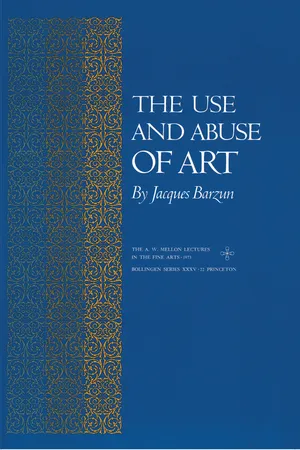
In this witty, provocative, and learned book, acclaimed cultural historian and writer Jacques Barzun traces our changing attitudes to the arts over the past 150 years, suggesting that we are living in a period of cultural liquidation, nothing less than the ending of the modern age that began with the Renaissance. He challenges our conceptions and misconceptions about art "in order to reach a conclusion about its value and its drawbacks for life at the present time."
- English
- ePUB (mobile friendly)
- Available on iOS & Android
eBook - ePub
The Use and Abuse of Art
About this book
Information
Publisher
Princeton University PressYear
2020Print ISBN
9780691018041
9780691099033
eBook ISBN
9780691216331
Topic
ArtSubtopic
Art Theory & CriticismLecture SIX
Art in the Vacuum of Belief
LADIES AND
GENTLEMEN :
You and I have taken a quick five-hour trip together through a rich country, in which clearings and cultivated lands occur side by side with jungles and swamps, and now the time has come for me to give a synoptic account of the exploration. Your impressions I very much regret that I cannot hear, though perhaps it is better for me that I should not. Your patient listening for one more session will, I hope, be justified by my attempt to bring together some ideas of possible use to you in resolving the large question with which we started: what the use or abuse of art does to life in our time.
I began by citing Nietzsche as a critic who had asked the same question about history, and I end by borrowing from him another convenient phrase about art. The role or purpose of art, said Nietzsche, is to enhance life. In so saying he summed up the whole nineteenth-century outlook which we briefly reviewed. From the Romantics onward, art was supposed to deepen, enrich, distill, refine, ennoble, redeem life. This diversified aim would not be distorted if one said simply that to enhance life is to make people livelier, to increase in them the concentration and force of the vital spirit.
But why should the effort be necessary? What need of art to revigorate mankind? The very definition of life is that it asserts itself. Anything that lives makes a claim on the environment to keep itself going, enable itself to grow. Life has the self-regard and self-confidence needed to seek out and assimilate food, air, sunshine. It surveys the world not with fear sometimes tempered by hope, but with hope sometimes tempered by fear. Life believes in itself first, long before taking thought. Therefore to enhance life through art must mean from the outset to increase hope and self-confidence, to reduce fear and self-doubt, not the reverse.
If art and life are to fulfill these conditions—I say IF this is the program—then looking about us today we must say that life has lost momentum and that art as we find it and use it is not performing as enhancer. Life lacks self-regard and self-assurance and does not provide art with satisfactory material to work on. Art retorts by condemning life, by persecuting any manifestation of self-regard. The net result is: we who make up the contemporary world are not lively—at times, one is tempted to say: not life-like. We are certainly not in love with life. We do not think life can be noble or even good. We take human life and our present view of mankind as equivalents and are not pleased. When we speak of the human condition we mean something execrable, a prison sentence we must endure. We seldom find among men individuals to revere, and we have nothing but scorn for social types, which we now call roles, as if to emphasize their falseness. The very word reverence has come to connote a benighted, “unrealistic” frame of mind. The hero has disappeared from fiction, from history, and from life. Art is largely devoted to showing the contemptibility of the human animal or, by pointedly neglecting him, his irrelevance and superfluity.
Nor is this repudiation directed at the single specimen or type. Art fights just as relentlessly against the large groups, classes, masses, nations and their institutions. The point that our society, our civilization is vicious and absurd is brought out directly as well as by an inversion worthy of the 90s: we are told, namely that aberration, crime, madness, and sloth are the last gestures of reason and virtue, both of them hounded and defeated by things as they are. The monopoly of artistic insight itself is lodged with the mad. As Vladimir Nabokov, at the launching of a new book, said to a reporter: “I have never seen a more lucid, more lonely, better balanced mad mind than mine.” This hardly improvised verdict on himself can cause no surprise; we acquiesce in the artist’s boasting of madness and lucidity together.
But more important than the paradox is the fear behind the pose, the fear of being caught in a belief. Any degree of self-ac-ceptance would be an acknowledgement of the power of life, with all the risks involved. Lucid mind and mad mind and the merit of loneliness are claimed so as to hedge a poor bet. This shuffling stance is not new, and judging from its frequency among our aristoi, not easily avoidable. It marks the supreme degree of self-consciousness, which has become the ruling passion: the mind automatically rejects anything that might imply confidence, much less self-confidence. Now confidence is a word built on the root meaning faith; absence of faith, its studied rejection, is the warrant for my calling our peculiar situation a vacuum of belief. It differs radically from the old sorrow at the loss of a common underlying belief; it is not the distress of facing a chaos of warring beliefs; it is not a painful skepticism about a remnant of strong beliefs; it is the inbred avoidance of the risks inherent in any beliefs; it is a flight from the sensation of belief—and therefore from life itself.
The forces that have produced this void are many, but as I hope to have persuaded you, art has been their most powerful medium. Deepening and spreading self-consciousness by analysis and corrosion has been the function of modern art that made me call it a destroyer. It was then clear why art could not cure the wound it sedulously kept open. Art is not a religion; it cannot make promises of grace, or fulfill them if it made them. Art is of this world, and though it is creative and formative in the exact sense of those words, it is also reflexive. In some fashion, crude or fine, it reenacts our lives—the hidden life, or the public life, or the collective life. As Henry James said: “art is our flounderings shown.” And in the light of contemporary art one must even say: our flounderings shown up.
That invidious, resentful relation of art to life has become general and unremitting. It obtains even when it is not immediately visible; and it dominates the field through a division of labor. Not all artists reflect all of contemporary life. Some, for example, respond to the dwarfing of man under mass civilization by banning the lovable from all fictions. Others respond to diagrammatic science by painting esoteric rectangles or revolting parodies of anatomical specimens. Still others pick up the refuse of practical life and shove it under our noses. The reflex, as I have termed it, is by no means always literal and by definition it is only in part deliberate. The reality, whatever it may be, palpable or invisible, goes into the eye or the mind’s eye and comes out as work of art. The conscious mind of the maker may have found his governing principle in technique or in the work of others or in political or sociological doctrine—no matter: the origins are in some portion of common experience. Art re-exhibits it in some mood—anger, contempt, derision, indignation or no less eloquent impassivity. Art knows best what we are like. A particular work or artist may err, especially about details, but art as a whole works its will on its contemporaries by using their helpless disclosures as evidence against them.
Such is the setting for the present conflict between art and life. In describing it as I have done, it may seem that I am contradicting myself. After demonstrating through five lectures that art has been moulding the receptive spirits to its own pattern, I am now saying that these same spirits have been the unconsciously determining element in the animus of art against the world. Both statements are true; there is no contradiction. Art and the world are conditions and consequences of each other. Art imitates nature and nature imitates art. The wedded life of art and society is the union we call by the single name of culture, and it is the possibility of considering it now from the side of action or life and now from the side of reflection or art that gives meaning to my theme—the uses of art. Because among us art and society are at odds yet mutually dependent, each can disturb and modify the other. Modern architecture and the huge city form one obvious example. The tall building makes for the large city and becomes its symbol. Then the large city revolts and decries the tall building as inhuman and its influence as coercive. Ways are sought to combat the influence and rehumanize the city. But it is the same men who make and use the architecture, overuse it, and end by decreeing its disuses, as by zoning.
In the arts that express more than gregarious or practical desire, the interaction may not find any limits—any zoning. That is why, in the time that remains to us, I want to define some uses of art that you may think amount to an abuse. These and their opposites constitute a sketch—the first so far as I know—of a general theory for the institution of art.
As I promised at the outset, I shall as far as possible frame my suggestions in the hypothetical form “if-then,” thus leaving you free to decide what you wish to see happening in art and society conjoined. This very idea that you have a choice may strike you as fantasy. You doubtless believe that you submit to whatever art blows your way as you do to wind and weather. But if you ask an artist he will not agree with you. He will maintain that he submits to your caprice—or more politely to your taste. He will ascribe to your insensibility, ignorance, and stiff-jointed habits the resistance he feels to his creative will. He blames you for plans defeated by prejudice and works blemished by compromise. He thinks, in short, that you are the sieve of natural selection which determines the survival of contemporary works, schools, and men.
He is right to give greater weight to opinion than you as an isolated member of the public are disposed to grant. Yet though you never feel its force or its absence, nothing kills or promotes quicker than the word-of-mouth. The gross example is of course the best-seller, but the same mechanism is at work in the most offtrack circle. Its most frequent effect is that of artistic rehabilitations. In my time I have seen Mozart and Henry James lifted from the status of empty, frivolous virtuosos to that of great and deep geniuses; El Greco rescued from a negligible place as a baroque artist; Berlioz raised from grudging toleration to the highest eminence; Italian opera recognized as permissible to attend; and the Cubists credited with sole seminal power in our century. All these conclusions began by being ideas in solitary minds, lone dissenters from the crowd. It follows that what you think—what you decide and keep firmly in mind is of the utmost importance. Before you know it, your conviction comes out in attitudes and words, which in turn start echoes and arguments distant from your own corner, and after that anything may ensue. The incalculable upshot of encounters among public thoughts, the side-effects of boredom and novelty-seeking, the defeats and victories of ideas relevant and irrelevant—all these produce alterations and fixities in what is finally summed up as the temper of the age.
Begin with a simple situation directly related to our main subject: the Supreme Court in its decisions on pornography expects us in effect to decide between what is obscene and what is art. The criterion is: redeeming social value. If you hold clear ideas of art as redeeming, through either its spiritual or its revolutionary force; and if you have made up your mind what the purpose is of depicting sex, or of depicting it in certain ways; and if your reason and feelings agree about the quality of speech you want from literature and drama, then you can begin to decide the question put to you by the Supreme Court. It is put to you individually in the sense that the standards of the community are invoked as guides to what is socially redeeming. I need not labor the point that if you never trouble to think about art in society or about the way art reflects and moulds the feelings of living men, your judgment on a piece of pornography is no judgment at all, but a superstition or a thought-cliché. Its being favorable or unfavorable leaves things as they are.
Next, let us consider the matter of style. It is odd that the principal use we make of the word is in the phrase “lifestyle.” The term rarely refers to art with its former honorific value, as in “this work has style.” It is used merely to mark small differences in a person’s mode of life, with no suggestion of special merit or quality. In culture at large, it is a long time since a single style has prevailed in any art. These facts pose one of our hypothetical questions: if a period lacks its own style, as well as a sense of style, then the sum of art produced will probably not exert any clear or subtle influence. The influence is scattered; the scattering bewilders. The observer, no matter how devoted or intelligent, has to make a continual effort to re-unify divergent impressions in his sensibility and thus waste a part of his power of attention, his readiness to absorb, his intake of pleasure.
What is more, the general attitude towards art gradually deviates from intimacy to curiosity. One surveys, explores, collects, and thence, by necessity, one studies—which may not be the best way to receive the ineffable messages of art. The advantage of having the art of one’s own time concentrated through one style—or one dominant and one upstarting—is that it heightens the sense of collective power and achievement. There is nothing like fresh art—or fresh eggs—to enhance the belief in life. New art, assimilable while still new, makes the beholder feel possessive about the whole effort of art; he learns its peculiarities and innovations by osmosis rather than brainsweat; he fights his immediate cultural ancestors with the support of the geniuses who create the new art, and he takes sides among these creators on the strength of subtle differences that affect not merely eye and memory, but heart and spirit, too; these differences become part of his mundane convictions and habits. In a word, the association of art with life is close and continuous, as it was for the generations before 1920 when the dam broke and styles, periods, fashions, avant-gardes, and retrogressions mingled in one flood.
If collective enthusiasm for contemporary art is desired, then some stylistic clustering and some steadiness in production are required. Freedom and variety are not excluded, but the battle at least is joined and intelligible, as it cannot be in a melée. Remember how much we now face: all the classics from the caveman onward, all the moderns from the last century onward, and all the styles of all the tribes brought from the ends of the earth westward. The succession and simultaneity of avant-gardes form a jungle in which all but Mowgli and Tarzan lose their way.
The disposition we make of the classics, I shall deal with in a moment as being peculiar and indicative of our state. Tribal art, of course, necessarily lacks the immediacy afforded by one’s own style. We think we experience the primitive with our full esthetic powers and the rich background of western art, but a multitude of ideas and feelings elude us which are in fact relevant. To Picasso African sculpture meant novelty of form and line. But that limited intake, which sufficed for his technical purposes, is the very thing that dehydrates much of the modern artistic experience, making it a game of forms and schemes. My authority for this complaint is Picasso himself. He often denied that the artist is only a talented organ of sight. He also protested against our prevailing use of art: “painting is not done to decorate apartments.” And he concluded: “It is an instrument of war for attack and defense against the enemy.” The upshot would seem to be discomfiture for all three parties—the formalist, the man who loves nice things, and the bedeviled social enemy. The profusion of styles tends to foster discontent instead of nourishing the spirit.
Notice as a further point that lacking a single style it is virtually impossible to have public ceremonies. The Greek and Roman and Medieval festivals caused no disgust and recriminations about style. Ours do, being either “corny” or “unsuitable.” The French revolution managed fairly well, and so did the nineteenth century until 1848. After that the only examples of a gregarious style are the Rock camp meetings, and they are far from giving all parts of the population equal satisfaction. If any society wants a different state of things, it will have to demand it. I do not recommend the search for a communal art. I merely say that it is possible to do something other than encourage whatever offers itself and multiply whatever we already have. There may be such a thing as an Ecology of art. The great historian Nikolaus Pevsner made that point about architecture when he said: “The guardian of the aesthetics of architecture is the architect. The guardian of the functional satisfaction is the client. ... If out of muddleheadedness, out of laziness, out of initial ignorance, he fails, the building will be an annoyance, and the architect will (in my opinion wrongly) be reproached.”
The difficulty is to know how “function” is to be defined and success measured in arts other than architecture. Earlier ages had more self-assurance. Lord Chesterfield, Dr. Johnson, Ruskin, Morris, Shaw knew what art was for and got many to agree with them. At the present time a number of contradictory positions occupy the field without generating public belief: under “formalist” tolerance, there are not even any instructive struggles between schools. The positions can be briefly put as follows:
| Art better than life | (a truer reality, a divine realm) |
| Art for a better life | (revolutionary art) |
| Art for a natural life | (spontaneous, primitive, improvisatory, disposable art) |
If we classify by use rather than by aim or function, we get another triad:
Art a sanctuary for life
Art the enhancer of life
Art the detergent of life
Sanctuary and enhancement are roles played for us largely by the classics. Contemporary art deterges. The resulting choices are numerous and complex. If we adopt Picasso’s formula of art as a weapon to fight the enemy and the enemy turns out to be the public as a whole, the first question is how long the surgery—not to say butchery—ought to last. If we need to be shaken and shattered, if we go to the artist in order to face again and again what an enthusiast of Ezra Pound’s called “his celestial sneer,” then it is proper to inquire how the treatment is succeeding. The object presumably is to cure the beholder of his detestable complacency and materialism. (There is about this purpose a curious air of Victorian moralism, scarcely brought up to date.) Yet the cure is to offer him in visual or imaginative shape nothing but visions of deformity. He naturally identifies himself with the misshapen and the malcontented that (says Art) is the way he is. No doubt, but it ought not to cause surprise that the patient continues deformed and malcontent. Add the angry artist’s will to humiliate as he teaches, and you perceive why the process has no end—or rather, it ends in a higher complacency, the complacency of the hopeless. Stubborn or shattered, the spirit resigns itself to its flaws and wounds after hearing them incessantly denounced as incurable. As between artist and society the conflict is a stalemate.
If the deadlock is to be broken, a moratorium will have to be declared on demonstrations of sin and guilt—or at least a little freshness introduced into the routine. The same holds for the related “lesson” that teaches the virtue of pure sensation. If the western world does not know by now that bright unmixed colors are wonderful, and subtle gradations as well; and if it does not know that words have resonances apart from meaning and that the mind is a stream of consciousness and that music started by knocking or rubbing objects together, it will never learn: it is a dunce not worth bothering with. Life is too short and art too long to carry the show any further with the same stance and grimace. It is more than 50 years since Breton and the Surrealists held up placards advertising all this above the general greeting: “Tas d'idiots!” (Bunch of idiots!) How long are such idiotic idiots worth working over?
If the rejoinder is that these lessons have their use as exercises, keeping us in trim long after we have assimilated the idea, then the demand ought to be for a more lively textbook. The lessons have grown dull by overuse and some of the tricks were fatuous to begin with. The varia...
Table of contents
- Cover Page
- Title Page
- Copyright Page
- Contents
- One: Why Art Must Be Challenged
- Two: The Rise of Art as Religion
- Three: Art the Destroyer
- Four: Art the Redeemer
- Five: Art and Its Tempter, Science
- Six: Art in the Vacuum of Belief
Trusted by 375,005 students
Access to over 1.5 million titles for a fair monthly price.
Study more efficiently using our study tools.
Frequently asked questions
Yes, you can cancel anytime from the Subscription tab in your account settings on the Perlego website. Your subscription will stay active until the end of your current billing period. Learn how to cancel your subscription
No, books cannot be downloaded as external files, such as PDFs, for use outside of Perlego. However, you can download books within the Perlego app for offline reading on mobile or tablet. Learn how to download books offline
Perlego offers two plans: Essential and Complete
- Essential is ideal for learners and professionals who enjoy exploring a wide range of subjects. Access the Essential Library with 800,000+ trusted titles and best-sellers across business, personal growth, and the humanities. Includes unlimited reading time and Standard Read Aloud voice.
- Complete: Perfect for advanced learners and researchers needing full, unrestricted access. Unlock 1.5M+ books across hundreds of subjects, including academic and specialized titles. The Complete Plan also includes advanced features like Premium Read Aloud and Research Assistant.
We are an online textbook subscription service, where you can get access to an entire online library for less than the price of a single book per month. With over 1.5 million books across 990+ topics, we’ve got you covered! Learn about our mission
Look out for the read-aloud symbol on your next book to see if you can listen to it. The read-aloud tool reads text aloud for you, highlighting the text as it is being read. You can pause it, speed it up and slow it down. Learn more about Read Aloud
Yes! You can use the Perlego app on both iOS and Android devices to read anytime, anywhere — even offline. Perfect for commutes or when you’re on the go.
Please note we cannot support devices running on iOS 13 and Android 7 or earlier. Learn more about using the app
Please note we cannot support devices running on iOS 13 and Android 7 or earlier. Learn more about using the app
Yes, you can access The Use and Abuse of Art by Jacques Barzun in PDF and/or ePUB format, as well as other popular books in Art & Art Theory & Criticism. We have over 1.5 million books available in our catalogue for you to explore.