The description for this book, The Rise and Fall of the New Deal Order, 1930-1980, will be forthcoming.
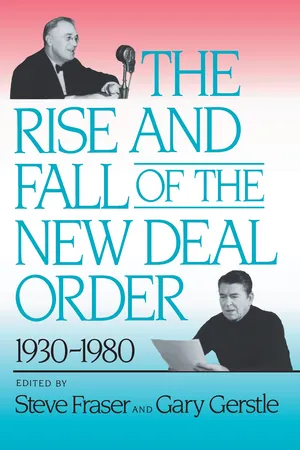
eBook - ePub
The Rise and Fall of the New Deal Order, 1930-1980
- English
- ePUB (mobile friendly)
- Available on iOS & Android
eBook - ePub
The Rise and Fall of the New Deal Order, 1930-1980
About this book
Information
Publisher
Princeton University PressYear
2020Print ISBN
9780691006079
9780691047614
eBook ISBN
9780691216256
PART I
The New Deal Political Order: Emergence and Crystallization, 1929–1960
1
Industrial Conflict and the Coming of the New Deal: The Triumph of Multinational Liberalism in America
THOMAS FERGUSON
IN OCTOBER 1929, the stock market crashed. Over the next few months the market continued dropping, and a general economic decline took hold. As sales plummeted, industry after industry laid off workers and cut wages. Farm and commodity prices tumbled, outpacing price declines in other parts of the economy. A tidal wave of bankruptcies engulfed businessmen, farmers, and a middle class that had only recently awakened to the joys of installment buying.
While the major media, leading politicians, and important businessmen resonantly reaffirmed capitalism’s inherently self-correcting tendency, havoc spread around the world. By 1932, the situation had become critical. Many currencies were floating and international finance had virtually collapsed. World trade had shrunk to a fraction of its previous level. In many countries one-fifth or more of the work force was idle. Homeless, often starving, people camped out in parks and fields, while only the virtual collapse of real-estate markets in many districts checked a mammoth liquidation of homes and farms by banks and insurance companies.
In this desperate situation, with regimes changing and governments falling, a miracle seemed to occur in the United States, the country that, among all the major powers in the capitalist world economy, had perhaps been hit hardest. Taking office at the moment of the greatest financial collapse in the nation’s history, President Franklin D. Roosevelt initiated a dazzling burst of government actions designed to square the circle that was baffling governments elsewhere: how to enact major social reforms while preserving both democracy and capitalism. In a hundred days his administration implemented a series of emergency relief bills for the unemployed; an Agricultural Adjustment Act for farmers; a bill (the Glass-Steagall Act, also sometimes referred to as the “Banking Act of 1933”) to “reform” the banking structure; a Securities Act to reform the Stock Exchange; and the National Industrial Recovery Act, which in effect legalized cartels in American industry. Roosevelt suspended the convertibility of the dollar into gold, abandoned the gold standard, and enacted legislation to promote American exports. He also presided over a noisy public investigation of the most famous banking house in the world: J. P. Morgan & Co.
For a while this “first New Deal” package of policies brought some relief, but sustained recovery failed to arrive and class conflict intensified. Two years later, Roosevelt scored an even more dramatic series of triumphs that consolidated his position as the guardian of all the millions, both people and fortunes. A second period of whirlwind legislative activity produced the most important social legislation in American history—the Social Security and Wagner acts—as well as measures to break up public utility holding companies and to fix the price of oil. The president also turned dramatically away from his earlier economic nationalism. He entered into agreements with Britain and France informally to stabilize the dollar against their currencies and began vigorously to implement earlier legislation that empowered Secretary of State Cordell Hull to negotiate a series of treaties reducing U.S. tariff rates.1
After winning one of the most bitterly contested elections in American history by a landslide (and giving the coup de grace to the old Republican-dominated “System of ’96”), Roosevelt consolidated the position of the Democrats as the new majority party of the United States.2 He passed additional social welfare legislation and pressured the Supreme Court to accept his reforms. Faced with another steep downturn in 1937, the Roosevelt team confirmed its new economic course. Rejecting proposals to revive the National Recovery Administration (NRA) and again devalue the dollar, it adopted an experimental program of conscious “pump priming,” which used government spending to prop up the economy in a way that foreshadowed the “Keynesian” policies of demand management widely adopted by Western economies after 1945. This was the first time this had ever been attempted—unless one accepts the Swedish example, which was virtually contemporaneous.3
Roosevelt and his successive New Deals have exercised a magnetic attraction on subsequent political analysts. Reams of commentary have sought to elucidate what the New Deal was and why it evolved as it did. But while the debate has raged for over forty years, little consensus exists about how best to explain what happened.
Many analysts, including most of those whose major works shaped the historiography of the last generation, have always been convinced that the decisive factor in the shaping of the New Deal was Franklin D. Roosevelt himself.4 They hail his sagacity in fashioning his epoch-making domestic reforms. They honor his statecraft in leading the United States away from isolationism and toward Atlantic Alliance. And they celebrate the charisma he displayed in recruiting millions of previously marginal workers, blacks, and intellectuals into his great crusade to limit permanently the power of business in American life.
Several rival accounts now compete with this interpretation. As some radical historians pose the problem, only Roosevelt and a handful of advisers were farsighted enough to grasp what was required to save capitalism from itself.5 Accordingly, Roosevelt engineered sweeping attacks on big business for the sake of big business’s own long-run interest. (A variation on this theme credits the administration’s aspirations toward reform but points to the structural constraints capitalism imposes on any government as the explanation for the New Deal’s conservative outcome.)
Another recent point of view explains the New Deal by pointing to the consolidation and expansion of bureaucratic institutions. It deemphasizes Roosevelt as a personality, along with the period’s exciting mass politics. Instead, historians like Ellis Hawley (in his latest essays) single out as the hallmarks of the New Deal the role of professionally certified experts, and the advance of organization and hierarchical control.6
Some of these arguments occasionally come close to the final current of contemporary New Deal interpretation. This focuses sharply on concrete interactions between polity and economy (rather than bureaucracy per se) in defining the outcome of the New Deal. Notable here are the (mostly West German) theorists of “organized capitalism,” several different versions of Marxist analysis, right-wing libertarian analysts who treat the New Deal as an attempt by big business to institutionalize the corporate state, and Gabriel Kolko’s theory of “political capitalism.”7
These newer approaches provide telling criticisms of traditional analyses of the New Deal. At the same time, however, they often create fresh difficulties. “Organized capitalism,” “political capitalism,” or the libertarian “corporate state” analyses, for example, are illuminating with respect to the universal price-fixing schemes of the NRA. But the half-life of the NRA was short even by the admittedly unstable standards of American politics. The historic turn toward free trade that was so spectacularly a part of the later New Deal is scarcely compatible with claims that the New Deal institutionalized the collective power of big business as a whole, and it is perhaps unsurprising that most of this literature hurries over foreign economic policy. Nor are more than token efforts usually made to explain in detail why the New Deal arrived in its classic post-1935 form only after moving through stages that often seemed to caricature the celebrated observation that history proceeds not along straight lines but in spirals. It was, after all, a period in which the future patron saint of American Internationalism not only raised more tariffs than he lowered but also openly mocked exchange-rate stability and the gold standard, promoted cartelization, and endorsed inflation.8 Similarly, theorists who treat the New Deal chiefly as the bureaucratic design of credentialed administrators and professionals not only ignore the significance of this belated opening to international trade in the world economy, but they also do less than full justice to the dramatic business mobilization and epic class conflicts of the period.
Nor do any of these accounts provide a credible analysis of the Democratic party of the era. Then, as now, the Democratic party fits badly into the boxes provided by conventional political science. On the one hand, it is perfectly obvious that a tie to at least part of organized labor provides an important element of the party’s identity. But on the other, it is equally manifest that no amount of co-optation accounts for the party’s continuing collateral affiliation with such prominent businessmen as, for example, Averell Harriman. Why, if the Democrats truly constituted a mass labor party, was the outcome of the New Deal not more congruent with the traditional labor party politics of Great Britain and Germany? And, if the Democratic party was not a labor party, then what force inside it was powerful enough to contain the CIO and simultaneously launch a sweeping attack on major industrial interests? These analyses also slip past the biggest puzzle that the New Deal poses. They offer few clues as to why some countries with militant labor movements and charismatic political leaders in the depression needed a New Order instead of a New Deal to control their work force.
In this essay I contend that a clear view of the New Deal’s world historical uniqueness and significance comes only when one breaks with most of the commentaries of the last thirty years, goes back to primary sources, and attempts to analyze the New Deal as a whole in the light of industrial structure, party competition, and public policy. Then what stands out is the novel type of political coalition that Roosevelt built.9 At the center of this coalition, however, are not the workers, blacks, and poor who have preoccupied liberal commentators, but something else: a new “historical bloc” (in Gramsci’s phrase) of capital-intensive industries, investment banks, and internationally oriented commercial banks.
This new kind of power bloc constitutes the basis of the New Deal’s great and, in world history, utterly unique achievement: its ability to accommodate millions of mobilized workers amid world depression. Because capital-intensive firms use relatively less direct human labor (and that often professionalized and elaborately trained), they were less threatened by labor turbulence. They had the space and the resources to envelop, rather than confront, their work force. In addition, with the momentous exception of the chemical industry, these capital-intensive firms were both world and domestic leaders in their industries. Consequently, they stood to gain from global free trade. They could, and did, ally with important international financiers, whose own minuscule work forces presented few sources of tension and who had for over a decade supported a more broadly international foreign policy and the lowering of traditionally high American tariffs.
THE RISE OF THE MULTINATIONAL BLOC, 1918–1929
At the center of the Republican party during the System of ’96 was a massive bloc of major industries, including steel, textiles, coal, and, less monolithically, shoes, whose labor-intensive production processes automatically made them deadly enemies of labor and paladins of laissez-faire social policy.10 While a few firms whose products dominated world markets, such as machinery, agitated for modest trade liberalization (aided occasionally by other industries seeking specific export advantages through trade treaties with particular countries), insistent pressures from foreign competitors led most to the ardent promotion of high tariffs.11
Integral to this “National Capitalist” bloc for most of the period were investment and commercial bankers. They had abandoned the Democrats in the 1890s when “Free Silver” and Populist advocates briefly captured the party. The financiers’ massive investments in the mid-1890s and after, in huge trusts that combined many smaller firms, gave them a large, often controlling, stake in American industry, and brought them much closer to the industrialists (especially on tariffs, which Gold ...
Table of contents
- Cover Page
- Title Page
- Copyright Page
- Dedication
- Contents
- Introduction: Gary Gerstle and Steve Fraser
- Part I: The New Deal Political Order: Emergence and Crystallization, 1929–1960
- Part II: The New Deal Political Order: Decline and Fall, 1960–1980
- Epilogue: Steve Fraser and Gary Gerstle
- List of Contributors
- Index
Trusted by 375,005 students
Access to over 1.5 million titles for a fair monthly price.
Study more efficiently using our study tools.
Frequently asked questions
Yes, you can cancel anytime from the Subscription tab in your account settings on the Perlego website. Your subscription will stay active until the end of your current billing period. Learn how to cancel your subscription
No, books cannot be downloaded as external files, such as PDFs, for use outside of Perlego. However, you can download books within the Perlego app for offline reading on mobile or tablet. Learn how to download books offline
Perlego offers two plans: Essential and Complete
- Essential is ideal for learners and professionals who enjoy exploring a wide range of subjects. Access the Essential Library with 800,000+ trusted titles and best-sellers across business, personal growth, and the humanities. Includes unlimited reading time and Standard Read Aloud voice.
- Complete: Perfect for advanced learners and researchers needing full, unrestricted access. Unlock 1.5M+ books across hundreds of subjects, including academic and specialized titles. The Complete Plan also includes advanced features like Premium Read Aloud and Research Assistant.
We are an online textbook subscription service, where you can get access to an entire online library for less than the price of a single book per month. With over 1.5 million books across 990+ topics, we’ve got you covered! Learn about our mission
Look out for the read-aloud symbol on your next book to see if you can listen to it. The read-aloud tool reads text aloud for you, highlighting the text as it is being read. You can pause it, speed it up and slow it down. Learn more about Read Aloud
Yes! You can use the Perlego app on both iOS and Android devices to read anytime, anywhere — even offline. Perfect for commutes or when you’re on the go.
Please note we cannot support devices running on iOS 13 and Android 7 or earlier. Learn more about using the app
Please note we cannot support devices running on iOS 13 and Android 7 or earlier. Learn more about using the app
Yes, you can access The Rise and Fall of the New Deal Order, 1930-1980 by Steve Fraser, Gary Gerstle, Steve Fraser,Gary Gerstle in PDF and/or ePUB format, as well as other popular books in History & North American History. We have over 1.5 million books available in our catalogue for you to explore.