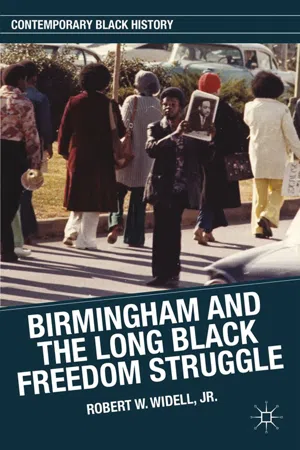
Birmingham, Alabama looms large in the history of the twentieth-century black freedom struggle, but to date historians have mostly neglected the years after 1963. Here, author Robert Widell explores the evolution of Birmingham black activism into the 1970s, providing a valuable local perspective on the "long" black freedom struggle.
- English
- ePUB (mobile friendly)
- Available on iOS & Android
eBook - ePub
Birmingham and the Long Black Freedom Struggle
About this book
Information
Notes
Introduction
1.Carl Braden, “Labor and Civil Rights Joined: Birmingham Movement Grows,” Southern Patriot, September 1972, 1; Portions of the introduction and section IV of this book appeared previously in Robert W. Widell, Jr., “‘The Power Belongs to Us and We Belong to the Revolutionary Age’: The Alabama Black Liberation Front and the Long Reach of the Black Panther Party” in Jama Lazerow and Yohuru Williams, eds., Liberated Territory: Untold Local Perspectives on the Black Panther Party (Durham and London: Duke University Press, 2008).
2.Ibid., 7.
3.The events leading up to and surrounding 1963 are described in detail in a number of works. Among the most important are Glenn Eskew, But for Birmingham: The Local and National Movements in the Civil Rights Struggle (Chapel Hill: University of North Carolina Press, 1997); J. Mills Thornton, Dividing Lines: Municipal Politics and the Struggle for Civil Rights in Montgomery, Birmingham, and Selma (Tuscaloosa: University of Alabama Press, 2002); Diane McWhorter, Carry Me Home: Birmingham, Alabama: The Climactic Battle of the Civil Rights Revolution (New York: Simon & Schuster, 2001); Taylor Branch, Parting the Waters: America in the King Years, 1954–1963 (New York: Simon & Schuster, 1988); David J. Garrow, Bearing the Cross: Martin Luther King, Jr. and the Southern Christian Leadership Conference 1955–1968 (New York: W. Morrow, 1986); Garrow, ed. Birmingham, Alabama, 1956–1963: The Black Struggle for Civil Rights (Brooklyn: Carlson, 1989); Andrew Manis, A Fire You Can’t Put Out: The Civil Rights Life of Birmingham’s Reverend Fred Shuttlesworth (Tuscaloosa: University of Alabama Press, 2000).
4.There are works that discuss post-1963 Birmingham but none that focus on that period and its connection to the movement. Eskew’s treatment of the period is an epilogue and relies mainly on census data from 1980 to make its assessment. His central focus, of course, is the 1963 demonstrations so the point is not to fault his work, but rather to simply note what it does not address. Eskew, But for Birmingham; Thornton, too, includes some discussion of post-1963 Birmingham, but his interest after about 1966 is primarily in electoral politics. Thornton, Dividing Lines; Much of Jimmie Lewis Franklin’s biography of Richard Arrington is set in post-1963 Birmingham, but it is centered, necessarily, on Arrington. Robin D. G. Kelley has published two chapters on black activism in Birmingham that extend into this period, but although they are largely correct in their characterization, they are not full-length studies. See Jimmie Lewis Franklin, Back to Birmingham: Richard Arrington, Jr. and His Times (Tuscaloosa: University of Alabama Press, 1989); Robin D. G. Kelley, “Birmingham’s Untouchables: The Black Poor in the Age of Civil Rights,” in his Race Rebels: Culture, Politics, and the Black Working Class (New York: Free Press, 1994), 77–100; Kelley, “The Black Poor and the Politics of Opposition in a New South City, 1929–1970,” in Michael B. Katz, ed., The Underclass Debate: Views from History (Princeton: Princeton University Press, 1993), 293–333.
5.On the Arrington campaign and its effect on the black community, see Franklin, Back to Birmingham, esp. 144.
6.Braden, “Birmingham Movement Grows,” 7.
7.Jeanne Theoharis, for example, has noted the ways in which the Birmingham campaign overlapped with and offered inspiration to the civil rights movement in Los Angeles. Jeanne Theoharis, “Alabama on Avalon: Rethinking the Watts Uprising and the Character of Black Protest in Los Angeles,” in Peniel Joseph, ed., The Black Power Movement: Rethinking the Civil Rights-Black Power Era (New York: Routledge, 2006).
8.Eskew, But for Birmingham, Chapter 9; idem., “‘The Classes and the Masses’: Fred Shuttlesworth’s Movement and Birmingham’s Black Middle Class,” in Marjorie L. White and Andrew M. Manis, eds., Birmingham Revolutionaries: The Reverend Fred Shuttlesworth and the Alabama Christian Movement for Human Rights (Macon, GA: Mercer University Press, 2000); Manis, A Fire You Can’t Put Out, 397, including note 12.
9.The best source for exploring the intersection of the national and local movements in 1963 is Eskew, But for Birmingham. On the limit...
Table of contents
- Cover
- Title
- Introduction “To Stay and Fight”: Birmingham’s Civil Rights Story and Twentieth-Century Black Protest
- Section I Implementation
- Section II Familiar Issues, New Directions
- Section III A New “Civil Rights Unionism”
- Section IV Black Power in the Deep South
- Conclusion The “Long” Movement and the South
- Notes
- Bibliography
- Index
Trusted by 375,005 students
Access to over 1.5 million titles for a fair monthly price.
Study more efficiently using our study tools.
Frequently asked questions
Yes, you can cancel anytime from the Subscription tab in your account settings on the Perlego website. Your subscription will stay active until the end of your current billing period. Learn how to cancel your subscription
No, books cannot be downloaded as external files, such as PDFs, for use outside of Perlego. However, you can download books within the Perlego app for offline reading on mobile or tablet. Learn how to download books offline
Perlego offers two plans: Essential and Complete
- Essential is ideal for learners and professionals who enjoy exploring a wide range of subjects. Access the Essential Library with 800,000+ trusted titles and best-sellers across business, personal growth, and the humanities. Includes unlimited reading time and Standard Read Aloud voice.
- Complete: Perfect for advanced learners and researchers needing full, unrestricted access. Unlock 1.5M+ books across hundreds of subjects, including academic and specialized titles. The Complete Plan also includes advanced features like Premium Read Aloud and Research Assistant.
We are an online textbook subscription service, where you can get access to an entire online library for less than the price of a single book per month. With over 1.5 million books across 990+ topics, we’ve got you covered! Learn about our mission
Look out for the read-aloud symbol on your next book to see if you can listen to it. The read-aloud tool reads text aloud for you, highlighting the text as it is being read. You can pause it, speed it up and slow it down. Learn more about Read Aloud
Yes! You can use the Perlego app on both iOS and Android devices to read anytime, anywhere — even offline. Perfect for commutes or when you’re on the go.
Please note we cannot support devices running on iOS 13 and Android 7 or earlier. Learn more about using the app
Please note we cannot support devices running on iOS 13 and Android 7 or earlier. Learn more about using the app
Yes, you can access Birmingham and the Long Black Freedom Struggle by Kenneth A. Loparo,Robert W. Widell, Jr. in PDF and/or ePUB format, as well as other popular books in History & Modern History. We have over 1.5 million books available in our catalogue for you to explore.