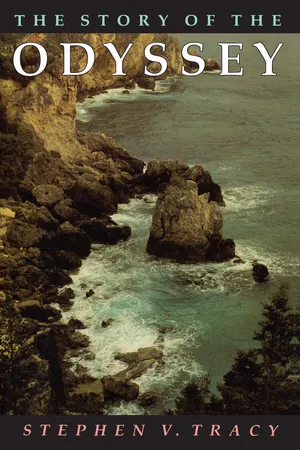
Here Stephen Tracy offers a vivid, fast-paced narrative that serves as a reading guide to Homer's monumental epic. He not only provides translations of key passages and traces the evolution of major themes in the Odyssey, but also helps new readers to understand the artistry of one of the best tales ever told. Aimed at advanced readers as well, this book stresses an appreciation of how Homer has ordered his narrative, covering such topics as character interaction, family relationships, elements of poetic language, and the symbolic treatment of death, rebirth, growth, and knowledge. Given the controversy over the way the Odyssey was composed and handed down, Tracy concentrates on presenting the poem as a highly unified work. His analysis of the narrative structure reveals the epic to be arranged as a series of parallel journeys. The journey, seen here as a symbol of growth and self-knowledge, is among the major themes discussed in detail, along with the importance of women as overseers of life's journeys and the need for the sons of heroes to grow up worthy of their fathers.
THE FIRST FOUR books of the Odyssey deal with Telemachus, the son of the hero. They come, or should come, as a considerable surprise to anyone encountering the poem for the first time. The title of the poem in Greek, Odysseia, means story of Odysseus and surely leads us to expect to meet right from the opening the hero whose name graces the title. Homer clearly took some pleasure as a poetic craftsman in postponing for four books the entrance of his hero. It is a tour de force surpassed only by the Iliad, where he introduces Achilles and then removes him for two-thirds of the poem, yet still manages to make the entire epic center on the absent hero. Once we get over our surprise, we should realize with delight what an effective beginning these four books make.
They present to us in the most vivid terms Ithaca, Odysseus’ goal, and the dire need for him at home. His wife besieged with suitors, his son disconsolate, his father withdrawn to the country in grief—his entire house threatens to fall. This is the background for Odysseus’ tale. This tetrad then establishes in a leisurely fashion several of the major themes of the poem, freeing the poet when he gets to Odysseus to concentrate on the hero. These themes are primarily the need for the sons of heroes to grow up worthy of their fathers, eating/drinking (especially in the context of entertaining guests) as a touchstone of behavior, and the journey as a symbol of growth.
In Telemachus’ search for knowledge of his father, the journey also soon becomes a metaphor for the search for identity. Telemachus begins by seeking news of his father, whether he is alive or not, but ends by gaining understanding of his father. Since to the Greeks one’s father in particular determines one’s identity—their very habit of name-giving (i.e., one is always “so and so, son of so and so”) reveals how ingrained in their psyche this thought pattern was—knowledge of one’s father becomes ultimately self-knowledge; by knowing his father Telemachus will know himself. Odysseus’ journeys, though more extreme, are also ones of selfdiscovery. Odysseus comes to understand who he is, in the sense of what it means to be a man and to die. He comes, as we shall see, to understand his mortality.
At the beginning, Telemachus in Ithaca keeps company with the unruly suitors who, by their constant feasting, are literally devouring Odysseus’ household. In terms of eating and drinking Telemachus has no positive role model at home and must journey outside to learn proper behavior. It is no accident, then, that he finds Nestor sacrificing and Menelaos celebrating a wedding feast, two of the most important occasions for feasting in the ancient world. These contemporaries of his father, then, give Telemachus proper models of behavior but just as importantly they give him firsthand experience of his father’s world. Menelaos in particular has experienced a return very similar to that of Odysseus. To begin with the son also emphasizes unmistakably that this poem deals with family in its largest sense and in that particularly Mediterranean sense of defining its continuance by male heirs. Sons have paramount importance.1
The gods, Athena first and foremost, take a particular interest in Odysseus and his family. Athena persuades Zeus at the opening of book one to agree to Odysseus’ return; disguised as Mentes and then Mentor, she advises Telemachus on Ithaca and then guides him to Pylos; and, lastly, at the end of book four she reassures Penelope about Telemachus’ safe return. Homer carefully depicts from the opening her concern for Odysseus’ entire family. In the case of Telemachus, Athena instigates action, breaks the impasse caused by his youthful lack of confidence, and guides him a short way. Her departures mark steps in his growing independence.
BOOK ONE
Homer begins his tale rapidly. After a ten-line proem in which he calls upon the Muse to sing the return (nostos) of a hero from Troy who had many adventures, the poet straight away gives his story a divine background (11–95). The first person we hear speaking is Zeus himself (32ff.). What more effective device could there be to persuade us of the importance of the action and the hero than to show the Olympian gods personally involved? Moreover, the use of Zeus allows the poet to be arbitrary without seeming to be. Zeus can bring up any subject he likes. Who would question it? Here he just happens to be thinking about Aigisthos and remarks that men blame the gods, but it is, in fact, they who bring destruction on themselves through their own recklessness. Aigisthos’ death at the hands of Orestes is his example. Homer here, in a seemingly casual manner, introduces the story of Agamemnon, a story that he will use repeatedly as a paradigm of behavior for both Telemachus and Odysseus. He also establishes at the outset the important principle that men are responsible for their actions. We have already had intimations of this from lines 6–9 of the proem, where we learn that Odysseus’ companions died because they ate the cattle of the Sun. It will not be long before we hear about the suitors and their eating habits (91–92). First, however, the story of Odysseus must be set in motion.
Athena takes the opportunity offered by Zeus’ musings about human affairs to bring up Odysseus. See particularly lines 48–49:
(But the heart in me is torn for the sake of wise Odysseus, unhappy man, who still, far from his friends, is suffering.)
The assonance and alliteration on delta and pi sounds in these two lines suggest Athena’s indignation. She tries to put Zeus on the defensive as she closes her speech (60–62) by suggesting with two rhetorical questions that he has it in for Odysseus. Zeus responds (64–65) with two rhetorical questions of his own:
(My child, what sort of word escaped your teeth’s barrier? How could I forget Odysseus the godlike. . . .)
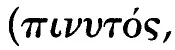
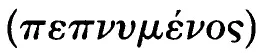
The juxtaposition of the words (Odysseus I) in line 65 suggests hyperbole, i.e., “Me!? Forget Odysseus?!" Zeus then points out what Athena has conveniently omitted, namely that Odysseus is hardly an innocent victim, but has earned Poseidon’s anger by blinding his son, Polyphemos (68–70). Having won the debate, Zeus amiably agrees to plan Odysseus’ return (76–77). Athena can scarcely believe her ears; so the gasping effect of the hiatus in line 83 seems to suggest as she utters the magic words, “Odysseus to return home" 2 She happily proposes that they send Hermes to Calypso and that she go to Ithaca (81–95). Her eagerness is deftly suggested by the fact that she does not wait for a reply at line 96, but immediately puts on her travelling shoes. The interplay between Zeus and Athena in this opening encounter presents us with subtle character drawing and serves notice to the audience that they must be sensitive at all times not only to what is said, but to how it is said; that, as in a drama, the interchange between characters is all-important. It is this aspect of the Odyssey more than any other which gives it its particular richness.3
Athena’s journey shifts the scene to Ithaca, where it remains for the rest of the book. Homer’s narrative art is here at its best. We expect Athena to do something and, since Hermes is to see to Odysseus’ return from Calypso’s island (84–87), it is natural enough that Athena should look after Odysseus’ interests at home in preparation for his return there. Still, we should not miss the fact that Homer now puts the main story of Odysseus on hold to present his son and the situation on Ithaca.
Athena arrives disguised as Mentes to find the suitors preparing for dinner (106–12). She takes along a battle spear, which Homer emphasizes (99–101).
(Then she caught up a powerful spear, edged with sharp bronze, heavy, huge, thick, wherewith she beats down the battalions of fighting men, against whom she of the mighty father is angered.)
This spear suggests the attitude with which she approaches the suitors. They, in turn, are immediately characterized in negative terms by the fact that they loll around “on the hides of cattle which they had killed” (108). To an ancient audience, for whom the consumption of meat, especially beef, came on rare occasions, the suitors’ extravagance would be clear. Homer here introduces a theme that will be developed at length in the poem, namely eating and drinking as a touchstone of behavior. As here, eating and drinking are normally combined with the proper reception and entertaining of guests. In ancient times, as is still true in modern Greece, it was customary first to offer food and drink to a guest before asking him who he is, where he hails from, and so forth. The suitors reveal themselves throughout this first scene as totally wanting in these matters and thus as thoroughly bad.
Homer introduces Telemachus beginning at line 113. He is sitting among the suitors, daydreaming about his father returning to rid the house of them. Suddenly he catches sight of Athena/Mentes standing in the doorway and is embarrassed that a guest should be kept waiting for so long (120). These few lines brilliantly develop the situation. We have the impression that Telemachus regularly, despite his wish to be rid of them, eats with the suitors. His embarrassment suggests that for the first time he feels a responsibility as host and, more to the point, that for the first time he sees the suitors for what they are. His association with them has almost made him neglect a guest, and he now separates himself and his guest from them (132–33). Athena/Mentes reinforces his newly realized perception of the suitors when she comments on their shameless feasting (225–29). Telemachus has begun to come of age.
He is, however, a very disheartened young man who believes his father is dead (161–68) and feels sorry for himself (217–20). Athena’s purpose in her interview with him is to get him moving. She does this by talking with Telemachus about his problems and offering detailed advice. Since we learn specifically at lines 189–90 that his grandfather no longer comes to the palace, we realize that this is the first serious talk he has experienced with an adult male in years. His father, after all, left for Troy when he was a baby. To Telemachus’ initial statement that his father is dead (158ff.), Athena responds that he is alive (196), predicts his return, and, under the guise of asking him if he is Odysseus’ son, notes in complimentary terms that he looks like his father (208–9). Telemachus responds, “My mother says so, but I would rather have been the son of some fortunate man” (215–19). This is an extraordinary denial of his paternity. Athena brushes it aside with a curt statement that the gods have not made his lineage nameless (222–23) and changes the subject to ask about the feast. She notes that any “sensible" man
229) would be outraged at these men. The implication is clear: “stop feeling sorry for yourself and do something about them,” i.e., live up to your epithet “thoughtful"
.4 Telemachus again, almost like a broken record, talks about his father’s death (234–44) and describes the suitors as destroying him by eating up his substance. Athena angrily wishes that Odysseus were present to act. She then gives an account of her first encounter with Odysseus; it is a curious story and clearly made up for this moment. He was on a quest for a man-killing poison to smear on his arrows (260–64). This detail both expresses Athena’s anger at the situation and conveys obliquely to Telemachus the way to deal with such men. She next tells him at length (270–96) what to do, specifically calling for the murder of the suitors (295–96), and ends by reminding him that as a grown man he should seek kleos such as Orestes obtained by killing his father’s murderer (297–302). Kleos (“fame on the lips of men”) is the goal par excellence of heroes;5 her challenge to Telemachus to be a hero like his father is crystal clear. Telemachus cannot fail to understand the explicit advice; to suggest that he has understood things on a more subtle level, Homer makes him comment that Mentes has spoken with kind intention “like a father to his own son” (308). Odysseus, in short, has become a great deal more real to him through this encounter (321–22).
After Athena’s departure, Telemachus acts decisively to-wards his mother and the suitors. These scenes reinforce our sense of his growing maturity. At the same time, they give us our first impression of these important characters. Penelope, heartsick at the absence of Odysseus, comes down from her chamber to ask the singer to sing something else and not “the return” (337ff.). Telemachus, now naming his father for the first time (354)—an emblem of Odysseus’ emerging reality for him—sends her back upstairs to do woman’s work and asserts his power in the household (359). Penelope goes back into the house in amazement (360). Without more ado (368ff.), Telemachus turns to the suitors and tells them that tomorrow he is going to order them out of his house. The suitors, like Penelope, react with wonder (382). Antinoos points out with sneering mockery that Telemachus has spoken so boldly that he fears lest he become king, his right by birth (384–87). The audacity of a pretender to say this to the rightful heir is apparent. In the same vein, the other ringleader of the suitors, Eurymachos, wishes that Telemachus might keep his possessions. The not very veiled threat of this line, line 402, is conveyed admirably in the Greek by the hissing sound of the sigmas.6 He then asks after the stranger and whether there is news of Odysseus’ return (405–8). Telemachus, in what is very Odysseus-like behavior, carefully lies to Eurymachos (412–19), saying that his father’s homecoming is lost and that the stranger claimed to be Mentes. Homer underlines the lie by his comment in line 420 that Telemachus knew in his heart that she was a goddess.
The book closes with Eurykleia, the devoted nurse, putting Telemachus to bed (425–44). Having strongly portrayed rapid growth in Telemachus, Homer draws it ba...
Table of contents
Cover Page
Title Page
Copyright Page
Dedication
Contents
Preface
Introduction
Chapter 1: Books One to Four
Chapter 2: Books Five to Eight
Chapter 3: Books Nine to Twelve
Chapter 4: Books Thirteen to Sixteen
Chapter 5: Books Seventeen to Twenty
Chapter 6: Books Twenty-One to Twenty-Four
Appendix: The Odyssey as the Conclusion to the Story of the Heroes at Troy
Suggestions for Further Reading
Articles and Books Cited
Index
Trusted by 375,005 students
Access to over 1.5 million titles for a fair monthly price.
Study more efficiently using our study tools.
Frequently asked questions
Yes, you can cancel anytime from the Subscription tab in your account settings on the Perlego website. Your subscription will stay active until the end of your current billing period. Learn how to cancel your subscription
No, books cannot be downloaded as external files, such as PDFs, for use outside of Perlego. However, you can download books within the Perlego app for offline reading on mobile or tablet. Learn how to download books offline
Perlego offers two plans: Essential and Complete
Essential is ideal for learners and professionals who enjoy exploring a wide range of subjects. Access the Essential Library with 800,000+ trusted titles and best-sellers across business, personal growth, and the humanities. Includes unlimited reading time and Standard Read Aloud voice.
Complete: Perfect for advanced learners and researchers needing full, unrestricted access. Unlock 1.5M+ books across hundreds of subjects, including academic and specialized titles. The Complete Plan also includes advanced features like Premium Read Aloud and Research Assistant.
Both plans are available with monthly, semester, or annual billing cycles.
We are an online textbook subscription service, where you can get access to an entire online library for less than the price of a single book per month. With over 1.5 million books across 990+ topics, we’ve got you covered! Learn about our mission
Look out for the read-aloud symbol on your next book to see if you can listen to it. The read-aloud tool reads text aloud for you, highlighting the text as it is being read. You can pause it, speed it up and slow it down. Learn more about Read Aloud
Yes! You can use the Perlego app on both iOS and Android devices to read anytime, anywhere — even offline. Perfect for commutes or when you’re on the go. Please note we cannot support devices running on iOS 13 and Android 7 or earlier. Learn more about using the app
Yes, you can access The Story of the Odyssey by Stephen V. Tracy in PDF and/or ePUB format, as well as other popular books in Literature & Ancient & Classical Literary Criticism. We have over 1.5 million books available in our catalogue for you to explore.