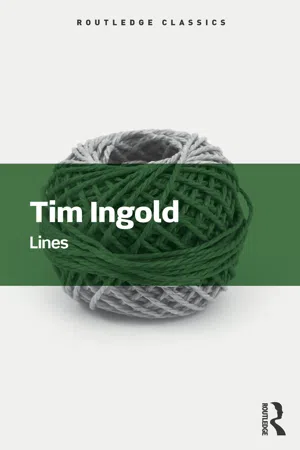
What do walking, weaving, observing, storytelling, singing, drawing and writing have in common? The answer is that they all proceed along lines. In this extraordinary book Tim Ingold imagines a world in which everyone and everything consists of interwoven or interconnected lines and lays the foundations for a completely new discipline: the anthropological archaeology of the line.
Ingold's argument leads us through the music of Ancient Greece and contemporary Japan, Siberian labyrinths and Roman roads, Chinese calligraphy and the printed alphabet, weaving a path between antiquity and the present. Drawing on a multitude of disciplines including archaeology, classical studies, art history, linguistics, psychology, musicology, philosophy and many others, and including more than seventy illustrations, this book takes us on an exhilarating intellectual journey that will change the way we look at the world and how we go about in it.
This Routledge Classics edition includes a new preface by the author.
Songs are thoughts which are sung out with the breath when people let themselves be moved by a great force . .. When the words that we need shoot up of themselves, we have a new song.
Orpingalik, an elder of the Netsilingmiut (Netsilik Eskimo) (cited in Adams 1997: 15)
On the Distinction Between Speech and Song
The problem I seek to resolve in this chapter stems from a puzzle about the distinction, and the relation, between speech and song. Those of us, like myself, brought up in the Western ‘classical' tradition are inclined to contrast these uses of the voice along the axis of a distinction between language and music. When we listen to music, whether vocal or instrumental, it is surely to the sound itself that we attend. And if we were to ask after the meaning of this sound, the answer could only be in terms of the feeling it evokes in us. As musical sound permeates the awareness of listeners, it gives shape or form to their very perception of the world. But most of us, I think, are convinced that when we listen to speech it is quite otherwise. The meanings of spoken words, we say, are to be found neither in their sounds nor in the effects that they have on us. They are rather supposed to lie behind the sounds. Thus the attention of listeners is not drawn to the sounds of speech in themselves but rather to the meanings conveyed by them and which they serve, in a sense, to deliver. It seems that, in listening to speech, our awareness penetrates through the sound to reach a world of verbal meaning beyond. And by the same token, that world is absolutely silent – as silent, indeed, as are the pages of a book. In short, whereas sound is of the essence of music, language is mute.
How do we come to have this peculiar view of the silence of language or, for that matter, of the non-verbal nature of musical sound? It is not one that would have made sense to our predecessors of the Middle Ages or classical Antiquity. In an oft-cited passage of The Republic, Plato has Socrates assert that music ‘is composed of three things, the words, the harmony, and the rhythm'.1 The words, then, are not just an integral part of music; they are its leading part. ‘The harmony and the rhythm', continues Socrates, ‘must follow the words.' Evidently for Plato and his contemporaries, serious music was an essentially verbal art. To take the words out of music, they thought, is to reduce it to a mere embellishment or accompaniment. This, in turn, accounts for the lowly status accorded at the time to instrumental music. But by the same token, the sounds of words, whether recited or sung, were central to their meaning.
Jumping ahead in time to the churchmen of the medieval period, we find much the same idea. As Lydia Goehr has observed, most early church music was sung ‘in a declamatory style designed to give priority to the word' (Goehr 1992: 131). The human voice, since it was uniquely capable of articulating the Word of God, was considered to be the only properly musical organ. Yet it was, so to speak, a mouthpiece for the word, not its creator. St Jerome, in the fourth century, advised worshippers to sing ‘more with the heart than with the voice'. One should sing, he explains, ‘not through the voice, but through the words he pronounces' (Strunk 1950: 72). Jerome's point, which strikingly echoes the aphorism of the Netsilingmiut elder Orpingalik that heads this chapter, was that the word is intrinsically sonorous, and that the role of the voice is not so much to produce the sounds of words but, in song, to let them go forth – to ‘shoot up of themselves', as Orpingalik put it.
This was a view that persisted throughout, and indeed beyond, the Middle Ages. Plato's rule, for example, was cited with approval by the Venetian choirmaster Gioseffe Zarlino, by far the most influential musical theorist of the Renaissance, in his Istituzioni armoniche of 1558, as well as in a text, dating from 1602, of the Florentine Giulio Caccini, composer of the first opera ever to be printed (Strunk 1950: 255–6, 378). It seems strange, however, to modern sensibilities. To exemplify the modern understanding of language and speech, I turn to the work of one of the founding fathers of contemporary linguistics, Ferdinand de Saussure, as set out in his celebrated courses of lectures delivered at the University of Geneva between 1906 and 1911 (Saussure 1959).
At first glance, Saussure seems as committed as his pre-modern forebears to the principle of the sonority of the word. ‘The only true bond', he insists, is ‘the bond of sound' (1959: 25). By means of a diagram (Figure 1.1), he explains that, in language, thought or consciousness hovers over sound like air over water. But on closer inspection it turns out that words, for Saussure, do not exist in their sounding. After all, he remarks, we can talk to ourselves or recite verse without making any sound, and even without moving the tongue or lips. Understood in a purely physical or material sense, therefore, sound cannot belong to language. It is, says Saussure, ‘only a secondary thing, substance to be put to use' (1959: 118). In language, then, there are no sounds as such; there are only what Saussure calls images of sound. Whereas sound is physical, the sound-image is a phenomenon of psychology – it exists as an ‘imprint' of the sound on the surface of the mind (ibid.: 66). Language, according to Saussure, maps one configuration of differences, on the plane of sound-imagery, on to another, on the plane of thought, such that for every segment of thought – or concept – there corresponds a specific image. Every coupling of concept and sound-image is a word. It follows that language, as a system of relations between words, is internal to the mind, and is given independently of its physical instantiation in acts of speech.
Figure1.1 Saussure's depiction of language at the interface between a plane of thought (A) and a plane of sound-imagery (B). The role of language is to cut the interface into divisions, indicated by vertical dashed lines, thereby establishing a series of relations between particular ideas and particular sound-images. Reproduced from Saussure (1959: 112).
The implication of Saussure's argument is that, in so far as words are incorporated into music, as in song, they cease to be words at all. They no longer belong to language. ‘When words and music come together in song', writes Susanne Langer, ‘music swallows words' (Langer 1953: 152). By the same token, so long as sounds are subservient to verbal expression, they remain alien to music. As the contemporary Japanese composer Toru Takemitsu puts it, ‘When sounds are possessed by ideas instead of having their own identity, music suffers' (Takemitsu 1997: 7). In a complete reversal of classical and medieval conceptions, pure music came in the modern era to be regarded as song without words, ideally instrumental rather than vocal. Thus the question I posed a moment ago can be rephrased as follows: how did it come about that the essential musicality of song was transferred from its verbal to its non-verbal components of melody, harmony and rhythm? And conversely, how was the sound taken out of language?
One possible answer has been persuasively argued by Walter Ong (1982: 91). It lies, he claims, in our familiarity with the written word. Apprehending words as they are seen on paper, both motionless and open to prolonged inspection, we readily perceive them as objects with an existence and meaning quite apart from their sounding in acts of speech. It is as though listening to speech were a species of vision – a kind of seeing with the ear, or ‘earsight' – in which to hear spoken words is akin to looking at them. Take the example of Saussure. As a scholar, immersed in a world of books, it was only natural that he should have modelled the apprehension of spoken words upon his experience of inspecting their written counterparts. Could he, however, possibly have come up with his idea of the sound-image, as a ‘psychological imprint', had he never encountered the printed page?
Ong thinks not, and it is on precisely this point that he takes issue with Saussure. In common with a host of other linguists in his wake, Saussure regarded writing as merely an alternative medium to speech for the outward expression of sound-images. What he failed to recognize, Ong thinks, was that the sight of the written word is necessary for the formation of the image in the first place (Ong 1982: 17; Saussure 1959: 119–20). The effects of our familiarity with writing do indeed run so deep that it is quite difficult for us to imagine how speech would be experienced by people among whom writing is completely unknown. Such people, inhabiting a world of what Ong calls ‘primary orality', would have no conception whatever of words as existing separately from their actual sounding. For them, words are their sounds, not things conveyed by sounds. Instead of using their ears to see, in the fashion of people in literate societies, they use them to hear. Listening to words as we would listen to music and song, they concentrate on the sounds themselves rather than on meanings that are supposed to lie behind the sounds. And for precisely this reason, the distinction that we – literate people – make between speech and song, and which seems obvious enough to us, would mean nothing to them. In both speech and song, for people at a stage of primary orality, it is the sound that counts.
The Script and the Score
Now if Ong is right to claim that the effect of writing is to establish language as a separate domain of words and meanings, detached from the sounds of speech, then the division between language and music would have been installed at the very origin of writing itself. Thenceforth the history of writing would have developed along its own path, so that it could reasonably be treated – as it generally has been – as a chapter in the history of language. Ong's claim has, however, been widely disputed. Indeed there is a good deal of evidence to suggest that the distinction between language and music, at least in the form in which it has come down to us, has its source not in the birth of writing but in its demise. I shall explain later what I mean by the end of writing. My immediate point is this. If, during much of the history of writing, music was a verbal art – if the musical essence of song lay in the sonority of the words of which it was composed – then the written word must also have been a form of written music. Today, for those of us schooled in the Western tradition, writing seems very different from musical notation, though as we shall see in a moment it is no easy matter to specify exactly where the difference lies. But it appears that this difference was not given from the outset. It has rather emerged in the course of the history of writing itself. To put it another way, there can be no history of writing that is not also a history of musical notation, and an important part of that history must be about how these two came to be distinguished. What we cannot do is retroject onto the past a modern distinction between language and music, and assume that in understanding how the one came to be written we need take no account of the writing of the other. Yet by and large, this is precisely the assumption that has been made. In my reading on the history of writing, I have rarely found more than marginal reference to musical notation. Usually there is none at all.
My contention, then, is that any history of writing must be part of a more comprehensive history of notation. Before turning to consider the form this history should take, let me first take up the question of how – according to contemporary Western conventions – the written text is distinguished from the notated musical composition, or the script from the score. This question was addressed by the philosopher Nelson Goodman in his lectures on ‘Languages of Art' (Goodman 1969). At first glance the answer might seem obvious. Is it not possible to propose, assert or denote by means of written words in a way that would be impossible in a score? And by the same token, does not the decipherment of a script call for a level of understanding beyond what is needed to recognize a performance as issuing from a score? As Goodman shows, however, neither of these criteria of differentiation withstands closer scrutiny. Instead, the issue seems to him to hinge upon where we would locate that essence of a composition or text that allows us to regard it as a ‘work'. I shall not dwell on the intricacies of Goodman's argument, but merely restate his conclusion, namely that, whereas ‘a musical score is in a notation and defines a work, . . . a literary script is both in a notation and is itself a work' (Goodman 1969: 210). The writer uses a notational system, just as a composer does, and what he writes is a work of literature. But the composer does not write a musical work. He writes a score, which in turn specifies a class of performances compliant with it. The musical work is that class of performances. To complete the picture, Goodman considers the cases of sketch drawing and etching, which are contrasted in the same way: the drawing is a work; with etching the work is a class of impressions compliant with the original plate. But unlike both the script and the score, neither drawing nor etching employs any kind of notation (see Figure 1.2). Setting aside the question, to which I return in Chapter 5, of what it takes for a drawn line to be part of a notation, why should there be this difference between the arts of music and literature in the location of the work?
Figure1.2 The differences between script, score, drawing and etching, according to Nelson goodman.
The answer, I believe, has its roots in the way in which, in the modern era, music came to be purified of its verbal component and language purified of its component of sound. Both the writer, in the production of a script, and the composer, in the production of a score, are making graphic marks of one kind or another on a paper surface. In both cases, these marks could be regarded as representations of sounds. But when we encounter these marks, they take us off in opposite directions. With the script, we recognize the marks as letters and words – that is, as projections of the Saussurian sound-image – imprinted on the surface of the paper just as they are supposed to be imprinted upon the surface of the mind. And they direct us immediately to what they are supposed to stand for, namely ideas or concepts. Recognizing the marks on the musical score, however, as notes and phrases rather than letters and words, they are taken to s...
Table of contents
Cover Page
Half Title Page
Title Page
Copyright Page
Table of Contents
List of Figures
Acknowledgements
Preface to the Routledge Classics Edition
Introduction
1 Language, music and notation
2 Traces, threads and surfaces
3 Up, across and along
4 The genealogical line
5 Drawing, writing and calligraphy
6 How the line became straight
Notes
References
Index
Trusted by 375,005 students
Access to over 1.5 million titles for a fair monthly price.
Study more efficiently using our study tools.
Frequently asked questions
Yes, you can cancel anytime from the Subscription tab in your account settings on the Perlego website. Your subscription will stay active until the end of your current billing period. Learn how to cancel your subscription
No, books cannot be downloaded as external files, such as PDFs, for use outside of Perlego. However, you can download books within the Perlego app for offline reading on mobile or tablet. Learn how to download books offline
Perlego offers two plans: Essential and Complete
Essential is ideal for learners and professionals who enjoy exploring a wide range of subjects. Access the Essential Library with 800,000+ trusted titles and best-sellers across business, personal growth, and the humanities. Includes unlimited reading time and Standard Read Aloud voice.
Complete: Perfect for advanced learners and researchers needing full, unrestricted access. Unlock 1.5M+ books across hundreds of subjects, including academic and specialized titles. The Complete Plan also includes advanced features like Premium Read Aloud and Research Assistant.
Both plans are available with monthly, semester, or annual billing cycles.
We are an online textbook subscription service, where you can get access to an entire online library for less than the price of a single book per month. With over 1.5 million books across 990+ topics, we’ve got you covered! Learn about our mission
Look out for the read-aloud symbol on your next book to see if you can listen to it. The read-aloud tool reads text aloud for you, highlighting the text as it is being read. You can pause it, speed it up and slow it down. Learn more about Read Aloud
Yes! You can use the Perlego app on both iOS and Android devices to read anytime, anywhere — even offline. Perfect for commutes or when you’re on the go. Please note we cannot support devices running on iOS 13 and Android 7 or earlier. Learn more about using the app
Yes, you can access Lines by Tim Ingold in PDF and/or ePUB format, as well as other popular books in Social Sciences & Art Techniques. We have over 1.5 million books available in our catalogue for you to explore.